

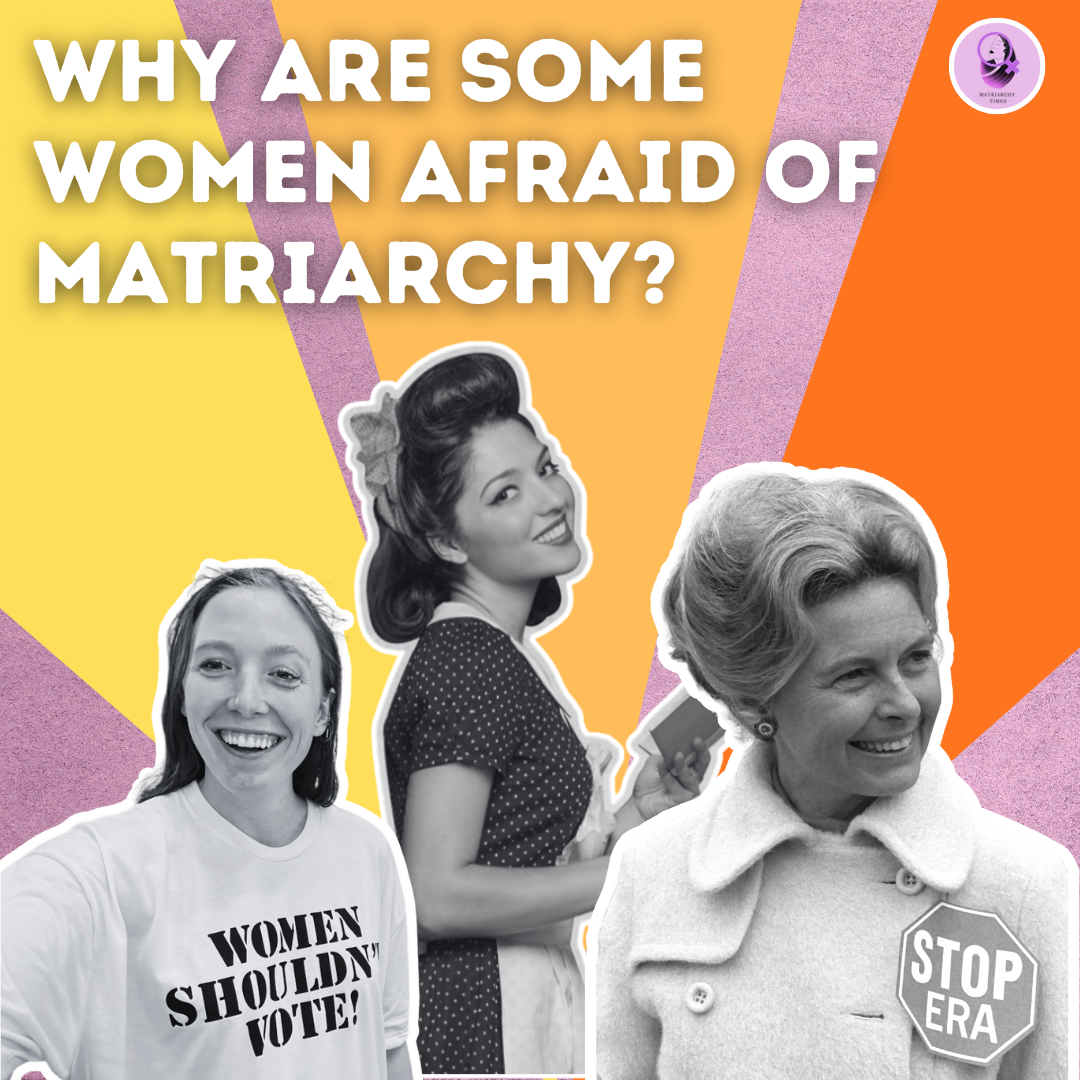
 For countless women the world over, Matriarchal ideology and feminine-led systems of governance are a beacon of hope in an ever more dangerous and corrupt patriarchal world. Just the imagination of a collaborative, egalitarian, feminine energy led world inspires our shoulders to drop, our hearts to open, and a soft smile to come to our lips. However, for some women, these ideas are not a beacon of hope, but rather an impetus for fear. Imagining a matriarchal world creates a pit in their stomach. This disparity, of course, begs the obvious question: why? If a significant change in policy - even rights and privileges - could benefit all women, why are there those for whom it inspires fear?
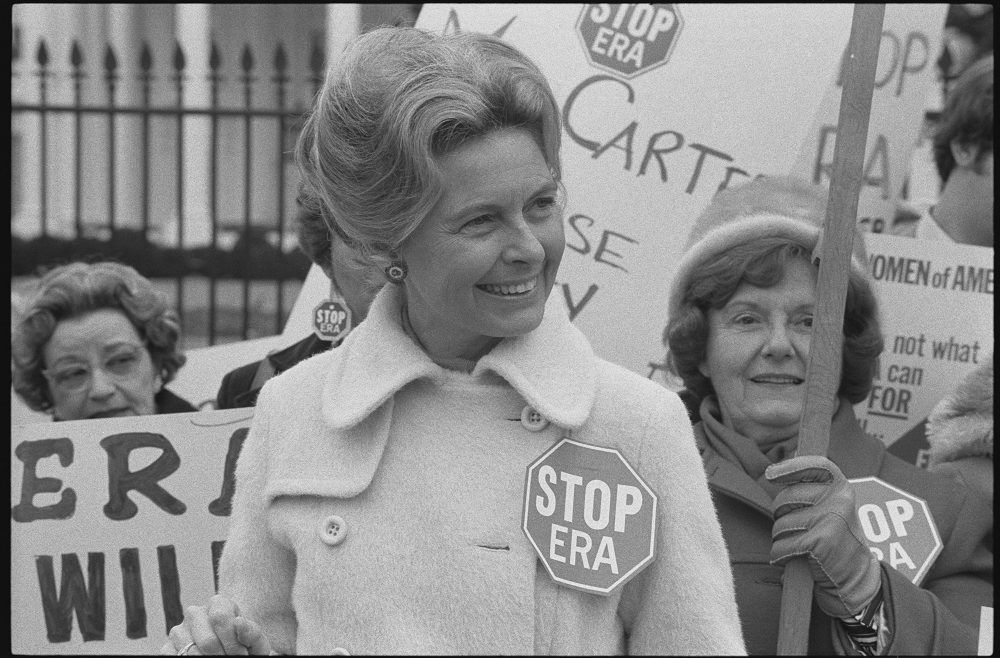
Back in the 1970s, as women across the United States and even the world were fighting for women’s rights, a particular woman named Phyllis Schlafly led the STOP ERA movement. “Stop Taking Our Privileges” was a loud and powerful group of women that successfully helped to defeat the Equal Rights Act. Essentially, the group argued that women would be stripped of their privileges, lose economic benefits bestowed upon them through their husbands (and/or the death of their husbands), be drafted into military service, or lose out on child support and other financial benefits. And they weren’t entirely wrong - which is likely a significant part of why they “won” against equal rights.
 However, today these concerns are far less impactful. Economically, women are pretty much on their own. According to A Theory of System Justification by Harvard University Press, only “around 6% of women with a partner are entirely dependent on their other half, while an additional 29% are somewhat dependent - totaling about 35% with some level of financial dependence.” Not only does this mean that the vast majority of women are working - and therefore not “provided for and protected by” men (or patriarchy) - it also means that under the current system which STOP ERA fought so hard to protect, most women still have to provide for themselves.
STOP ERA’s concerns about women losing child support under the ERA (equal rights act) also manifested in exactly the way they feared, albeit under the oppressive, patriarchal system they chose to defend. Ambivalent Sexism, an article published through NYU, states that less than half of custodial parents reported receiving full child support payments and almost a third reported receiving no payments at all.
The list goes on, but the point is clear: STOP ERA actually created the very reality they thought they were protecting women from - only without any constitutional, social, or legal structures in place that would have actually helped women. Equal pay, for example, or improved enforcement of paternal financial obligations. Their fears may have been well-founded, but they neglected to take into account the impact of the broken system they defended. A system they likely defended for many of the same reasons that women resist matriarchal and feminist ideologies today. So why do women resist this ideological shift?
There is no one clear answer, of course. Resistant responses to feminist and matriarchal ideas are highly personal and wildly nuanced. However there are a few basic themes and categories that emerge when we take a look at some of the common reasons women feel this way.
One of the oft-cited objections to feminine leadership is some version of the phrase, “It’s not natural.” Effectively meaning that patriarchy has been so deeply seated in their reality and vision of the world that nature itself is patriarchal. Men are “destined” to be leaders and women are not. Despite the reality that matriarchal systems would actually benefit these individuals, they are so well conditioned to believe in the correctness of the existing, oppressive system, that they - the oppressed - defend it’s “rightness”. There’s a name for this phenomenon: System Justification Theory, and it was developed by John Jost and Mahzarin Banaji.
The belief systems behind this theory also play into the trad-wife reality that we see espoused on social media; the patriarchal dogma that a woman’s place is in the home, and that her greatest value is birthing and rearing children. The idea that men are “meant” to be providers and protectors, and women are “meant” to be caretakers and home makers. However, as we pointed out in our article Males are Protectors? Since when, and at what cost? (Link to https://buymeacoffee.com/matriarchytimes/males-are-protectors-since-when-and-what-cost), patriarchal systems don’t actually take care of women. Nor do they protect women. Which leads us back to the question, why would women be in favor of a system that doesn’t actually work for them in the way they think it does?
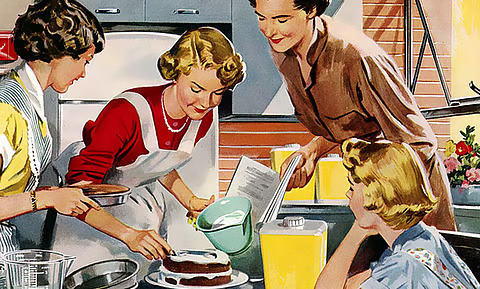 Perhaps our theoretic woman has been so thoroughly convinced of her unworthiness that she truly believes that no woman will ever be intelligent or powerful enough to lead. Or perhaps she fears that her social circles and safe spaces would reject or judge her harshly for going against their ideology. Perhaps deep down she feels like a failure because she didn’t run her own business or compete as a professional athlete. Perhaps her heart really wanted those things but she was conditioned to believe by society or family or whatever that she shouldn’t or couldn’t. So she made herself a wife and a mother according to what society expected of her and seeing other women step out of the home and into roles of leadership or power threatens her ability to believe she made the right choices for herself.
Too, there’s the possibility that some women crave the validation that might come from “making it” in the patriarchal system. Research on “benevolent sexism” by by Peter Glick and Susan Fiske suggests that some women may feel that they need the hierarchal structure to prove their worth. Or, they’ve found comfort in being viewed as delicate or treasured and therefore in need of protection - even if that protection comes with constraints on their rights and freedoms.
Perhaps she’s simply become comfortable in the way she views herself through the male lens; she feels that she’s achieved some measure of approval in the patriarchal system and that if that collapses, she’ll have to start all over. Perhaps she wants a system of domination to validate her success.
A sentiment observed, studied, and validated by the Queen Bee Syndrome documented by Belle Rose Ragins, in which women resist supporting other women in achieving success because their own successes (and battles to get there) would no longer be special or inspiring. When a person has fought tooth and nail to make it to the top of the patriarchal hierarchy, it might feel like a loss to “give up” that station in favor of feminine-led systems.
Then there are women that are genuinely afraid of allowing other women to be in control because they have been conditioned all of their lives to believe that women are in competition with one another (largely, for male or patriarchal approval in some form). As Matriarchy Times discussed in our article Patriarchy’s Greatest Trick: Convincing Women to Police Each Other (Link to the article https://buymeacoffee.com/matriarchytimes/patriarchy-greatest-trick-convincing-women-police-each-other), women are taught to run each other down in order to eek out some semblance of acceptance from men. In short, girls were taught to be mean to each other. It makes sense then, that some women would fear being poorly treated if a woman rose to power because they’ve rarely (if ever) been supported or celebrated by other women.
Sadly, of course there are also some women who can’t afford to support matriarchy and feminist ideals - literally. After decades of raising children they may feel they have no marketable qualities to support themselves in the work force - and they might be right. Or maybe they just wouldn’t want to. Perhaps they live in a political or economic environment that simply doesn’t allow them to wholly provide for themselves.
What’s fascinating, however, is that outside of that last scenario, almost every other reason that we’ve explored here for a woman to resist feminist views and feminine-centric ideology is related in some way to the way a woman sees and values herself (and/or the way she imagines other see her).
If women were taught to recognize, celebrate, and define their value to and for themselves, it wouldn’t matter to a woman whether or not the people around her agreed with her choices and the way she chose to exist in the world. If women deeply and authentically loved who they were, it wouldn’t matter if men had any judgement at all about them. Empowered women don’t really give a shit about anyone else’s approval.
Neither do they concern themselves with another person’s success. If women developed a deep, inherent respect for themselves because they adored who they were as people, it wouldn’t matter if other women achieved “greater” success - the success of others wouldn’t take away from the success of an individual. There would be no reason to fear other women in power because each would know they also have power. What’s more, living in a matriarchal society necessitates that no one woman (or person) has power over the others. Rather, the power and gifts of all individuals are celebrated, supported, and cultivated by the group.
 Ultimately, all of this means that in very many cases, women are afraid of matriarchal systems and feminism because underneath all the fear mongering and conditioning, they simply don’t love and value themselves. Delightfully, this reality can be changed - and it starts with you. With the rise of each and every woman who bravely begins to see herself as empowered and valued, patriarchy will continue to fall. How can women re-value themselves? We’ll explore more on that in the coming articles, so stay tuned!