

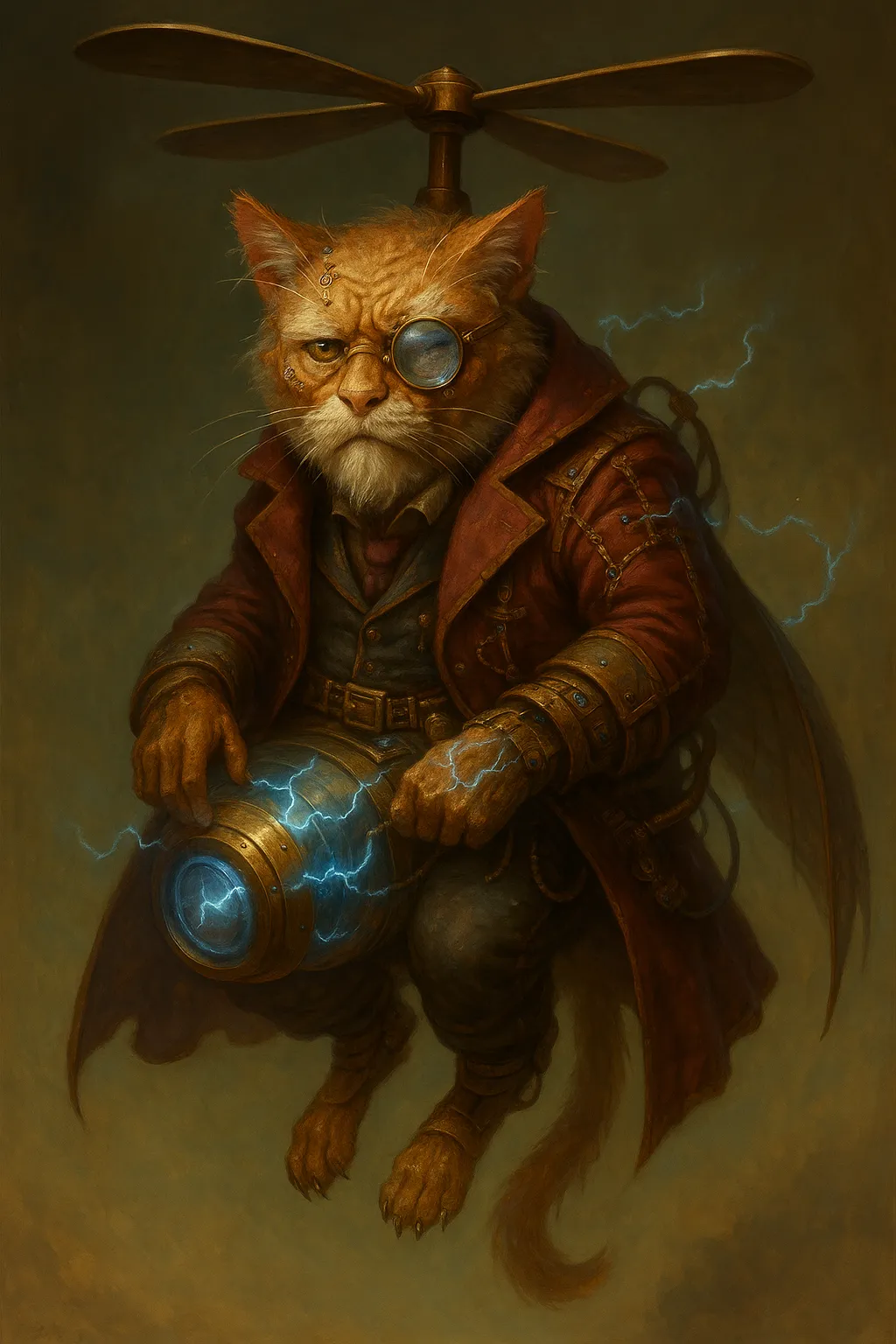
In the world of Sebaka, spellbooks are not just for wizards, they’re for any soul who can cast a spell. And we can thank Mr. Ratta for that. More on him below.
In this world, there are 2 key elements I want to share with the community today: magitech (called “maginetics” in this world) and Custom Spell Creation.
Maginetics is the approach in which elemental energies like fire, cold, radiant, etc. are converted into lightning (or irl electricity) to run all sorts of gadgets and inventions at the heart of society.
This world also holds a freehand spellcraft system. Sort of a custom spell creation system. Anyone can research, develop, and create new spells. Every spellcaster keeps a personal spellbook or journal, documenting spells they invent or discover. Progress and its chaos both hinge on these open, collaborative ideas, turning magical innovation into a living part of everyday culture. Similar to how we can find instagram handles on trains and busses, in Sebaka you could find random glyphs in such places. Some may be gags like dying your hair blue, other could be actually useful, like making the chair more comfortable or conjuring a soft breeze around you in the hot summer days.
However, many worldbuilders might be of opinion that “magic needs to be studied” or that “wizards may spend years of school and repetition for mere cantrips” (in Dungeons and Dragons for example). To which my answer is: education…and… a certain cat person.
About Mr. Ratta
Mr. Ratta (awakened catfolk) is a pioneer, an engineer, scientist, a revolutionary, artificer. He was the Dean of Maginetics (before he just left because of his discontent with academia) for decades. He founded this Faculty decades back. His contributions are countless. But for the purpose of this post, the main contributions were those two listed above.
Rather than relying on locked spell lists, citizens experiment, research, and inscribe their discoveries onto journals, blueprints, or publish them in magazines, fueling a culture of makers, tinkerers, and daring arcane engineers. There are even books of spells like books of recipes in number and diversity. His “Year 0” (a work in progress writing) speech in Hu’ka Masala became the cornerstone for generations to come. This was still decades after the founding of the faculty (yeah, he is pretty old for a cat).
Setting & Everyday Life in Sebaka
In Sebaka, maginetics isn’t just an industry: it’s the pulse running through every brick and beam of the city or village. The streets hum (sometimes literally) with lightning of fireballs, frostbolts, or radiant bursts, channeled through dense webs of coils, glyphs, and runes. Bakeries might run on a perpetual heat charm sealed into the oven decades ago (needing some daily or weekly upkeep maintenance). Trams and skytrams glide along tracks powered by captured storm magic. Even the streetlamps glow not from mundane fuel, but from recycled light spells, faintly flickering when the magic is fresh and stable, buzzing when it’s not.
The plazas and parks are less “public squares” and more “open-air laboratories.” Anyone with a half-baked prototype and enough nerve can set up a stall, throw on some protective wards, and test their work in front of a curious (and sometimes singed) audience. Failures are spectacular. Some examples include exploding sugar sculptures, runaway broom races, fountains that won’t stop singing.
Successes are folded back into the living archive of Sebaka’s magical ecosystem. Spells here are alive in the cultural sense: traded, debated, rewritten, sabotaged, and rebuilt until they’re almost unrecognizable from their first draft.
Why is it significant?
This open spellcraft ethos tore down the walls between the arcane ivory towers and the everyday streetcaster. Suddenly, magic wasn’t just for the chosen few, it was a tool anyone could shape, a language anyone could write in. That freedom birthed waves of innovation, new schools of thought, and yes, more than a little chaos.
In Sebaka, the line between “world-changing breakthrough” and “glorified prank” is paper-thin. One invention might revolutionize city transport; the next might summon cats to every window in the village at 4 a.m. (and both would probably get equal column space in The Sebaka Ledger). Every new spell or device carries the potential to rewrite the rules of society, of daily life, of reality itself… sometimes overnight.
Magic here is no longer a fixed doctrine. It’s a living, breathing force of change, fragile in its stability, volatile in its potential, and beautiful in its imperfection.
“A spell’s not done until your neighbor can use it and your rival can’t break it.” — Master Ratta
How do maginetics and spellcraft meet?
The tow aren’t always separate disciplines. More often than not they’re woven together. A spell isn’t just cast; it’s wired, looped, and fed into machinery that bends it into something new.
Likewise, a device isn’t merely built; it’s enchanted, “brought to life” with carefully tuned runes and raw arcana. Society thrives in this overlap, where a clever twist of engineering can turn a simple cantrip into a power source, and a single rune adjustment can turn a gadget into a masterpiece….or a disaster.
Of course, there are certain states, cities, villages, and cultures that might not share the exact same perspective.
Your thoughts?
What’s your take on maginetics and freehand spellcraft?
Does the idea of DIY spellcraft and magic-powered tech thrill you, worry you, or spark a dozen “what if” scenarios in your mind?
If you’ve got ideas, warnings, or stories from your own tables and worlds, I’d love to hear them.
Credits
Special thanks to Gorilla of Destiny, who has created extensive content exploring and merging science and D&D and developed an innovative spellwriting system and a bunch of fun books about the topic (I don’t use them directly, but as a source of inspiration and flavor). Mr. Ratta may also be partially based on the guy.
Special Thanks as well to The Fantasy Forge for the insightful video “The TRUE Scale of D&D MAGIC (and why it breaks everything)” that made me rethink how magic actually interweaves with a world and its development as well as its day-to-day life.
The term "maginetics" was coined by a close friend of mine quite some time ago, though I am not certain of its original source.