
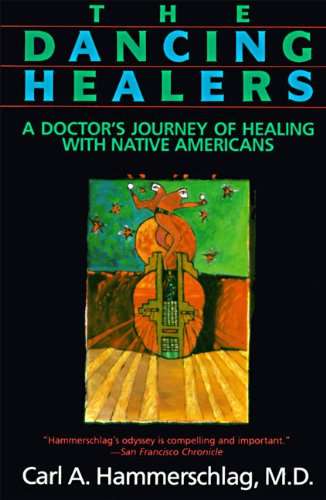
 I finally had a chance to finish reading a book while in Costa Rica. The book was given to me (and another copy to Brian) from an artist, Juan, who lives in Arizona. His friend did the cover art. Juan and his friend are both Native Americans, and the book title was “The Dancing Healers.” It was written by the late Carl A. Hammerschlag, M.D.
Hammerschlag was a Yale-trained psychiatrist, who served the communities out in “Indian Country.” Without going too deep into the book, it is a story of a young doctor, who thinks he will change the world, only to find that the world changes him. Most notably is his journey that reveals that all things healing are sacred acts. As a patient of his, a Pueblo priest Santiago asked when he heard he was a doctor “do you know how to dance?” A seemingly odd question to be asked, but Santiago goes on to explain that in order to heal one must know how to dance, and to dance, one must have his own music. Santiago, gets out of his hospital bed, oxygen tubes and all to show Hammerschlag the steps he has learned.
This isn’t a story about dancing doctors and its 1988 publishing date, when compared to the Dances with Wolves time of cultural consciousness could be dismissed as a white Jewish guy, son of Holocaust survivors finds a pathway to personal peace and self awareness through Indian mysticism. Anyone who points fingers of “cultural appropriation” would have a field day with this as Hammerschlag is invited on a journey to understand his patients and talks about finding peace in teepee as provocative as a synagogue. But that would be a mistake, because what this book really is about is a man who humbles himself by seeing people he is taking care of as fellow human beings. He has to come to terms with his own rage about family and friends who perished in the Holocaust.
And rage is the common denominator that he and his patients share. Once Hammerschlag figures this out, he finds that he can see beyond the rage of the Native Americans he treats. The mutual acceptance allows him to help people who have amazing patience, kindness, endurance once they are treated with no pretensions and honesty. Hammerschlag goes through the trauma of being a psychiatrist for people who have been treated with contempt and indifference. They struggle with all the pitfalls of societal ills: alcohol abuse, sexual abuse, out-of-wedlock births, poor education, scarce health or dental care and on and on. The traditions are held by a few older people, who try to teach the young. Even when the young are interested, the sheer poverty and demand to survive prevents them from staying in the community.
But at the time of Hammerschlag’s writing, he could witness these elders healing people traditionally. Even though he was a Jew and white, all the elders wanted of him was to acknowledge that the sacred aspect of the human soul needs to be paramount. For the Native American healers, that translated into “the dance.” What was necessary was not to copy the dance, but to dance to your own music. So not appropriation, but emulation along with adaptation. And that only after permission, which centered on seeing his patients as equals who have something to teach him. In fact, over time, he is sought out because he is willing to not judge others. One fascinating story is his treating a woman who thought part of her stillborn child was still in her. She was trying to pierce her navel to get the remains from her, so she wouldn’t die. Hammerschlag could have dismissed or treated her illness with a very clinical process. But instead he gives her a bowl of broccoli and talks to the broccoli in front of her, asking it to cleanse her insides of the stillborn. He then prescribes a powerful laxative to allow the woman to experience the cramping and release. The unorthodox approach works as the woman feels heard and also is ritually healed of her psychosis. It is a dance and Hammerschlag made up the tune.
I wondered why Juan gave me this book. I am not a doctor, but I do know a thing or two about music. I am not Native American, but I know enough to know I don’t know enough. I can at least be respectful and open.
The very least I can do with all people is to touch their souls as equals through music. And lifting souls is all we are called to do in this life.
Yes, in this era we are now in, there is something sad, but compelling to go back 50 years to read about this psychiatrist, who sacrifices a big career, his ego, his own rage about his people being slaughtered and even his fealty to his faith in order to become a “dancing healer.” And one doesn’t have to be a doctor to heal but have the belief that one can help others (and others can be helped) once the sacredness of being a person with a beating heart is acknowledged.
We all hurt in this current era, when victimization has been elevated to a noble state. We lash out at our friends, family and most frequently strangers. Society eggs us on to “hurt before you get hurt.” The news unfortunately is rife with such soullessness.
We all are in need of some sort of healing on our journey through this world. To be a dancing healer, we need to start with empathy and respect. We cannot ape our way through it, and we must be aware not everyone wishes to be healed. The dancing healer is there when it is evident to be there. Creating music, especially live music allows such situations to come about, but it can also happen in many ways--it is the mindful kindness needed today to help heal our divisions and banish the demons of our own making.
READ MARTIN'S OTHER BLOG HERE.