

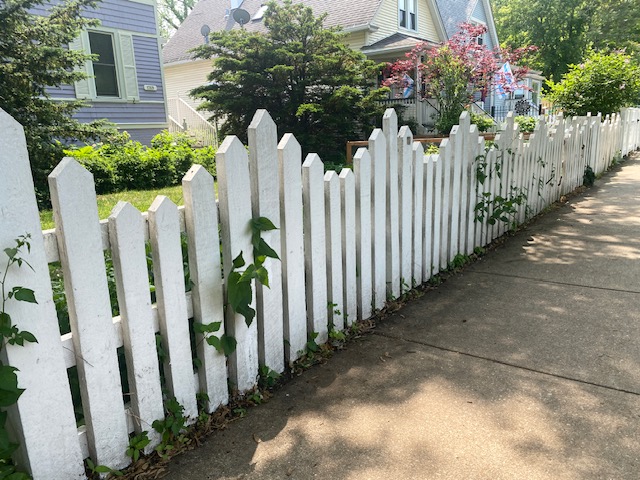
The fence made of virgin pine 2 x 4's from Hyde Park.
When Annie and I were working on our house, we found that we had a preponderance of genuine 2 x 4” s, 2 x 5” s and 2 x 3” s. Yes, all those various sizes were created for building homes back in the late 1800’s and early 1900’s. Some of these pieces of wood came from our friend, HT, who is a contractor. He was working on renovating homes in the Hyde Park section of Chicago. He salvaged many of the boards and it was his creation that graces our front yard. Our yard had no front fence for a long time. While that looked great, it was an open invitation for people to use our yard for everything and anything imaginable. Clark street is but a stone’s throw away from our yard, and like any urban thoroughfare, a lot of colorful folks congregate. When I say everything and anything imaginable took place, I mean it.
What I love about the boards is that these were virgin pine from northern Michigan and Wisconsin. Cut them and you could see the tight grain of the trees. The measurements were true to scale, not like our so-called 2 x 4” s of today. HT was creative in his making of the fence, taking each board size and making a pattern due to the width of the board itself.
The result is a big, thick and impressive fence. There is a drawback, though. The pinewood was never treated for the elements. We painted every inch of the boards to waterproof them, but alas, water has a way of getting into everything eventually. I even encased the wood in my favorite covering of choice, Flex-seal. That is a rubberized paint that turned the stave into a seemingly water-tight element. But I hadn’t counted on the boards physically being knocked into, scratched by squirrels and hit by falling tree branches. The result is that the wood will rot from within, leaving what looks like a stave but really is the shell of what was a stave. The final problem is that all the original boards have been used. Now, I have to improvise, cutting big boards down to all three sizes. 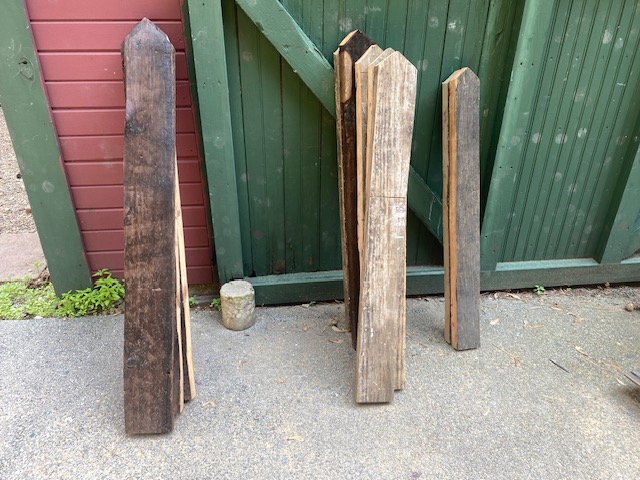
Old boards, salvaged and in turn cut into fence staves--art?
It has become a summer ritual. As I write, I have eight newly cut staves, awaiting cleaning, oil-paint and flex-seal. I will affix them with screws and a prayer that they will last for more than a year. I go along the fence-line, looking for boards starting to give way. It is not the most efficient way to have a fence. But it is a lovely work of art that HT made, and I am loath to give in to the efficiency of modern fences. Around the neighborhood, I see the vinyl and plastic fences emerging. They are efficient, they are impervious to the elements, and they all look pretty much the same. What makes me sad about my fence is that time is not on my side. Time and the weather love to rot wood and that is why there are so many products out there made to look like wood perhaps, but are made from PVC, plastic or even concrete. All in an effort to fight the fight I am fighting. The day may come when this old fence will have to come down. When I will wave the white flag. But for the time being, I love the idea of a unique, artfully created fence, with repurposed native grown pine from a time when there were still virgin stands of forest here in the Midwest. It seems not only artistically correct but morally correct as well.
READ MARTIN’S OTHER BLOG HERE.