
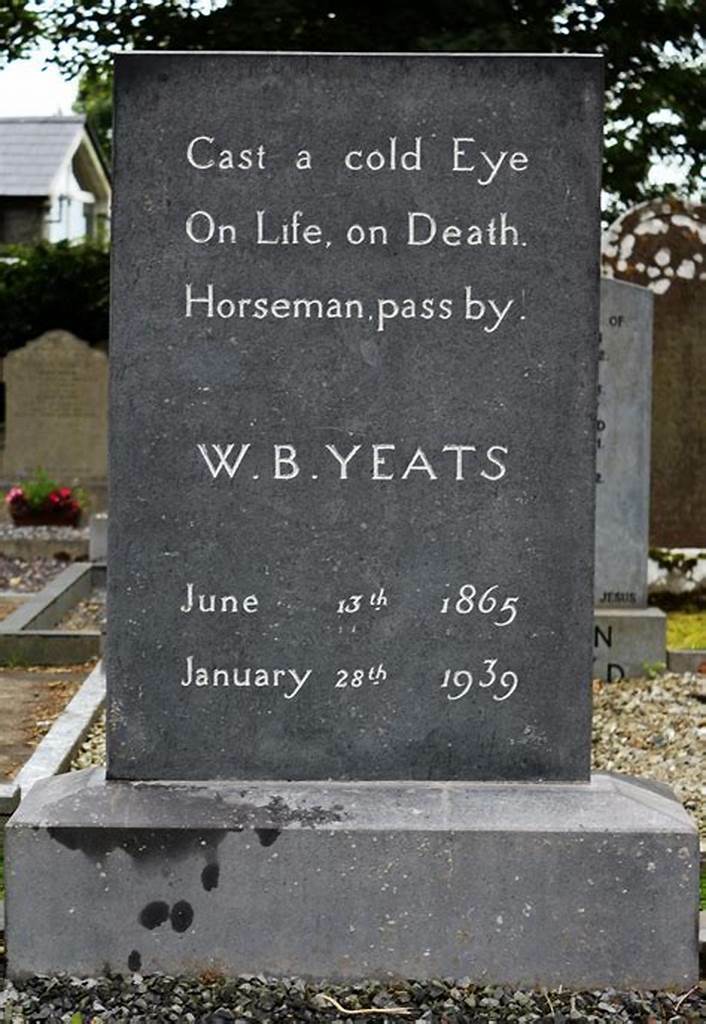
When William Butler Yeats died, he was buried at the Church of Ireland cemetery in Drumcliff, County Sligo. It was an area that was the setting for a lot of his poems. One can see why he loved the area so much. It has a majestic sweep to it that takes the breath away. The large tabletop mountain, Ben Bulben, towers over Drumcliff. Hidden in the vales are waterfalls, groves and even holy wells. There is an abundance of ancient Celtic history too. Queen Maeve’s tomb at Knocknarea brings the historic past to the present. Sitting on a towering mountain, it can be viewed for miles. It was no wonder that Yeats, who was part of a revival in Irish language and literature, loved this beautiful land. Years ago, one could visit Drumcliff and walk up to Yeats’s grave. It was poignant to visit and see this most famous of writers and poets, at rest in a simple churchyard. The fact that it was still a churchyard, a humble one at that, drove the point home. It was one of the few places in Ireland a personal connection with a famous person could intimately be made. I imagine Yeats probably felt that he would be at rest in this peaceful cemetery. His epitaph read: “Cast a cold eye on life, on death, horseman, pass by.” It is part of a bigger poem “Under Ben Bulben” which Yeats comments on not only current events, but the struggle of the artist as well, from ancient times to the present. In particular, the Irish artist.
Yeats’s resting place, sadly, is no longer a restful place. I found out the hard way when bringing a group to visit it. His grave can be visited, but now for a fee. Eight euros per person is the charge to walk around the graveyard and look at his grave. Not a stone’s throw away are toilets and a cafe. A statue at the entrance celebrates his poem, “Aedh Wishes for the Cloths of Heaven.”, one of my most favorite of Yeats’s poems. A booth sits in the graveyard in which a lady takes euros and can hand out headsets for people to listen to someone talk about Yeats and his life in the area.
What an insult to Yeats.
Once the cemetery was just that, a resting place of souls, many who would have lived with and been friends with Yeats. Now it is an attraction.
“We need the money to keep the place up,” the lady told me, as she insisted, I paid for the group. I explained we were there to see the grave and get back on our way, but no bother. Yeats’s resting place, once an unspoiled, personal visit, was only possible to visit by payment.
It will be the last time I will be at Drumcliff, for the magic, the beauty has been spoiled. There are places in the world that we need to leave alone. We need to respect the dead, for instance, not charge a fee to see where they lie. That Yeats has become part of the Irish economy is something I think he would have been horrified to know. That people now look at his grave as more of an attraction rather than a final resting spot of a beautiful, complicated soul, is taking away the one thing that made his poems poignant.
I paid for our group. The lady with money in hand, was now almost apologetic. "I can give a quick tour to your group," she suggested. Half the people were on the coach, having used the bathroom. A few lingered looking at the graveyard, happy to stretch their legs. I had lost any desire to even show the folks this site. I sighed and told her no thanks. She seemed almost relieved.
I am sure she saw on my face the disappointment. She probably felt that I was upset about the money. But it wasn't that. A place that was sacred in my memory was now taken over by the moneychangers in the temple. There was no way to drive them out of that temple. I literally had to drive myself out.
I think Yeats’s lines about “cast a cold eye” means that life is rough. One has to look at it with a cold eye, especially when others see some money to be made. I am sure that the people who monetized Yeats’s grave feel is that this is the best way they could take care of Yeats's grave, the old church, the graveyard. Yet, in my opinion, they managed to desecrate the very thing that they want to hold sacred. The solemn, quiet, country churchyard that was poetic in its unspoiled, ordinariness is forever, completely gone. A former shade of itself now is available to gawk at for a few euros.
Such is life and yes, one has to look at it with a cold eye.
Horseman, pass by.
Unless you have eight euros.
READ MARTIN’S OTHER BLOG HERE.