

The Weekly Spark - 24th October 2026
You can spend a considerable of money on a colour e-reader, yet end up with a screen that can appear darker and less sharp. When you’re buying something mainly to read on, that’s quite a compromise.
Last week E Ink announced Kaleido 4, its latest colour display technology, promising better contrast, brighter screens and improved colour reproduction. So could this finally address some of the biggest compromises of colour E-Ink? And might we soon see it appearing in Kindles, Kobos and the like?
What exactly is E Ink?
Before getting into the announcement, there’s something that perhaps not everyone realises. E Ink isn’t simply the name we give to the displays found in e-readers. It’s actually the name of the company that produces the electronic-paper technology used in most of the popular e-readers on the market.
It’s a Taiwanese company, and its technology is used by manufacturers including Amazon, Kobo, BOOX and reMarkable. When it comes to colour e-readers and notebooks, there are two main approaches you’re likely to come across.
The first is Kaleido, which you’ll find in devices such as the Kobo Libra Colour and BOOX Note Air6 C, and which underlies Amazon’s customised Colorsoft displays. It works by placing a colour filter over a black-and-white E Ink display.
It’s a clever solution, but that additional filter makes the screen darker. And while Kaleido 3 displays black-and-white content at 300 pixels per inch, colour content is limited to 150. Black text can still be displayed at the higher resolution, but colour images don’t have the same level of fine detail.
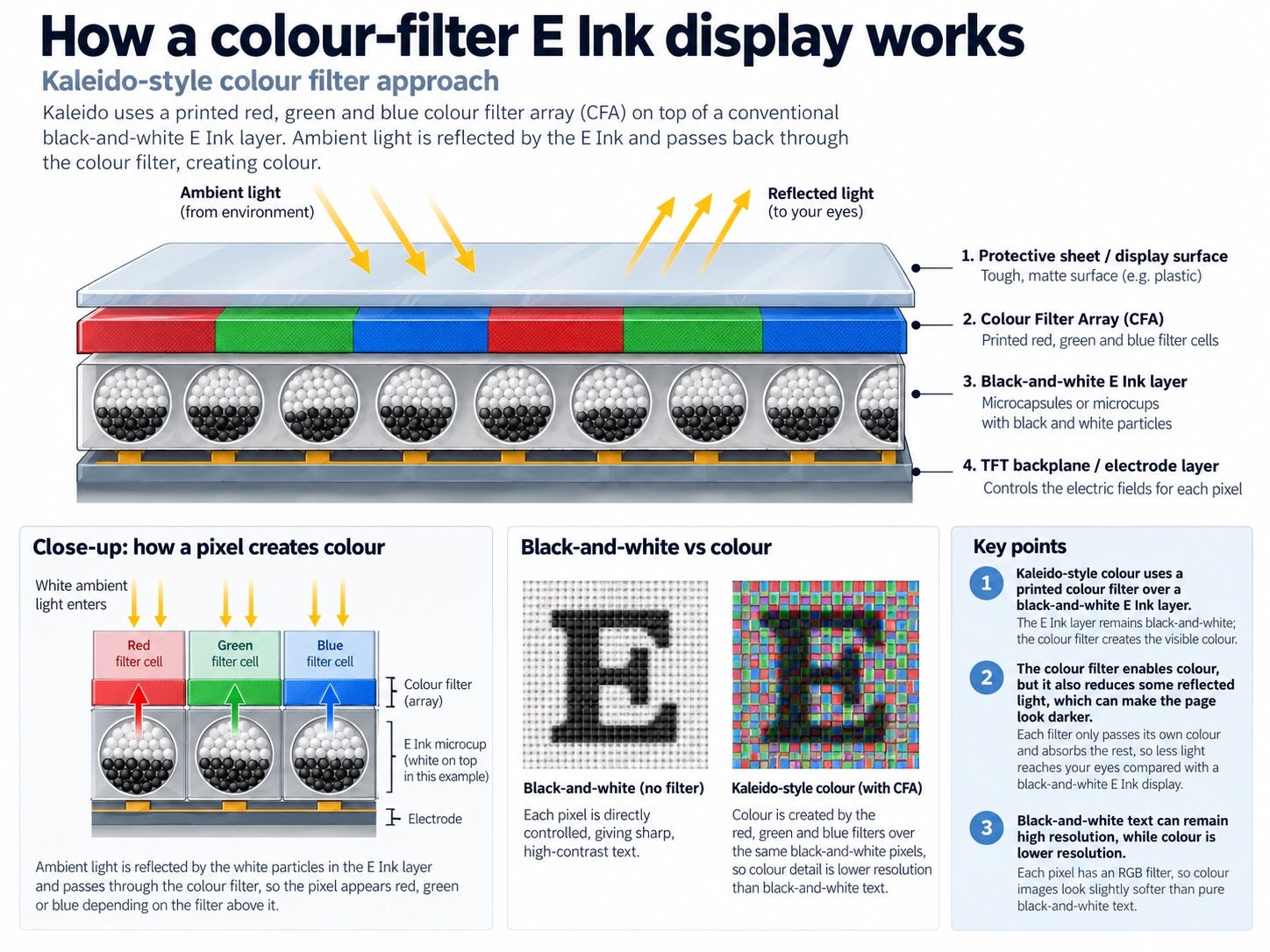 Kaleido creates colour using a filter over a black-and-white E Ink display. Simplified illustration.
The other approach is Gallery 3. This is what reMarkable’s Canvas Color displays are based on, including those in the Paper Pro and Paper Pro Move.
Instead of using a colour filter, Gallery 3 uses actual coloured ink particles to produce the image itself. This allows it to reproduce colour without that separate filter, although colour refreshes can take longer. So there are different ways of getting colour onto an e-reader, but much of the underlying technology still comes from the same company.
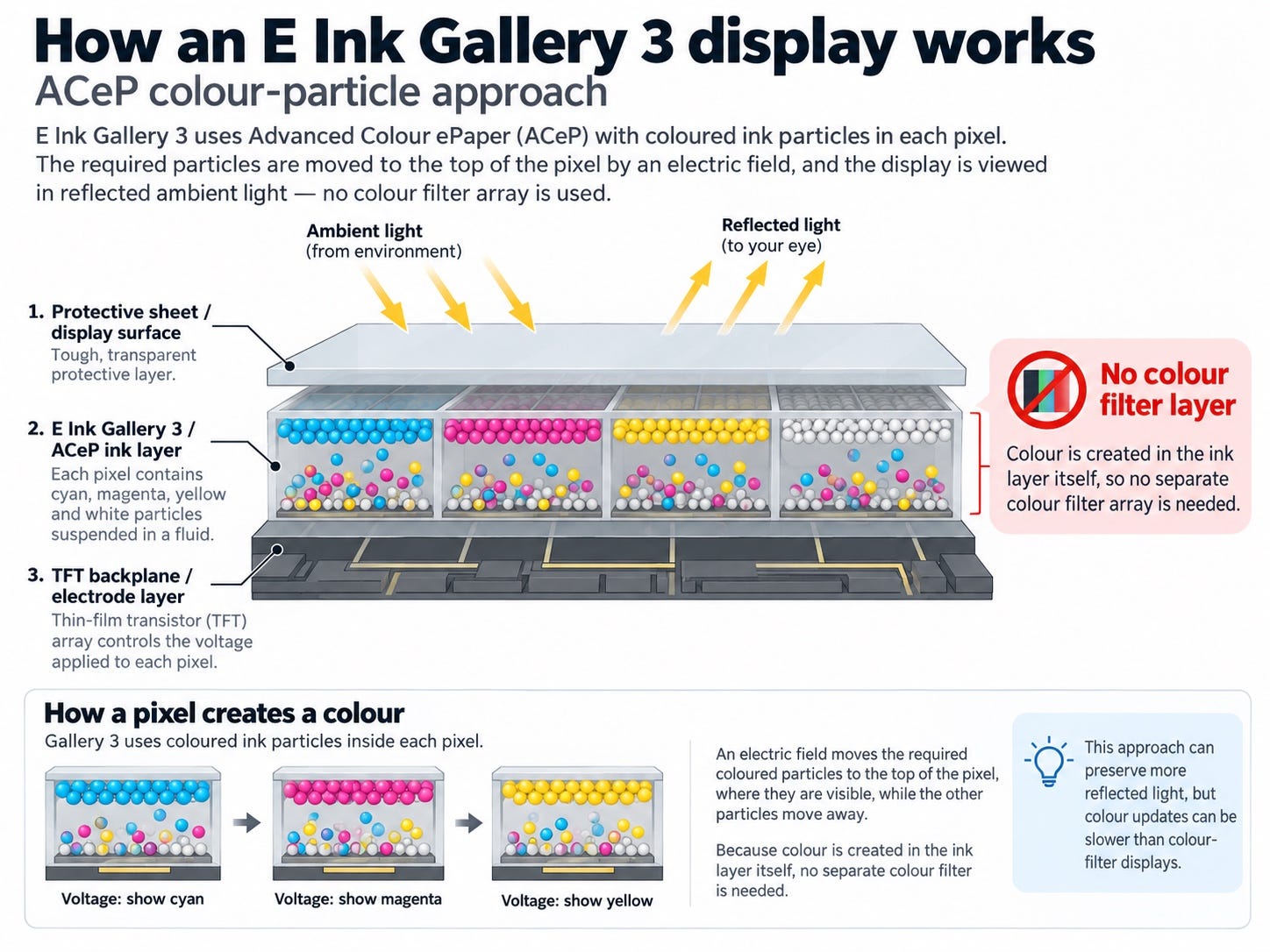 Gallery 3 creates colour using coloured ink particles, without a separate colour filter. Simplified illustration.
What’s new with Kaleido 4?
E Ink is promising three headline improvements over Kaleido 3:
50% better contrast, which should help text and images stand out more clearly against the background.
15% higher white reflectance, which should help the screen appear brighter.
Double the colour gamut volume, potentially giving us richer, more natural-looking colours.
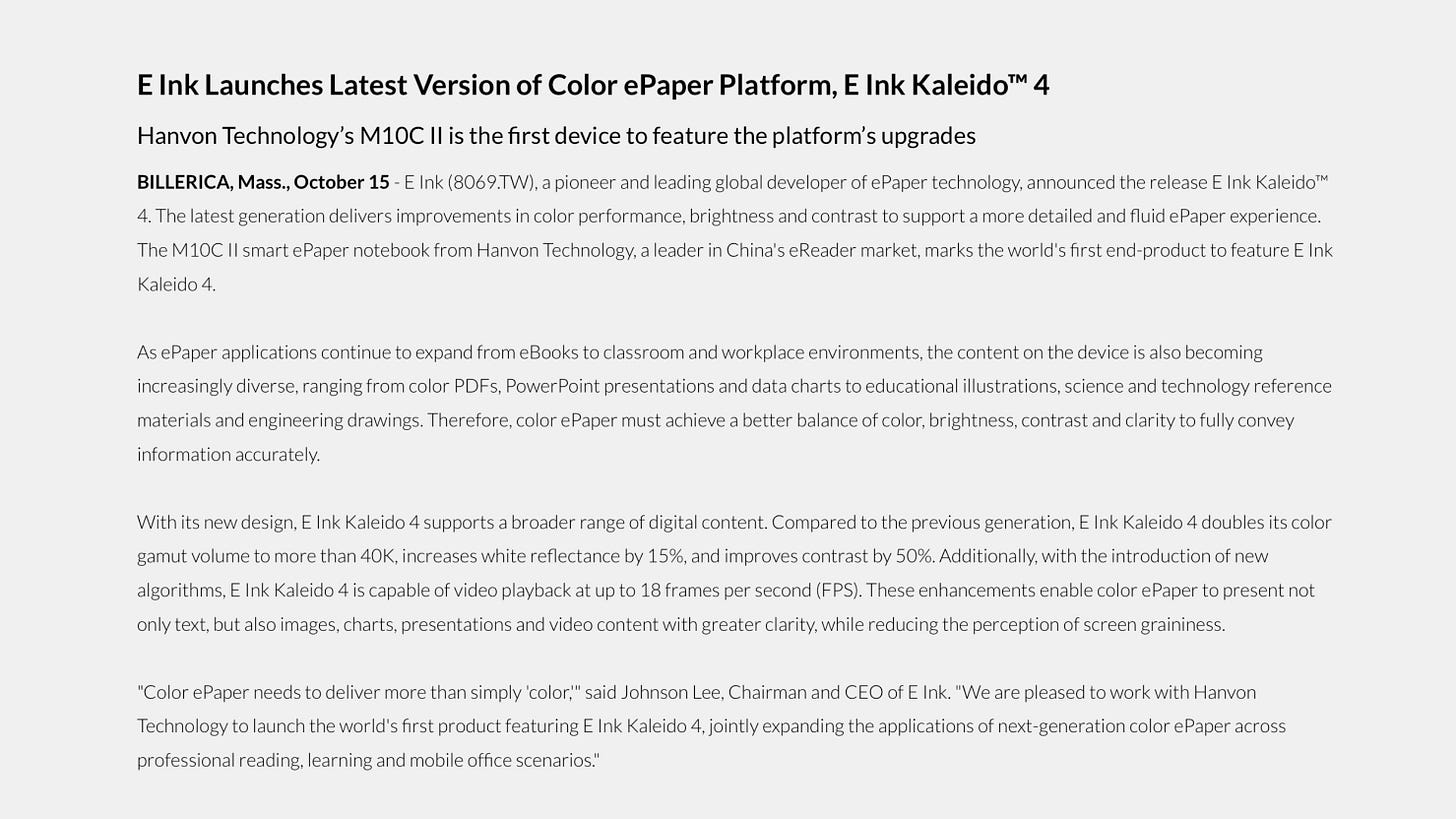 E Ink’s announcement sets out the headline improvements promised for Kaleido 4. Source: E Ink.
Having recently compared Amazon’s new basic Kindle with the Kindle Colorsoft over on my review channel, The Spark!, I found that the basic Kindle had a noticeably whiter-looking screen, with text that appeared a little crisper.
And while I think colour is lovely for book covers, illustrations and highlighting—and I do like that splash of colour—most of the time many of us are simply reading black text on a light background. For those readers, improving that everyday reading experience will be more important than making the colours look better.
That’s what interests me most about this announcement. Better-looking book covers would be lovely, but I’d be more interested in a colour screen that gets closer to the clarity of a good monochrome one when I’m halfway through a novel.
Faster refreshes, too
There’s also a new oxide display backplane, the part underneath the ink layer that helps control the pixels, which supports faster screen refreshes. Alongside updated algorithms, E Ink says Kaleido 4 can play video at up to 18 frames per second.
Compared with an LCD tablet, that doesn’t sound particularly impressive. I don’t imagine many of us are planning to watch Netflix on our Kindles, either. But faster refreshes could make navigating menus, scrolling through documents and using E-Ink notebooks feel more responsive.
Of course, these are manufacturer claims. We’ll need to get our hands on the technology to see how noticeable the improvements are in everyday use. A percentage in a press release is one thing; reading on the screen is another.
When will we see Kaleido 4?
The first device announced with Kaleido 4 is the Hanvon M10C II, a colour E-Ink notebook from a Chinese manufacturer.
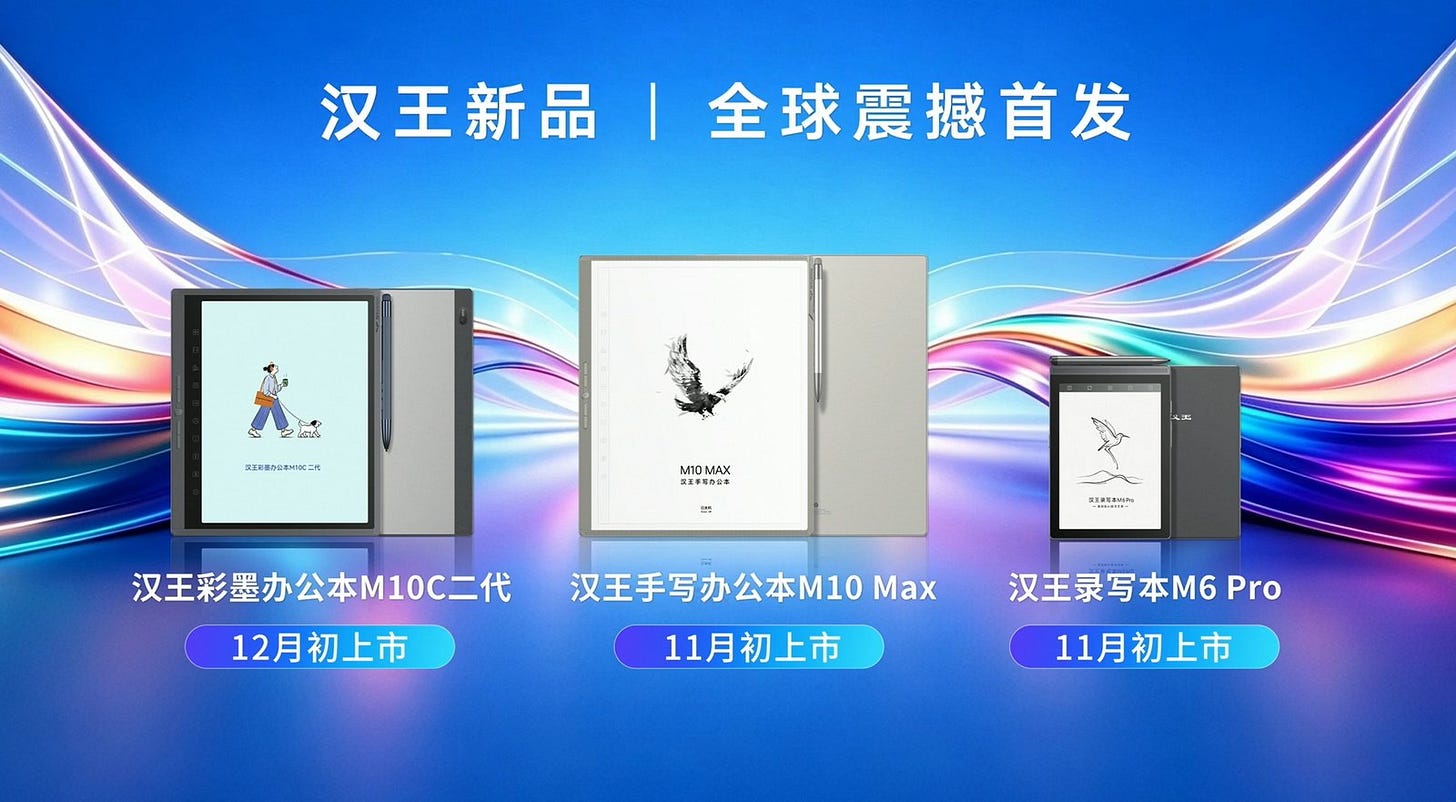 The Hanvon M10C II, on the left, is the first device announced with Kaleido 4. Image: Hanvon.
E Ink says the combination of the new display and Hanvon’s own technology delivers 27% faster page turning and scrolling on that notebook. That figure applies to this particular device, so we shouldn’t assume every future Kaleido 4 product will offer the same improvement.
As for Amazon, Kobo and BOOX, there’s no confirmed timetable for Kaleido 4 devices from those manufacturers at the time of writing. There’s no confirmation that Amazon’s upcoming refreshed Kindle Colorsoft uses it, either. Amazon’s announcement describes changes to its display, but doesn’t identify it as Kaleido 4.
And there’s one important detail missing from E Ink’s official announcement: the colour resolution.
We know Kaleido 3 displays colour at 150 pixels per inch, but the Kaleido 4 announcement doesn’t specify whether that has increased. Better contrast and colour reproduction don’t automatically mean a higher-resolution colour image, so that’s something I’ll be keeping an eye on.
Should you wait for Kaleido 4?
I think this is an encouraging development, particularly if you’ve been reluctant to buy a colour e-reader because of the compromises involved. The improvements E Ink is talking about address some of the things that have bothered me when comparing colour and monochrome screens.
But would I recommend holding off buying a Kindle Colorsoft or Kobo Libra Colour until Kaleido 4 arrives? Not necessarily. We don’t know when the major manufacturers will adopt the technology, what their devices will cost or how significant the improvements will be in everyday use.
And if you already have a colour e-reader you’re happy with, there’s certainly no reason to start feeling that it’s suddenly outdated. It will still do everything you liked about it before this announcement appeared.
For me, the interesting question is whether we’re getting closer to a point where choosing colour no longer means compromising quite so much on the ordinary monochrome reading experience. If Kaleido 4 can make meaningful progress there, I’ll be very interested to try it.
Are you happy with the colour E-Ink screens we already have, or have you been holding off until the technology improves? Let me know in the comments.
Connect with me: X | Instagram | Threads
Subscribe to my YouTube channels: The Spark | The Weekly Spark
Buy stuff: Affiliate Page