

The Weekly Spark - 19th September 2026
BOOX has recently announced three new E-Ink devices, ranging from a phone-sized reader to a full 10.3-inch colour tablet.
They all run Android 16, use upgraded 4-nanometre octa-core processors and include BOOX Super Refresh technology, which the company says should make E-Ink feel faster and more responsive.
Look a little closer, though, and the picture becomes less straightforward. One appears to be a meaningful update, one occupies a slightly strange position in the range, and one may leave existing owners wondering what has actually changed.
There is even a fourth, tiny BOOX reader lurking in the background which may be the most unusual device of the lot.
I haven’t handled any of these devices, so this isn’t a review. It is a look at BOOX’s announcement and published specifications, with a little scepticism applied where necessary!
Note Air6 C: a sensible update, not a revolution
The largest of the three devices is the BOOX Note Air6 C, a 10.3-inch colour E-Ink tablet designed for reading, writing, annotating documents and what BOOX describes as a complete digital workflow.
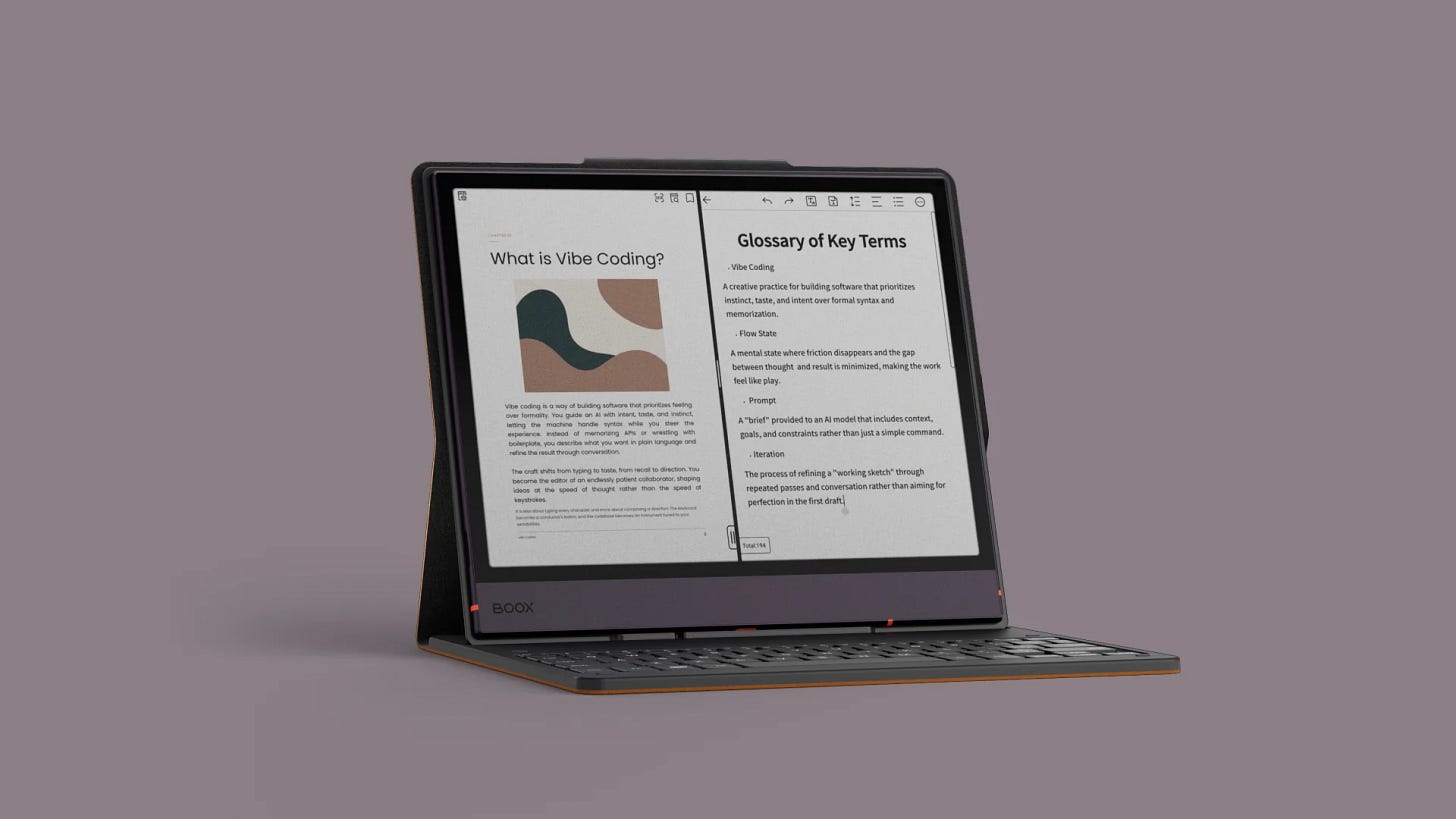
It uses a Kaleido 3 display capable of showing 4,096 colours, with a resolution of 300 pixels per inch for black-and-white content and 150 pixels per inch in colour. That is familiar territory for a modern colour E-Ink tablet.
Inside, there is an upgraded 4-nanometre octa-core processor, 6GB of RAM, 64GB of storage and a microSD card slot supporting cards of up to 2TB. The BOOX Pen3 is included, offering 4,096 levels of pressure sensitivity and tilt detection.
An optional keyboard case connects through pogo pins and includes its own USB-C port for pass-through charging. BOOX is clearly pitching this as more than a digital notebook. It wants the Note Air6 C to handle at least some of the work people would normally do on a conventional tablet or laptop.
BOOX says the improved processor and its Super Refresh technology provide page turns that are up to 40 per cent faster. The accompanying software includes Dual Notes, which allows two documents to be used side by side, and Talk Insights, which can record, transcribe and summarise meetings. Unfortunately, Talk Insights is not currently available in the UK.
At the time of writing, the Note Air6 C is listed on the BOOX website at $579.99.
The problem is that much of the device remains unchanged from the Note Air5 C. It uses the same size and resolution of Kaleido 3 display, with the same 6GB of RAM, 64GB of internal storage and 3,700mAh battery. Its physical dimensions are identical too.
The genuine upgrades are the faster processor, Android 16, Bluetooth 6 and the newer software features. Those should make the Note Air6 C noticeably better when opening large documents or using several apps, but anyone who already owns the Note Air5 C can probably sit this generation out.
Note Mini C: the most interesting of the three
The Note Mini C is where this announcement becomes more intriguing.
It is an 8.52-inch colour E-Ink tablet positioned between BOOX’s smaller readers and its full-sized note-taking devices. It weighs around 300 grams, is 6 millimetres thick and has been designed to be carried and used comfortably in one hand.
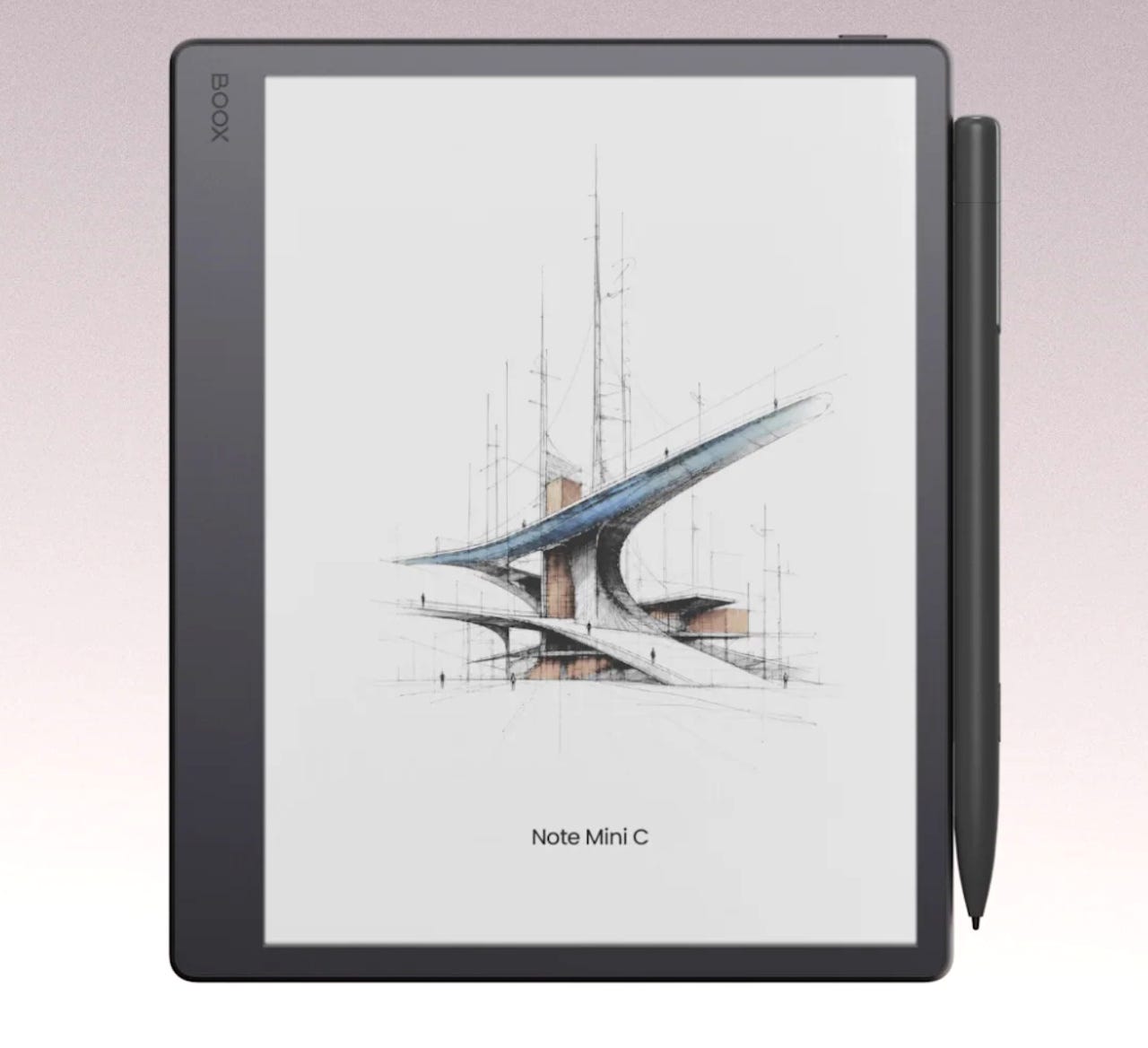
The Kaleido 3 display offers the same 300ppi black-and-white and 150ppi colour resolutions as the larger model. Inside is an upgraded 4-nanometre octa-core processor, along with 6GB of RAM, 64GB of storage, Android 16 and microSD expansion up to 2TB.
An InkSight active stylus is supplied in the box. Yes, InkSight, not InkSense. It offers 4,096 levels of pressure sensitivity and has a side button, although BOOX doesn’t list tilt sensitivity. The tablet has a dual-tone front light, fingerprint recognition and a 3,150mAh battery.
In many ways, it looks like a long-overdue successor to the older Tab Mini C. The new model is slimmer, lighter, more powerful and runs much newer software. However, the battery has fallen from 5,000mAh in the Tab Mini C to 3,150mAh in the Note Mini C.
Then there is the price.
At the time of writing, the Note Mini C is listed on the BOOX website from $549.99. That still doesn’t make it a cheap, smaller alternative.
You are paying almost the same amount for portability rather than saving money by accepting a smaller screen.
That isn’t necessarily a bad trade. As someone who appreciated the size of the reMarkable Paper Pro Move, I can see the appeal. For many people, an 8.5-inch screen will be better for carrying around, reading in bed or taking notes while travelling. When the larger Note Air6 C costs virtually the same amount, however, BOOX has made the decision unnecessarily difficult.
Palma 3: more premium, but familiar
The Palma 3 is the latest version of BOOX’s phone-shaped monochrome reader.
It retains the same 6.13-inch, 300ppi display as the Palma 2, along with 6GB of RAM, 128GB of storage, a 16-megapixel rear camera and a 3,950mAh battery.
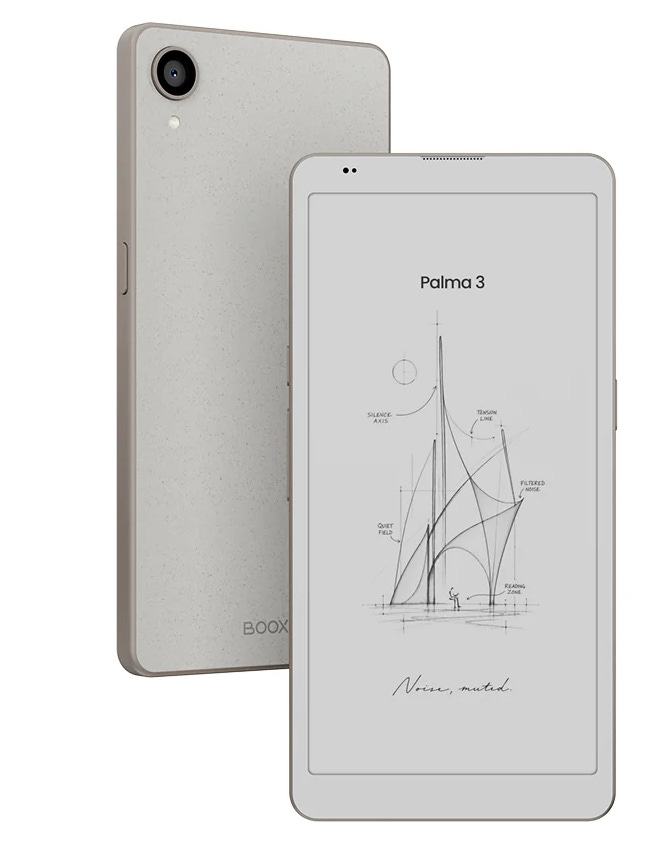 The upgrades include the newer processor, Android 16 and Bluetooth 6. BOOX has replaced the plastic frame with anodised aluminium and added a textured fibreglass back. The screen now supports the company’s InkSense Plus stylus, although the pen is sold separately.
Pen support could make the Palma much more useful for quickly annotating a book or jotting down a note without carrying a larger device. It is probably the most meaningful functional change in this generation.
Quite a lot remains untouched, though. The display resolution, storage, memory, camera and battery all carry over from the Palma 2. Despite becoming slightly thinner and narrower, the listed weight has risen from approximately 170 grams to 195 grams.
At the time of writing, the Palma 3 is listed on the BOOX website from $319.99. The existing Palma 2 is currently listed at $249.99.
That puts the Palma 3 fairly close to the $379.99 Palma 2 Pro, which gives you a colour display, 8GB of RAM and 5G mobile-data support. The Palma 3 has the newer operating system and a cleaner monochrome display, but BOOX now has several Palma models sitting uncomfortably close together on price.
And then there is the Picco
The BOOX Picco was not formally included in the three-device launch, but it deserves a mention.
Shown recently at IFA, Berlin’s major annual technology show, the Picco is a tiny 3.97-inch reader roughly the size of a playing card. It weighs just 58 grams and combines a touchscreen with physical page-turn buttons and an adjustable warm and cool front light.
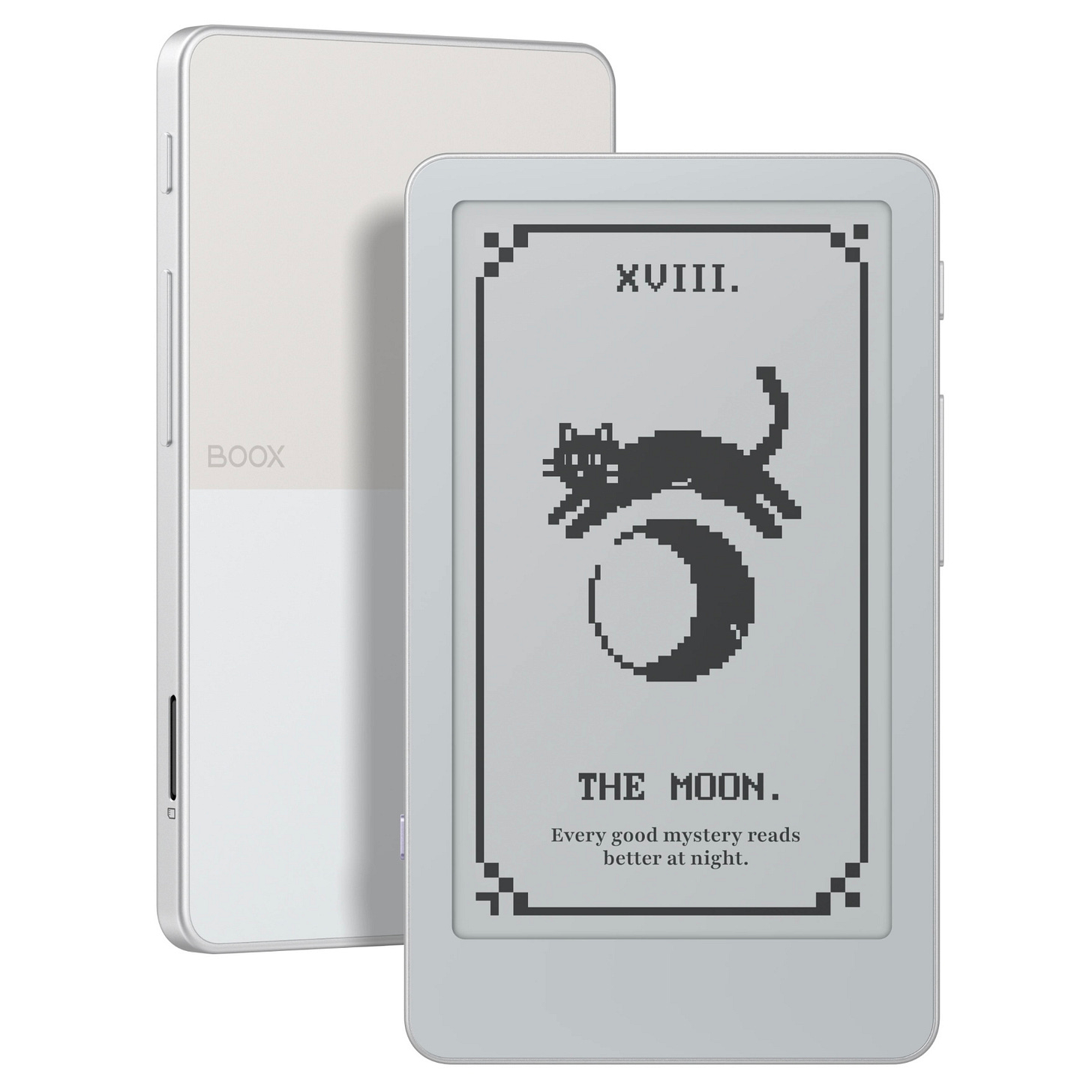
It comes with a pre-installed 16GB microSD card and supports cards of up to 2TB. Its 920mAh battery sounds tiny by smartphone standards, but this is a much simpler device than BOOX’s Android tablets.
BOOX does not advertise Google Play or support for installing third-party reading apps such as Kindle, Kobo or Libby. Instead, you provide your own compatible files and transfer them using the BOOX Tiles app or website.
At the time of writing, the Picco is listed on the BOOX website from $99.99. It is clearly competing with devices such as the XTEINK X4 Pro, which I already own and have reviewed on my YouTube channel.
Both devices offer a touchscreen and adjustable front light, but there are some important differences. The Picco is smaller and lighter and retains physical page-turn buttons. The X4 Pro has a slightly larger display, a larger 1,100mAh battery and built-in magnets for attaching it to the back of a phone.
That comparison deserves a proper comparison review of its own as soon as I can get hold of a Picco.
Which one should you buy?
The Note Air6 C looks like the safest option. It takes an established design and gives it a faster processor, newer software and improved performance. It should be a very capable colour E-Ink tablet, but Note Air5 C owners have little reason to rush into upgrading.
The Note Mini C is the device I am most curious about. Its size makes sense, it is considerably more modern than the Tab Mini C and it could offer an excellent balance between reading, writing and portability. Its price is the awkward part. When the larger Note Air6 C costs almost the same amount, you really need to value that smaller form factor.
The Palma 3 looks more premium, adds pen support and brings the monochrome Palma range onto the much newer Android 16. If you already own a Palma 2, however, there may not be enough here to justify replacing it.
As for the Picco, it may be the simplest device of the four, but it could also be the most fun.
Which would you choose? Would you buy the compact Note Mini C when the larger Note Air6 C costs almost the same, or does the Palma 3 offer enough to tempt you away from the Palma 2?
Let me know in the comments.
Connect with me: X | Instagram | Threads
Subscribe to my YouTube channels: The Spark | The Weekly Spark
Buy stuff: Affiliate Page