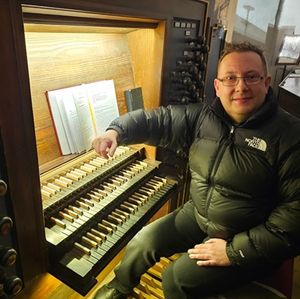

The Braunsberg-Oliva Tablature started life around 1610 at the Jesuit Collegium Hosianum, founded in 1565 by Polish Cardinal Stanislaus Hosius, in the Polish city of Braniewo (Braunsberg). The tablature consists of two volumes, T1 covering 326 pieces of music, and a partial T2 volume covering 8 works.
The initail owner and assumed scribe of many of the works in T1 was Jacobus Apfell (???? - 1653), whose name is inscribed on the title page and on the front cover of the manuscript. On 17 June 1612 Apfell became a member of the Marian sodality active at the collegium, which mainly admitted only senior students, which suggests his education at the collegium had started several years prior to that already.
T1 was started in Braunsberg around 1610, with fol 14r in the manuscript bearing an inscription in red ink giving the date of 13 September 1610. At some point, Apfell moved to the Cistercian Abbey in Oliva (then a small hamlet outside of the hanseatic city of Gdansk (Danzig) which grew to become a supberb of Gdansk in the 1923 comunal reform) and took the tablature with him, where he likely handed it into the care of another scribe in 1619. Perhaps the handover to a new scribe indicates the time of his move to the abbey, but this cannot be said with certaintity. The last works transcribed by Apfell have been first published in print in 1615. Given that he would not have known these works from a hand written copy, it may be assumed that Apfell's move to Oliva falls sometime between 1615 and 1619.
The new scribe carried on with T1 from around piece no. 300 and started T2. Nothing is known about the identiy of the new scribe or about the timeframe in which they worked on both manuscripts. The year 1630 is indicated as a conservative estimate of when work on the tablature stopped, but it is safe to assume that it likely finished before then at some time.
T1 was was started on paper produced between 1602–1611 by Emanuel Zöschlin (1578–1611), who took over the paper mill founded in 1591 in Zöschlingsweiler near Lauingen (Bavaria) by his father Hans. This paper mioll's products was highly regarded at the time. The same type of paper was also used for one of the four tablatures from the Benedictine Abbey of Neresheim and, outside Bavaria, for a tablature compiled at the Jesuit collegium in Riga. The Jesuits, who were largely German speaking, appeared to have had their own supply chain to source such high quality paper all the way from Bavaria.
Towards the end of T1, Apfell decided to extend the manuscript with additional paper from either Kupfermühle or the Straszyn (Straschin) paper mill near Gdańsk, both of which were leased to Heinrich Probstly Jr. (d. 1634), added to the manuscript. Such paper was found to have been used for documents dated between 1589 and 1617. This extension of T1 might have happened in Oliva already, with the Abbey not having access to the Bavarian sourced paper that was available at the Braunsberg college.
The final part of T1 and the surviving part of T2 are made on paper which has been dated to between around 1619 and 1620.
Apfell was listed in the archives of the Oliva Abbey as deacon in 1624, and as an "infirmarius" in 1631 and 1645. Jacobus Apfell died on 14 October 1653 from an outbreak of the plague at the Oliva Abbey, where was laid to rest.
The tablature was transferred to the Prussian State Archive in Königsberg in 1831 at the dissolution of the Cistercian Abbey in Oliva.
The manuscripts were evacuated from Königsberg to Lochstädt Castle near Pillau between 1942 and 1944, which saved them from destruction during fierce war action in 1944 and 1945, which saw the city of Königsberg being largley destroyed.
Both manuscripts were entered in the Library of the Lithuanian Academy of Sciences in Vilnius in late 1949. While some review and research on the manuscript has been carried out in the 1970s, its survival and existence was first written about by Paweł Podejko in 1988. Information pertaining to the current whereabouts of both manuscripts, their contents along with their first inventory, and a two volume edition of selected pieces was published by Jan Janca in the early 1990s. Originally musicologists referred to the tablature as just the Oliva Tablature (PL: Tabulatura Oliwska, DE: Olivaer Orgeltabulatur)
Between 2016 and 2021 Marcin Szelest and his team from the University of Warsaw for the first time analysed and published the entire contents of both manuscripts under the title "Tabulaturae Braunsbergenses-Olivenses", reflecting the more detailed knowledge as to the origin and history of the tablature.
At the time of writing, Marcin Szelest's edition can be downloaded or bought in printed from from: http://fontesmusicae.pl/notes-editions-c-series/
My personal first ever encounter with this collection of music was in 1994 through Jan Janca's recording of selected pieces on the magnificent organ of St. Mary's Basilica in Gdansk. Incidently, this was also my first ever encounter with early music and the catalyst for my eventual interest in the early organ music, and in the history of organ music and pipe organs of Gdansk.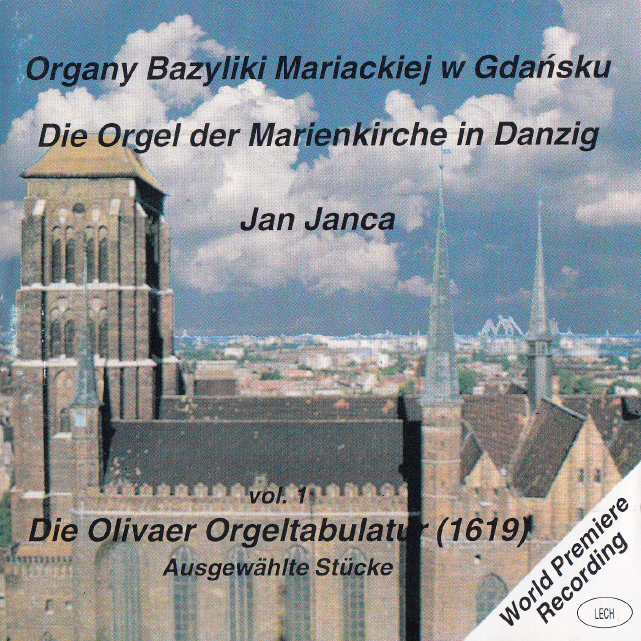
Jan Janca's CD, sadly long out of print and not available on any streaming services, contains 11 audio tracks making up 21 pieces from the tablature. The booklet contains Jan Janca's own write up on the history of the tablature (as known in 1994), note on the selected pieces, brief history of the organ on which the CD was recorded as well as a listing of all registrations used for each piece.
That this recording disappeared without a trace is a real shame for music lovers across the world who have an interest in early organ music. Jan Janca's playing is lyrical, with colourful registrations and plethora of ornamentation in many of the performed pieces.
Although Jan Janca later on expressed to me that he was not entirely happy with this CD recording and that he would take a different approach to interpreting some of the works if he was to record this again, I personally find the entire album very pleasant and musically pleasing, even if it differs from the approach many would take to performing pieces from this period.
A playlist with my own performances of pieces from the Tablature can be found on my YouTube channel:
https://www.youtube.com/playlist?list=PLGaK9p9x97EVaQGO1UIDOmagQGDdg8K6w