
A manuscript with the signature “Ms. 300 R/Vv. 123” at the Gdańsk State Archive in Gdańsk (German: Danzig), Poland contains a varying collection of documents dating to a time period between 1571 and 1627 : the rights and duties of burghers, a list of city council members from 1343 to 1619, a city council balance sheet including musicians’ pay from 1604 to 1605, a list of royal officials from 1457 to 1619, privileges granted to the Hanseatic cantorate in Lund, notes (excerpts from various city documents) by the city council secretary Martinus Lange, and forty-two keyboard pieces, two notated in New German Tablature and forty in Italian Intavolatura on two staves.
The musical compositions can be roughly divided into three categories: seventeen Phantasias, twenty-four keyboard arrangements of different types of vocal music, and one chorale prelude. At the bottom of some of the pages are inscribed epigrams in Latin, Greek or German which perhaps point to the author’s mindset at the time of writing.
The manuscript cover carries the initials “PWSP”, possibly the writer’s or owner’s initials, and the number 1591, which by now is commonly accepted as the year in which these stacks of loose papers were bound together. This collection of music is frequently referred to as the Gdańsk Tablature (Polish: Tabulatura Gdańska; German: Danziger Tabulatur).
The music parts of the manuscript are written on paper bearing two distinct water marks: the older being identical to Briquet no. 1862 dating to 1567, while the newer mark is identical to Briquet no. 8978 and 8979, with manufacturing dates between 1588 to 1597. Assuming the paper was bound in parchment sometime in 1591, this would place the manufacturing dates of the latter batch to range from 1587 to 1591.
Assumed composer
The composer of the music and its occasion or the purposes of its composition are unknown. In his 1931 monograph on the subject of the music of Gdańsk, Herman Rauschning suggested that the likely composer of the music in the manuscript would be Cajus Schmiedtlein, although it is unclear on what basis he made this attribution. It could be supposed that he had sight of documents which are presumed lost since 1945 without referencing them in this 1931 book. This attribution of the music to Schmiedtlein has since become more readily accepted and his name is sometimes printed as composer in concert programmes and on CD recordings.
Cajus Schmiedtlein, whose name knows different spelling variants, including Key Schmedeke (the low German dialect form of Cajus Schmiedtlein), was probably born around 1555 Dithmarschen region of Northern Germany, according to Klaus Beckmann. For a period of time he was organist in Husum until 1578, when he became organist at Saint Olaf's Church, Helsingør. Just over a year later he had to resign from that post following a controversy over his own unauthorised modifications of the organ to create a pedal division.
It is unclear what Schmiedtlein did following his resignation in Helsingør, but it is believed he went to Hamburg.
In 1585 Schmiedtlein became the organist at St. Mary's Church, Gdańsk. He appears to have left the post for an extended period of time before being re-appointed for life by the city council in 1589. He was absent for some time during 1590 and again for six weeks in 1591 to sorting out his personal financial affairs in Hamburg. He married in 1591 and was awarded the citizenship of the city of Gdańsk the same year.
On 2 August 1596 he was one of 54 invited organists to play at the inauguration of the new organ at the castle in Gröningen, near Halberstadt, for which he had to travel 650 km each way.....a considerable distance for an organist to travel for a performance and somewhat indicating the standing he might have enjoyed amongst his peers at the time.
In 1611 the church authorities assigned the young Paul Siefert, who had just returned from a three year study with Jan Pierteszoon Sweelinck in Amsterdam, as his assistant. Schmiedtlein wrote a letter to the city council in which he bitterly complained about Siefert's musical skills as well as his personality, and used the occasion to also refute accusations that under his stewardship of the organ the instrument fell into a state of bad repair.
He died in Gdańsk in March 1611 and was buried on 17 March 1611 under tomb stone 111 inside St. Mary's Church, located near the organ gallery.
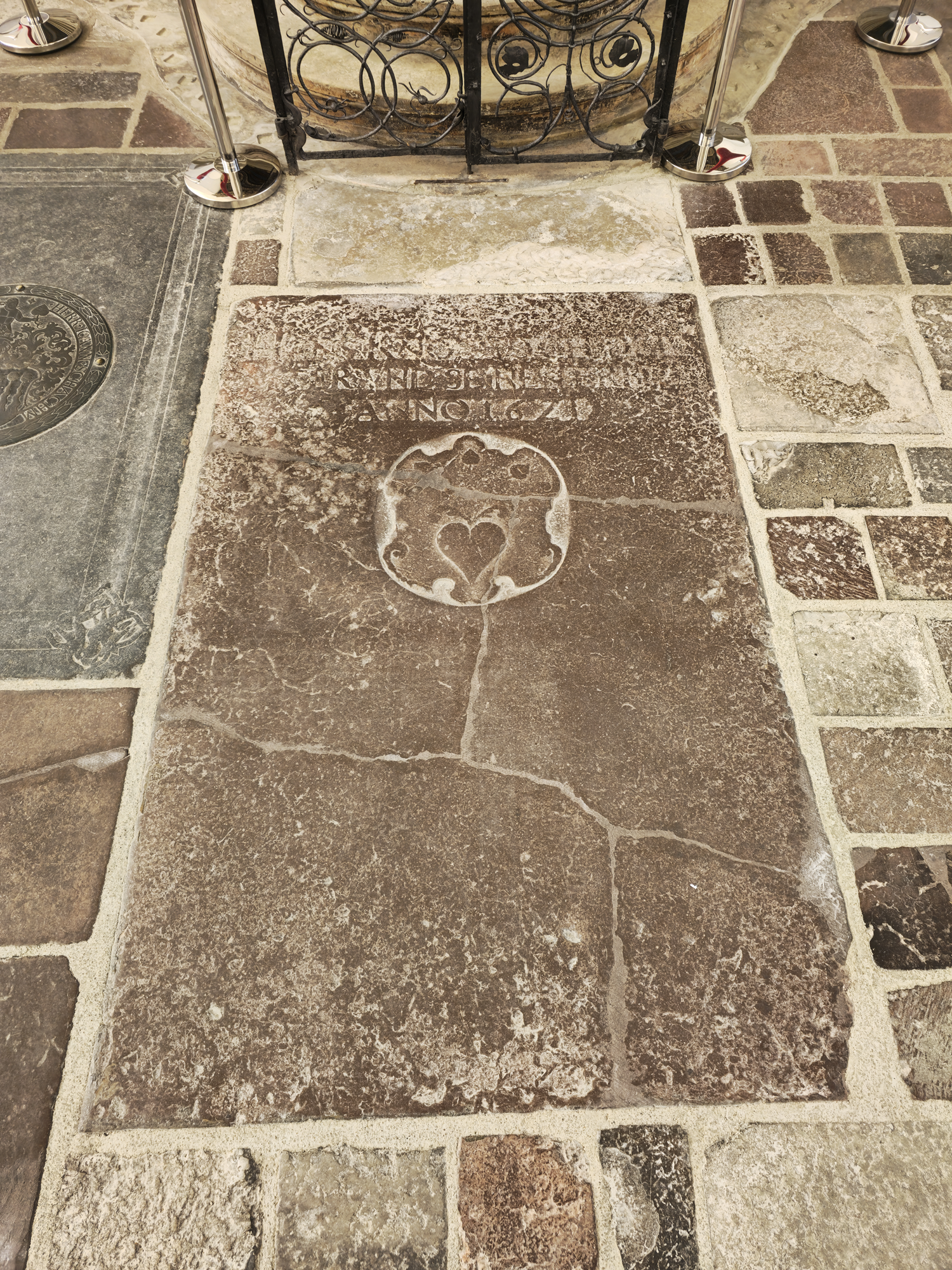 (Close up of tomb stone 111)
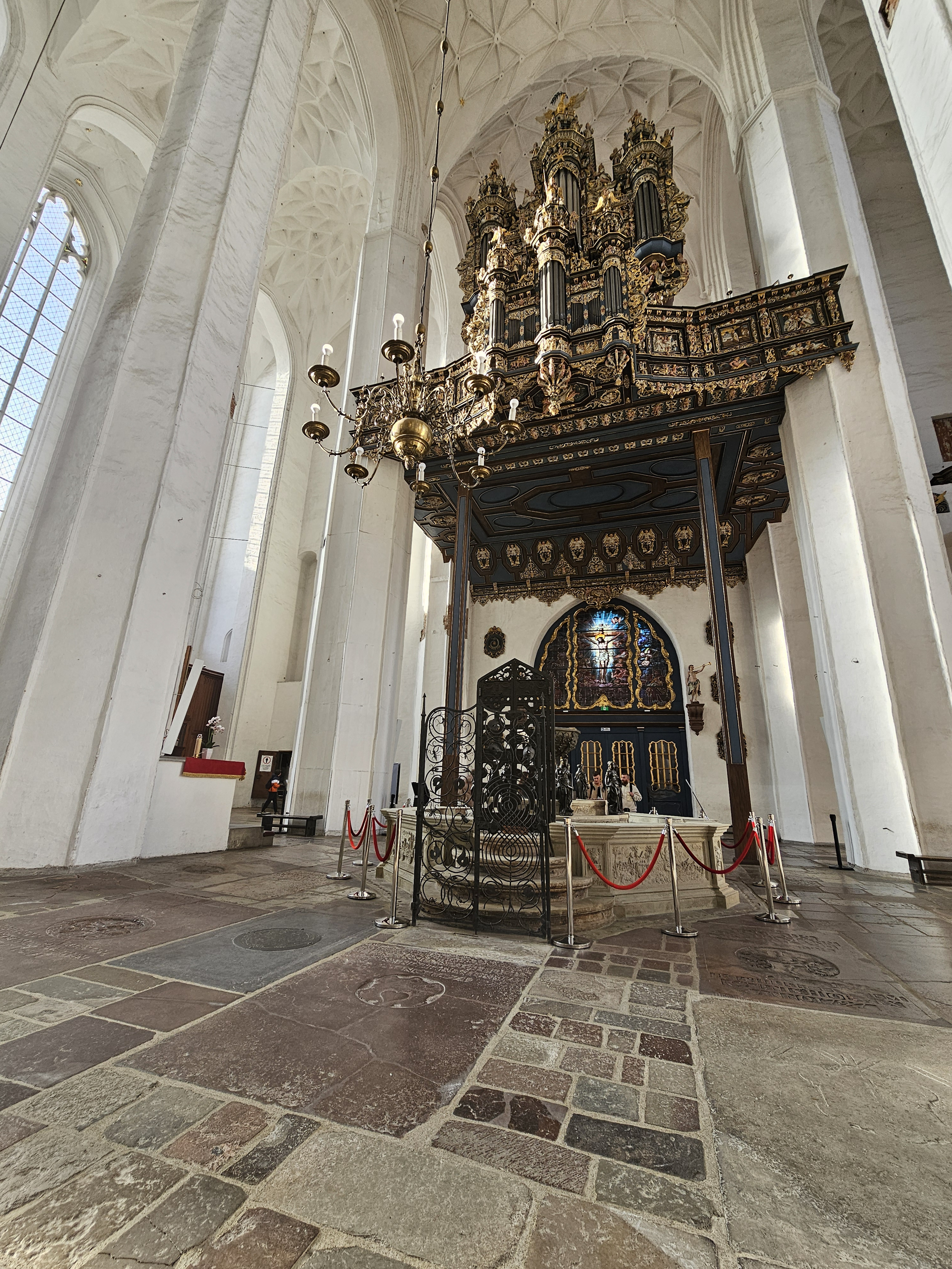 (Tomb stone 111 in front of the baptism fountain and the ornate organ case)
No. 1 Phantasia Primi Tonii
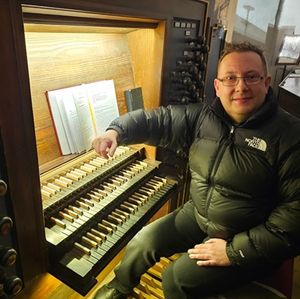
This is my own recording of the opening piece of the Tablature, Phantasia Primi Tonii, performed and recorded at Hillebrand organ at St. Mary's Basilica, Gdańsk, in 2015.
I played this using the pleno of the Hauptwerk: Prinzipal 16', Oktave 8', Oktave 4', Quinte 2 2/3', Oktave 2', Mixtur VII.
It was an extraordinary pleasure and memorable occasion to be able to play and record this piece in Gdańsk and I am very grateful to the organist, Professor Bogusław Grabowski, for granting me such a privilege.
No. 20 Vader unse ym Hemmelrick
Here is my sample set recording of the only chorale setting in the Tablature, Vader unse ym Hemmelrick, or in High German: Vater uns im Himmelreich. A chorale setting on the Lutheran chorale for the Lord's Prayer.
Version control
Version 1: 13/05/2025