

The market for AI Security Engineers is expanding rapidly, driven by the shift from wrapper APIs to production autonomous agents, Model Context Protocol (MCP) integrations, and fine-tuned enterprise deployments. However, most hiring managers are exhausted by generic portfolios filled with copy-pasted wrappers or basic RAG implementations.
To stand out to recruiters and hiring managers as an AI Security Engineer, your portfolio must demonstrate two things simultaneously: deep security domain expertise (threat modeling, sandboxing, isolation, runtime guardrails) and practical AI literacy (model lifecycles, prompt mechanics, dynamic context loading).
Here is how to structure your GitHub and LinkedIn footprint to demonstrate production-grade AI security capabilities.
1. The GitHub Blueprint: Build Production-Grade Tools, Not Toy Projects
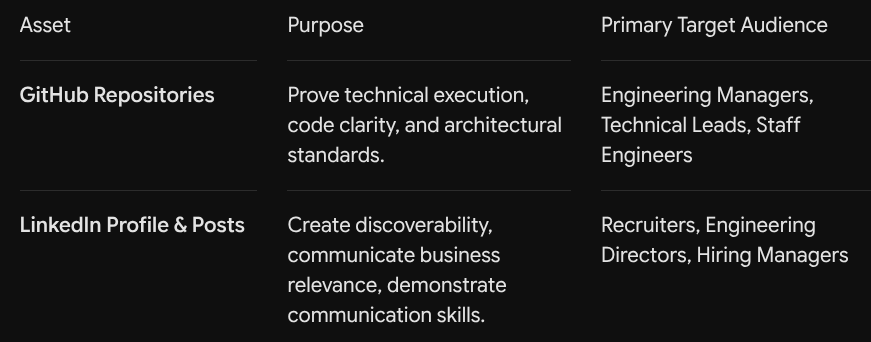
Hiring managers skim repositories to verify system design maturity, code quality, and security intuition. Your GitHub should feature 2 to 3 core repositories, each backed by clean documentation, automated testing, and functional CI/CD pipelines.
Top 4 High-Impact Portfolio Project Ideas
Project Idea A: Model Context Protocol (MCP) & Skill Security Scanner
The Problem: The open ecosystem of MCP servers and agent skills introduces massive supply chain and privilege-escalation risks.
What to Build: A static and dynamic security analyzer for agent capabilities and MCP tools.
Key Components:
Parse schema definitions to identify overly permissive tool interfaces (e.g., unrestricted shell access, unsanitized SQL drivers).
Scan tool dependencies for supply-chain vulnerabilities and malicious payload patterns.
Output structured security findings in SARIF format for seamless integration into CI/CD pipelines.
Project Idea B: Agentic Sandbox & Zero-Trust Execution Boundary
The Problem: Autonomous AI agents executing code locally or in the cloud present immediate remote code execution (RCE) and exfiltration threats.
What to Build: A lightweight, rootless container or WebAssembly (Wasm) runtime wrapper designed specifically to execute untrusted LLM tool calls.
Key Components:
Implement strict egress filtering to prevent unauthorized data exfiltration.
Enforce dynamic system call restrictions using
seccompor eBPF.Log all input/output payloads to produce immutable, audit-ready event streams.
Project Idea C: High-Throughput Prompt Injection & Data Redaction Gateway
The Problem: Latency-sensitive production environments cannot afford heavy model roundtrips just to detect prompt injections or secret leaks.
What to Build: A fast proxy layer sitting between the application and the LLM provider.
Key Components:
Implement multi-stage input filtering: regex patterns for static secrets/tokens, lightweight embeddings/classifiers for semantic jailbreaks, and fallback evaluation.
Provide dynamic PII/secret masking and context restoration without inflating API token costs.
Benchmark processing overhead under high traffic (e.g., target under 10 ms overhead per request).
Project Idea D: Dynamic AI Threat Modeling & Attack Surface Crosswalk
The Problem: Organizations struggle to operationalize framework guidelines (like OWASP Top 10 for LLMs or MITRE ATLAS) into concrete code controls.
What to Build: An automated threat modeling CLI or spec parser for AI architectures.
Key Components:
Accept architecture inputs (e.g., YAML definitions of vector DBs, LLM endpoints, external APIs).
Automatically map data flows against known attack vectors (indirect prompt injection, model poisoning, insecure output handling).
Output actionable remediation steps mapped directly to security frameworks (NIST AI RMF, ISO 42001).
Engineering Best Practices for Your Repositories
my-ai-sec-repo/
├── .github/
│   └── workflows/
│       ├── test.yml          # Unit and integration tests
│       └── security-scan.yml # Dependency & static analysis scans
├── docs/
│   └── threat-model.md       # STRIDE / OWASP threat model of your tool
├── src/
├── tests/
├── .env.example
├── Dockerfile
├── LICENSE
└── README.md
To make your repository stand out, ensure your README.md follows a structured template:
Architecture Diagram: Use ASCII art or a clear diagram to illustrate data flows, execution boundaries, and control points.
Threat Model Section: Explicitly document what security assumptions you made, what risks you are mitigating, and what remains out of scope.
Reproducible Demo: Include a quick 3-command setup (
docker compose upor single CLI invocation) along with example output.
2. The LinkedIn Strategy: Position as an AI Security Subject Matter Expert
Recruiters rarely locate talent by searching raw GitHub repositories. Your LinkedIn profile acts as the conversion layer that translates technical depth into visible business impact.
Headline Optimization
Avoid generic titles like "Software Engineer | Interested in AI Security." Use precise role targeting:
Option A:
AI Security Engineer | AppSec | LLM Guardrails & Agent SandboxingOption B:
Security Engineer | Defending AI/ML Systems, Infrastructure & Agent Workloads
Structuring Your "About" Section
Frame your expertise at the intersection of traditional security discipline and emerging ML paradigms:
I specialize in securing enterprise AI systems, protecting autonomous agent runtimes, and building scalable defense pipelines. My work spans traditional Application Security, Cloud Defense, and specialized AI/ML security controls.
Core Engineering Focus:
Agent & LLM Security: Guardrails, prompt injection defenses, MCP tool isolation, agent sandboxing.
Cloud & AppSec: Secret management, zero-trust access, secure software development lifecycle (SSDLC).
Governance & Threat Modeling: NIST AI RMF, OWASP Top 10 for LLMs, MITRE ATLAS integration.
Content Strategy: Publish Breakdown Articles & Demos
Posting regularly signals active involvement in the field. Structure technical updates into short, highly digestible posts:
The Code Snippet Post: Share a code block demonstrating how to securely isolate tool execution in Python/Docker, detailing why standard sandboxing falls short.
The Vulnerability Breakdown: Deconstruct a recent real-world AI security vulnerability or prompt injection attack vector. Detail how to threat-model the flaw and implement a mitigation.
The Architecture Walkthrough: Share a diagram showing how to secure an enterprise Retrieval-Augmented Generation (RAG) pipeline, from vector DB access control to dynamic response sanitization.
3. Connecting the Dots: GitHub to LinkedIn Pipeline
Final Checklist Before You Publish
[ ] Pin your top 2 AI security projects to your GitHub profile.
[ ] Add explicit
threat-model.mdfiles to every major portfolio repository.[ ] Update your LinkedIn headline to include target keywords: AI Security, Agent Isolation, AppSec, LLM Security.
[ ] Add working demo videos or visual diagrams directly to your GitHub
README.mdand featured LinkedIn media sections.
[Article revised using AI] / Manuela Schrittwieser - LLM Engineer & Tech Writer