
Thank you for listening to the Making Lemonade Podcast!
Please remember to subscribe, share, review, rate and, if you can, support the making of this podcast by donating here on BMAC, or by becoming a member of the Lemonade Makers. You'll find information on how to do that at the top of this page.
I'd love to hear from you - your thoughts and reflections on what you've heard (things you've liked/haven't liked, things you'd like to hear more/less of), your own experiences, and suggestions for people who you think would make brilliant guests.
You can contact me by emailing [email protected] or by messaging me on...
Instagram or TikTok - @markmakeslemonade
Twitter/X - @immarkosullivan
Follow Charlotte on Social Media here:
Instagram: @charlotte2153
Bluesky: @charlotte2153.bsky.social
Facebook: Facebook.com/charlottenichols4WN
Website:
https://www.charlottenicholsmp.com/
If you've been affected by anything you've heard in this episode, please take care of yourselves, and consider visiting (or contacting) any of these organisations:
www.mind.org.uk
https://www.samaritans.org
www.ptsduk.org.uk
https://thesurvivorstrust.org
Transcript
[00:00:00] Hi everyone. Before we jump in a note on our content this episode contains themes and discussion that might be upsetting or triggering for some listeners. Please check the show notes for more detailed descriptions And look after yourself.
It's one of those things that I think helps kind of create meaning when something bad has happened, because there is no. Time machine that I'm aware of where I can go back [00:00:30] to, 2020 and, you know, change the course of events. so therefore, because you can't change what's happened, you think, well, the next best option. Is to make something good out of it, do something positive with it,
Hi everyone. Welcome to another episode of Making Lemonade. You've had a great week.
I was one of the thousands and thousands of people in London at the weekend, uh, for the London Marathon. [00:01:00] Not running it. My running style, according to a friend of mine is what a broken goose would look like, which, uh, probably isn't great for marathon running.
I was there cheering on. My wife Jenny, Who was running it in aid of a, a great cause in memory of a friend of ours who died last year.
And I was trying to do that thing where you go to a couple of different spots around the course and, uh, you track the person that you are following, On the Brilliant app and around about the 18 mile mark [00:01:30] near Canary Wharf, I found a, a quiet spot and was standing and waiting with my daughter for Jenny to come running along.
And we found ourselves standing next to a woman who was like lots of people and like us, cheering people as they were going past. It's great if you've never been, loads of the runners have their names printed on the front of their vests, and that means that loads of people shout out their names And shout out encouragement, which is really, really lovely thing. And, and I know my wife tells me it means such a lot and [00:02:00] really helps, especially, you know, as it's getting tougher. And a few minutes before Jenny came running along, a young man started waving to the woman next to us and came running up to her and gave her a big hug And he was laughing, and, uh, he, turned to me and said, do you want a hug as well? And, um, said a few words to the woman and then he, he went running off and as he disappeared around the corner, the woman next to us started crying and. He said that he had just finished six months [00:02:30] of chemotherapy and no one had any idea how huge this moment was for him and for everyone.
He knew him, and I was just completely struck by it.
By the energy and level of determination, it takes anybody to run a marathon, but Somebody's just come through treatment like that. I can't imagine how difficult that must be. But I do know, and I, I do understand, and I'm learning more every episode about
that desire that [00:03:00] will to make something good come out of the really difficult things that we go through. So I just wanted to share that. And now, let me tell you about this episode. It was recorded at the end of 2024 and it was special for a couple of reasons.
Firstly, because I'd had a chat with this person about a year before about something else that we mentioned in the podcast. Actually,
something that I feel really strongly about and we'll talk about at some point in another episode of this [00:03:30] podcast. But secondly, it was. Really cool because the person I'm talking to is a member of Parliament here in the uk and, um, I assumed we'd find a studio somewhere, but she said, no, no, no, no.
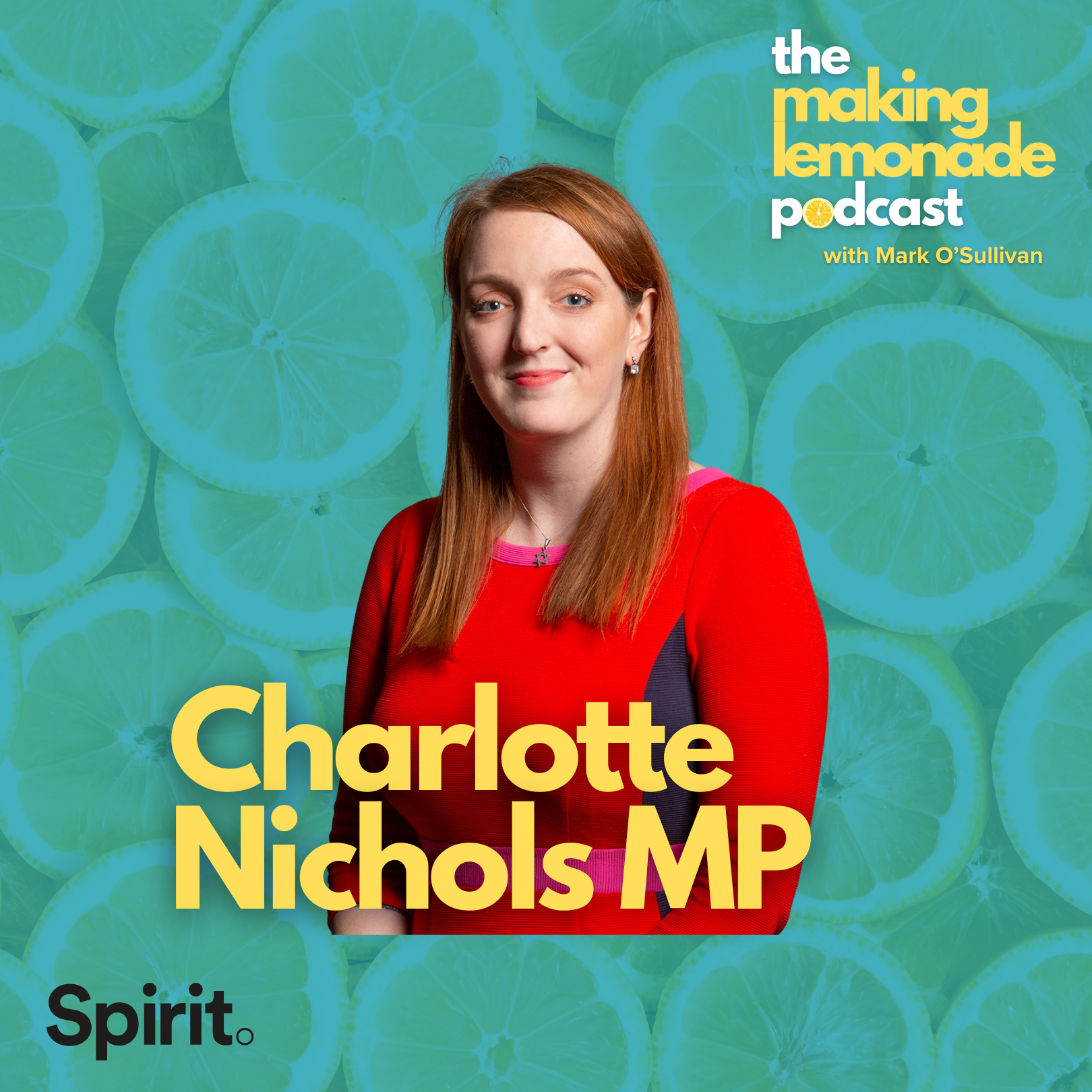
Come to come to Parliament. So me and Ian Cullen, who recorded and edited this episode. Packed our stuff and went to Port Ellis house, To meet my guest for this episode, the mp Charlotte Nichols,
[00:04:00] Mp Charlotte Nichols.
Just Charlotte's fine. Is
it? Yeah. Oh. It's kind of like the idea that every time you pick up the phone you have to say the whole thing.
Well, I did used to have a housemate who when I was coming in of an evening, would shout down the stairs. Like, is that the right honorable? Oh, you can help me out there.
Oh no. Yeah, so I'm, I'm not right honorable. Uh, that's Privy counselors, right? So when we're in the chamber, you have to refer to each other in certain ways. So you know, the [00:04:30] Honorable member four. Constituency name here and things like that out of politeness more than anything. You're not allowed to use the word you in the chamber, but in my, you know,
because you're always talking through the, the speaker.
Speaker Aren. Yeah. You're speaking through the
chair. Um, which is strange to learn, to adapt to, but yeah, in, in my normal life, just Charlotte and then, yeah, my friends call me Onion. Okay.
Nicknames you weren't expecting from today? Yeah, it's, uh,
yeah, like, uh. The lady of [00:05:00] Ot. OT is Hyper Onion. Onion or Sid after the sloth in ice Age that my family say I look like.
Wow.
I, I'll, I'll answer to any of those things. That's,
um,
I dunno what to say about
your friends and family. I mean. Do you, you know, you can, there are other people
Yeah,
yeah. That, you know, you can be friends with if you, if you want to.
I'm all for it. I think it's like a sid cult, culturally Irish thing.
Like you, you show your friends and family that you [00:05:30] like them by just gently roasting them all the time. It's. Familiar. If they're polite to you means familiar, it means they don't like you. You know? Yeah. Your, your closest people are the ones that you just, you gently wind up all the time.
And if someone's too nice to you, you're kind of going, yeah, you've gone off me, haven't you?
Yeah. It feels
fake.
Yeah. I think I, I know, I know exactly what you mean. What, um, so you've explained what makes someone Right. Honorable. That was one of my, yeah. Sort of stupid questions. My other stupid question is, are [00:06:00] you. Now in government is Charlotte Nichols in government?
Yes. So because laborer in government, all labor mps are government mps.
Right. But I'm not in government in so far as I don't hold a ministerial office. Uh, I'm a I'm a back bencher.
So You are, but you're not. Yeah. That's straightforward.
A lot of how this place works is a bit like that. It's it's a lot to wrap your head around. It's like,
it's like a weird escape route. Yeah.
Yeah.
I think they keep it kind of. [00:06:30] Deliberately vague and some of the arcane procedures and policies and practices and stuff just to, you know, keep normal people out,
just to make shit up, basically. Yeah. Oh no, you can't do that on a Thursday.
Oh, there's all sorts of strange things that you've, even having been here now five years.
There's still things that I'm finding out about in terms of, you know, things in ERs in May, the big books. Oh yeah. The speaker has in front of him with all of [00:07:00] the rules and procedures and things. It's learning something new every day.
I get ERs in May sometimes mixed up with Readers Digest, and I know they're very different.
Yeah,
very different. They're very different, aren't they? Yeah.
You can't get ERs and me fortnightly from your news agents, can you?
Although I think there's people that would. Sign up for that. There's a lot of, uh, parliamentary geeks who love all the trivia of this place. Are they? Yeah.
I bet sometimes those people know more than the people in.
You know, [00:07:30] the mps have just come in, you know? Oh
yeah. I mean, I, I employ one of them. So Max and my team, he's been here for God probably 20 years, something like that. There's very little, he doesn't know about the place he is. So I love just asking him random trivia. Like he'll tell me things like, you know, Lord Luke's dad was Clement at Lee's Chief Whip in the Lords, and things like that, where you're like, what?
And you look that up and you think that can't be true. And it always is. It
is. You must be a great person to have on a pub quiz team. Oh,
[00:08:00] completely.
Do you have pub quizzes?
We do sometimes. In fact, um, I mean, I know this isn't very helpful for people listening, but if you, if you were to look just above my shoulder, you'll see I actually have a trophy on the shelf from the, uh, I won the mps versus the lobby pub quiz at Labor Party Conference a couple of years ago.
Is that the one next to the frog? Yes. Yes. Okay.
And the tankered that, uh, says that I'm parliamentary pub champion of the year for 2022. I think that [00:08:30] was
Charlotte. I knew I was going to like you, but I like you even more now with all this trivia. Yeah. And these souvenirs and trinkets. Yeah. I'm really impressed by all of that.
Um, I was trying to remember on the way down when we first spoke, and I think it was about a year ago.
Yeah, that feels about right.
Because I was just about to go and do a therapeutic psilocybin trip in the Netherlands and I heard [00:09:00] you on the radio talking about PTSD, which we are both, I was gonna say proud owners of proud.
I dunno, do you have it on a badge? I dunno if I,
I definitely don't have a badge, but I feel like it's something, um, I'm always happy to speak about because I think. Over time, we've reached a much better awareness and understanding of mental health in this country. But a lot of it is around things like depression and anxiety, [00:09:30] which of course can have debilitating consequences for people, can be awful to live with.
But mental health is a much broader thing than that. And actually some of the, you know, messier harder, more difficult, uh, you know, conditions, things like PTSD and. You know, the, the ways that that can impact your life. I, I still think that those sorts of conditions aren't spoken about enough and there still is a lot of that stigma there.
So I feel like, [00:10:00] I wouldn't say I'm proud to have it because in many ways I'd rather not, my life would be enormously easier.
Yeah.
Um, but it's, uh, I'm upfront about it, I guess is maybe how I'd phrase it.
No, I get that completely. And yeah, I, when, as soon as I said proud odor of, I thought, Hey, that's, I'm not proud to have it.
It's something I would rather not have. Yeah. But I do have it. And a bit like everything else that's happened to me, if I [00:10:30] have to have it, then I'm gonna do something with it.
Yeah. And I think it's about like being proud of being able to live with it, being very different from being proud of having it.
It's, it's a lot to do the kind of jobs that we do. Yeah. And live with it. And the fact that we've both been able to, I'm very able to joke about it and I, I actually think that it's a good thing to be able to, um, my mum sometimes tells me off because I'll [00:11:00] joke about, you know. When I went mental, or when I was in the funny farm, or when I broke out of the funny farm as a kind of, you know, for, for coming out of hospital.
And she's like, you need to stop cooking. You know, that, that makes it sound really sort of, you know, you are not mental. And I'm like, well certifiably, I kind of am kind
of was, wasn't I? Yeah, yeah. But like,
I'm, I'm okay with that And it's okay to joke about it, you know, I wouldn't, I wouldn't use those terms to talk about other people's experiences.
But when I'm talking about my [00:11:30] own, I'm like, I should, you know.
Exactly. I should be allowed to joke about it. It's our, yeah, and if we have to have it, let's do what we want with it. Yeah. That's got to be right. I was just thinking back to when we first started talking about PTSD there, that there's another thing that happens with P ts D that I don't think happens with other conditions, which is that it's very much used as a sort of a comedy line, isn't it?
Mm. Oh. Uh, have you been at your mother-in-law's all weekend? Yeah, I've got PTSD now and I [00:12:00] laugh at yeah, everything. You know, I made a whole documentary in sitcom about being sexually abused. I can find the funny when I need to. Yeah. But there's something about that that does great with me now that I've been diagnosed with it and I know what it is.
Do you, how do you feel about that?
Yeah, I mean, I think you see it quite a lot with OCD as well where people say, oh, I'm really OCD about insert whatever here. And you think, well. You know, you don't have OCD. And again, you know, when I was in psychiatric hospital, there were people in my [00:12:30] ward who did have OCD to the point that it had completely ruined their lives and it.
And joking about it when it's not your experience. Uh, I, I do find a bit problematic, and as you said, I hate all of this chat about, um, you know, snowflakes and getting triggered and all this sort of, yeah. And as you said, PTSD being used as this kind of throwaway thing by people that don't have PTSD. If you've got [00:13:00] PTSD and you wanna joke about it.
Like, I love that for you. Yeah. You know? Yeah. You, you have to be able to find the funny in life sometimes, but if you don't, it's, it's not yours to make jokes about.
Yeah. I, I absolutely agree with that. I totally get what you're saying there. When did you, when did you first realize or find out that you did have PTSD?
So in. 2021, I was the victim of a violent [00:13:30] crime. And over the course of the months following that, um, I was becoming more and more unwell. Um, and it was sort of backend of that summer, I think when I was formally diagnosed. Um, and then. In the November of that year, um, things had got so bad that I spent a month [00:14:00] in psychiatric hospital and coming out of hospital was the point at which I decided to publicly acknowledge that this was something that I was living with for the first time.
Because having been off for that whole month, um. I kind of felt like I owed my constituents an explanation about where I'd been. There were obviously votes that had happened during that time that I'd not taken part in. I was worried people would think that, you know, I'd [00:14:30] lost interest in the job or, you know, I'd been off gallivanting somewhere or what have you.
And I, I thought it was just better to be honest. And I, you know, I said when I was coming out of hospital, you know, I've. I've come out of hospital, this is where I've been, um, you know, be gentle with me for a little bit because, you know, it's gonna take me a few weeks to kind of get back on top of things that have happened while I've been away.
Um, and was met with a really, um, sort of quite, [00:15:00] uh, understanding response from people. And then, um. Um, probably a month or two after that. That was when I was kind of specific. I, I think I'd said at the time that it was psychiatric hospital, but I'd not been specific about for what reason. And that was when I said for the first time, kind of PTSD.
Um, and like with yourself, I think given the job that I do and some of the [00:15:30] opportunities there to. Use my own experiences to hopefully make things better for other people. I thought there was a value in being open about it to be able to start having some of those conversations, make some of those changes.
Um, so yeah, I mean, 20, 24 now, few, few years in. Yeah. Um, but it's as much as if I could be cured tomorrow, I would love to [00:16:00] be. Um, I also am quite proud of the fact that I've been able to use my experiences to hopefully make things a bit better for other people that are living with it, that don't have some of the privilege that I do.
Yeah. I've, I've no doubt you've done that and that are continuing to do that and hope, you know, all of us can, speaking about what's happened to us and. And the effects that it's had on our lives and on the [00:16:30] people around us. Let's be honest.
Yeah. Oh, completely.
Yeah.
I think during that time I would've been dreadful to be around, you know, as a friend, as a colleague, as a family member.
Um, you know, it, it took a toll on everyone.
Yeah. Yeah. Did you have, I mean, you might, again, you might not want to talk about it, but did you have sort of specific things happening, like symptoms that, that kind of. Um, gave you a clue that that's what was happening?
Yeah. It was [00:17:00] strange at first because I, I didn't register and recognize that a lot of the things that were happening were as a result of PTSD because initially a lot of the symptoms were very physical, so I would find myself feeling.
Powerfully sick all the time. And I remember there was once I was walking down to the train station from my home in Warrington and a car went past and I [00:17:30] could hear this music and it reminded me of the event that had sort of caused my PSD and I just vomited in, in the street at, you know, sort of 10 o'clock in the morning out of nowhere.
And I remember thinking. Why have I just been sick? What's that like? What's, and things like waking up of a morning and having kind of. Completely like sweated through all of your bed clothes and just feeling really, you know, [00:18:00] hot all the time and all those sorts of things. And, and you know, England's not a hot country.
Um, it wasn't a particularly warm time of year. Warm, oh, I mean, the sun always shines in Warrington, but, uh, a micro climate, isn't it? Yeah. Yeah. Glorious tropical. The, the cost del was, it's, um, but yeah, it was, it was all of those sorts of things that. You know, so, but I, I was kind of thinking like, am I going through like the early menopause?
I mean, you know, I'm mean, at the time I was like [00:18:30] 30 and I was like, well, that doesn't feel right. And, you know, I, I knew that I was feeling very anxious at the time and all this, but I, I kind of didn't really link. A lot of this stuff up. And it was, I was having sort of quite regular contact with my GP around that time, and I was telling her about, you know, I, I keep being sick and I keep having these sort of panic attacks and I'm, I'm just, every morning, like I'm, I'm having to wash my sheets every day [00:19:00] because I'm so, and she was sort of quite gently like, okay, well this is kind of textbook.
PTSD, these things you're describing and you know, are, are these things happening, you know, at night? Are you having kind of nightmares and things? And I was like, yeah, and, you know, and, and is this happening? I was like, yeah. And she was like, yeah, that's, that's PTSD. And
what was that like when she said it to you?
It kind of, it made sense in a way and given what had [00:19:30] happened sort of prior to that time, um, kind of context wise I guess, but. I also, like many people do associated PTSD with being something that war veterans have.
The military Yeah. Yeah. People in war zone
and the ways that, that's kind of depicted in film and TV where like someone hears something that sounds a bit like a chopper and they, they're hiding.
Yeah. Or under a table or under that. Yeah, that's, that's what I thought [00:20:00] PTSD was. Yeah. And so having that. It was really helpful because then I was able to go away and look at, you know, the mind website, for example, and see all of these things where I was like, yeah, that's, that's me. That's, that's what's happening.
And it helped with, you know, starting to go into therapy and that kind of thing, understanding that a lot of this stuff that was happening wasn't [00:20:30] random. So as an example, I've found. And I didn't know why, but like I couldn't get the tube for ages because I would feel really anxious on the platform and feel this kind of overwhelming urge to like throw myself in front of the oncoming tube to end it this kind of really intense distress.
But the tube had absolutely nothing to do. With the crime that set off my [00:21:00] PTSD. Yeah. It, it had, it brought no kind of relation to it whatsoever. And so I was thinking, well, why is this happening every time I'm getting on the tube? Like, this doesn't, this doesn't make sense. Yeah. Yeah. And then again, working it through with my therapist and she was saying, well, you know, the tube is, is the feeling of being trapped.
And because I, I was thinking, well, I'm not getting on the train. You know, I get the train multiple times a week between, you know, Westminster and Warrington wasn't getting on that could get in a bus, fine, could get in a [00:21:30] taxi or a car. I was like, why the tube? And she was like, you're enclosed and you're trapped.
And when you're on the tube, you know, you can't see the outside. You can't, you can't just stop the door. You know you are. And it was that kind of light bulb moment of like, oh yeah, it's not. Random and then working out what the other things that were setting me off again, where they were coming from and why.
Yeah. And being able to kind of then work that through, find strategies for. [00:22:00] Dealing with it. And at first it was silly things like I'd have a elastic band around my wrist when I was getting the tube, and if I could feel myself getting really worked up then to snap it really hard. Which would kind of bring you back into the, back into your body, doesn't it?
Yeah. Yeah. And then I had a little, um. Like sachet thing of, uh, dried lavender that one of my friend's little daughters had picked for me and put in a little, and again, smelling [00:22:30] that would kind of again, bring different things back that would then, and, and then I got to the point where I could get on the tube again, and it was,
and they helped just those little techniques.
Yeah, those, those
little techniques. But I, I wouldn't have been able to do any of that stuff. Without kind of having the recognition that what was happening was PTSD, like yeah, get getting to a point of being able to live alongside it [00:23:00] wouldn't be possible without knowing that that's what it was, what it was, because it, it did all just feel before that random and scary, and as I said, all these things that were happening, but where I, it just, I, I couldn't work out why, you know, I, I, it was like a reason for it.
I know what you're talking about. So, well, even though, you know, what happened to me is different mm-hmm. And, and how my PTSD kind of make, makes or [00:23:30] made itself known is, is quite different as well. Knowing that it is this thing and you're not just, just a bit shit and a bit broken. Yeah. Is really good and powerful, isn't it?
And that
other people have experienced it.
Yeah.
Um, you are not kind of. Uniquely fucked up in some way for want of a better way of putting it. You know, there's, it's so true. It's, you know, this is what's up there is a, there is a cause this is a [00:24:00]condition and you know, there are ways in which you can live alongside it.
Yeah,
yeah.
It's a game changer.
Hi everyone. Just before we get back to the episode, a quick reminder that if you are enjoying the podcast, there are a few things you can do to help us.
You can share it, tell people about it, put it on your social [00:24:30] media.
If you want to go a step further, you can rate it or leave a review on whichever platform you listen to your podcasts. That is so helpful because it helps a podcast to become more visible. Honestly, clicking one of those stars, I mean, if you could click the fifth one, that would be really incredible, and just leaving a few words is a massive, massive help.
The other thing you can do is subscribe. Just hit subscribe wherever you get your podcasts, and that way you always [00:25:00] get the next episode landing in your feed, all ready to go each Wednesday.
And lastly, This podcast is only made possible by some really great people donating their time, their expertise, and sometimes some money. If you want to be one of them, go to buy me a coffee.com/making lemonade, where you'll find show notes,
You'll find information about each guest and you'll also, if you want, be able to buy me a coffee or a couple of coffees.
And if you can do any or all of that, [00:25:30] I'll be so, so grateful.
And now let's get back to the episode.
I only really realized. That it was PTSD for me, you know, over 30 years after it had happened. Really? And one of the clues for me was, well, there were two things. First of all, my friends and my family, and in particular my teenage children have always known that they can make me jump really easily.
Yeah. [00:26:00] I'm like, I've got the, you know, I, I, it doesn't take much a loud noise and I'm, I sort of jump outta my skin. And, um, but the other thing that was, that started to make sense was I realized for as long as I could remember, and I do mean decades, whatever building I was inside, I would try not to spend too much time near the windows in case someone shot me.
Mm. And you know, what happened to me Had nothing to do again, not [00:26:30] military. I've never been in the military. I would be rubbish. Yeah. I would be hiding in behind a false wall if it were me. Right. Um, but, but for some reason my body just felt like I was constantly in danger. Yeah. And there were ways to protect myself.
One was to make sure that I couldn't be got at.
And that hypervigilance thing is so weird when it first starts happening. This kind of level of awareness that you've got for [00:27:00] things that, like you said, no one's coming to shoot you. It's not, no, but you become paranoid about really odd stuff. And I'm, I'm very much the same.
You know, I would, anywhere I was going, I would need to see the exits Yeah. And things. And I would be sat with sort of my back to the wall so that people couldn't come up behind me. Yeah. And all these [00:27:30] things that, and it, you know, it sounds mad to say because it is, uh, but at, at the time you. You don't understand why you've started thinking these things and why they've become so powerful that you, you can't not do them.
They're so real, aren't they? Yeah. They feel in your body. Yeah. And your mind so real and so necessary. And they sort of become the normal, [00:28:00] don't they? Yeah. Or the thing that you just take as being normal, I think. I suppose it would be good to talk now, you know, we've, we've spoken about the lemons side of this, haven't we?
You know, the, the shit things Yeah. That we, all of us go through. They don't all look the same, these lemons, but we all get given lemons, don't we? Yeah. But for me now, it's about what we do with that. What is the lemonade? Yeah. That comes out of that. And for me, you know, it is writing and making silly things that make me [00:28:30] laugh, but actually are powerful and really healing for me.
What, what is your lemon? I, you know, do you know what? Every time I say that someone, what is your lemonade? It sounds really weird, doesn't it? Charlotte? What's your lemonade, would you say? What's
always my lemonade? Uh. Beyonce have an album called Lemonade.
She did? Yeah. And that was very much Beyonce's Lemonade.
Yeah. Yeah.
Um, I, I think it is the job that I do and the ability that I have [00:29:00] to do something about all of this stuff. It's the most annoying thing in the world. If you are outside of politics as obviously I was pre 2019 and seeing something that's wrong or that needs to be fixed and kind of not being in a place to fix it, and you're shouting at the telly and you're like, you know, this is so obvious, why would they just do this thing?
And now being in a job where you know, I'm able to do the things is [00:29:30] really rewarding. And I think for. This issue in particular as something that obviously personally affects me. Um, but also, you know, the amount of constituents that I speak to who live with PTSD for all sorts of different reasons. Yeah.
And hearing their stories and again, being able to use all of that to hopefully make things better. It kind of. It gives you that [00:30:00] warm, fuzzy feeling and reason to get out of bed in the morning and come in this place to try to do it. It's, I can imagine that's my lemonade.
It's powerful, isn't it? Power.
Power out of powerlessness. Mm-hmm.
It's one of those things that I think helps kind of create meaning when something bad has happened, because there is no. Time machine that I'm aware of where I can go back to, you know, [00:30:30] 2020 and, you know, change the course of events. Um, you know, again, if there was, I might, uh, but you know that there isn't.
But so therefore, because you can't change what's happened, you think, well, the next best option. Is to make something good out of it, do something positive with it, and that feels like something [00:31:00]that's eminently divable in my line of work.
I bet, I bet. You know, I, I kind of feel a bit of that in what I do.
Mm-hmm. But I am, I can imagine, you know, how much more that's amplified in, in what you do, I guess. Although I feel
like they're so related. I mean, you know, you look at all of the changes that happened at the beginning of this year. With the post office horizon scandal, for example. I mean, that was something that I've been on the Business and Trade committee for a number of years.
We set up [00:31:30] the, um, inquiry effectively, and there's just been this slog for years of really slow progress and just edging towards something at glacial pace. Mr. Bates versus the post office comes out on ITV. Brings the public into this conversation and makes 'em aware of just the scale of the injustice there.
Yeah. And [00:32:00] suddenly all of these things that they'd said would take years to do and to sort out and or couldn't be done, suddenly they found a way to do it. And I feel like when the media and politics are both working well, it's a, it's a symbiotic relationship because it's. Where the public's attention is and on what issues.
And then they're the things that they then start writing to their mps about. And then we think, oh, we should probably do something about this issue. [00:32:30] And it's, uh, when it's working well, I think can be really reinforcing like that.
And that's the power of stories, isn't it? You know, stories, whether that is something that is being fictionalized by someone like me or someone sharing their own story.
That's what, what? Stories can do, isn't it? They can move people in a way that they might not be moved, you know, by something else, by,
yeah. I mean, you know, you look at statistics for all sorts of things and you know, they, they tell [00:33:00] a story of sorts, but actually you're much better off sitting down with one person who's affected by that issue and hearing from them to really understand it.
Yeah. And. The have then that emotional connection to the issue. To humanize it. Yeah. To make
it about people. But
sometimes you don't get with departmental briefings with a load of numbers in, or you Yeah. Yeah. It's, it's the stories that are the bit that really make you sit up and go, oh, you know,
and you kind of need both, [00:33:30] don't you?
Yeah. You need both of those and they inform each other as well. I guess. I, I suppose the thing that. I think about when I, I think about the work you are doing and you know, the, your reasons for doing it is that you are like your colleagues in a, in a really unique position in that yes, you've got this ability and power to help make change, but you are also so much in the spotlight and in the firing line [00:34:00]for people's negativity.
How do, how do you deal with that?
I think I. The best advice that I got was from a friend of mine who's an actor, and for most jobs and professions, it's kind of, it's not your name above the door. Do you know what I mean? It's the corporation that you work for or the company or the whatever that someone doesn't like.
But when you are [00:34:30] doing something like. Politics or acting or any kind of public facing role. People who don't know you or anything about you will feel like they do and have very strong opinions on who you are and what you're about.
Yeah.
And that you almost have to, her advice was basically to kind of detach your sense of [00:35:00] self.
From your kind of public facing self and your private self, and they might hate your public facing self and the kind of projection of you, but because they don't know you. They don't actually hate you on a personal level's, and you kind of, yeah, there's a, there's a cognitive dissonance bit play that, but the uniform you put on, isn't it to be Yeah.
But you kind of No, they, [00:35:30] they hate me. The mp, they don't hate me. Charlotte Nichol's, the person, because they've never met me. They don't know me. They dunno anything about me.
Yeah.
And if you. If you rationalize it to yourself that way, I think it becomes a lot easier. 'cause a lot of this stuff obviously feels like personal attacks, but it kind of isn't.
'cause as I said, they, they don't actually know you.
Gosh, I wish someone had told me [00:36:00] that years ago.
I, I found, I found it profoundly helpful. I have to say
I love it when those moments say mostly unexpected moments where you read something or someone says something, and to them it might not mean. Very much, but it absolutely lodges in your head.
Yeah. And it sort of shifts your perception in a, in a really fundamental way. I love it when those things Yeah. Happen. Um. We should talk more about the work you are doing specifically to try and help people like us with PTSD, which [00:36:30] I've obviously got my own experience of, which is psychedelics and, and their use.
When did you first start becoming aware of. Of the power of psychedelics and, and, and the work that's happening around the world.
So it was around the time that I'd gone into hospital in 2021. I'd read Michael Pollin's How to Change Your Mind. And I found it absolutely fascinating, but as someone [00:37:00] with no sort of medical background, uh, you know, I've got a humanities degree.
Uh, you know, I, I work in politics. Uh, you know, it, it, it was a very interesting argument, but I didn't know. If there was actually anything to what he was saying. And at one point I remember having, while I was in hospital conversation with my psychiatrist and you know, he was a very eminent consultant, psychiatrist, and, you know, very serious and qualified bloke.
And saying to him, I'd read [00:37:30] this book. And it was saying about, uh, you know, psychedelics for treatment of things like PTSD, is this kind of. Pop psychology bollocks, or is there something to it? Like, is this, is this legit? Basically, yeah. And he said, oh no, this is, you know, a, an absolute. Game changer in the field.
It's, you know, probably the, the best thing that you could have in your arsenal as a [00:38:00]psychiatrist. You know, you can do this really deep work with people. You can, you know, really fascinating all this research. Um, but. It's not legal here in the uk and it wouldn't be legal for me to even tell you where you could go to access it elsewhere, really.
And then he looked at me, obviously knowing full well what I do for a job and said, but that's one for the politicians to sort out with a bit of a wink. And I remember just thinking, huh, you know, [00:38:30]there's, there's my next bit of campaigning. I think one of my kind of proudest days as an MP was leading, we had a, a debate.
On the floor. Uh, so the, in the chamber of the House of Commons, you know, it wasn't in one of the side chambers for the smaller debates and discussions. It was, you know, the iconic green benches. Yeah. And leading a debate, talking about psilocybin. And, uh, yeah, it was from there, things have been moving [00:39:00] not as fast as I would like, but it's, it feels like we're headed in the right direction on it.
I could talk about that. Yeah. All day long. But there's one last question that I'd love to ask you, and that is for, for our listeners, people who, and you know, the series is about talking to people who've had all sorts of challenges or traumatic events happen in their life. Um, all sorts of [00:39:30] lemons. Mm-hmm.
What would you say, what advice would you give them about, about. The opportunity to, or the choice to make lemonade, whatever that is. What would you say to them?
Oh, I think it's gonna sound very glib and it's a very MP answer, but everyone has within them the capacity and agency for making change. [00:40:00] It's about who you have on your team.
And there are 650 mps representing every single different part of the country. Get your MP on your team. Go and speak to them. Go to a surgery. Sit down with them, talk to them about why this is important. Talk to 'em about, you know, what you've been through and what you'd like to happen and work with them to make it happen.
There's [00:40:30] always things that can be done. There's always progress that we can make, come and be a part of it.
That was amazing. That's absolutely amazing. What a message to send out. Charlotte, thank you so much. Oh, thank you for being a guest and for sharing your experience and your, your version of, um, lemonade as well.
Really appreciate it and I know that listening to [00:41:00] this, it'll help so many people.
Thank you.
A huge thanks to Charlotte for agreeing to take part in the podcast and for recording that episode with us. there's so much of what Charlotte and I spoke about that, that I can very directly relate to.
But I hope as with every episode, there's something for everyone in there.
Thank you for listening. Thanks for being here for the [00:41:30] conversation.
A huge thanks to Ian Cullen for recording and editing the episode.
And thank you to Greg and Martin, who's donations made this episode possible. See you next time. for the next episode of Making Lemonade.