

Why Highschoolers & Homeschooler Graduates Should Consider a Multi-Disciplinary Studies Career Path Before Picking a Major & Going to College
Cultivating Multiple Interests, Skills, Career Possibilities & Income Opportunities Before Committing to One Educational Direction
By MAJESTY-ALL-MIGHTY
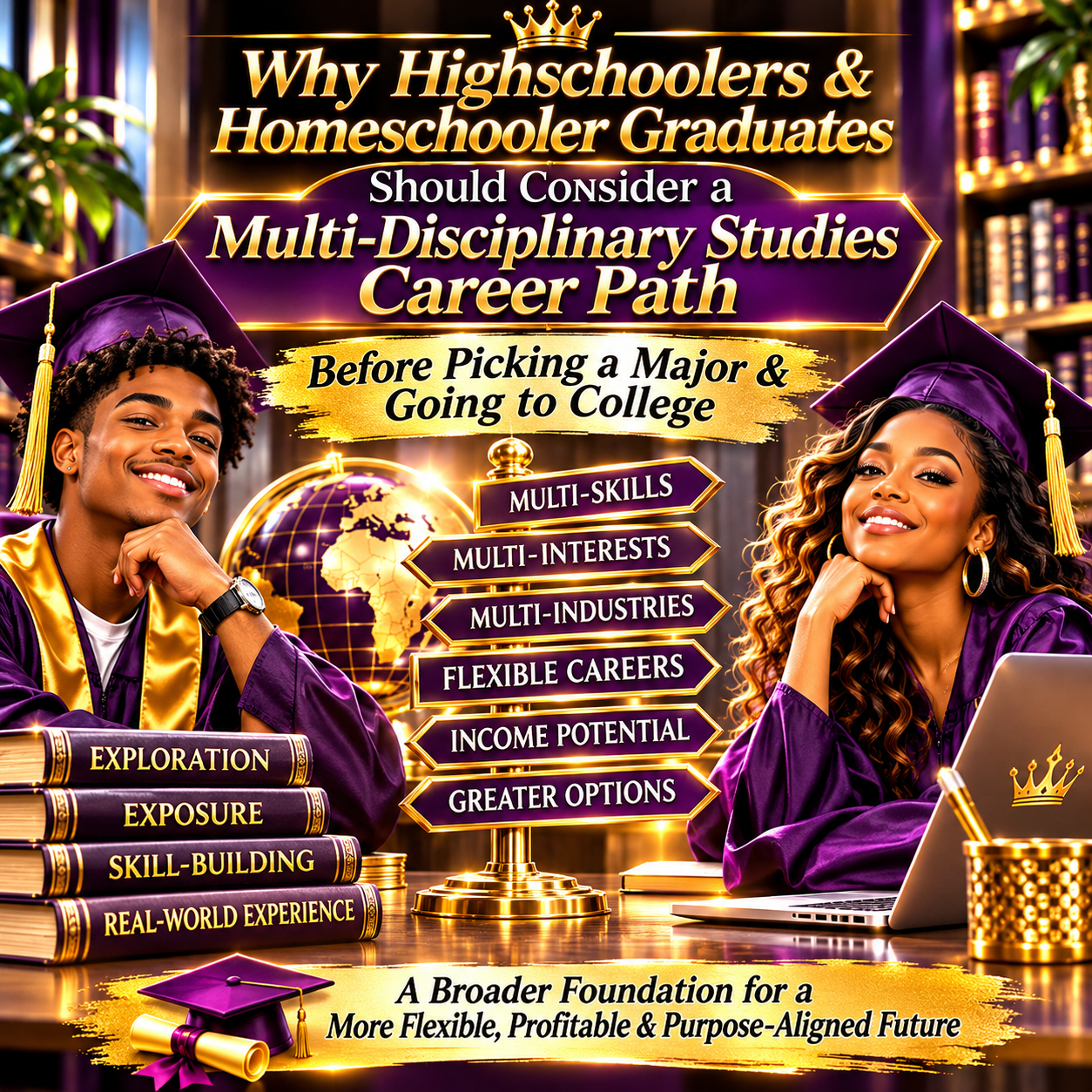
WHAT IF YOUR FUTURE IS BIGGER THAN ONE MAJOR, ONE CAREER, OR ONE TRADITIONAL EDUCATIONAL PATH?
If you're approaching high school or homeschool graduation—or you've recently graduated—there's an important conversation I would love for you to consider before selecting a college major, committing to years of study, or investing substantial financial resources into a particular professional direction.
What if you could begin exploring several of your interests, developing marketable skills, completing educational programs, and discovering multiple career possibilities before deciding which path deserves a longer-term commitment?
What if your next educational chapter didn't require you to immediately narrow your future to one discipline?
And what if you could create a customized learning experience that recognizes the WHOLE of your interests, abilities, aspirations, and emerging professional identity?
WELCOME TO THE POSSIBILITIES OF A MULTI-DISCIPLINARY STUDIES CAREER PATH!
As a new-era educational facilitator and purpose path placement coach, I've long encouraged individuals to recognize that education and professional development do not have to be confined to a single conventional template.
And for emerging graduates, this perspective can be especially valuable.
FIRST, THIS IS NOT AN ARGUMENT AGAINST COLLEGE
Let's establish something important.
If you're excited about attending college, have earned a scholarship, or already know that your desired profession requires a particular degree, I am not suggesting that you abandon those plans.
College can provide valuable academic, professional, social, and personal experiences.
Certain professions also require accredited degrees, supervised training, licensing, and other specific educational qualifications.
However, attending college and exploring multidisciplinary education do not have to be opposing decisions.
YOU CAN PREPARE FOR COLLEGE WHILE EXPANDING YOUR POSSIBILITIES BEYOND A SINGLE MAJOR.
You can also explore alternative educational experiences before enrolling, alongside your college studies, or after completing a degree.
The objective is not to replace one rigid educational template with another.
It is to recognize that you have choices.
And those choices deserve thoughtful consideration before you make significant commitments involving your time, money, energy, and future opportunities.
THE PRESSURE TO PICK ONE PATH BEFORE YOU'VE EXPLORED YOUR POSSIBILITIES
For generations, a familiar educational pathway has shaped how students prepare for adulthood.
Graduate from high school.
Select a major.
Attend college, trade school, or another educational institution.
Complete your studies.
Find employment in your chosen field.
Build your career.
And while this traditional sequence can work very well for many individuals, it does not guarantee that every graduate will experience the same results.
Some students discover that their chosen major no longer reflects their interests.
Others complete degrees only to encounter limited opportunities in their preferred field.
Some accumulate student loan debt before fully understanding the financial implications of their educational decisions.
And others recognize, sometimes years later, that their interests and professional abilities extend far beyond the discipline they initially selected.
Now imagine experiencing these realizations between the ages of 18 and 25, when you're still developing your understanding of yourself, your capabilities, and the professional world.
That's a significant amount of pressure.
But what if your educational experience could include more exploration before making a major commitment?
WHAT IF YOU GAVE YOURSELF PERMISSION TO DISCOVER MORE BEFORE DECIDING WHERE TO INVEST MORE?
YOUR INTERESTS MAY BE MULTIDISCIPLINARY FOR A REASON
Not everyone has one dominant professional interest.
You might love business and technology.
Writing and psychology.
Healthcare and entrepreneurship.
Graphic design and marketing.
Education and multimedia production.
Finance and creative development.
Or perhaps your interests extend across several fields that don't appear related at first glance.
That doesn't necessarily mean you're confused about your future.
It may mean you have multiple interests and capabilities worth exploring.
A multidisciplinary studies approach allows you to examine different areas of knowledge while discovering how they might complement one another.
For example, a student interested in entrepreneurship might explore business management, digital marketing, communication, financial literacy, artificial intelligence, and project management.
Someone interested in wellness might explore nutrition fundamentals, health education, communication, entrepreneurship, and community development.
A creative student might combine writing, publishing, design, media production, and business development.
These combinations can introduce new professional perspectives and help students recognize how different disciplines interact in real-world environments.
YOUR FUTURE MAY NOT REQUIRE YOU TO ABANDON SEVERAL INTERESTS JUST TO PURSUE ONE.
Sometimes, the combination of your interests becomes part of your distinctive professional advantage.
CONSIDER CREATING YOUR OWN MULTI-DISCIPLINARY EDUCATION EXPERIENCE
One approach I encourage students to consider is developing a customized educational pathway that includes multiple subjects, skill-building experiences, and opportunities to earn credentials.
Instead of immediately committing all your educational resources to one degree program, you might begin with shorter courses in several areas.
Depending on the educational provider and program, these experiences may offer certificates of completion, professional certificates, diplomas, or other forms of documented learning.
This can give you opportunities to explore different disciplines while developing a clearer understanding of what genuinely interests you.
For instance, imagine spending several months exploring courses in business, technology, writing, communications, and digital media.
During that time, you may discover that one subject deserves more advanced study.
You may also recognize that two or three disciplines work particularly well together.
Or you might discover a professional interest you had never previously considered.
EXPLORATION CAN BECOME PART OF YOUR EDUCATIONAL STRATEGY RATHER THAN SOMETHING YOU FEEL PRESSURED TO COMPLETE BEFORE GRADUATION.
And the beauty of customized learning is that your pathway can evolve as your interests, resources, and professional goals become clearer.
WHY MULTIPLE EDUCATIONAL COMPLETIONS CAN BE VALUABLE
One of the opportunities available through shorter educational programs is the ability to document learning across several subjects.
Rather than studying multiple areas informally without any record of completion, you may be able to earn individual certificates or diplomas for eligible programs.
For example, you could complete separate courses in digital marketing, business communication, project management, and introductory data analysis.
Each completed program may provide documentation of what you've studied.
However, it's important to understand that not all educational credentials carry the same recognition.
A certificate of completion is not necessarily equivalent to an accredited degree, an industry-recognized professional certification, or a license.
Some programs provide valuable introductory knowledge, while others are designed to meet specific occupational standards.
Before enrolling, investigate the provider, curriculum, credential type, employer recognition, and any applicable costs.
THE OBJECTIVE IS NOT SIMPLY TO COLLECT CERTIFICATES. IT IS TO CULTIVATE KNOWLEDGE, DEVELOP CAPABILITIES, AND CREATE MEANINGFUL EDUCATIONAL PROGRESS.
The credentials can help document your journey.
But the knowledge and your ability to apply it are equally important.
DISCOVER CAREER POSSIBILITIES BEFORE COMMITTING TO ONE
Here's another reason I encourage young people to explore multidisciplinary education.
YOU MAY NOT KNOW HOW MANY PROFESSIONAL POSSIBILITIES EXIST UNTIL YOU BEGIN EXPLORING THEM.
Many students become familiar with careers through family members, teachers, community experiences, social media, or traditional educational guidance.
But the professional world extends far beyond the occupations we happen to encounter while growing up.
New technologies are changing how work is performed.
Established industries continue to develop specialized roles.
Entrepreneurship provides opportunities to create services and commercial experiences.
And professionals increasingly combine capabilities from different disciplines throughout their careers.
Exploring multiple subjects can broaden your understanding of the kinds of work available.
It may also help you recognize which professions require formal degrees, which value particular technical skills, and which offer opportunities through apprenticeships, portfolios, experience, or alternative training.
You might discover that your desired career requires college after all.
And that's valuable information!
Because now you can approach that decision with a more informed understanding of what you're pursuing.
THE PURPOSE OF EXPLORATION ISN'T TO AVOID COMMITMENT. IT'S TO MAKE YOUR COMMITMENTS MORE INTENTIONAL.
YOU CAN BEGIN DEVELOPING MARKETABLE SKILLS BEFORE COLLEGE
Another advantage of exploring multidisciplinary studies is the opportunity to develop practical skills earlier in your educational journey.
Depending on your interests and readiness, you might begin learning skills related to writing, design, administrative support, digital communications, research, website development, business operations, or other professional activities.
Some of these capabilities may eventually support employment, freelance projects, internships, entrepreneurship, or other income-producing opportunities.
Of course, completing an introductory course does not automatically qualify someone for a job or guarantee earnings.
Practical experience, portfolio development, professional standards, market demand, and additional training may still be necessary.
But beginning your skill development before college can give you valuable opportunities to learn how your interests translate into real-world applications.
And for students who eventually pursue traditional degrees, these experiences can complement their academic education.
YOU DON'T HAVE TO WAIT UNTIL YOU RECEIVE A COLLEGE DEGREE TO BEGIN DEVELOPING USEFUL PROFESSIONAL CAPABILITIES.
You can start learning now.
You can start exploring now.
And you can begin creating a foundation for future possibilities while determining which educational commitments best serve your goals.
A MULTI-DISCIPLINARY PATH CAN HELP YOU MAKE MORE INFORMED FINANCIAL DECISIONS
Let's talk about another important consideration.
THE COST OF EDUCATION.
For many students and families, educational expenses represent a significant financial commitment.
Tuition, textbooks, transportation, housing, technology, and other costs can add up.
And while scholarships, grants, employer-sponsored education, and financial aid may help, not every student has access to the same resources.
Exploring free or affordable educational programs can provide an opportunity to learn more about your interests before committing to a costly degree.
For example, completing an introductory course in a subject may help you determine whether you'd enjoy pursuing more advanced studies in that area.
You might discover that the subject is exactly what you expected.
Or you may realize that another discipline interests you more.
Either outcome can provide useful information.
However, shorter online courses aren't automatically substitutes for accredited college coursework, and they may not transfer for academic credit.
The financial advantage depends on the particular programs, costs, and goals involved.
THE VALUE IS IN HAVING MORE INFORMATION BEFORE MAKING A SIGNIFICANT INVESTMENT.
And sometimes, a little exploration today can help you make a more informed educational decision tomorrow.
YOUR EDUCATIONAL JOURNEY CAN INCLUDE MULTIPLE PATHWAYS
One of the most important things I want emerging graduates to understand is that you don't have to view your educational future as an all-or-nothing decision.
You can pursue a traditional college degree and complete supplemental online courses.
You can attend trade school while developing complementary business skills.
You can begin with introductory multidisciplinary studies and later select a degree program.
You can explore apprenticeships, professional training, internships, and independent study.
You can also pursue entrepreneurship while continuing your education, where appropriate.
These pathways can complement one another.
And your educational strategy can change as you gain experience and discover new interests.
ONE EDUCATIONAL DECISION DOES NOT HAVE TO DEFINE THE ENTIRETY OF YOUR PROFESSIONAL LIFE.
Your first major doesn't have to be your final area of expertise.
Your first career doesn't have to be your only career.
And your first educational credential doesn't have to represent the full range of what you're capable of learning.
THE WHOLE OF YOUR EXPERIENCE MATTERS
Throughout my work as a multidisciplinary entrepreneur, author, educational facilitator, and purpose path placement coach, I've consistently emphasized the importance of recognizing the whole person.
People are not limited to one interest.
Their capabilities are not necessarily confined to one industry.
And their professional possibilities do not always fit neatly within conventional categories.
This is especially important for young people entering a world where the ability to continue learning, adapt, collaborate, and develop new capabilities can be valuable throughout their lives.
A multidisciplinary educational experience can help you become more familiar with different subjects, identify connections between fields, and develop a broader understanding of your interests.
It can also help you recognize that there are many ways to build a meaningful professional life.
YOU ARE NOT REQUIRED TO REDUCE YOUR ENTIRE FUTURE TO ONE MAJOR BEFORE YOU'VE HAD THE OPPORTUNITY TO EXPLORE YOUR POTENTIAL.
And you don't need to know every answer at 18 years old.
What matters is developing the awareness, information, and capabilities to make increasingly informed decisions as your journey unfolds.
EXPLORE FREE ONLINE LEARNING WITH ALISON
If you're interested in exploring a customized multidisciplinary education pathway, one resource you may want to investigate is Alison.
Alison offers a broad selection of online courses across areas such as business, technology, personal development, healthcare-related subjects, and other fields.
Many courses are free to study, while certificates, diplomas, and other optional services may involve fees.
You can explore different subjects, review available programs, and determine which educational experiences align with your interests.
For students who want to begin exploring several disciplines before selecting a college major, this type of learning environment can provide an accessible starting point.
Explore 5000 online courses with diplomas and certificates with my affiliate link for Alison Education.
Affiliate disclosure: If you access Alison through one of my designated affiliate links, I may receive a commission or referral benefit where applicable. The link above is Alison's general website; you can substitute my designated affiliate link when publishing.
Remember to verify the credential type, program requirements, costs, and recognition before relying on any course for employment, licensing, or college credit.
BEFORE YOU PICK YOUR MAJOR, CONSIDER THE MAGNITUDE OF YOUR POSSIBILITIES
As you prepare for your next educational chapter, I encourage you to think beyond the question:
“WHAT DO I WANT TO MAJOR IN?”
Consider asking yourself:
What subjects genuinely interest me?
Which skills would I enjoy developing?
What industries and professional environments would I like to explore?
Could several of my interests complement one another?
Which careers require formal degrees or professional licensing?
What affordable educational experiences could help me make a more informed decision?
How can I begin building practical experience while continuing my studies?
What kind of life and professional future do I want my education to support?
These questions can help you approach education as a broader experience rather than a single decision you must get perfectly right the first time.
Because your educational journey is not merely about selecting a major.
It's about cultivating knowledge, expanding awareness, developing capabilities, and preparing yourself to participate meaningfully in the world.
BEFORE YOU PICK YOUR MAJOR, GIVE YOURSELF PERMISSION TO EXPLORE THE MAGNITUDE OF YOUR POSSIBILITIES.
Whether your next step involves college, trade school, online education, entrepreneurship, professional training, or a combination of pathways, you can make that decision from a more informed position.
And if your interests span several disciplines, consider the possibility that your educational journey can reflect that multidimensional nature.
ONE LIFE. MANY INTERESTS. MULTIPLE EDUCATIONAL POSSIBILITIES.
Your future doesn't have to fit inside one box.
Your interests don't have to compete for permission to exist.
And your educational journey can be as intentional, expansive, and purpose-aligned as the life you're preparing to live.
CULTIVATE THE WHOLE OF YOUR POTENTIAL BEFORE COMMITTING THE WHOLE OF YOUR RESOURCES TO ONE DIRECTION.
Your next chapter is yours to explore.
And So Much More!
By MAJESTY-ALL-MIGHTY
Also enjoy the Medium article version...Why Highschoolers & Homeschooler Graduates Should Consider a Multi-Disciplinary Studies Career Path Before Picking a Major & Going to College
If you need support in navigating your Beyond HS Path, I provide several formats including email coaching, mentoring and consulting intensives for both parents and students. If you’re interested, please send an email to [email protected]
If you’re an adult that would like to continue your education, career path or life mastery in this format, here are a few options to consider provided by me and Alison Education.
Explore My E-Learning Marketplace
Journal Bookstore…Explore over 300 journal-style publications for different industries at…www.amazon.com/author/alicianwaters
5000 online courses with diplomas and certificates with my affiliate link for Alison Education.
Explore over 800 digital products by typing in the search bar your desired topic at… ALLTHINGSMAJESTYALLMIGHTYMARKETPLACE
If this blog post has been inspirational and you would like to show your support, please consider buying me a coffee on my Buy Me a Coffee page, here’s my link MAJESTY (buymeacoffee.com)