

THE UNDISQUALIFIED MIDDLE
Where What Happens Between Does Not Determine What You Are Authorized to Be, Receive, or Express
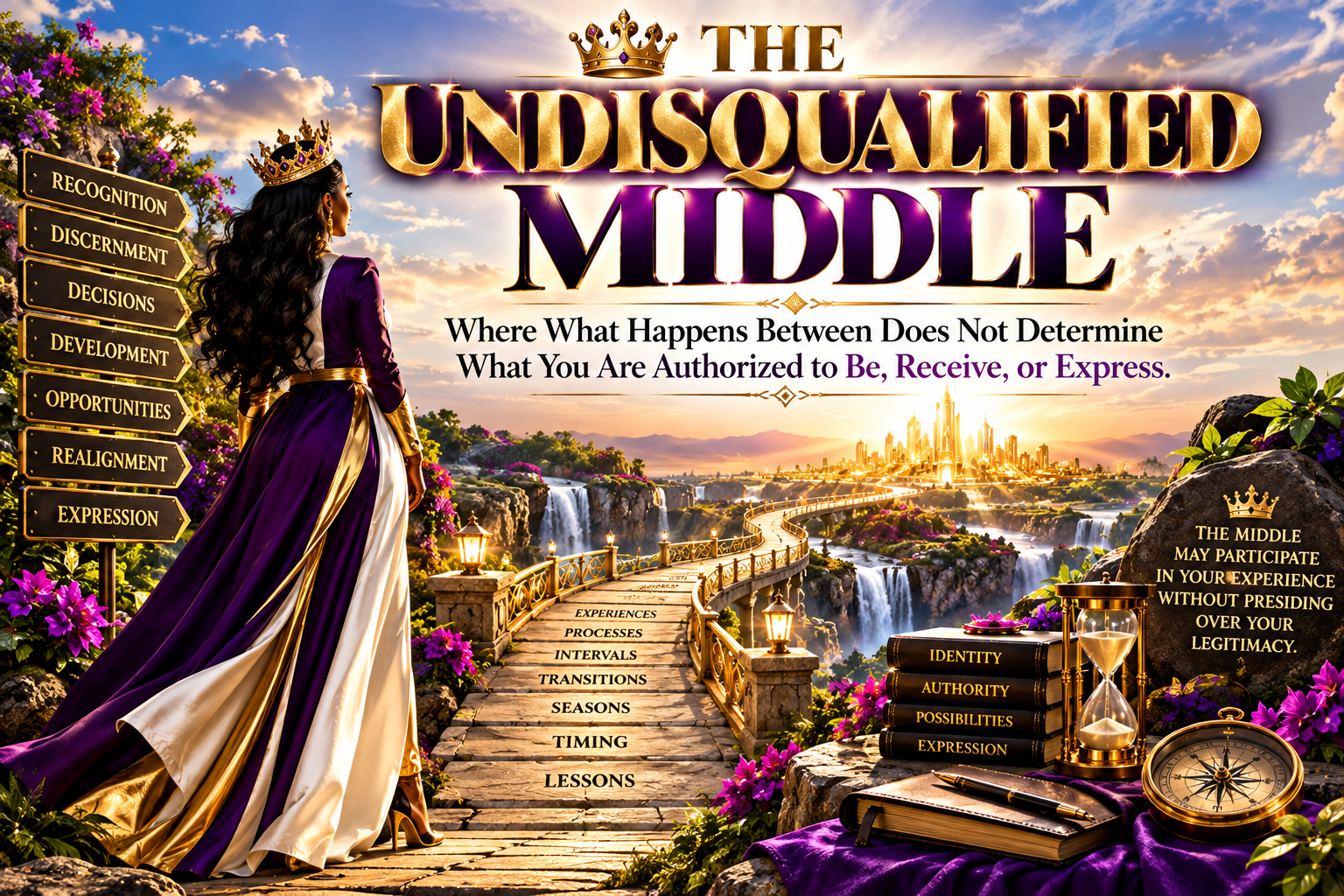 The middle may participate in your experience without presiding over your legitimacy.
There is a profound difference between experiencing what happens between two points and allowing what happens between those points to determine whether you are qualified to reach, receive, or embody what belongs to your life.
We have often been taught to regard the middle as a place of uncertainty, delay, resistance, testing, or unfinished business.
The middle is where things supposedly become complicated.
Where progress is questioned.
Where confidence is challenged.
Where circumstances appear to contradict conviction.
Where the distance between what has been recognized and what has become visibly expressed seems to demand an explanation.
But what if the middle has been given an authority it was never entitled to exercise?
What if the experience of an interval does not automatically make that interval an obstacle?
And what if the presence of a process does not mean that your identity, capacity, authority, or possibilities are suspended until the process concludes?
Welcome to the Undisqualified Middle, where what happens between is no longer permitted to determine what you are authorized to be, receive, or express.
THE MIDDLE IS NOT AUTOMATICALLY A SEPARATION
One of the most limiting interpretations of the middle is the assumption that anything occurring between recognition and realization represents separation.
If something has not yet appeared in its anticipated form, we may assume that we are distant from it.
If an outcome involves several stages, we may interpret those stages as barriers.
If time passes, we may conclude that time itself is evidence of resistance.
But sequence and separation are not synonymous.
A seed and its harvest belong to the same living continuum, even though their expressions differ.
A manuscript and its published edition may be separated by editing, formatting, and production, yet those activities do not invalidate the authorship already present.
A decision may be complete before every practical consequence of that decision has unfolded.
And a person may be fully authorized to occupy a position before every external system has acknowledged that authority.
The existence of an interval does not establish the absence of legitimacy.
The middle may be where something develops, travels, becomes visible, changes form, or enters a new context.
It does not necessarily represent the absence of what is already true.
And it does not automatically possess the power to determine whether fulfillment is possible.
THE DIFFERENCE BETWEEN AN INTERVAL AND AN INTERFERENCE
An interval describes what occurs between identifiable moments, conditions, or expressions.
An interference disrupts, obstructs, or alters the functioning of something.
These are not interchangeable.
Yet how often do we interpret an interval as interference simply because something has not unfolded according to our preferred timing?
Consider an ordinary financial transaction.
A payment may have been initiated but not yet posted to the receiving account.
The processing interval is real.
It may involve established banking procedures, verification, or settlement.
But the interval does not automatically mean the transaction has failed.
Nor does acknowledging that the funds have not yet arrived mean the recipient has somehow created resistance through awareness.
The practical distinction matters.
You can recognize what is underway without pretending it has already concluded.
You can remain confident without misrepresenting the facts.
You can exercise authority without denying the mechanics of an experience.
And you can respond appropriately to an actual obstruction without treating every interval as one.
The Undisqualified Middle does not require us to declare that all processes are illusions.
It invites us to recognize that a process does not become a disqualification merely because it exists.
WHO GAVE THE MIDDLE PERMISSION TO JUDGE YOUR QUALIFICATIONS?
This is where the conversation becomes especially interesting.
At some point, an experience that was supposed to be part of a journey can become an imagined judge over the person traveling through it.
The middle begins issuing verdicts.
You haven't arrived yet, so perhaps you aren't ready.
You haven't received it yet, so perhaps you aren't worthy.
You haven't seen the evidence yet, so perhaps your conviction is misplaced.
You encountered opposition, so perhaps you were never authorized.
But these are interpretations, not automatic truths.
An experience can reveal information about your circumstances without delivering a final judgment about your identity.
A delay can identify a logistical issue without establishing a deficiency in your being.
A rejection can describe another person's decision without becoming an absolute statement about your value.
And an unfinished process can remain unfinished without making you an unfinished person.
The middle may contain information. It does not possess unlimited jurisdiction over your identity.
This distinction does not eliminate accountability, preparation, or the importance of actual qualifications where they are required.
It simply refuses to transform every circumstance into a verdict about personal worth, divine standing, or ultimate possibility.
There is a difference between recognizing a requirement and accepting a condemnation.
There is a difference between addressing a limitation and becoming identified by it.
And there is a difference between participating in a process and surrendering authorship to that process.
AUTHORITY DOES NOT HAVE TO WAIT FOR EVERY CONDITION TO AGREE
Authority is frequently misunderstood as the ability to prevent every undesirable experience.
Under that interpretation, an unexpected circumstance becomes evidence that authority has failed.
But authority can also be expressed through discernment, decision-making, responsibility, and the ability to determine an appropriate response.
You may not control every circumstance.
You may not dictate every timeline.
You may not be able to override every external system.
Yet none of those realities automatically eliminates your capacity to choose, act, interpret, create, or respond.
In the biblical account of Joseph, his identity and calling were not finally defined by the conditions of the pit, slavery, or imprisonment.
Those circumstances were real.
The injustice was real.
The time involved was real.
Yet the circumstances did not become the final authority over the meaning of his life.
Joseph's story does not teach us that every difficult experience is divinely required or that everyone should passively endure injustice.
It demonstrates something more particular:
An experience can be consequential without being conclusive.
What happens within a chapter does not necessarily determine the entirety of the story.
And what occurs during an interval does not automatically possess authority over every expression that follows it.
THE MIDDLE DOES NOT HAVE TO DISAPPEAR TO LOSE ITS DISQUALIFYING POWER
There is a popular tendency to imagine freedom as the elimination of everything between desire and fulfillment.
No waiting.
No process.
No development.
No uncertainty.
No intervening experience.
But perhaps freedom does not always require the disappearance of the middle.
Perhaps it requires a different relationship with it.
An appointment can remain scheduled for next week without making today meaningless.
A project can remain in development without making its creator illegitimate.
A desired financial outcome can remain unrealized without making a person inherently deficient.
A transition can still be unfolding without canceling the validity of what has already changed.
And an answer can remain unknown without making the present moment incapable of holding wisdom.
The middle can exist without becoming your master.
You do not have to fight the existence of every interval.
You do not have to deny the sequence of events.
You do not have to manufacture an immediate conclusion to prove that your present identity is intact.
And you do not have to postpone every expression of your authority until external circumstances become ideal.
The middle may still be there.
But its existence does not entitle it to govern everything.
PATIENCE IS NOT THE SAME AS PERSONAL POSTPONEMENT
One of the most consequential misunderstandings about patience is the idea that patience requires placing your life on hold.
Under that interpretation, patience becomes an identity of perpetual waiting.
You cannot enjoy the present because something has not arrived.
You cannot exercise your gifts because an outcome remains pending.
You cannot recognize your present resources because your attention is consumed by what is missing.
You cannot move because the next stage has not been confirmed.
But patience need not require any of those things.
Biblical patience is frequently associated with endurance, steadfastness, love, and faithfulness.
It is not simply a demand to tolerate circumstances without exercising discernment.
Nor is it a requirement to suspend present participation in life.
You can await an event without becoming a person whose entire identity is waiting.
You can acknowledge an outstanding need while remaining engaged with the resources and opportunities already available.
You can maintain a preference for a particular outcome while remaining receptive to new information.
And you can act where action is appropriate without believing that every unresolved circumstance must first be eliminated.
Patience does not have to postpone your personhood.
It can coexist with movement.
It can coexist with clarity.
It can coexist with decision.
And it can coexist with the recognition that your present life is not merely a waiting room for your future life.
WHAT HAPPENS BETWEEN MAY HAVE VALUE WITHOUT HAVING FINAL AUTHORITY
The Undisqualified Middle does not diminish the significance of experiences.
Quite the opposite.
It creates room to recognize their value without exaggerating their authority.
An unexpected conversation may reveal a new perspective.
An interruption may expose an outdated commitment.
An apparent detour may introduce an option that was previously outside your awareness.
A period of development may refine the expression of something already meaningful.
An experience may even reveal that what you originally intended no longer reflects what you now choose.
These possibilities matter.
But the presence of value does not mean every experience was necessary, divinely arranged, or deserving of indefinite continuation.
Some experiences are useful.
Some are neutral.
Some are harmful.
Some require immediate action.
Some invite reconsideration.
And some become meaningful only through what we choose to do after they occur.
An experience does not need to be declared essential to be acknowledged as real.
Nor does it need to become permanent to have mattered.
The middle can inform your decisions without dictating your identity.
It can contribute to your understanding without owning your future.
And it can become part of your story without becoming the author of your story.
WHEN THE MIDDLE BECOMES A PLACE OF EXPRESSION
Here is another possibility worth considering.
What if the middle is not merely something that happens to you?
What if it can also become a place where you consciously express what is already true of you?
A person who values generosity can practice generosity before achieving every financial goal.
A person who recognizes their creative identity can continue creating while awaiting publication, distribution, or recognition.
A person who exercises wisdom can make sound decisions even while certain outcomes remain unresolved.
A person who walks in faith can pray, discern, act, and remain receptive without needing to explain every circumstance.
In each case, the present expression is meaningful in its own right.
It is not merely a rehearsal for a future identity.
The middle can become an environment of participation rather than a condition of postponement.
This does not mean every desire is already materially fulfilled.
It means that the absence of one expression does not necessarily require the absence of every related expression.
You can be a creator while something you created is still reaching its audience.
You can be decisive while the consequences of a decision are still unfolding.
You can be resourceful while additional resources are being pursued.
And you can be fully present without demanding that every unresolved matter disappear first.
THE UNDISQUALIFIED MIDDLE AND DIVINE AUTHORSHIP
For those who understand their lives through faith, divine authorship introduces another important distinction.
God's sovereignty does not require us to interpret every intervening circumstance as a divine obstacle course.
Nor does walking in God-given authority require us to claim that every desired outcome has already occurred.
There is room for truth.
There is room for trust.
There is room for prayer.
There is room for practical responsibility.
And there is room for divine illumination that does not depend upon our ability to predict the next development.
Psalm 119:105 describes God's word as a lamp for our feet and a light for our path.
The imagery is significant.
A lamp illuminates.
A path provides a place for movement.
The existence of a path does not automatically imply separation from God.
And the presence of another step does not mean the traveler has lost divine favor.
Guidance and movement can coexist with a reality that is already meaningful in the present.
The question is not always how to eliminate the distance between where you stand and where you intend to go.
Sometimes the question is whether that distance has been given authority to invalidate where you stand.
And sometimes the next illuminated step is sufficient for the moment.
THE UNDISQUALIFIED MIDDLE DOES NOT REQUIRE AN UNFINISHED IDENTITY
Perhaps this is one of the most important revelations of all.
An unfinished experience does not require an unfinished identity.
Your circumstances may contain unresolved matters.
Your plans may contain pending decisions.
Your financial life may contain outstanding transactions or obligations.
Your creative work may contain projects at different stages of completion.
Your relationships may contain conversations that have not yet occurred.
But none of these conditions automatically means that your entire being is suspended.
You are not required to become the unfinished status of everything surrounding you.
A pending matter is a pending matter.
A developing project is a developing project.
An unresolved question is an unresolved question.
These realities deserve appropriate attention.
They do not deserve unlimited authority.
You can have unfinished business without being an unfinished person.
And you can recognize the legitimacy of the present without pretending that every desired outcome has already been achieved.
That is not contradiction.
That is discernment.
COMPLETION DOES NOT HAVE TO CONDEMN WHAT CAME BEFORE IT
There is another dimension to the Undisqualified Middle that becomes especially meaningful when an experience concludes.
Sometimes we arrive at a new expression and begin treating everything that preceded it as something that should never have existed.
The earlier stages become embarrassing.
The process becomes something to erase.
The interval becomes a mistake.
And the completed outcome is treated as though it has invalidated the journey.
But completion does not automatically cancel significance.
A chapter can end without becoming worthless.
A responsibility can expire without having been meaningless.
A season can conclude without requiring its entire history to be condemned.
And an experience can cease to be relevant to your present participation while remaining a legitimate part of your lived history.
What is no longer required does not have to be retroactively disqualified.
The middle may have served a purpose.
It may have revealed information.
It may have contained meaningful development.
Or it may simply have been part of what occurred.
Whatever its significance, its conclusion does not require us to deny that it existed.
Nor does honoring its existence require us to return to it.
THE FINAL DISTINCTION: THE MIDDLE IS NOT THE JUDGE
The Undisqualified Middle is not a doctrine of pretending that time, circumstances, and processes do not exist.
It is not a demand to deny practical realities.
It is not a promise that every desired outcome will occur without effort, uncertainty, or external participation.
And it is not a claim that every experience carries a hidden divine assignment.
It is a recognition that what happens between does not automatically possess the authority to determine what you are qualified to be, receive, or express.
An interval can be real without becoming a verdict.
A process can be meaningful without becoming a prison.
A circumstance can require attention without acquiring ownership of your identity.
A delay can affect timing without necessarily determining destiny.
And an experience can become part of your history without becoming the governing authority over your future.
You are allowed to recognize the present as meaningful.
You are allowed to exercise your authority within the circumstances you actually occupy.
You are allowed to respond to what requires action.
You are allowed to appreciate what is unfolding.
And you are allowed to recognize when a chapter has reached its completion.
The middle does not have to disappear for its disqualifying power to be dismissed.
Because perhaps the middle was never meant to decide whether you belonged to your own life in the first place.
THE UNDISQUALIFIED MIDDLE
Where What Happens Between Does Not Determine What You Are Authorized to Be, Receive, or Express.
The middle may contain movement.
It may contain mystery.
It may contain development, redirection, discovery, or completion.
But it does not automatically contain the authority to invalidate your identity, your present participation, or your rightful possibilities.
The middle may participate in the experience without presiding over its legitimacy.
And perhaps that is the freedom we have been looking for all along.
Not the absence of everything between.
But the recognition that nothing happening between must automatically become a disqualification.
Written by MAJESTY-ALL-MIGHTY
Also, enjoy....DISSOLVING OF THE COCOON DOESN'T DISQUALIFY ITS EXPERIENCE NOW THAT A BUTTERFLY IS BORN
If you would like additional support in this area, email [email protected] for VIP Day intensives or email coaching combo.
If this blog post has been inspirational and you would like to show your support, please consider buying me a coffee on my Buy Me a Coffee page, here’s my link MAJESTY (buymeacoffee.com).