

LIFE BEYOND THE ASSIGNMENT
When the Completion of an Old Mission Does Not Require the Acceptance of Another
LIFE DOES NOT HAVE TO BE REASSIGNED IN ORDER TO BE LIVED.
BY MAJESTY-ALL-MIGHTY
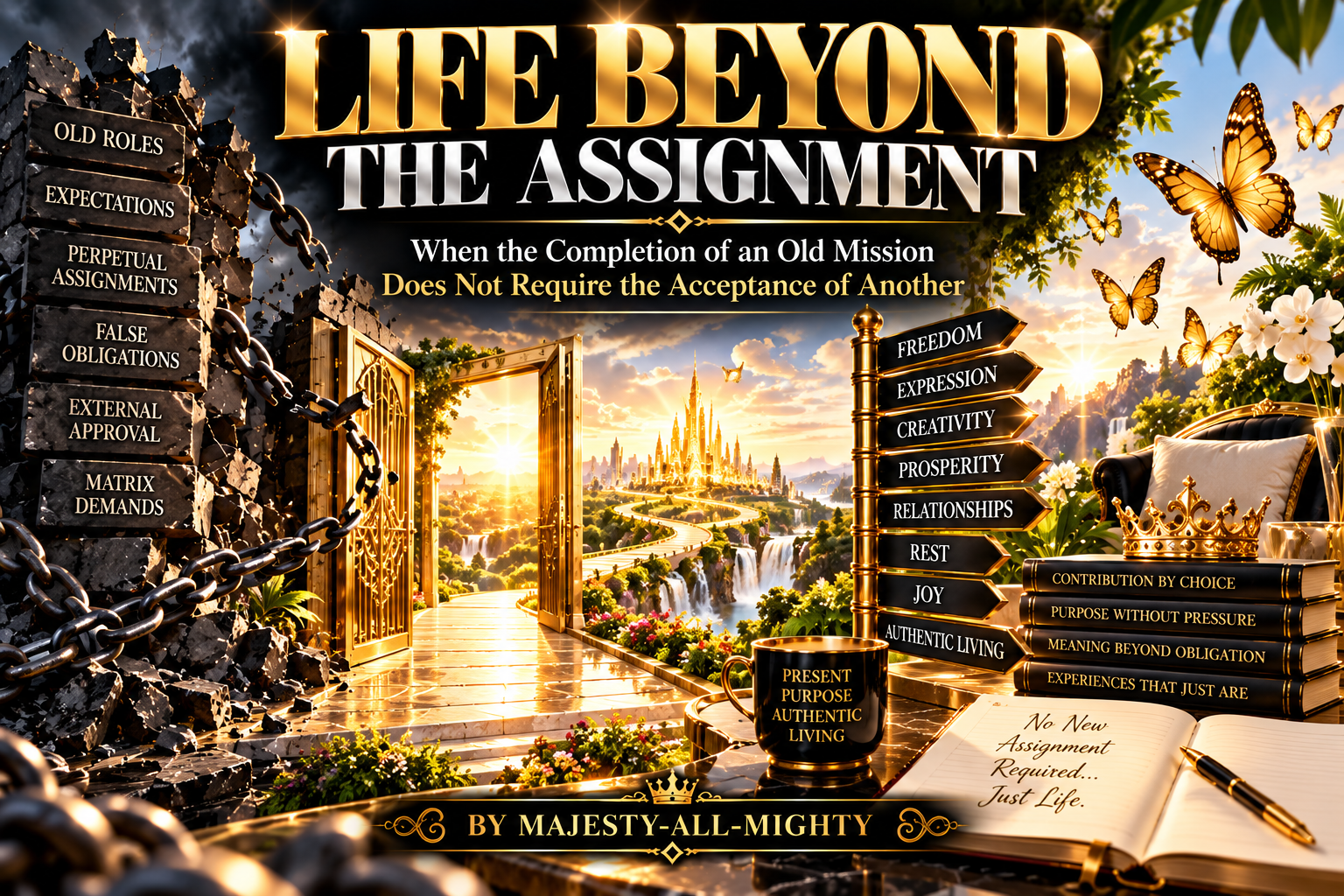 There is a narrative that often accompanies the conclusion of significant life chapters, responsibilities, missions, and assignments.
It suggests that when one assignment ends, another must immediately begin.
When one mission is completed, a new mission must be activated.
When one responsibility is fulfilled, another responsibility must be discovered.
And when an individual emerges from a prolonged season of preparation, contribution, sacrifice, or service, the next question becomes:
What have you been assigned to do now?
But what if that question is based upon an assumption that no longer belongs to the individual's present reality?
What if the completion of an assignment does not automatically create another assignment?
What if the conclusion of a mission does not establish an obligation to discover a replacement?
And what if the life beyond the assignment is not another mission waiting to be identified, but an entirely different orientation toward living?
WELCOME TO LIFE BEYOND THE ASSIGNMENT.
THE ASSUMPTION OF PERPETUAL ASSIGNMENT
For many individuals, life has been interpreted through the language of missions, callings, duties, responsibilities, and obligations.
Every experience must serve an assignment.
Every relationship must fulfill a purpose.
Every transition must introduce another mission.
Every season must carry a designated responsibility.
And every completed chapter must be followed by a new explanation of what the individual is now supposed to accomplish.
Within this framework, even freedom can become another assignment.
Liberation becomes a mission.
Restoration becomes a mission.
Self-discovery becomes a mission.
And the experience of living becomes another responsibility that must be performed correctly.
But there is a distinction between recognizing meaningful purpose within life and requiring life to remain permanently organized around assignments.
PURPOSE DOES NOT HAVE TO BE REDUCED TO PERPETUAL OBLIGATION.
Meaning can exist without an accompanying mandate.
Contribution can occur without compulsory responsibility.
Expression can emerge without requiring a mission statement.
And life can be significant without every moment being interpreted as another task to complete.
THE COMPLETION OF AN ASSIGNMENT DOES NOT CREATE A VACANCY THAT LIFE IS OBLIGATED TO FILL
Consider what happens when a person completes a major responsibility.
Perhaps they have spent years developing a body of work.
Perhaps they have fulfilled a demanding leadership role.
Perhaps they have supported others through a significant transition.
Perhaps they have completed an extended period of service, preparation, caregiving, or professional responsibility.
The assignment reaches its natural conclusion.
Yet instead of recognizing completion, the individual may immediately begin searching for the next responsibility.
Not necessarily because another responsibility has genuinely emerged.
But because they have become accustomed to defining their existence through what they are required to do.
Completion begins to feel unfamiliar.
Unassigned time begins to feel unproductive.
And freedom from a former responsibility can be mistaken for the absence of direction.
But completion is not automatically a vacancy.
WHAT HAS BEEN COMPLETED DOES NOT REQUIRE REPLACEMENT SIMPLY BECAUSE IT HAS ENDED.
An assignment can fulfill its purpose without establishing a permanent cycle of assignments.
A mission can conclude without leaving behind an existential debt.
And a person can recognize the significance of what they have accomplished without requiring another responsibility to validate their continued existence.
WHEN LIBERATION BECOMES ANOTHER OBLIGATION
One of the more subtle contradictions within narratives of freedom occurs when liberation is immediately followed by another compulsory mission.
An individual is told that they have been released from an old system, but must now dedicate their life to dismantling that system.
They are told that they have completed an old assignment, but must now fulfill a greater one.
They are told that they have emerged from limitation, but must now carry responsibility for liberating everyone else.
And they are told that they are finally free, provided they accept the new responsibilities associated with that freedom.
But freedom that must continually justify itself through obligation deserves closer examination.
LIBERATION DOES NOT HAVE TO BECOME ANOTHER FORM OF CAPTIVITY THROUGH REASSIGNMENT.
This does not diminish the value of advocacy, leadership, service, or meaningful contribution.
It simply distinguishes freely expressed contribution from an assumed obligation to carry responsibilities that have not been authentically recognized or chosen.
Someone may genuinely desire to teach.
Someone may genuinely desire to lead.
Someone may genuinely desire to create, support, advocate, mentor, or contribute.
Those expressions can be meaningful.
But their value does not establish a universal requirement that every liberated individual must become responsible for liberating others.
YOU CAN CONTRIBUTE TO THE WORLD WITHOUT BEING ASSIGNED RESPONSIBILITY FOR SAVING IT.
YOUR EXISTENCE IS NOT AN UNFINISHED ASSIGNMENT
There is a difference between having responsibilities within life and interpreting life itself as an unfinished responsibility.
Responsibilities can be accepted, fulfilled, adjusted, shared, or completed.
Projects can begin and end.
Roles can change.
Commitments can evolve.
And meaningful opportunities can emerge through genuine interest, relationship, creativity, and participation.
But existence is not inherently a task awaiting completion.
You do not have to earn the right to live by continually demonstrating your usefulness.
You do not have to justify your presence through an endless record of accomplishments.
You do not have to transform every personal experience into a lesson for public consumption.
And you do not have to interpret every moment of peace as preparation for another demanding assignment.
LIFE IS NOT MERELY THE SPACE BETWEEN ONE OBLIGATION AND THE NEXT.
Life includes expression.
Enjoyment.
Relationship.
Discovery.
Creativity.
Beauty.
Rest.
Participation.
Prosperity.
Wonder.
And experiences whose value does not depend upon whether they can be converted into another mission.
These dimensions do not become less meaningful because they are not attached to an assignment.
They are dimensions of living.
CONTRIBUTION IS NOT THE SAME AS COMPULSION
A person can be deeply purposeful without being perpetually obligated.
They can create because creativity is an authentic expression of their being.
They can teach because they possess knowledge they genuinely desire to share.
They can lead because an opportunity for meaningful leadership aligns with their interests, capacities, and present circumstances.
They can serve because service is an expression of generosity rather than a compulsory condition of worthiness.
And they can participate in commerce, community, relationships, and meaningful endeavors without requiring every activity to satisfy an externally imposed definition of destiny.
CONTRIBUTION CAN BE AN EXPRESSION OF LIFE RATHER THAN THE PRICE OF EXISTENCE.
This distinction changes the relationship between the individual and their activities.
Instead of asking, What must I accomplish to justify being here?
The question becomes:
What genuinely belongs to my present expression?
Instead of assuming that every opportunity represents an assignment, discernment allows each opportunity to be recognized according to its actual relevance.
Some opportunities invite participation.
Some deserve consideration.
Some can be appreciated without being accepted.
And others may have no relationship to the individual's present interests or direction.
NOT EVERYTHING THAT CAN BE DONE IS YOURS TO DO.
And not everything that carries significance requires your participation.
THE END OF AN OLD MISSION DOES NOT REQUIRE A NEW IDENTITY
Assignments often become closely associated with identity.
A person may spend years being recognized as the leader, the helper, the rescuer, the teacher, the provider, the problem-solver, or the one who carries extraordinary responsibility.
Over time, the role can become so familiar that the individual begins to interpret themselves primarily through its demands.
But a role is not necessarily the entirety of one's being.
A responsibility can be significant without becoming a permanent identity.
A mission can shape an experience without possessing authority over every future expression.
And the completion of a role does not require the individual to immediately adopt another title in order to remain meaningful.
YOU ARE NOT REQUIRED TO REPLACE EVERY COMPLETED ROLE WITH ANOTHER ROLE TO REMAIN WHO YOU ARE.
The capacity to contribute may remain.
The knowledge may remain.
The wisdom may remain.
The relationships, accomplishments, and meaningful experiences may remain.
But the former obligation does not have to remain the organizing center of life.
And its completion does not automatically authorize another system, person, or narrative to determine what must come next.
WHEN THE NEXT CHAPTER IS NOT ANOTHER MISSION
What if the next chapter is not about accepting a greater burden?
What if it is not about rescuing more people?
What if it is not about proving that previous experiences qualified you for another demanding responsibility?
What if it is not about discovering a hidden assignment that explains why everything happened?
What if the next chapter simply involves living from the capacities, wisdom, awareness, and freedom already present?
Not because life has become meaningless.
But because meaning no longer has to be confined to the language of assignments.
LIFE BEYOND THE ASSIGNMENT IS NOT LIFE WITHOUT MEANING.
It is life without the assumption that meaning must always be validated through another obligation.
There can be new experiences without new missions.
New relationships without compulsory roles.
New opportunities without predetermined responsibilities.
New expressions without another identity to perform.
And new possibilities without an old narrative having to authorize them.
This is not the rejection of meaningful action.
It is the recognition that meaningful action does not always require an assignment.
THE DIFFERENCE BETWEEN DIRECTION AND REASSIGNMENT
Direction does not necessarily require a predetermined mission.
An individual can recognize what is appropriate for their present life without interpreting every movement as obedience to another external mandate.
They can make decisions based upon discernment.
They can pursue opportunities based upon genuine alignment.
They can establish relationships through mutual recognition.
They can create from inspiration.
They can participate in experiences because those experiences are meaningful, desirable, or appropriate.
And they can change direction when new information becomes available.
DIRECTION CAN EMERGE THROUGH LIVING WITHOUT LIFE BEING REDUCED TO DESTINY MANAGEMENT.
This distinction also makes room for customization.
Not everyone requires the same path.
Not everyone desires the same experiences.
Not everyone expresses their capacities through the same activities.
And not everyone who completes a significant mission needs to adopt the same interpretation of what completion means.
The individual is not required to fit another universal narrative simply because a previous narrative has concluded.
COMPLETION DESERVES TO BE RECOGNIZED AS COMPLETION
There is something important about allowing a completed experience to remain completed.
Without reopening it unnecessarily.
Without manufacturing unfinished business.
Without inventing another obligation to explain its significance.
And without assuming that the only acceptable continuation is a greater version of the same responsibility.
Completion can be recognized without becoming stagnation.
It can be honored without becoming an ending to all future expression.
It can coexist with ongoing creativity, participation, development, and discovery.
COMPLETION DOES NOT REQUIRE CONTINUATION OF THE SAME CONDITION.
Nor does it require a replacement condition.
An individual can continue living without recreating the structure of what has already been fulfilled.
And the absence of another assignment does not mean that life has stopped moving.
It means that life is not dependent upon perpetual assignment for its legitimacy.
YOU ARE ALLOWED TO LIVE WITHOUT TURNING EVERYTHING INTO AN ASSIGNMENT
You can enjoy an experience without making it a mission.
You can develop an interest without turning it into a responsibility.
You can create something beautiful without requiring it to become an empire.
You can participate in a relationship without making yourself responsible for the other person's entire transformation.
You can recognize an opportunity without assuming that every opportunity must be accepted.
You can appreciate a moment without converting it into another productivity requirement.
And you can recognize that your life possesses significance beyond what you accomplish for others.
NOT EVERY EXPERIENCE NEEDS AN ASSIGNMENT ATTACHED TO IT.
Some experiences are simply meant to be experienced.
Some expressions arise because they authentically belong to the present.
Some opportunities deserve participation because they are genuinely desirable.
And some moments are valuable without needing to become anything beyond themselves.
LIFE BEYOND THE ASSIGNMENT IS NOT THE ABSENCE OF PURPOSE
It is the freedom to recognize purpose without reducing it to perpetual obligation.
It is the ability to contribute without being consumed by compulsory responsibility.
It is the recognition that meaningful existence does not require an endless sequence of missions.
It is the capacity to honor completion without treating it as an emergency that must be resolved through reassignment.
And it is the freedom to live without continuously searching for an external explanation of why living is permitted.
YOU DO NOT HAVE TO BE ON AN ASSIGNMENT TO BE IN YOUR LIFE.
You can be present.
You can be creative.
You can be fulfilled.
You can be prosperous.
You can be relational.
You can be expressive.
You can be engaged.
You can be at peace.
And you can experience dimensions of life that do not exist merely to prepare you for something else.
THE LIFE ITSELF IS NOT A SECONDARY MISSION
Perhaps one of the most significant distinctions is this:
Life does not have to become the reward for completing enough assignments.
It does not have to remain suspended until every mission has been fulfilled.
It does not have to be perpetually postponed in favor of responsibilities that continually reproduce themselves.
And it does not have to be interpreted as another assignment simply because an old one has ended.
LIVING IS NOT WHAT YOU FINALLY GET TO DO AFTER EVERY OTHER RESPONSIBILITY HAS BEEN COMPLETED.
Living is the present experience within which meaningful responsibilities, expressions, relationships, and opportunities may arise.
Assignments may belong within life.
But life does not have to belong to assignments.
THAT IS THE DISTINCTION.
You can recognize a calling without allowing the language of calling to consume the entirety of your existence.
You can fulfill responsibilities without making responsibility your permanent identity.
You can contribute significantly without becoming obligated to carry every need you encounter.
And you can continue expressing yourself without interpreting each new expression as another mission to complete.
LIFE BEYOND THE ASSIGNMENT
The completion of an old mission does not automatically establish a new one.
The fulfillment of a responsibility does not create an existential vacancy.
The conclusion of a role does not require the immediate adoption of another identity.
And freedom does not need to be justified through another compulsory assignment.
There is life beyond what you've been required to do.
There is expression beyond what you've been expected to carry.
There is significance beyond the responsibilities you've fulfilled.
And there is meaningful existence beyond the perpetual search for another mission.
YOU ARE NOT AN UNFINISHED ASSIGNMENT.
YOU ARE NOT A VACANCY WAITING FOR ANOTHER RESPONSIBILITY.
YOU ARE NOT REQUIRED TO KEEP SAVING, PROVING, PERFORMING, OR COMPLETING IN ORDER TO JUSTIFY YOUR EXISTENCE.
You can contribute because you desire to contribute.
You can create because you desire to create.
You can participate because the opportunity genuinely belongs to your present life.
And you can simply live without needing another assignment to authorize the experience.
THE COMPLETION OF AN ASSIGNMENT DOES NOT CREATE A VACANCY THAT LIFE IS OBLIGATED TO FILL.
LIFE DOES NOT HAVE TO BE REASSIGNED IN ORDER TO BE LIVED.
LIFE BEYOND THE ASSIGNMENT.
BY MAJESTY-ALL-MIGHTY
If you need support in this area, I provide email coaching and VIP Day Intensives. If you’re interested, please send an email to [email protected] for Sovereign Stabilization Success VIP Intensive.
If this blog post has been inspirational and you would like to show your support, please consider buying me a coffee on my Buy Me a Coffee page, here’s my link MAJESTY (buymeacoffee.com).