
History isn't just a collection of dates and battles. It's the story of people - people like you and me, trying to navigate complex times while carrying their hopes, fears, and dreams.
When we learn about World War I in school, it's easy to point fingers. "If only the leaders weren't so foolish," we say. "If only people weren't so nationalist." But what if the truth is more uncomfortable? What if the path to war was paved by countless choices made across all levels of society - from political leaders to colonial administrators, from civilians to workers - each decision seeming reasonable within its own context at the time?
The Great Gambit invites students to understand how peaceful societies can gradually transform into ones where neighbors end up killing each other, not through sudden changes, but through subtle shifts that accumulate over time. Through this lens, students discover they are part of something far bigger than themselves - a complex web of social interactions where individual decisions ripple outward in unexpected ways. Understanding this interconnectedness will help them recognize how a lack of broader perspective can lead to decisions that, while seemingly reasonable in isolation, contribute to growing tensions within society and escalating conflicts on the international stage.
To help navigate these complexities, The Great Gambit teaches us several fundamental insights about human nature and society:
Understanding Influence in Society
Living in society, we naturally develop frameworks to understand power dynamics. Sometimes, groups lacking voice might turn to desperate measures when normal channels fail them. Other times, groups with too much influence might reshape society without understanding consequences. History shows us how these imbalances, both within nations and between them, can create conditions where conflict becomes more likely.
Exploring Social Behavior
Historical events rarely stem from simple good or evil choices. Different groups - whether workers, civilians, or leaders - adopt various approaches to achieve their goals. Sometimes seeking stability preserves peace; other times it suppresses needed change. Sometimes disruption leads to necessary reforms; other times to chaos. Understanding these patterns helps us recognize how societies can drift toward outcomes that no single group intended.
The Power of Communication
Historical examples show us how actions that make perfect sense to one group can affect others in unexpected ways. Workers fighting for safer conditions, communities preserving their traditions, leaders pursuing security - each group's choices ripple through society in complex ways. These historical lessons show us why talking across social divides is crucial for understanding each other's perspectives and finding sustainable solutions.
Understanding Different Perspectives
One of the crucial insights from this period is how different groups within society viewed and responded to the same events in vastly different ways. Each group's hopes, fears, and decisions made sense from their own perspective and position in society. This understanding of multiple viewpoints helps explain how decisions that seemed rational from one perspective could contribute to growing tensions when combined with choices made by others across the social spectrum.
How Society's Ground Can Shift Over Time
One of history's most important lessons isn't about specific villains or heroes. When we study tragedies like World War I, focusing only on immediate triggers - like an assassination or a particular leader - misses crucial context. Rather, it's about understanding how societies in peacetime can unconsciously prepare the ground for future tragedies through a powerful chain reaction: reasonable choices create patterns, patterns become social norms, norms shape institutions, institutions influence broader societal decisions - a gradual shift that no one person "caused" yet many unwittingly enabled. The conditions that make such events possible often develop slowly, through years of seemingly unrelated choices and changes, building tensions that can eventually erupt into conflict.
The Past's Impact on the Present
This period lays the foundation for today's society. Understanding how people's choices shaped their future helps us recognize our own role in shaping tomorrow. Not because we're all equally responsible for what happens in society, but because we can better recognize how small choices and attitudes contribute to the kind of world we create together.
These are foundational insights about how societies function and change. They're tools for understanding not just the past, but our own world and our role in shaping what comes next.
How It Works
Here, we'll explore how our carefully designed elements bring the previous insights to life and help students understand how societies change over time. To fully understand the game mechanics and rules, we recommend reading our "How To Play" post.
Understanding Influence in Society
Our scoring system uses gems to represent real influence in society - the ability to be heard. In our simulation, avoiding war requires each group to achieve at least 35 gems, representing sufficient influence both within Germany and internationally.
The system reveals complex social dynamics:
A balanced society needs groups to have similar levels of influence (for example, 2-3 gems each) to avoid internal pressures and conflicts. Without influence, even the most reasonable voices go unheard
However, this internal balance alone isn't enough - when all groups have low influence internationally (low gem totals), the entire society becomes vulnerable to external pressures
That's why reaching 35 gems for each group isn't just about "winning" - it represents creating conditions where every group has enough voice to be heard internally (between social groups) and externally (as a whole society on the international stage), preventing the desperation and power imbalances that can lead society toward conflict
Exploring Social Behavior
Our decision cards represent behavioral patterns in society. Each card carries one of four symbols reflecting different approaches to social interaction:
Triangle (Conflict and Change): Represents disruption - whether that's reform or upheaval
Square (Stability and Balance): Symbolizes maintaining order - which can preserve existing systems or resist change
Circle (Unity and Diplomacy): Shows attempts at bringing people together - through cooperation or pressure for conformity
Star (Aspiration and Risk): Represents bold initiatives that could lead to either breakthrough achievements or dangerous overreach.
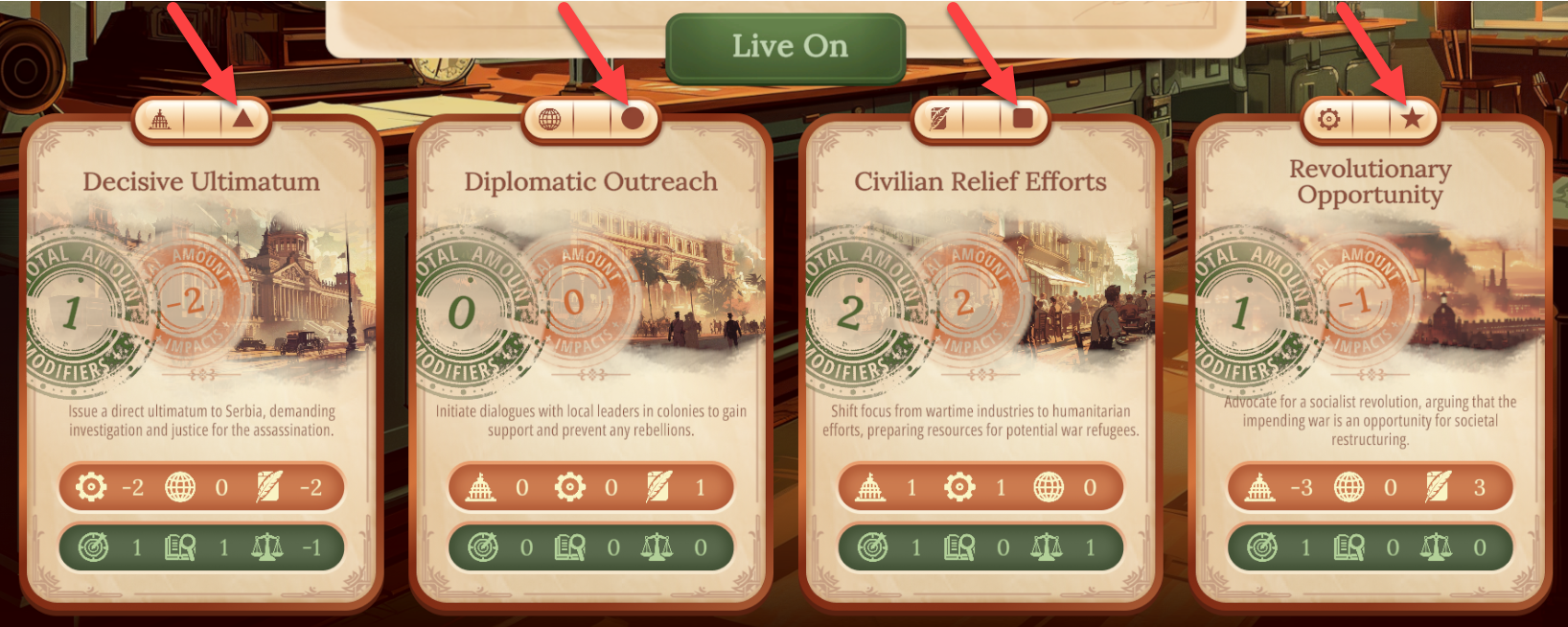
These patterns invite deep analysis of each situation rather than quick moral judgments. Understanding context and consequences helps inform better decisions than relying on predetermined frameworks.
The Power of Communication
After each turn, groups can discuss outcomes and share perspectives. Our testing shows something interesting: when groups take time to understand each other's viewpoints and concerns, they're more likely to find sustainable solutions. Our consolidation mechanic reinforces this through potential rewards when groups align their approaches - groups can earn additional influence by coordinating their decisions with others, but only if they've truly understood each other's perspectives and intentions. This creates a natural incentive for meaningful dialogue rather than superficial agreement. Through both discussion and mechanics, students learn firsthand why communication matters.
Understanding Different Perspectives
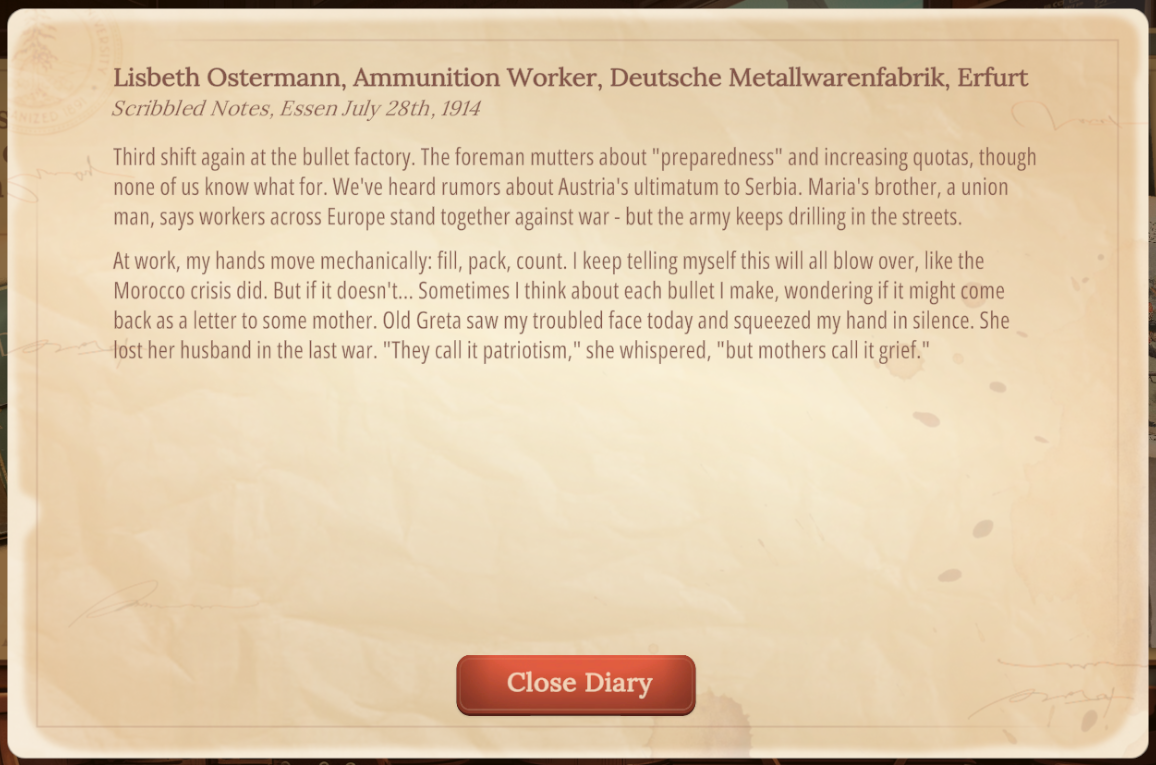
Our diary entries feature fictional characters, but their stories, attitudes, and experiences are grounded in extensive historical research. Through these intimate accounts, we experience how different people viewed their changing world. A Bavarian baron worries about losing regional identity. A dockworker questions colonial ambitions while feeling a pull of national pride. An ammunition worker wonders if the bullet she's making will bring news of someone's son.
Reflection Lessons
While our simulation provides hands-on experience with historical dynamics, some of the deepest learning happens in guided reflection sessions. Through these discussions, students connect their gameplay experiences to broader historical understanding and current social issues.
Purpose These sessions help students:
Process the emotional and intellectual impact of their decisions
Uncover patterns that might not be immediately obvious during play
Connect historical dynamics to contemporary situations
Bridge the gap between mechanics and meaning
After Powder Keg Mode In this first reflection, we explore how societies can drift toward conflict through incremental steps. Key themes include:
How reasonable individual decisions can collectively lead to unintended consequences
How power imbalances shape group behavior and decision-making
The relationship between internal social tensions and international conflicts
How society's ground shifts through seemingly minor choices over time
Why focusing only on immediate triggers misses deeper societal transformations
Through guided discussion, students confront profound questions:
"How do we measure the value of peace when its greatest triumphs are the tragedies that never occurred?"
"Is the drive for power and dominion an inescapable part of human nature, or a flaw that we must transcend to ensure our survival as a species?"
"When did you notice your group's reasonable choices contributing to larger tensions?"
After Butterfly Effect Mode The second reflection examines how small changes can alter social dynamics and explores paths not taken in history. Key themes include:
The relationship between individual agency and historical forces
Ways that communication and understanding can prevent conflict
How historical transformations continue to influence modern dynamics
The role of conscious choice in shaping society's direction
How recognizing patterns from the past helps us make better choices today
Students explore challenging questions:
"How does a nation define itself and its place in the world when denied the crucible of war?"
"In the face of overwhelming forces of history, do individual acts of courage or compassion truly matter?"
"What enabled your group to make different choices this time?"
"How did improved understanding of other groups change your decisions?"
A Tool for Understanding
This educational tool aims to encourage discussion about how societies function and change. It should be used alongside comprehensive historical materials, recognizing that historical events involve greater complexity than any simulation can capture. Our goal is to promote thoughtful engagement with historical understanding while acknowledging the limitations of any educational tool.
We invite educators and students to join us in this exploration, not to simplify history, but to understand its complexity. Through this understanding, perhaps we can better appreciate our own role in shaping tomorrow's world.