

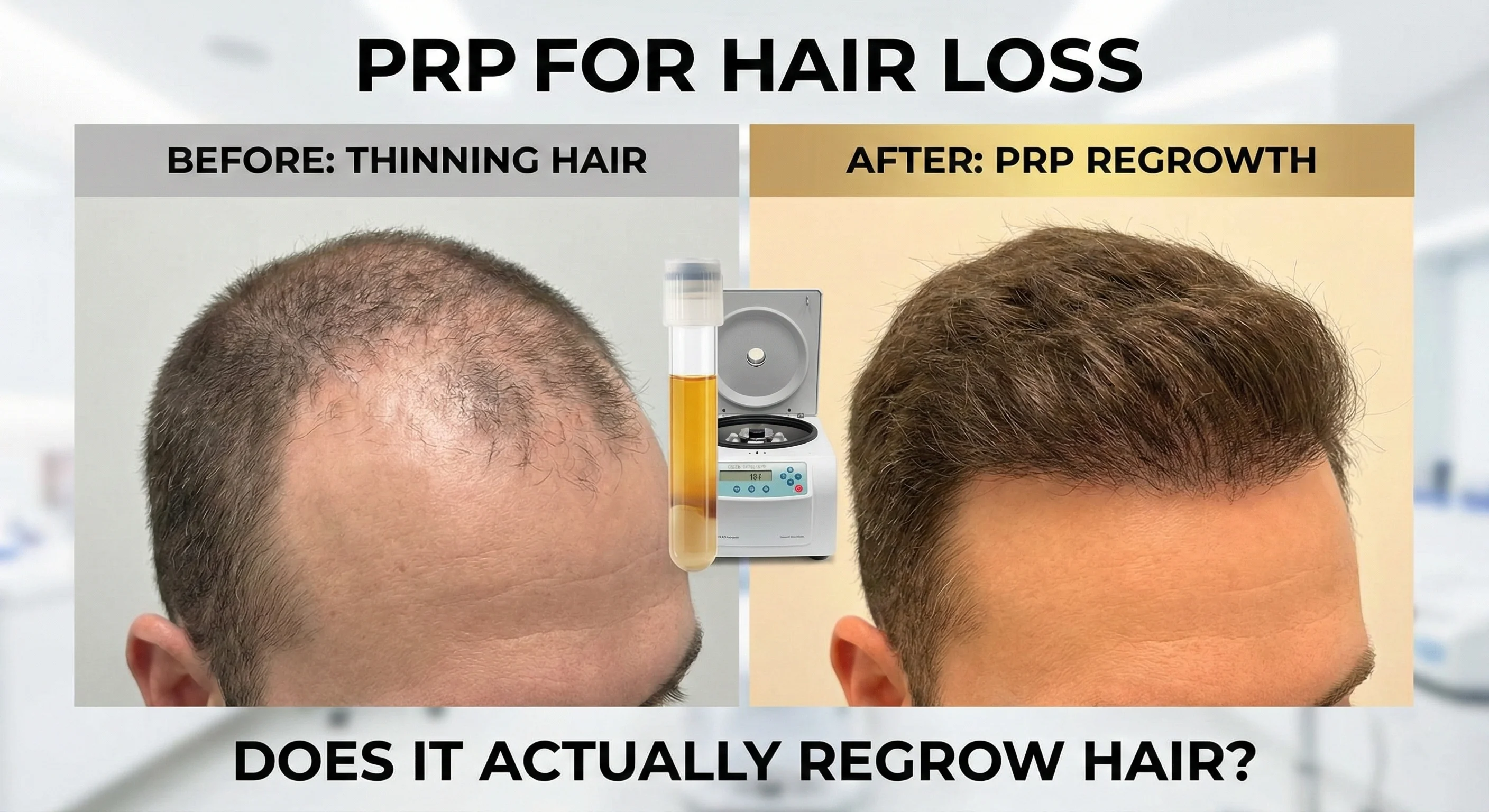
Losing your hair feels personal. It is not just about vanity. It feels like you are losing a piece of your identity with every shower. You start counting strands in the drain and angling mirrors to check your crown. The internet is full of "miracle" shampoos and gummies that promise the world but deliver nothing. You are tired of the snake oil. You want medical science. That search for a real, biological solution is why PRP hair restoration has become the gold standard for non-surgical hair growth.
But does it actually work? Or is it just another expensive trend? Let's strip away the marketing and look at the biology.
What is PRP Therapy? (The Short Answer)
PRP (Platelet-Rich Plasma) is a three-step medical treatment used to combat hair thinning. A provider draws your blood, spins it in a centrifuge to isolate the plasma, and injects that concentrated "liquid gold" back into your scalp. This plasma is packed with growth factors that stimulate dormant hair follicles to wake up and grow again. It is completely natural because it uses your own body's repair system.
The Science: How It Acts as "Fertilizer"
Think of your scalp like a garden and your hair follicles like seeds. If the soil is poor and blood flow is low, the seeds go dormant. They don't die immediately; they just stop producing. PRP acts like a high-powered fertilizer. When injected, the platelets release powerful growth factors (like VEGF and PDGF). These proteins do two critical things:
Increase Blood Supply: They build new blood vessels around the follicle, delivering more oxygen and nutrients.
Extend the Growth Phase: They push the hair follicle from its resting phase (Telogen) back into its active growth phase (Anagen).
The Timeline: When Will You See Results?
This is where most people get impatient. Hair growth is slow. If a clinic promises you a full head of hair in two weeks, run away. Real biological change takes time.
Month 1 (Treatment 1): You won't see growth yet. In fact, you might see a little shedding as old, weak hairs are pushed out.
Month 2-3 (Treatment 2-3): Shedding decreases significantly. Your hair feels thicker and healthier to the touch.
Month 4-6: This is the magic window. You will start to see new "baby hairs" filling in the thinning areas. The scalp becomes less visible.
Who Is This For? (And Who Is It NOT For?)
PRP is powerful, but it is not a magic wand for everyone. It relies on the fact that your hair follicles are still alive. If you have a completely smooth, shiny bald spot where there has been no hair for 5 years, PRP cannot help you. You cannot revive a dead follicle.
The Ideal Candidate:
You have noticed thinning in the last 1-3 years.
You have "miniaturized" hairs (thin, wispy strands) in the area.
You are looking for a natural alternative to a hair transplant.
The Wrong Candidate:
You have advanced, slick baldness (Class 6 or 7).
You have an active scalp infection.
You want a "one-and-done" fix (PRP requires maintenance).
The Bottom Line
If you catch hair loss early, you don't always need surgery. You just need to give your follicles a reason to keep working. PRP provides that biological wake-up call. It is safe, natural, and for the right candidate, incredibly effective. Don't wait until the follicles are gone forever. Start the conversation while you still have plenty to save.