

 Chhatarpur, tucked along South Delhi's green belt near Mehrauli, has grown from a farmhouse-heavy suburb into one of the capital's more sought-after residential pockets. Families, young professionals, and retirees are drawn here for a mix of open spaces, relatively lower rents compared to South Delhi's core, and a lifestyle that still feels less crowded than the rest of the city.
But before choosing any locality, most people ask a simple, practical question: what happens if someone falls sick at 2 AM, or if a child needs a school nearby, or if daily groceries are hard to find? Access to healthcare and everyday facilities often matters more than the size of the apartment or the view from the balcony.
This is especially true for anyone searching for a family rental property in chhatarpur, since families tend to prioritize proximity to clinics, pharmacies, and schools over anything else. This article walks through what's actually available in and around Chhatarpur — hospitals, diagnostic centers, pharmacies, markets, schools, and transport — so you can judge the locality on real, everyday utility rather than just listing photos.
Key Takeaways
Chhatarpur has a mix of large multi-specialty hospitals nearby (in Saket and Gurugram) and smaller local clinics within the area itself.
Daily essentials — groceries, pharmacies, ATMs — are well spread across Chhatarpur's main road and inner lanes.
Emergency healthcare access depends heavily on which pocket of Chhatarpur you live in, since some inner lanes have narrow roads that slow ambulance access.
Chhatarpur Metro Station (Yellow Line) is a major advantage for reaching hospitals in Saket, Malviya Nagar, and further into Delhi.
The locality suits families and long-term tenants more than those needing instant access to super-specialty care.
Understanding Chhatarpur as a Residential Zone
Chhatarpur isn't one uniform neighborhood — it's a cluster of sub-areas including Chhatarpur Extension, Chhatarpur Enclave, and the farmhouse belt near Chhatarpur Mandir. Each pocket has a slightly different character. Chhatarpur Extension is more built-up with apartments and PGs, while the farmhouse zones offer larger independent spaces but sit farther from main roads.
This distinction matters for healthcare access. A resident in Chhatarpur Extension can usually reach a pharmacy or clinic within five to ten minutes on foot. Someone living deep inside the farmhouse lanes may need a vehicle even for basic errands. When evaluating any listing, it helps to check exactly which sub-pocket of Chhatarpur it falls under.
Hospitals and Multi-Specialty Care Near Chhatarpur
Chhatarpur itself does not have a large multi-specialty hospital within its core, but it sits close to some of Delhi's well-known medical centers.
Max Smart Super Speciality Hospital, Saket — roughly 15-20 minutes away, known for cardiac and multi-specialty care.
Fortis Escorts Heart Institute area hospitals in Okhla and Saket — accessible via the Chhatarpur-Saket road corridor.
AIIMS and Safdarjung Hospital — further away but reachable within 30-40 minutes depending on traffic, useful for major treatments and government healthcare schemes.
Several nursing homes and mid-sized hospitals operate along the Chhatarpur-Mehrauli road, handling routine admissions, maternity care, and minor surgeries.
For residents, this means major medical emergencies typically require a short drive rather than a walk. This is a fair trade-off many people accept for the quieter, greener environment Chhatarpur offers.
Local Clinics and Nursing Homes
Within Chhatarpur itself, general physicians, dental clinics, and small nursing homes are common along the main market road. These handle day-to-day health needs — fever, minor injuries, routine checkups — without requiring a trip to a bigger hospital. For elderly residents or families with young children, having a trusted local doctor nearby often matters more than a distant super-specialty hospital.
Pharmacies and Diagnostic Centers
Access to medicines and lab tests is one of the most practical, everyday concerns for any household.
What's available:
Multiple standalone pharmacies along Chhatarpur's main road, several open late into the night.
Diagnostic chains offering blood tests, X-rays, and basic scans within the locality.
Home sample collection services from Delhi-wide diagnostic networks, which now cover most of Chhatarpur.
Why this matters: For elderly residents managing chronic conditions like diabetes or hypertension, having a nearby pharmacy that stocks regular medication — without needing to travel — significantly improves quality of life.
Everyday Shopping and Daily Needs
Healthcare is only part of the picture. Daily convenience — groceries, vegetables, ATMs, and essential services — shapes how livable a locality actually feels.
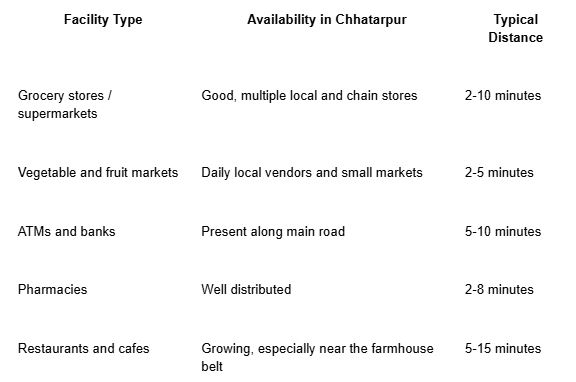 Chhatarpur's main market road functions as the practical hub for most households, while the farmhouse areas rely more on delivery services and occasional trips to nearby markets.
Schools and Educational Facilities
Families evaluating Chhatarpur usually ask about school access early in their search. The area has a mix of options:
Local schools within Chhatarpur and neighboring Mehrauli, covering CBSE and other boards.
Well-regarded schools in nearby Saket and Vasant Kunj, reachable within 20-25 minutes.
Preschools and daycare centers concentrated in the more residential pockets like Chhatarpur Extension.
For families with school-going children, checking bus routes and average commute time is worth doing before finalizing a home, since some inner lanes can add extra travel time during peak hours.
Transport and Connectivity
Getting to healthcare facilities and daily errands depends heavily on how connected the locality is.
Chhatarpur Metro Station on the Yellow Line is the biggest advantage here, linking residents directly to Saket, Malviya Nagar, and central Delhi.
Road connectivity via the Mehrauli-Gurugram Road and Chhatarpur-Mehrauli road makes hospitals in Saket and Gurugram reasonably accessible by car or auto.
Auto-rickshaws and cabs are readily available near the main market and metro station, useful for quick trips to clinics or pharmacies.
This connectivity is a key reason many tenants search for fully furnished rooms in chhattarpur close to the metro corridor — it cuts down travel time not just for work, but also for quick pharmacy runs or clinic visits when needed.
Benefits of Living Near Chhatarpur's Facility Network
Balance of green space and access: Fewer high-rises, more open surroundings, without being cut off from hospitals or markets.
Metro connectivity: Direct link to South Delhi's larger medical and commercial hubs.
Growing local infrastructure: More pharmacies, diagnostic centers, and eateries have opened in the last few years, reducing dependence on far-off areas.
Relatively lower rents: Compared to core South Delhi localities like Saket or Greater Kailash, while still being close to similar facilities.
Challenges to Consider
Emergency response time: Inner lanes, especially in the farmhouse belt, can slow down ambulance access during emergencies.
Traffic during peak hours: The Chhatarpur-Mehrauli stretch can get congested, adding to travel time toward hospitals in Saket.
Uneven facility spread: Some pockets are well served by pharmacies and clinics, while others further from the main road have fewer options within walking distance.
Limited super-specialty care on-site: For serious medical conditions, residents still need to travel outside Chhatarpur.
Chhatarpur vs Nearby Localities: A Quick Comparison
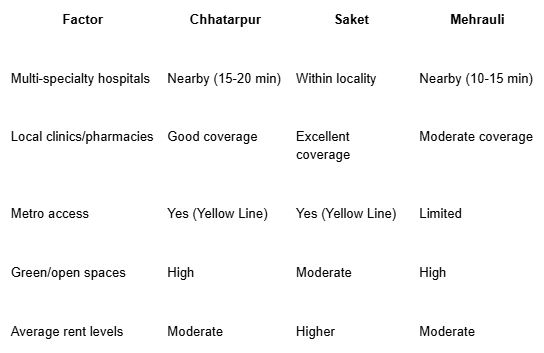 This comparison shows Chhatarpur sitting in a practical middle ground — not as facility-dense as Saket, but better connected and greener than several nearby options.
Real-Life Considerations for Tenants and Buyers
Anyone actually planning to live in Chhatarpur should think beyond the property itself:
Check the exact sub-locality, since facility access varies significantly between Chhatarpur Extension and the deeper farmhouse lanes.
Visit during both day and night to get a real sense of how accessible pharmacies, autos, and markets feel after dark.
Ask about ambulance and emergency response times from current residents or local property managers, especially for elderly family members.
Factor in commute time to work and school, not just distance on a map, since traffic patterns vary through the day.
Look at long-term rental options if healthcare access and neighborhood stability matter more than short stays.
Talk to local rental experts before signing anything. Asking around for the best rent wala in chhatarpur — someone who actually knows which lanes have wider roads and quicker pharmacy access — often saves more time than scrolling listings online. Verified rental platforms such as apna paryavaran property rentals can also help shortlist homes that are genuinely close to clinics, markets, and metro access rather than just marketed that way.
Checklist: Evaluating Healthcare and Facility Access Before Renting in Chhatarpur
Nearest pharmacy is within a 10-minute walk or drive
A general physician or clinic is available locally
Diagnostic center or lab is reachable without a long commute
Multi-specialty hospital is within a reasonable drive (15-20 minutes)
Grocery and vegetable markets are close to the property
Metro station or reliable transport is nearby
Roads leading to the property are wide enough for emergency vehicles
Schools or daycare centers are within an acceptable commute.
Future Infrastructure Trends in Chhatarpur
Chhatarpur has been steadily adding retail outlets, cafes, and healthcare setups over the past few years, largely driven by rising residential demand. As more gated communities and mid-rise apartments come up alongside the traditional farmhouse plots, local infrastructure — including pharmacies, diagnostic chains, and grocery delivery hubs — is expected to expand further. Improved last-mile connectivity from the metro station is also gradually reducing dependence on private vehicles for daily errands and medical visits.
Investors evaluating Chhatarpur alongside other Delhi NCR micro-markets often widen their search beyond South Delhi too. For instance, buyers comparing infrastructure-led growth sometimes look at premium projects on dwarka expressway, where new hospitals, schools, and retail hubs are being planned as part of the corridor's larger development push — a useful reference point when judging how quickly a locality's facility network can mature over time.
Conclusion
Chhatarpur offers a practical balance for anyone weighing healthcare access against everyday livability. It isn't a locality packed with hospitals at every corner, but it makes up for that with strong metro connectivity, a growing base of local pharmacies and clinics, and easy access to major hospitals just a short drive away in Saket and Gurugram. For families, tenants, and long-term residents who value open spaces without losing touch with essential facilities, Chhatarpur remains a locality worth serious consideration — as long as the specific sub-area and its access to healthcare are checked carefully before moving in.
Frequently Asked Questions
Are there good hospitals near Chhatarpur?
There is no large multi-specialty hospital within Chhatarpur itself, but several well-known hospitals in Saket and along the Mehrauli-Gurugram road are within a 15-20 minute drive.
Is Chhatarpur safe for senior citizens who need regular medical care?
Yes, with some planning. Local clinics and pharmacies cover routine needs, but families should confirm nearby ambulance access and keep a hospital contact ready for emergencies.
How far is the nearest pharmacy from Chhatarpur residential areas?
Most residential pockets, especially Chhatarpur Extension, have pharmacies within a 5-10 minute walk or short drive.
Is Chhatarpur well connected by metro?
Yes, Chhatarpur Metro Station on the Yellow Line connects the area directly to Saket, Malviya Nagar, and further into central Delhi.
What are the daily shopping options like in Chhatarpur?
The main market road has grocery stores, vegetable vendors, ATMs, and small restaurants, covering most daily needs without long travel.
Is Chhatarpur suitable for families with school-going children?
Yes, several schools operate within Chhatarpur and neighboring Mehrauli, with more options available in Saket and Vasant Kunj within a 20-25 minute commute.
How does Chhatarpur compare to Saket for healthcare access?
Saket has hospitals within its own boundaries, while Chhatarpur residents typically travel 15-20 minutes for major hospital care, though local clinics handle routine needs well.