

Preamble
Why This Method Matters
If you are new to photography, one of the biggest frustrations you will encounter is focus.
You see a moment.
You react.
You press the shutter.
And the image is not sharp.
This happens for a simple reason:
You are relying on autofocus.
Autofocus is powerful, but it is not perfect.
It can lock quickly in good conditions, but it can also:
choose the wrong subject
hesitate in low light
struggle in complex scenes
Most importantly, it can force you to think before shooting.
That delay is often enough to miss the moment.
A Different Approach
This method is built on a different idea.
Instead of asking the camera to find focus for you, you define it in advance.
You decide:
how far your subjects will be
how much of the scene should be sharp
Then you shoot without waiting.
No focus confirmation.
No hesitation.
No correction.
Why It Works
In real life, most scenes fall into simple distance categories:
close to you
a few meters away
far in the background
You do not need perfect focus for every exact distance.
You need reliable zones.
This is what depth of field provides.
It allows you to transform focus from a precise point into a usable range.
From Focus to Distance
With this method, you stop thinking in terms of focus.
You start thinking in terms of distance.
You are no longer asking:
"Is the camera focused?"
You are asking:
"Is my subject inside my zone?"
This is a much simpler and faster decision.
Shooting Instinctively
Once everything is set:
you do not wait for autofocus
you do not adjust focus between shots
you do not lose time
You see.
You react.
You shoot.
And the image is very likely to be sharp.
What You Gain
faster reaction time
more consistency
significantly fewer missed moments caused by focus
a more intuitive way of shooting
This is not about being technical.
It is about removing friction between you and the moment.
Before You Continue
The method that follows is simple, but it requires one shift:
You must trust distance instead of autofocus.
Once you accept that, everything becomes easier.
A Note on Inspiration
This article was inspired by the following video from Ian Jukes:
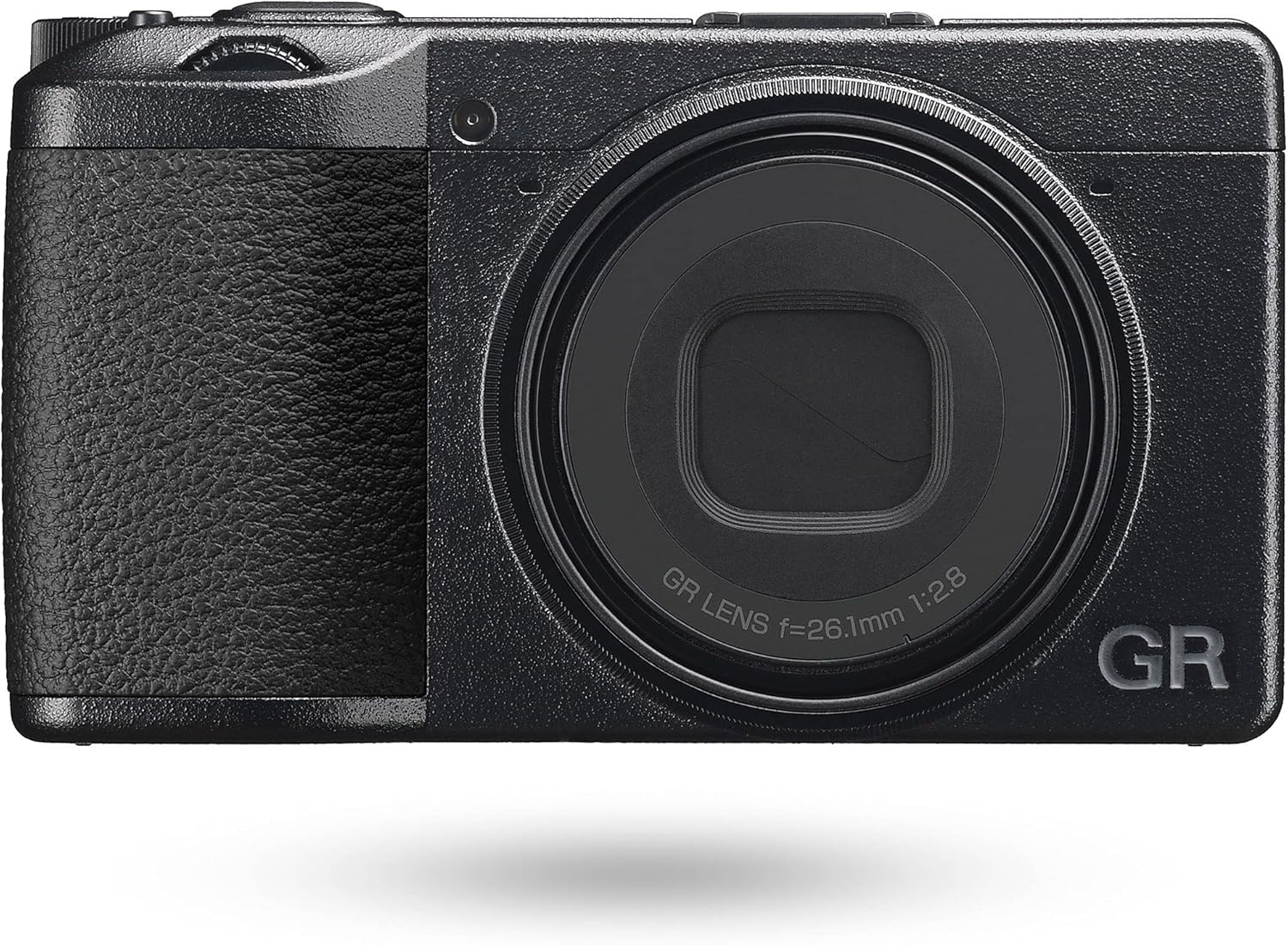
It expands on that idea and adapts it specifically to the GR IIIx.
Why Manual Focus + Snap Focus Changes Everything
The Ricoh GR IIIx is often misunderstood.
Most discussions around the GR system revolve around Snap Focus, or traditional zone focusing inspired by the classic “F8 and be there” approach.
The expression itself comes from photojournalism and describes a simple idea: set your aperture to f/8, rely on depth of field, and focus on capturing the moment rather than adjusting settings.
https://en.wikipedia.org/wiki/F/8_and_be_there
Why the GR IIIx Is Different
But the GR IIIx is not the GR III.
The difference is not cosmetic.
It fundamentally changes how you shoot.
The GR III uses a 28mm equivalent lens.
The GR IIIx uses a 40mm equivalent lens.
That single change has major consequences.
Depth of Field Changes Everything
At 28mm, depth of field is naturally wide.
At f/8, you can realistically keep a very large portion of the scene in focus, often from close distances to infinity.
This is what makes the traditional “F8 and be there” approach so effective on the GR III.
You can rely on depth of field to absorb imprecision.
At 40mm, everything tightens.
Depth of field becomes significantly shallower.
The distance needed to keep everything sharp moves farther away.
Close subjects fall out of focus much more easily.
What was forgiving at 28mm becomes selective at 40mm.
The Practical Consequence
You can no longer set a single focus distance and expect everything to be sharp.
If you optimize for distance, you lose close subjects.
If you optimize for proximity, you lose the background.
This is the key difference.
The GR III often allows you to ignore focus.
The GR IIIx forces you to think in terms of distance.
And this is exactly why the hybrid method exists.
What This Article Introduces
This article presents a hybrid shooting method that combines Manual Focus and Snap Focus into a single, fluid system.
The result is a shooting experience that is:
immediate
predictable
independent from autofocus
The Limitation of Traditional F8
If you try to apply the classic F8 method directly on the GR IIIx, you quickly reach its limits.
A focus set around 5 meters works well for general scenes.
But anything closer than approximately 2.5 to 3 meters becomes less reliable.
You are forced to choose between two imperfect options:
optimize for distance and lose proximity
optimize for proximity and lose the rest of the scene
This is where most users struggle.
The Hybrid Solution
The GR system offers something unique.
It allows two focus behaviors to coexist.
Manual Focus
Snap Focus
Instead of choosing one, you can use both as part of a single workflow.
The Core Idea
You define two focus zones:
a primary zone using Manual Focus
a secondary zone using Snap Focus
And you switch between them using nothing but your finger.
No menus. No adjustments. No delay.
The Setup
Base Settings
Mode: Aperture Priority
Aperture: f/8
ISO: Auto 100 to 6400
Minimum shutter speed: 1/320 s
Focus Configuration
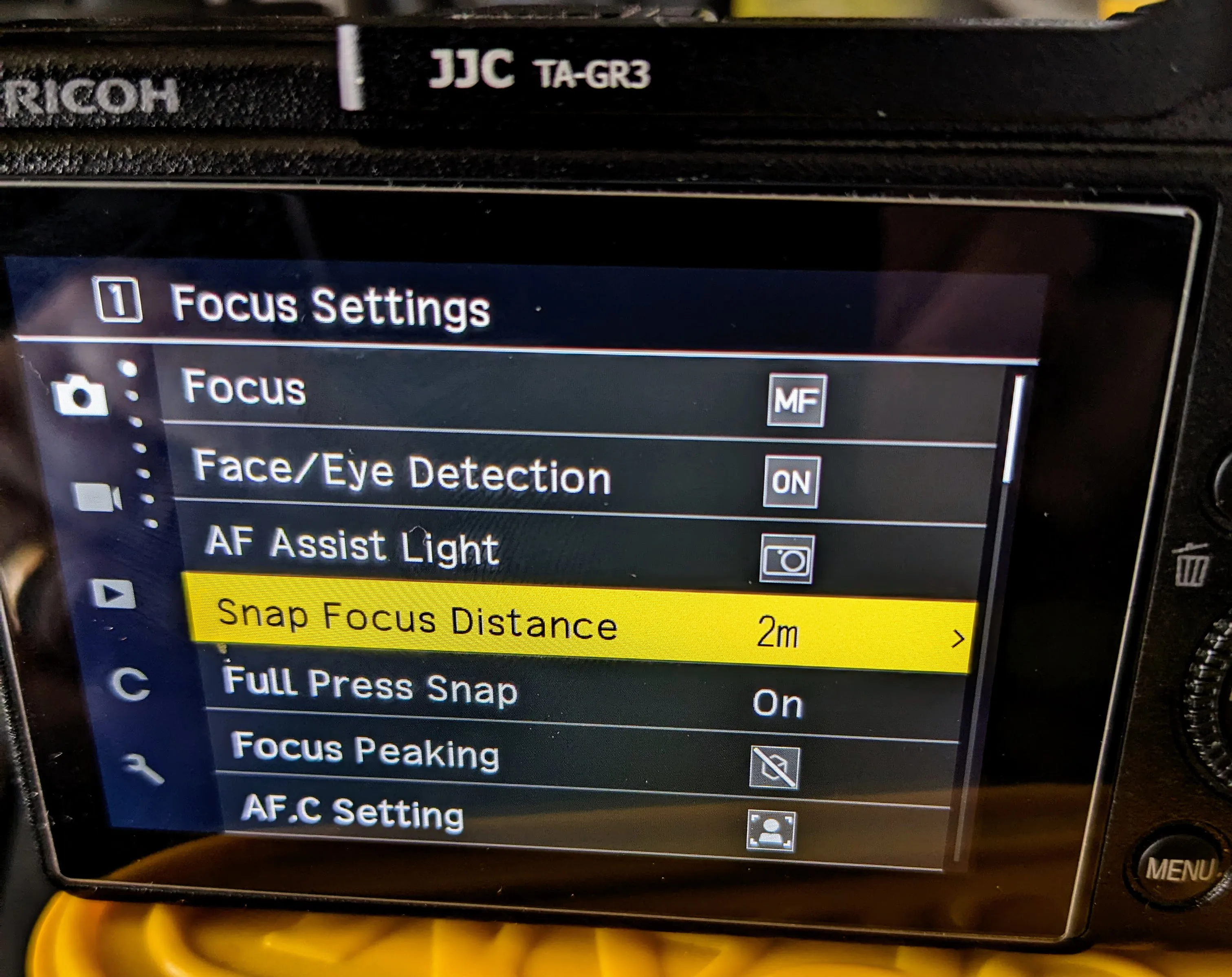
Focus Mode: Manual Focus
MF Distance: 5 meters
This becomes your default working zone.
Snap Focus
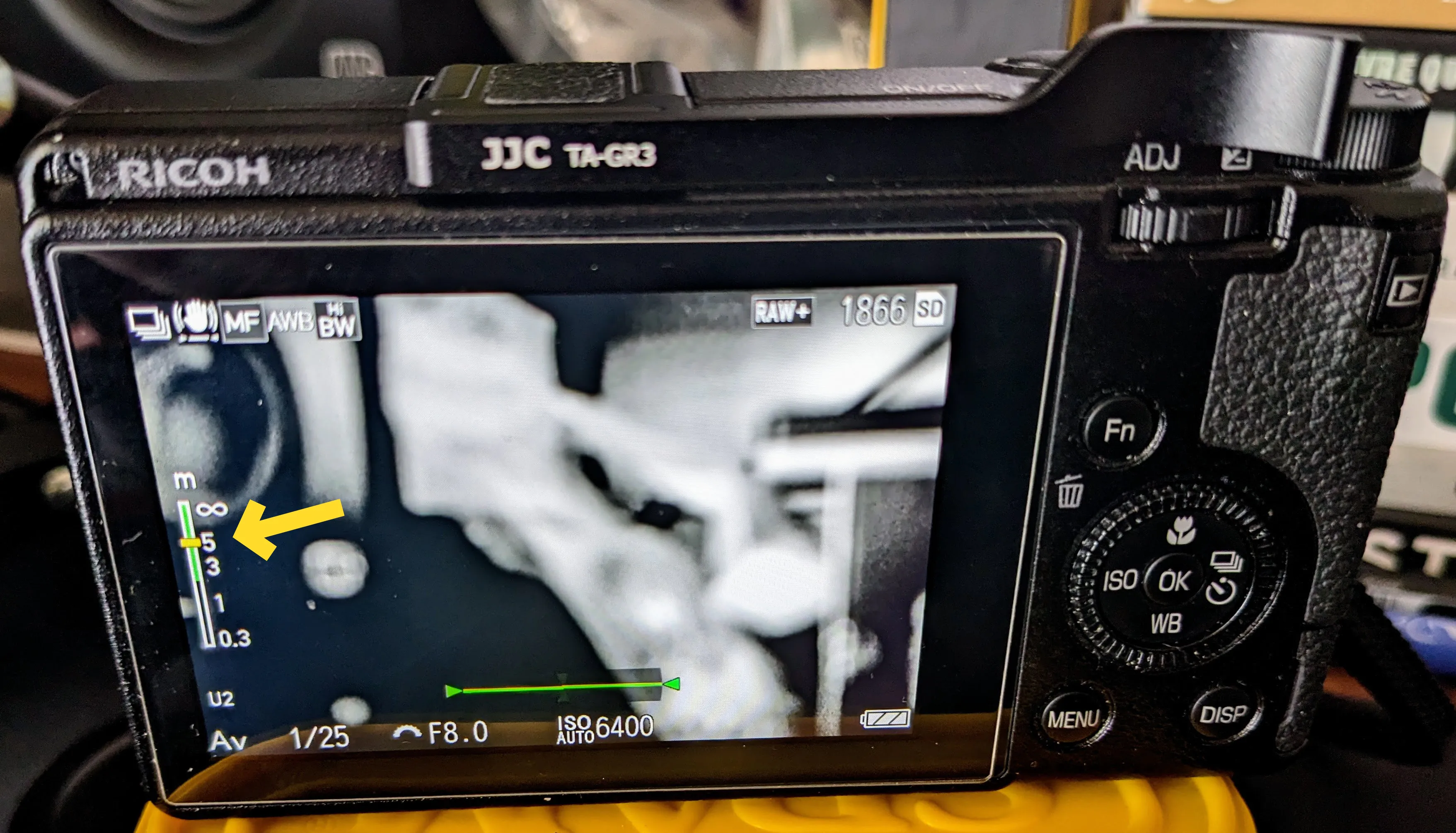
Snap Distance: 2 meters
Full Press Snap: Enabled
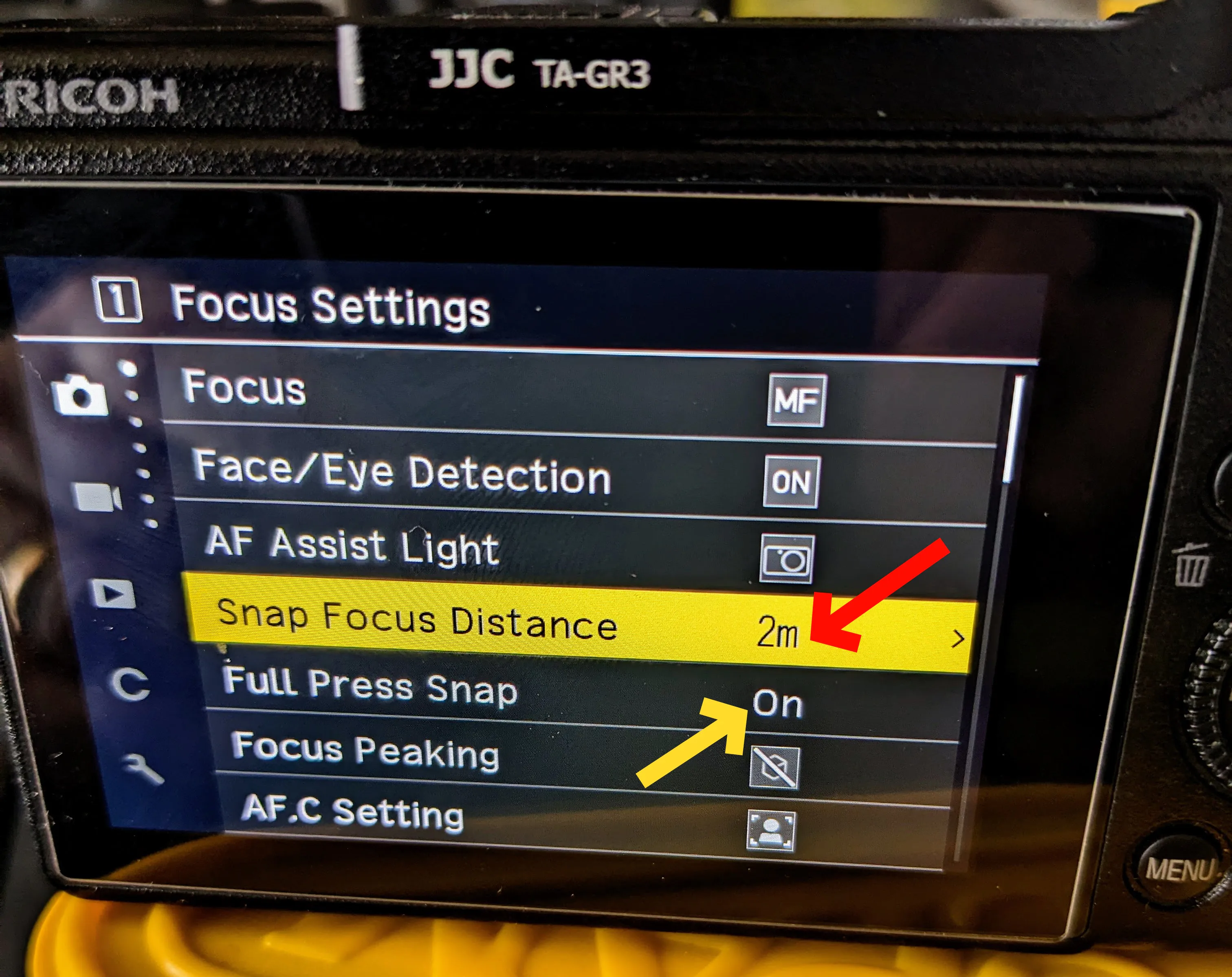
This ensures Snap Focus is triggered when pressing the shutter in one motion.
Note: 2 meters is a chosen working distance for this method. The GR IIIx allows multiple Snap distances, but this value provides a strong balance for close interaction.
What This Creates
You now have two active depth of field zones:
Manual Focus at 5 m for general scenes
Snap Focus at 2 m for close interactions
Understanding the Depth of Field
Manual Focus at 5 meters
Practical sharp zone:
from about 3 meters
to very far distances, approaching infinity
These values are practical approximations intended for real-world shooting.
For precise control, always refer to the camera’s on-screen depth-of-field indicator.
Why this works:
More of the sharp area extends behind your focus point than in front of it.
This makes 5 meters a very stable base distance.
In practice, this covers:
people in the scene
mid-distance action
background elements
Without requiring precise focus.
Snap Focus at 2 meters
Practical sharp zone:
from about 1.5 meters
to about 3 meters
This zone is tighter, but perfectly aligned with close subjects.
At this distance:
subjects feel more immersive
framing becomes more intimate
reactions are faster
The Key Difference
5 meters equals coverage
2 meters equals precision
Why These Two Work Together
These two distances complement each other:
5 meters handles everything beyond immediate interaction
2 meters handles everything close to you
Together, they cover most real-world situations.
The Underlying Principle
You are not choosing focus points.
You are choosing distance zones.
far focus expands toward distance
close focus concentrates around the subject
How It Works in Practice
The system is controlled entirely by how you press the shutter.
Controlled Shooting
Half press, then shoot.
The camera uses Manual Focus at 5 meters.
Use this for:
general street scenes
layered compositions
subjects at distance
Instinctive Shooting
Press directly in one motion.
This works when Full Press Snap is enabled.
The camera uses Snap Focus at 2 meters.
Use this for:
close subjects
fast interactions
unexpected moments
Why This Feels Natural
This system works because it aligns with human behavior.
When a subject is far:
you have time
you compose
you half press
When a subject is close:
it happens quickly
you react
you press immediately
Your gesture becomes your focus decision.
What Changes in Your Shooting
You are no longer:
adjusting focus
thinking about distance
You operate within a distance system:
calm situations use the wide zone
urgent situations use the close zone
Strengths of the Hybrid Method
no autofocus dependency
no focus hesitation
instant access to two working distances
highly predictable rendering
Most importantly:
You significantly reduce missed moments caused by focus.
Limitations
This method requires:
awareness of subject distance
basic understanding of depth of field
a short adaptation period
It also relies on:
sufficient light for f/8 to remain effective
consistent distance estimation
But once learned, it becomes second nature.
GR III vs GR IIIx
This method is especially powerful on the GR IIIx.
On the GR III, depth of field is wide enough that a single zone often works.
On the GR IIIx, you need structure.
This hybrid approach provides it.
Instinctive Operation
Why Snap Focus Works So Well for Close Subjects
When a subject enters close range:
distance collapses
reaction time becomes minimal
The natural response is to press immediately.
This triggers Snap Focus at exactly the right distance.
When the subject is farther away:
the scene is stable
you take your time
You naturally half press, keeping Manual Focus active.
This creates a simple mapping:
fast press equals close distance
controlled press equals general distance
Conclusion
The GR IIIx is not a point and shoot camera.
It is a distance-based camera.
When you stop trying to make it behave like an autofocus system and instead embrace its logic:
Manual Focus becomes your foundation
Snap Focus becomes your reflex
Together, they create a system that is:
faster than autofocus
simpler than constant adjustments
aligned with how you actually shoot
You are no longer focusing.
You are choosing distance.