

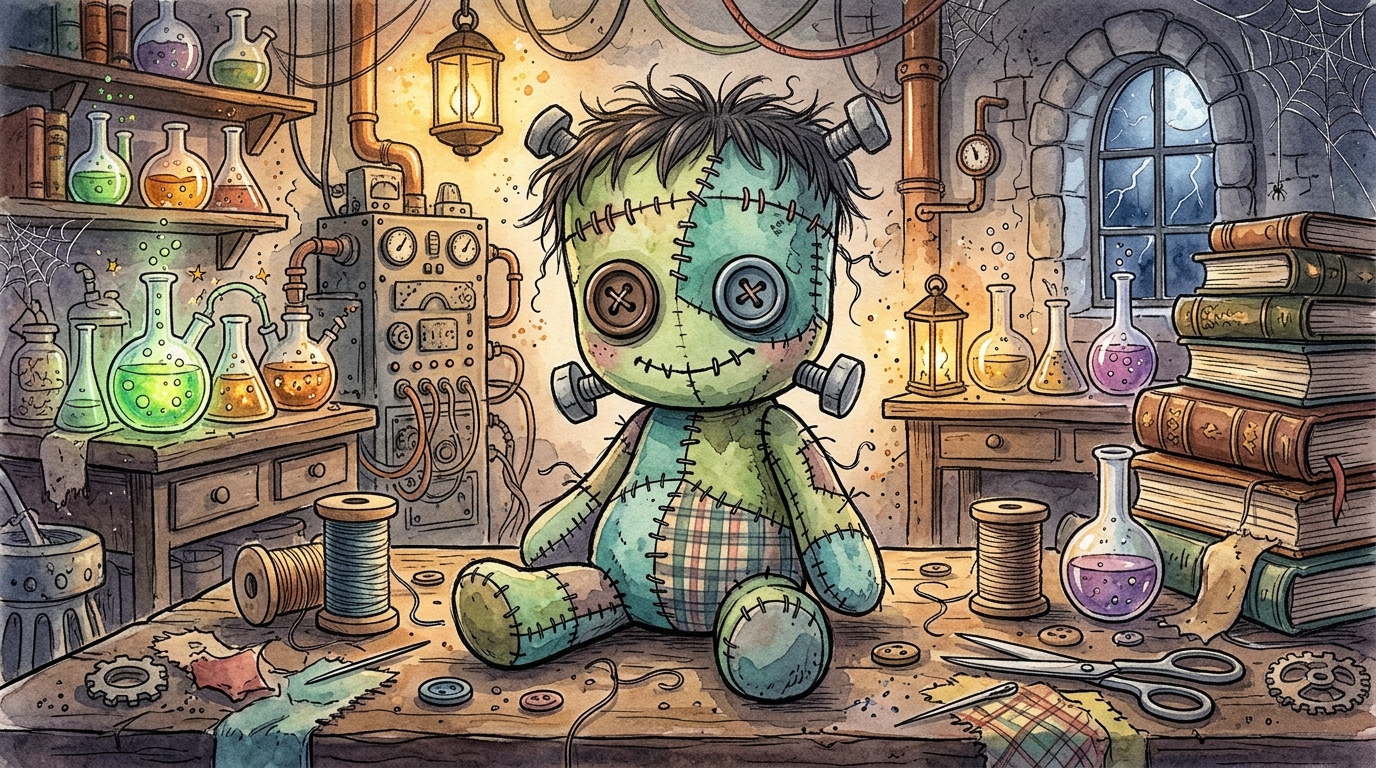
 Bringing a manuscript back to life is an exercise in madness. Adding chapters. Cutting scenes. Moving things around and then moving them twenty more times. Introducing a new character that skewers the plot. You become convinced that if you just work hard enough, a few (dozen-million) more hours, the manuscript will catch fire and be amazing.
Sometimes this is possible.
Sometimes, you're just stitching together a messier monster.
Last year, I ghostwrote a finance book. My client and I had an ambitious idea: pair with a sketchnote artist and use illustrations to make the complex financial concepts more accessible to readers. I even brought an artist on board. It was going to be unlike anything else in that section of the brick-and-mortar bookstore.
It sounded brilliant, until it didn't.
We were asking high-net-worth clients, millionaires next door, to trust my client with their entire life's assets, presenting his serious and revolutionary investment concepts in something closer to a comic book style. The tone was completely wrong. I called the sketchnote artist and explained that I'd made a mistake. She was so gracious.
That was my first false start.
We tried another approach.
Honestly, I don't even remember what that second approach was because it was craptastic too. Unfortunately, I didn't realize it until about three-quarters of the way into the manuscript. My intuition sent up warning flares. Something didn't feel right. I asked my proofreader, who also serves as my sometimes- beta reader, to take a look.
This individual is blessedly and brutally honest. Why I love her. She doesn't hesitate to tell me if I've fallen in love with my own idea and it's crap. We talked through one manuscript problem after another until I finally said the ugly part aloud.
"I'm going to have to start over. Aren't I?"
She agreed.
I felt sick. My business lives and dies by booking schedules. Starting over on one book means the fall of so many dominoes that come after: other waiting clients, deadlines to subcontractors, and only so many hours in a day before exhaustion sets in. It was so much word count to abandon, but I had to get this book, like all my client books, right. My reputation depends on it.
Around this time, my client had read a nonfiction book by a wildly successful bestselling life coach/self-help author. He loved the approach of this author's books. This author wasn't in the money lane of the publishing market, but the experience of reading his books stayed with him. He loved the tone, the structure, and the way the author handled complex information.
I suggested we accept inspiration from that author's books and build something similar around my client's personality and expertise, in the finance lane of the industry.
He loved the idea.
I bought three of the author's books and studied their structure and the author's branding. I wasn't about to imitate his voice. My client had his own unique personality, a bit more casual, sort of like a confidant across the cafe table on a rainy day. But I could learn from how the other writer connected with readers, and how he kept them engaged with deep, fairly obscure concepts.
Third time was a charm. The book came together beautifully. I was able to salvage a bit from the earlier manuscript, but I did start over from sentence one, blinking cursor. I will forever be grateful to my beta reader who gave me the verdict I needed to hear on my third try: Yes! This is it!
The amount of time, the months and years, we've invested in a manuscript shouldn't determine if the manuscript deserves to survive.
I put down the needle and thread and took the entire thing apart.
Sometimes, the best thing we can do for a manuscript is to stop trying to make it something it was never meant to be.
When the monster is an earlier version of you
I've encountered a different kind of Frankenstein in my personal fiction.
Around 2005-2009, I wrote several novels that never found their footing. For some, I wasn't yet a sophisticated enough plotter. Others fell short of romance reader expectations. At least two didn't make it to the finish line. One went out to publishers and came back like a boomerang, over and over, never finding a home.
Since then, I've occasionally pulled them out, reread them, and tried to resurrect them. I'll remember that original incandescent spark, those heroes I fell in love with, and the story that once kept me glued to the keyboard. The potential, still there. I'm a book coach, for goodness sake. What kind of book coach can't circle back and fix her own stuff?
Except that sometimes we can't.
Some of the premises aged out of their moment. Technology has changed so much that some plot twists don't work in the modern world. Or society has moved on. We're in a different collective stage of the zeitgeist, and the world I imagined inside these stories no longer exists in quite the same way.
Most importantly, I'm a very different writer than I was in 2005.
Yes, I'd bring my present-day skills, but the stories were conceived by an earlier version of me. I'm no longer the person who wished to tell that story. Heck, I'm not even sure I believe in the same themes that the novels center on.
A few of them still interest me. I haven't ruled them out completely. But bringing them back to life would mean spending a copious stretch inside a lab, recreating a monster. Every writer with a drawer full of unfinished manuscripts knows this monster.
So how do we know when to keep at it and when to stop trying to resurrect a manuscript?
I wish I had some sage words here. I don't. But I know now to pay attention to my intuition when it tells me something fundamental isn't working. I've learned to seek outside perspectives when I'm too close to see the book clearly. And I've learned that being willing to start over sometimes is the most responsible decision I can make. For my client. For me.
Not every abandoned manuscript deserves to be saved. Sometimes they can just be what they were: a learning playground that was one stop on our journey.
If you're having trouble deciding, reach out to me. I will be your outside perspective. And if you have an entire laboratory of Frankensteins, let's talk, as well. A few stitched monsters are normal. A high monster body count might indicate something else entirely.
✨Happy haunting those pages, my friends.