
Somewhere along the way, we made simplicity a luxury.
Sep 04, 2026
Sometimes I dream of a very small life… not small in meaning, not small in love, experience or wonder. but small in noise, in rushing… small in the endless hunger for more.
I imagine a little cottage, no nothing grand, nothing that would make anyone stop and stare. Just a warm little house with a garden beside it, a wooden table beneath a tree, tomatoes growing unevenly on their vines, basil I can pick with my fingers while cooking, pumpkins resting heavily against the earth, fruit trees that change with the seasons, and perhaps a few animals wandering around as if the land belongs to them too.
And horses… always horses, somewhere close enough that I can hear them before I see them.
I imagine waking with the sun instead of an alarm, opening a window and actually smelling morning and knowing what season I am living in not because the calendar tells me, but because something outside my door is flowering, ripening, falling or becoming bare. Knowing it rained last night because the earth still carries the smell of it. Knowing summer is coming because the tomatoes are beginning to turn red. Knowing autumn not from a date on my phone, but from the leaves gathering beneath my feet.
I want mornings that don’t begin with notifications. I want to hear birds before I hear traffic.
I want to walk outside barefoot, still half asleep, and see what changed overnight. A new flower, a ripened fruit, tiny footprints in the soil… something alive that wasn’t there yesterday. This maybe that sounds like a small life, but lately, I have been wondering if we have completely misunderstood the word small. Because there is nothing small about being present enough to notice the world changing around you. And perhaps there is nothing poor about a life that allows you to actually witness yourself living it.
I think somewhere along the way we became confused about what it means to be rich.
We learned to associate richness with height, speed and accumulation, bigger houses, higher buildings, faster cars, fuller calendars, better titles… more money, more things., more places to go and more things to accomplish once we get there.
We built cities that stretch toward the sky and filled them with people who barely see it. We wake early, enter elevators, sit in traffic, disappear into buildings, spend most of the day beneath artificial light, staring into screens, answering messages, eating between meetings, checking the time, checking the phone, checking what comes next.
Then we drive home… Six o’clock… Seven o’clock and sometimes later.
And suddenly the sun has lived an entire day without us, we didn’t notice where it rose, didn’t feel the afternoon becoming cooler, didn’t see the shadows lengthening, didn’t smell rain coming…. we just know the day is finished because the clock says so and hahaha we call this life.
Then, when we become exhausted by it, we say something strange: I need to get away. And where do we go? We go to the sea. The mountains. A forest. A lake. A farm. A little wooden cabin somewhere.
We search for somewhere with trees. Somewhere quiet, somewhere we can walk barefoot, somewhere we can hear birds in the morning, somewhere the phone doesn’t work very well. We say we need to escape. But I have started wondering whether we have the language completely backwards, maybe we are not escaping life when we go there, maybe we are returning to it. Because our bodies are older than our cities… Much older, before fluorescent lights, before elevators, before notifications, before highways and supermarkets and screens, there was earth… Water… Fire… Wind.... Sunlight… Darkness... Trees…. Animals… Seasons.
Human beings sitting beside other human beings. We speak about nature as though it is something outside us, some beautiful place we occasionally visit, but we forget the simplest truth of all:
We are nature too. We come from the same elements.
The water moving through our bodies belongs to this earth. The minerals in our bones came from it. The iron in our blood belongs to the same ancient world as the iron buried beneath our feet. We breathe what trees release, and they take in what we release.
Nature is not scenery. It is not decoration. It is not something beautiful to put behind us in a photograph…. It is home.
And maybe that is why something inside us changes when we return to it.
Why the sea makes us breathe differently.
Why forests make us quieter.
Why touching an animal brings us suddenly into the present.
Why the smell of rain on dry soil can awaken something we cannot even name.
Maybe the body remembers what the mind has forgotten… I know mine did, because for a little while, I experienced the life I keep dreaming about, not permanently, not long enough to call myself a farmer or pretend that I understand what it means to depend on land for survival, but long enough to feel something.
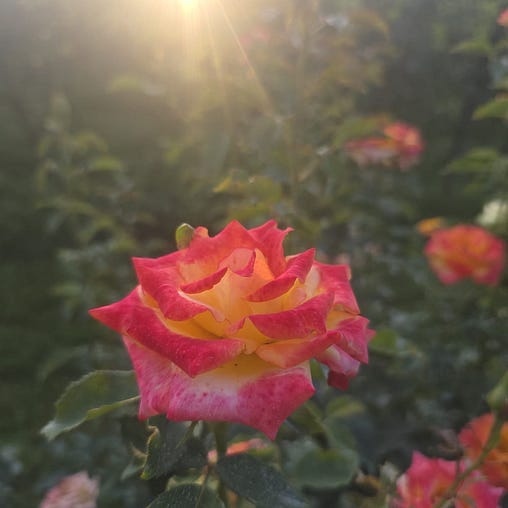
I was there with my husband and my daughter. We went into the farm and picked tomatoes straight from their vines, basil..peppers, vegetables growing directly from the soil.
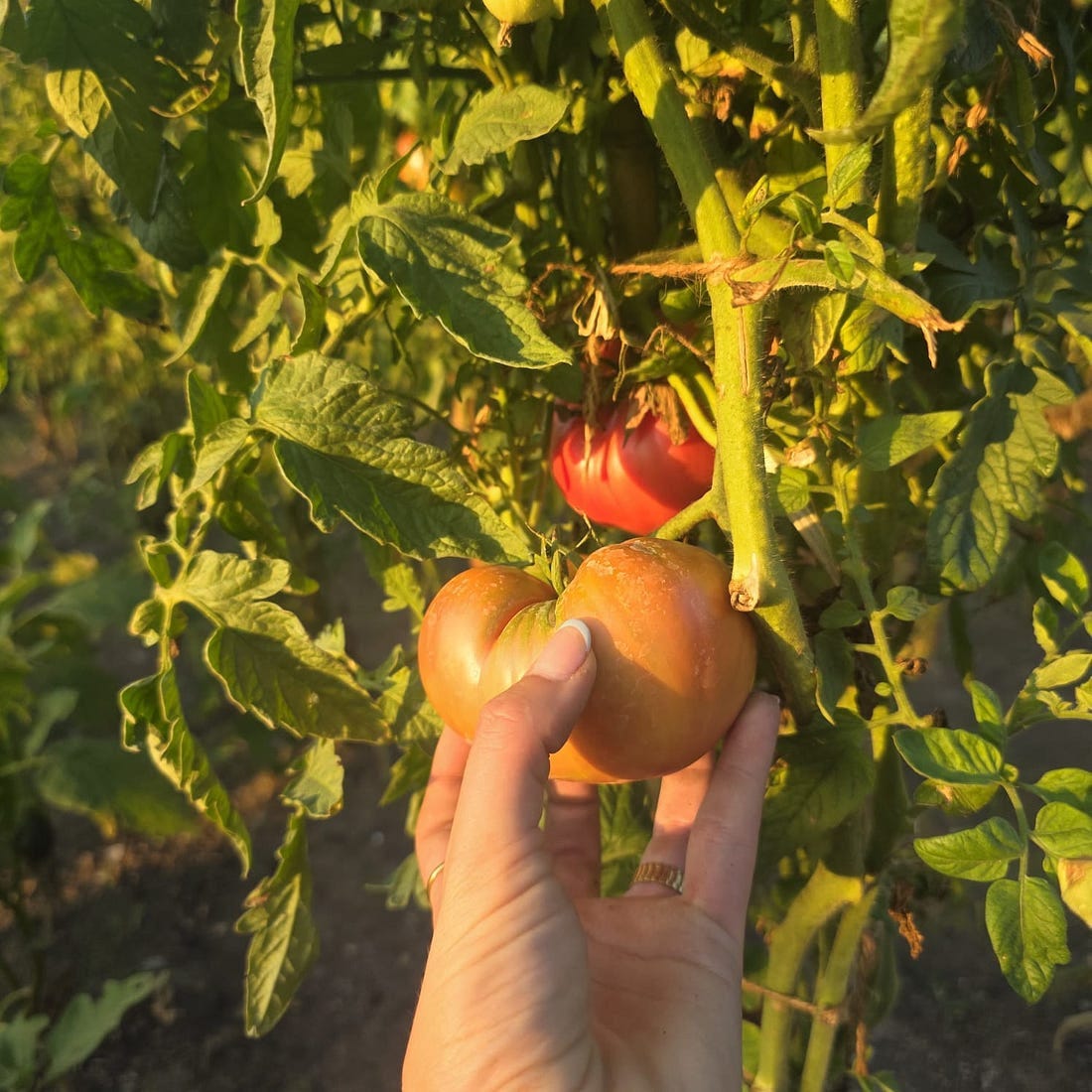
I know how ordinary that sounds. We picked tomatoes… That’s all, but perhaps that is exactly the point.
When did picking our own food become an experience?
I remember touching the plants and smelling the basil on my fingers. I remember seeing the earth still clinging to what we picked. There was no plastic wrapping… No barcode, no supermarket lighting, no delivery bag waiting outside a door.
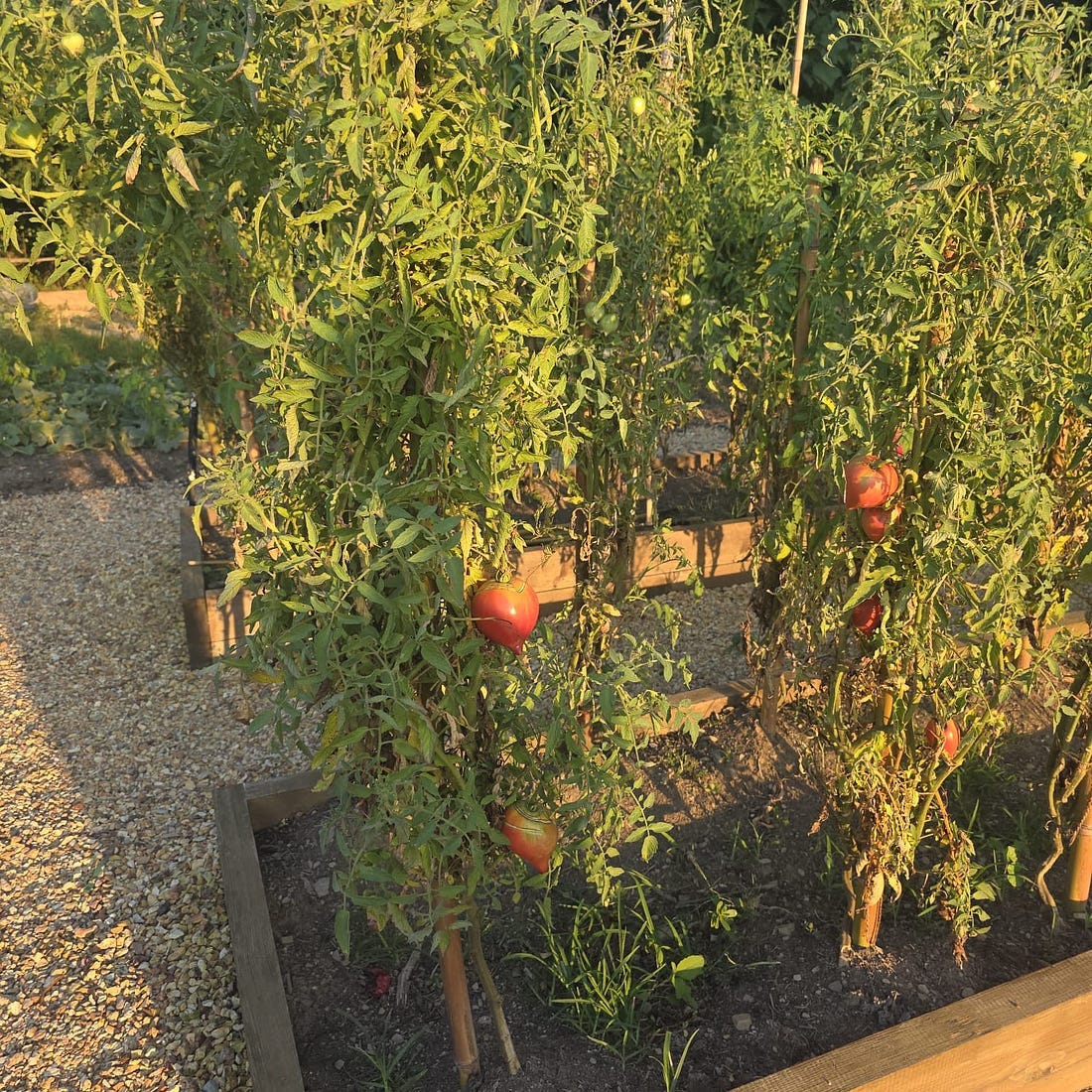
There was simply soil, a plant, sunlight, water, time and food.
I held a tomato in my hand and suddenly remembered that a tomato has a beginning, it was once a seed. Something tiny was buried in darkness, someone watered it, sunlight found it, roots moved deeper, s stem emerged, leaves opened, flowers appeared, fruit slowly formed, and then one day, someone could eat it.
How did we become so accustomed to miracles that we stopped calling them miracles?
After picking the vegetables, we would head to the stables. We fed the horses. We touched them, spent time with them, ran beside them.
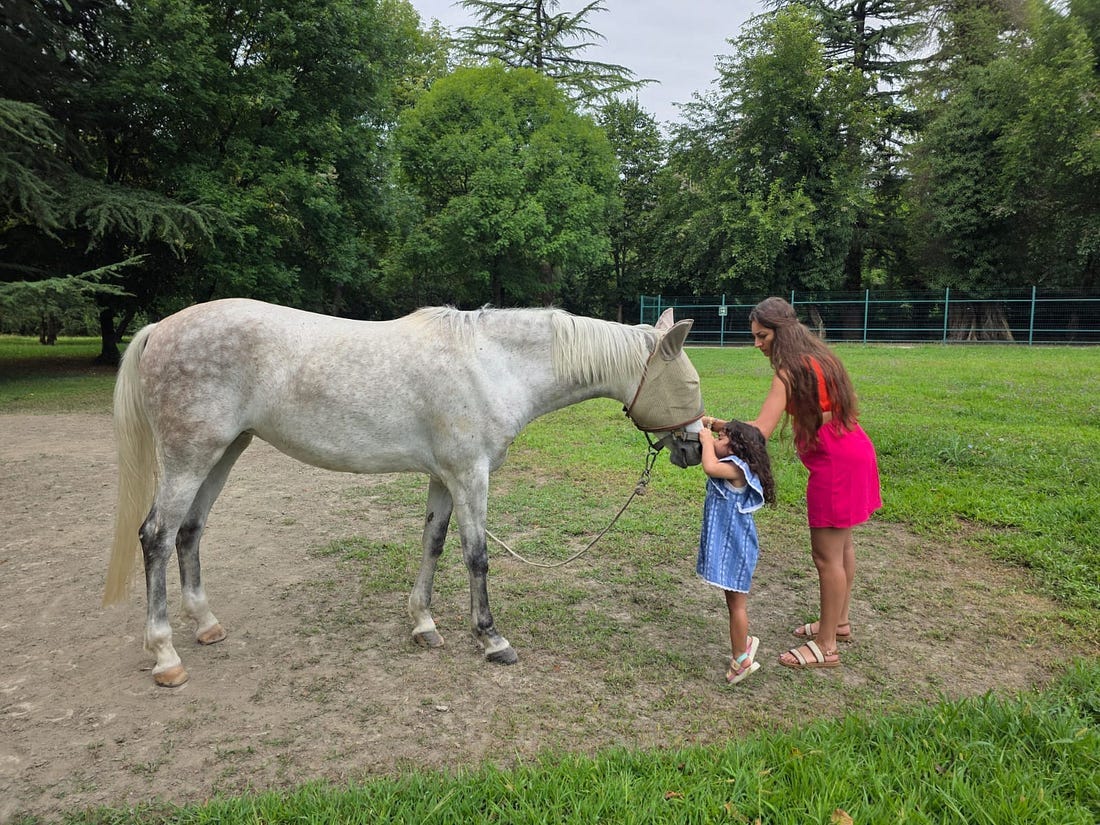
There is something about running with a horse that empties the mind that you cannot be somewhere else. There is this enormous, breathing creature beside you. Hooves striking the ground, muscles moving beneath skin. Breath. Dust. Movement.
For those moments, there is no yesterday and no tomorrow… There is just now.
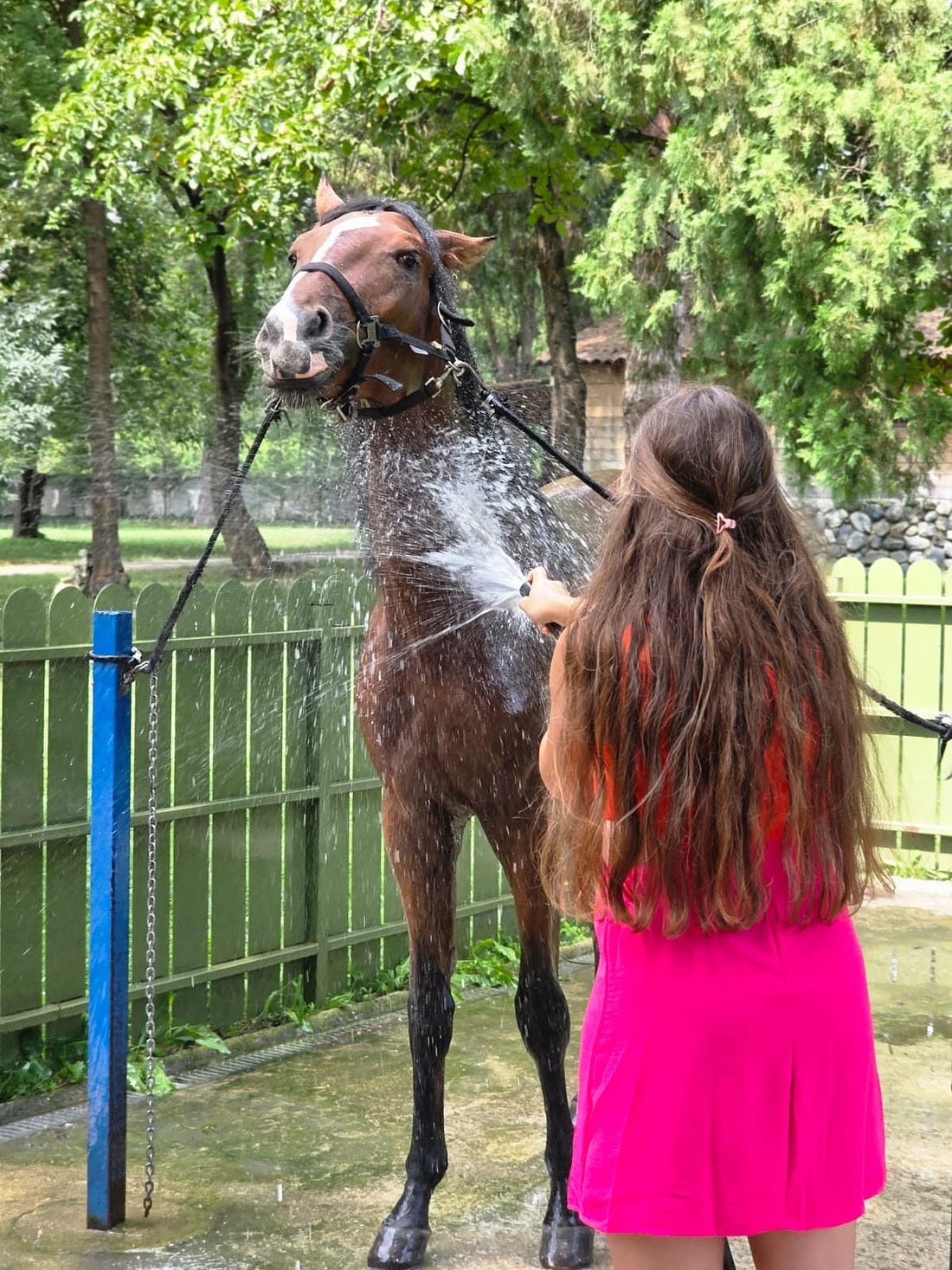
Later, we showered the horses. Water running across their warm bodies. Wet earth beneath our feet. The smell of the stable. Their breathing. Our hands moving across them.
And afterwards, we did something that now feels almost radical.
Nothing.
We made tea or coffee and sat beneath a tree…. Our backs rested against its trunk.
There was nowhere important to be, nothing to rush toward, no reservation, no perfectly designed café, no entertainment, just a tree, a warm cup and the people I love.
And my daughter fell asleep outside. I remember looking at her. She wasn’t sleeping inside a closed room with the curtains drawn. There was no artificial white noise playing beside her. No machine recreating the sounds of nature while nature waited outside. She was simply sleeping beneath a tree, the shade covering her little body, fresh air touching her face, leaves moving above her with the wind… birds singing somewhere around us. The earth continuing its ancient rhythm while she slept inside it.
And I looked at her and thought… this is life.
I felt it so deeply that I still struggle to explain it. I didn’t feel entertained. I didn’t feel accomplished. I didn’t feel productive…. I felt alive, I swear truly, completely alive… and maybe we have become so disconnected from that feeling that when it finally returns, it almost shocks us.
For those hours I wasn’t trying to become anything. I wasn’t producing. I wasn’t consuming. I wasn’t rushing toward the next thing.
We had picked food. We had cared for animals. My husband was beside me. There was a warm cup between my hands. My back was against a tree. My daughter was sleeping beneath birdsong. Nothing extraordinary was happening, and yet everything was happening. Life was happening, and for once, I was actually there for it.
I think about farmers differently now. We often look at the farmer and see a hard life… the weathered hands, old clothes, dirt beneath the fingernails, long days under the sun… modest home. And yes, farming can be incredibly hard. I don’t want to romanticize it. Crops fail. Animals get sick. Weather destroys months of work. Bodies become exhausted. Income can be uncertain. There is nothing poetic about hunger or financial fear.
But hardship and richness can exist in the same life.
I wonder whether the farmer possesses a kind of wealth our modern language doesn’t know how to measure. He knows his land. He knows when rain is needed. He notices when a leaf changes. He knows what grows in which season. He plants something when it is almost invisible and waits for it to become food. Maybe he plants a tree when he is young and rests beneath its shade when his hair has turned grey. He grows older beside the things he planted. His children know that strawberries don’t begin inside plastic boxes. They know the smell of soil. They know what happens before food reaches a plate. Perhaps they watch their father plant, then one day, they plant beside him. And years later, maybe their own children run between those same trees.
Tell me…how poor is that?
Maybe that farmer sometimes looks toward the city and envies us, he sees the glass buildings, beautiful cars, clean offices, restaurants and comfortable homes and thinks we have everything. Maybe while I romanticize his garden, he dreams about an income that doesn’t depend on rain. That matters, because I don’t want to pretend the past was perfect or that everyone should abandon modern life and become a farmer.
I love comfort too as I am grateful for medicine, technology, education, electricity, clean water, airplanes, books, communication and all the extraordinary things progress has given us. I don’t want humanity to go backwards. I just wonder whether, while running forward, we dropped something valuable and never turned around to pick it up and I feel this most when I look at our children.
We give children so much today, rooms filled with toys, toys that speak, toys that sing, toys that flash... tablets, games, cartoons, YouTube, characters, play centres. …. Endless activities and endless things designed specifically to entertain them. They play with one thing for five minutes…then another… then another. Then comes the sentence every parent knows: I’m bored, so we find something else, another toy, another video, another distraction… another purchase. We keep feeding stimulation to children who somehow become harder and harder to stimulate. But take a child outside and something changes. Give them a forest. A horse. A dog. A stream. Mud. Stones. A fallen branch.
Suddenly a stick is no longer a stick. It becomes a sword, a magic wand, a fishing rod, a walking stick, a spoon for a soup made of leaves.
Let them search for mushrooms as though they are treasure.
Let them look for wild berries.
Let them follow tiny footprints in the mud.
Let them feed a horse.
Brush one.
Run beside a dog.
Climb over a fallen tree.
Collect stones that, for reasons known only to them, are priceless.
Let them get muddy.
Let them fall.
Let them get up.
Let them come home with leaves in their hair and dirt beneath their fingernails.
Let them be bored long enough for imagination to wake up… eventually, let them fall asleep because their bodies actually lived that day.
Sometimes I wonder whether we spend enormous amounts of money trying to manufacture the wonder that the natural world gives children freely.
And then I come to the strangest part of all, because I really do want that simple life.
I want the little cottage. I want some land.
I want vegetables outside my door.
I want fruit trees.
I want horses nearby.
I want my daughter to know what basil smells like when she crushes it between her fingers.
I want her to know the difference between mud after rain and dry summer soil.
I want her childhood memories to contain trees she climbed, animals she loved, things she planted and places where she ran until she was exhausted.
I want mornings that actually feel like mornings. I want evenings beneath an open sky.
I want to grow older beside things that are growing too. Simple…. Except it isn’t simple anymore.
Because if I wanted to build that supposedly poor little life today, I would probably need to be rich…. Very rich. Land costs money. A cottage costs money. Water costs money. Animals cost money. Keeping horses costs money. Maintaining land costs money, and perhaps the most expensive thing of all is having enough financial freedom to stay there… to actually live the life instead of leaving it before sunrise every morning and returning after dark just to afford it.
And this is the irony that keeps circling inside my head: We have made simplicity a luxury.
Our ancestors lived close to the earth because that was life. They didn’t call growing vegetables slow living. They were growing dinner. They didn’t call walking barefoot grounding… their feet were simply on the ground. They didn’t call sitting beneath trees forest therapy… there was a tree, they were tired, and they sat beneath it. They didn’t pay thousands to retreat somewhere without Wi-Fi so they could reconnect with themselves… they simply lived in a world that had not yet placed so many layers between the human body and the earth.
And now some of us work for twenty or thirty years dreaming of the day we will finally have enough money to buy a piece of land, grow our own tomatoes and sit beneath a tree.
We rush so that one day we won’t have to rush. We spend our days indoors so that one day we can afford to live outside. We sacrifice our time to earn enough money so that one day we can buy our time back.
There is something almost funny about it… and something heartbreaking, maybe wealth is not only money, okay money matters, security matters, opportunity matters, but time is wealth too. Health is wealth. Clean air is wealth. Silence is wealth. Knowing how to grow something is wealth. Having somewhere your child can run freely is wealth. Eating something your hands helped bring into existence is wealth. Knowing an animal well enough that it recognizes your footsteps is wealth. Watching a sunset without needing to photograph it is wealth. Having enough quiet to notice the moon. Knowing that rain is coming because you can smell it. Having dinner before exhaustion has swallowed the evening. Sitting beside someone you love without either of you asking what time it is.
Maybe wealth is having enough time to witness your own life while you are still living it. And perhaps that is why I keep returning in my mind to that afternoon beneath the tree. My back against its trunk. The warm cup between my hands. My husband beside me. The smell of basil still somewhere on my fingers. The horses nearby, and my daughter asleep beneath the shade while birds sang above her.
If you had asked me what was happening, I could have said: Nothing.
We were just sitting beneath a tree, but now I think the opposite.
Everything was happening and nothing was missing.
Maybe that is all I want, not a bigger life, just a life close enough to me that I can feel it. A life where the seasons don’t pass unnoticed, where food still has a story, where my daughter knows that wonder doesn’t require a charger.
Maybe one day I will have that little cottage, maybe I won’t.
But I know now what it represents… life
The life we learned to call poor was carrying a kind of richness we only began to understand once we moved far enough away from it to miss it, and perhaps that is one of the strangest ironies of our modern world:
We became so rich that now we have to become wealthy enough to afford simplicity again.