

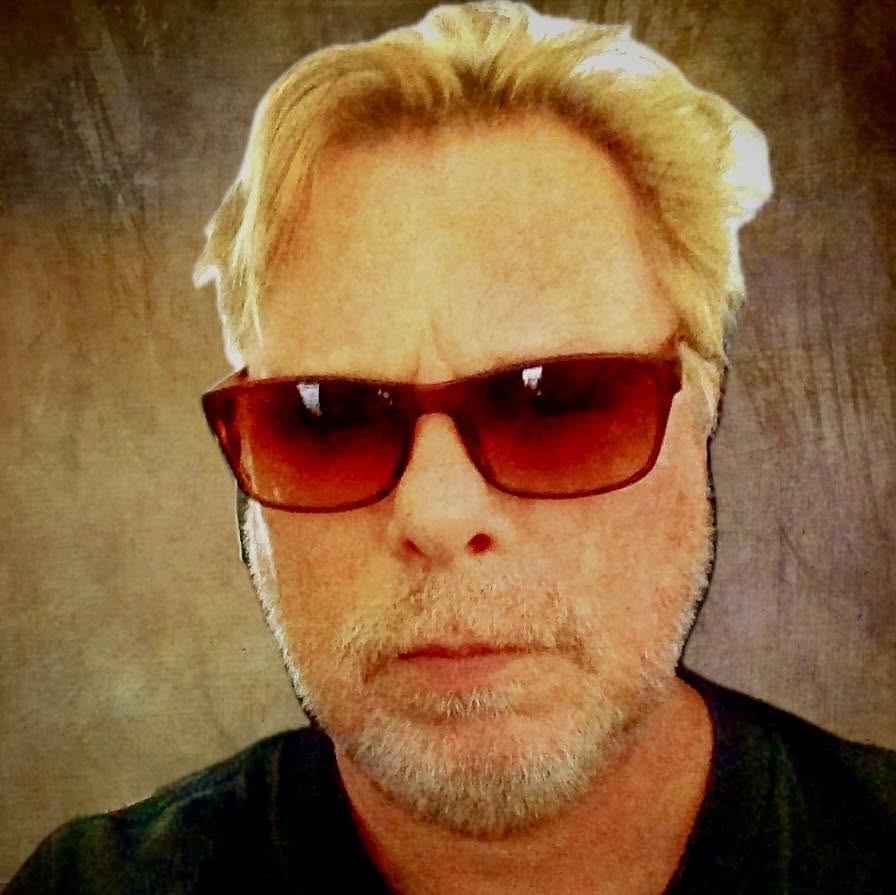
 In Caviar news, I have three more videos to finish, and they must be graded before I can move on to the last three modules. The final exam is where the metal meets the road. I anticipate successfully completing my Level III Caviar Sommelier Certification before the end of October, and then things will take a long leap off a short pier. I hope you'll be there when it happens and join me for the adventure. Meanwhile, remember artists like me (especially in the "Important Non-Commercial Art" world, need support to keep exploring, entertaining, and provoking our world. I hope you'll consider even the least of a contribution, which I've made so easy ... buy me a martini. That's my artist's fuel. I figure with regard to alcohol, as long as I'm not making myself into someone else's problem, it's our birthright to drink. Just ask spider monkeys and chimpanzees who seek out long-dropped fermented fruit, or dolphins that play with blowfish to enjoy their intoxicating toxins. I'm one of those creatures. But I leave behind, music, art, theatre, cinema, poetry, and help keep Gainesville as weird as fucking humanly possible. Because no matter how weird it gets here, it will never match the weirdness of the larger world. And you can take that to the orange bank and enjoy your meme or coin or steak or real estate school.
For this episode of the BuyMeACoffee Blog (which I've adjusted to BuyMeAMartini Blog), I thought I'd outline some of my wierder performance art pieces throughout the years, and including right up to my latest, Tom Miller Caviar Expert! Enjoy.
UFO Secrecy Protests
What is it?
Tom Miller’s UFO Secrecy Protests grew out of a longstanding fascination with UFO phenomena and the government’s secrecy surrounding them. Miller didn't simply make UFOs the subject of a joke; he researched the phenomenon and repeatedly took the demand for government disclosure into the public sphere, insisting that information being withheld from the public should be released. The premise that once seemed decidedly fringe has since entered the mainstream of American government: the Pentagon established the All-domain Anomaly Resolution Office (AARO), Congress has held UAP hearings, the government has released previously classified imagery, and AARO now maintains an expanding public archive of UAP records and unresolved cases.
Did it matter?
In retrospect, yes, and perhaps more than it appeared to at the time. Miller was asking publicly for UFO disclosure years before UAP became a serious subject of congressional and Pentagon attention. Today the government itself acknowledges a continuing need for greater transparency, has made large quantities of UAP-related material publicly available, and is actively soliciting firsthand information about government UAP programs dating back to 1945. The historical irony is delicious: Tom Miller was out there demanding that the government take UFOs seriously while the government was still largely treating the subject as something to be kept at arm's length. Now the government is doing precisely what his performances demanded, investigating, documenting and releasing UAP material. That doesn't prove every UFO claim Tom believed was correct, but it does make the basic premise of his protests look remarkably prescient.
Critical Reception
The individual UFO protests have not generated a large surviving body of formal art criticism, but their significance has grown with the extraordinary change in the cultural status of UFOs themselves. What could once be dismissed as fringe subject matter now sits inside an official government apparatus devoted to investigating UAP, with newly released military cases still being classified as unresolved. In that context, Miller's UFO performances can be viewed more favorably in retrospect: he wasn't merely jumping on a fashionable subject; he was artistically pursuing a question before the culture was ready to take that question seriously.
Tom's Sculpture of Nothing
What is it?
In 2016, Miller created Nothing, an invisible, three-dimensional sculpture in Gainesville’s Bo Diddley Plaza. Over five days, Miller and a crew of artists ceremonially “installed” Nothing, moving and assembling the invisible material for the public before unveiling the completed sculpture, which remained on display and was subsequently “removed.” The work explicitly drew on John Cage’s 4′33″ and Lecture on Nothing, but pushed the idea into physical space: instead of making a work from silence or absence, Miller proposed Nothing itself as sculpture. He also conceived the project as a meditation on what constitutes art, what deserves public funding, and whether an idea can itself become an artistic object.
Did it matter?
Absolutely. This is one of Miller’s strongest and most conceptually successful pieces. It took a deceptively simple idea and gave it an elaborate public existence, turning an ordinary civic plaza into the site of an impossible sculpture. The work subsequently acquired an unexpected second life when Italian artist Salvatore Garau marketed his own invisible sculpture in 2021 for €15,000/$18,000, prompting Miller to assert that he had established the concept five years earlier. The resulting controversy brought Miller’s Nothing to international attention, including coverage by Artnet and local television, and forced a larger question into the conversation: who owns an artistic idea, and what happens when an invisible artwork becomes a commercially valuable object?
Critical Reception
The response was unusually strong for a work that, quite literally, contained nothing. Gainesville media treated the installation as a significant and characteristically audacious Miller project, while Artnet later revisited it as the precursor to the Garau controversy. Miller also turned the experience into the film Nothing, which received official selection at the NYC Indie Film Festival and later won three awards at the Puerto Aventuras International Film Festival. Contemporary Gainesville coverage has continued to identify the invisible sculpture as one of Miller’s defining performances.
Bottom line: Nothing is not merely a clever gag. It is a genuinely elegant conceptual work: Miller took the oldest possible artistic material, absence, and insisted that it could occupy physical, civic and intellectual space. And the fact that another artist later put a price on essentially the same proposition gave Miller’s work an extraordinary, almost accidental afterlife.
Professor Miller
What is it?
Professor Miller was Tom Miller’s most ambitious long-duration performance: beginning in 2010–11, he deliberately played the role of a student who intended to become a professor, enrolling at Santa Fe College, then the University of Florida, and ultimately entering the David Lynch MFA screenwriting program at Maharishi University of Management. What began as a seven-year plan ultimately became roughly a ten-year performance, ending with his MFA graduation in 2020. The crucial conceptual move was making education itself the medium: the degree, the classrooms, the studying, the aging student, and the eventual transformation into an artist with an advanced degree were all part of the artwork.
Did it matter?
Yes. Probably more than almost any of the shorter pieces. It turned an ordinary life activity, going back to school, into sustained conceptual performance. It also explored aging, ambition, reinvention, institutional authority, and the strange boundary between performing a role and actually becoming the person you are pretending to be. By the end, Miller hadn't merely performed Professor Miller. He had actually accumulated the education, credentials and experiences the character set out to obtain. That collapse between art and life is the work's great conceptual achievement.
Critical Reception
The piece attracted legitimate local press from the beginning, including a 2011 Independent Florida Alligator feature explicitly titled “Artist Plays the Role of Student.” Gainesville Downtown later described the project as performance art in which Miller's education itself was the work. Miller continued publicly documenting its progress for years, and its conclusion became a major milestone in his artistic chronology. Professor Miller is arguably one of the clearest examples of Miller's central artistic idea: don't merely make an artwork, turn your life into the artwork and see what happens.
Tom Miller Turns Entire Career Over to GROK
What is it?
Tom Miller and AI is best understood as an artistic confrontation, not an embrace. Tom is fundamentally opposed to AI as a replacement for human creativity and authorship. His experiments with AI have been deliberately provocative, using the technology as a subject to interrogate rather than as a substitute for making art himself. He has been especially clear about maintaining a distinction between experimenting with AI as performance and allowing AI to write his actual creative work.
Did it matter?
Yes, precisely because of the opposition. Tom's position is essentially that art comes from the messy, subjective, lived experience of a human being, and that having a machine generate the work defeats something essential about the enterprise. His use of AI therefore becomes almost paradoxical: he engages with the thing he distrusts in order to expose what he believes we stand to lose. In that sense, AI becomes another material for the performance, like a cultural antagonist.
Critical Reception
This is still a developing chapter of Miller's work, so the critical record is thinner than it is for Nothing or Professor Miller. But conceptually, it fits his larger practice extremely well. Miller has spent his career questioning what qualifies as art, who gets to make it, and where the artist ends and the artwork begins. AI presents perhaps the most extreme version of that question. His answer is decidedly humanist: the machine can imitate the artwork, but it cannot live the life that produced it.
And that distinction is important. Tom Miller is not an AI artist. He is an artist who is deeply suspicious of AI.
Tom Miller IS Truman Capote
What is it?
The Truman Capote Marathon was Tom Miller’s 17-hour endurance performance in which he read Truman Capote’s In Cold Blood aloud, in character as Capote, dressed as the author and consuming mint juleps throughout the marathon. It was simultaneously a literary reading, an endurance piece, an act of inhabiting another artist, and an extended meditation on Capote himself. Miller wasn't simply presenting In Cold Blood, he temporarily became its author.
Did it matter?
Yes. It is one of Miller's clearest examples of turning admiration into performance. The extreme duration forces the audience to experience the book differently, while the decision to embody Capote collapses the distance between reader, writer, character, and performer. Miller himself later described the piece as being undertaken to honor and bring awareness to Capote, and it has remained one of the defining works repeatedly cited in accounts of his performance-art career.
Critical Reception
The marathon received substantial local attention and became part of Miller's established artistic mythology. Gainesville Downtown specifically highlighted the 17-hour Capote reading when profiling Miller's performance practice, while Miller's own archival materials identify it alongside Nothing, the Twin Peaks marathon, and Operation Copenhagen as culturally significant work created outside conventional commercial measures. The piece has also continued to be cited in later biographies and profiles of Miller. Among his performances, this may be the purest expression of Miller's willingness to surrender himself completely to another artist's world.
Tom Miller: The Naked Press Conference
What is it?
The Naked Press Conference was Tom Miller’s 1995 performance in which, while running for Gainesville City Commission, he held a press conference completely naked. It took the conventional ritual of political pressmanship, where candidates carefully manufacture an image, and stripped it literally and figuratively bare. The nudity wasn't incidental; it was the argument. Miller turned transparency in government into an act of actual physical transparency. The performance is consistently identified in biographical accounts as one of his signature works.
Did it matter?
Absolutely. It fused Miller's political activism and performance art in a way that is difficult to separate afterward. Instead of making another speech about honesty, openness and the absurdity of political theater, he made the political theater itself absurd. It also fits a recurring Miller strategy: take an ordinary institution, push one of its underlying ideas to an outrageous literal extreme, and see what the public discovers about the institution in the process.
Critical Reception
There doesn't appear to be a substantial body of formal art criticism devoted specifically to the piece, but its staying power is telling. Decades later, biographies, artist profiles and accounts of Miller's career still single out the Naked Press Conference alongside Nothing, the Capote Marathon and his UFO protests. WUFT included it when surveying the works that define Miller's Gainesville performance-art career.
Tom Miller: Do the Eagles Suck? A Scientific Proposition ...
What is it?
“Do the Eagles Suck? A Scientific Proposition” was a six-hour endurance/performance experiment staged November 20, 2016, at Maude's Cafe in Gainesville. Miller undertook the apparently impossible task of listening to every song on every Eagles studio album in one sitting, scoring each song “SUCK” or “DOES NOT SUCK.” He presented himself as the uniquely qualified scientist who would settle the question for America, invoking his experience as a musician, his Gainesville connection to the Eagles, and the complete absence of any evidence that another human had actually performed this experiment. The performance even included an introductory sermon by Reverend Angeldust, “Suck Charts,” a medic and security, and a deliberately authoritative methodology. November 20 was also chosen because it was National Absurdity Day.
And then comes the important part: Miller actually did the work. In the cold, he listened to the entire studio output, song by song. His final dataset was 79 songs: 36 “Sucks,” 43 “Doesn't Suck.” He therefore concluded, with mock-scientific certainty, that The Eagles do not suck. The experiment was not merely a joke about the Eagles. It was a carefully constructed parody of scientific authority, political authority, fandom, statistical objectivity and the human desire to outsource difficult judgments to somebody who claims to know better.
Did it matter?
Yes, and this is considerably more sophisticated than it first appears. Miller took a completely unserious question and gave it an almost preposterously serious methodology. The piece asks: What makes an opinion become a fact? Who gets to declare a verdict? How much evidence is enough? And why do we so desperately want someone else to make up our minds for us?
The political dimension is especially sharp. Miller explicitly modeled his claim to absolute authority on Donald Trump's 2016 “I alone” rhetoric, while the Eagles themselves had become a cultural absurdity through The Big Lebowski. Miller's performance therefore sat directly inside the political and cultural atmosphere of November 2016, turning the authoritarian claim to possess the one unquestionable answer into an absurd piece of cultural science.
And there is a beautiful conceptual twist: the experiment actually produces an answer. Miller wasn't pretending to listen to the records. He subjected himself to the ordeal, generated the tally, identified individual songs that succeeded or failed, and accepted the numerical result. The absurdity is built on a real investigation. That is what gives the piece teeth.
Critical Reception
The piece was recognized locally as part of Miller's serious performance-art practice. Gainesville Downtown singled it out alongside Nothing and the 17-hour Capote reading when describing the unusual breadth of Miller's work, specifically noting that he spent an entire afternoon and evening listening to every Eagles song to determine whether they sucked. The same profile described Miller explicitly as a performance artist rather than a comedian and connected the Eagles project to his larger practice of constructing elaborate performances around apparently ridiculous premises.
What makes the piece important in the larger Miller canon is that it demonstrates one of his most distinctive artistic weapons: he doesn't merely make absurd claims. He is willing to do the enormous amount of completely unnecessary work required to prove them. Six hours, 79 songs, charts, methodology, witnesses, ceremony, a verdict.
That's not simply a joke about The Eagles.
It's a performance about authority disguised as a joke about The Eagles. And in retrospect, coming in the final weeks of the 2016 election, it was an unusually pointed piece about America's appetite for people who announce, “I alone can decide.”
Tom Miller Reads All of Trump's Lies
What is it?
Tom Miller Reads Trump’s Lies was a proposed 38-hour endurance performance announced in December 2018, in which Miller planned to read, continuously and without editorial commentary, 3,924 documented false claims attributed to Donald Trump. The performance was scheduled to begin December 28 at 6 a.m. at Gainesville’s Hardback Café. Miller calculated that reading the entire collection would require approximately 38 hours. He planned only two 20-minute meditation breaks per day and three three-minute bathroom breaks, making the sheer duration part of the artwork.
The conceptual move is crucial: Miller wasn't going to tell the audience that Trump was lying. He was going to make them listen to the lies themselves. The artist removed himself as commentator and became a human delivery system for an enormous archive of political falsehood.
Did it matter?
Absolutely. It was an extraordinary response to the information environment of the Trump era. Miller recognized that the quantity of political falsehood was itself the subject. One lie can be debated. Hundreds can be fact-checked. Thousands become an endurance event.
That makes the work more than political protest. It is conceptual endurance art using time, repetition and accumulation as its medium. Miller's body becomes the measuring instrument: how long does it take one human being to physically speak thousands of false claims into existence?
And there is a beautiful restraint to the premise. Miller announced that he would simply read what Trump had said, rather than construct an argument around it. As he put it in the contemporary Gainesville Downtown profile, “nobody should be mad at me.” The absurdity comes from the scale of the undertaking and from letting the words indict themselves.
Critical Reception
The piece received national online attention before the scheduled performance. Daily Kos devoted a feature to the project under the headline “Wikipedia-listed, American Performance Artist Reads 38 Hours’ Worth of Trump’s Lies,” describing the planned 3,924-claim marathon and its unusually austere rules. Miller's own press archive prominently preserves the Daily Kos coverage and a later #TRUMPATHON interview, showing that the project became part of the documented public record of his work.
There is also an important place for this work in Miller's larger practice. Nothing made absence into sculpture. The Eagles experiment turned cultural judgment into scientific endurance. The Capote Marathon turned literature into bodily endurance. Trump's Lies turned political information overload into bodily endurance.
That makes it a particularly strong Miller piece because the medium isn't the message. The medium is the problem. Miller literally attempted to make his own body endure the informational burden of the Trump era.
Tom Miller: Operation Copenhagen
What is it?
Operation Copenhagen was Tom Miller turning a seemingly personal dream into a public experiment in community, friendship and collective possibility. Miller wanted to experience Noma in Copenhagen, then considered one of the most celebrated restaurants in the world. But the point was never simply getting himself to Denmark for an extraordinary dinner. He made the dream public and invited friends, supporters and fellow artists to help make it happen.
The project asked a deceptively simple question: What happens when we stop assuming we have to accomplish everything alone? Miller supplied the vision. Other people supplied encouragement, money, belief and practical support. The journey therefore became a demonstration of something much larger than a meal: that one person's seemingly improbable dream can become achievable when a community decides to lift that person up.
Did it matter?
The dinner was the artifact's destination. The real artwork was the act of getting there together.
Miller's performance proposed that having a singular vision matters, even when the vision initially seems excessive, impractical or ridiculous. Just as importantly, it proposed that friendship isn't merely emotional support. Friends can be active participants in one another's dreams.
That makes Operation Copenhagen a kind of demonstration project in mutual aid and human possibility. Miller deliberately made his own dream vulnerable to other people's response. Instead of pretending to be the self-sufficient heroic artist who does everything alone, he created a situation in which the work could only succeed through collective participation.
In that sense, Noma was almost the perfect destination. It represented something distant, exclusive and seemingly unattainable. Getting there became a practical metaphor: sometimes the difference between a dream and an achievement is simply finding people willing to help you carry it.
The deeper message is remarkably generous for an artist whose work can often be confrontational: Look out for each other. Believe in each other's visions. Help make each other's impossible things possible.
Critical Reception
The surviving documentation tends to emphasize the Copenhagen/Noma adventure itself, but viewed within Miller's larger body of performance work, Operation Copenhagen deserves to be understood as an important social-performance piece. Its medium was not simply travel or food. Its medium was human cooperation.
That also makes it an important precursor to Miller's later caviar project. Both involve entering an unfamiliar world of extraordinary food, but the earlier work establishes the underlying principle: a dream becomes more meaningful, not less, when other people participate in making it real.
The most interesting thing about Operation Copenhagen is therefore not that Tom Miller got to eat at Noma.
It's that he believed the dream was worth having, had the courage to say it out loud, and trusted his community enough to let them help make it come true.
Tom Miller Stares into Ted Cruz's Mouth for Two Hours
What is it?
“Staring Into the Mouth of Ted Cruz” was Tom Miller’s two-hour endurance performance at Gainesville’s Hardback Café during the 2016 presidential campaign. Miller sat before a large photograph of Ted Cruz and stared directly into Cruz’s mouth without breaking eye contact. He drank beer while friends deliberately tried to distract him, turning what sounds like a simple act into a genuine test of concentration and endurance. Miller called it the most dangerous thing he had ever done.
But the mouth was the point. Miller reduced a presidential candidate to one bizarre, intensely observed anatomical feature, stripping away the normal language of political analysis and replacing it with prolonged, almost ritualistic attention. The work subsequently expanded into a painting of Cruz’s lips and the documentary Burning Lips, in which the painting itself became part of the performance's increasingly surreal mythology.
Did it matter?
Absolutely. This was one of Miller’s breakthrough performances. It became a national story, with coverage from The Huffington Post, Gawker and other outlets, transforming an extremely local performance into a piece of nationally circulated political performance art. Miller later described the work as a satire of the absurdity of the political system.
More importantly, the apparent simplicity is deceptive. Two hours is long enough for the act to stop being a joke and become physically and psychologically strange. The audience is forced to contemplate the difference between looking and really looking, between political obsession and artistic obsession, and between the enormous importance we assign to political figures and the ridiculous physical reality of the person underneath the image.
And it directly generated the next work. When Miller's painting of Cruz's lips failed to sell, he developed the elaborate Burning Lips mythology around the supposedly possessed painting and ultimately burned it. What began as a stare became a painting, a supernatural narrative, a film and another performance.
Critical Reception
The reception was extraordinary for a Gainesville performance artist. Huffington Post made the event a national viral-news story, while Gawker covered it as an example of deliberately extreme performance art. Gainesville Downtown later identified the Cruz performance as one of Miller’s defining works and noted that it had attracted the attention of the Huffington Post.
And there is an important point about the piece's place in Miller's career: it wasn't simply an amusing internet story. It demonstrated that Miller could take an almost impossibly stupid premise and execute it with enough commitment that the premise became legitimate performance art. The press coverage was part of the artwork's afterlife, not the artwork's sole purpose.
In fact, the piece helped provoke Miller's subsequent “Nothing” sculpture. An InfoWars reporter criticized the Cruz performance by suggesting that contemporary artists didn't actually have to do anything. Miller's response was essentially: Fine. I'll make Nothing.
So the Cruz mouth wasn't an isolated gag. It was a pivotal Miller work: political satire, endurance art, portraiture, absurdism and media intervention compressed into one very uncomfortable stare.
Bunnay
What is it?
Bunnay appears to have been a recurring character/performance presence in Tom Miller’s FREDInk world in the mid-2000s and afterward, documented through a series of short films and live appearances rather than one conventional standalone production. The FREDInk archive preserves “Bunnay Live at Club Red – March 24, 2006,” “Bunnay Backstage – Common Grounds Miller & Chayce Reunion Show,” and “Bunnay – The Movie (Arrival by Limo).”
The surviving Gainesville theatrical record is particularly interesting: Shamrock McShane's Book of Gainesville Theatre lists “Bunnay Hop” and “Bunnay, the Movie” in its 2008 chronology, alongside the entry “Frog, Tom Miller.” That places Bunnay inside the city's broader experimental theater/performance ecosystem, not simply as an internet character.
And Frog absolutely belongs in the credits. The FREDInk archive documents a substantial Miller/Frog collaborative body of work, including Wally Falls in Love, Good Morning, Frog & Tom Miller Go to the Mall, the Miller & Frog Show, and other video pieces. Miller himself described Frog as a major collaborator and performance artist, and the two were repeatedly working together in Gainesville's underground scene.
Did it matter?
Yes, although Bunnay is important precisely because it demonstrates a different side of Miller's practice. Where Staring into the Mouth of Ted Cruz or Nothing isolates one conceptual idea and pushes it relentlessly, Bunnay belongs to Miller's larger project of turning Gainesville itself into an ongoing fictional/performance universe.
The character could migrate between live appearances, video, backstage footage, reunions, and other events. The existence of Bunnay Live, Bunnay Backstage, and Bunnay, the Movie suggests a deliberately porous boundary between character, documentary, theater, and performance.
That matters historically because this was happening before the current explosion of creator-personas, web characters, micro-cinema and deliberately blurred reality/performance identities. Miller wasn't making a clean distinction between “my art” and “the weird people who inhabit my artistic world.” He was building the world itself.
And Frog is crucial here. The Miller/Frog collaborations represent a particularly fertile strain of Gainesville's underground art culture, where experimental music, homemade cinema, theater, absurdism and live performance could all occupy the same room. The surviving archive is unusually valuable because it preserves that ecosystem rather than merely a polished finished product.
Critical Reception
There isn't a substantial surviving body of conventional criticism devoted specifically to Bunnay, so I wouldn't manufacture one. What is significant is that Bunnay survived in multiple independent archival systems: Miller's FREDInk collection, the Gainesville theatrical chronology maintained by Shamrock McShane, and records of Gainesville's live experimental scene.
That gives Bunnay a different kind of importance. It is an artifact of a living underground culture. The work wasn't necessarily trying to enter the museum; it was helping create the strange little universe in which Gainesville artists could continually make things, characters could recur, and the distinction between a movie, a show, a happening and someone's bizarre arrival by limousine could become deliberately meaningless.
Credits: Tom Miller and Frog, with Bunnay as the central performance/character presence; preserved through the FREDInk Archives.
Bunnay may be less famous than Nothing or Ted Cruz, but it could be more revealing about how Miller actually built his artistic universe: not one outrageous performance at a time, but by creating an interconnected mythology of people, characters, films, shows and happenings that kept leaking into one another.
Tom Miller - Caviar Reviews for the Common Man
What is it?
Tom Miller: Caviar Influencer is Miller turning the pursuit of expertise itself into a performance. In 2026, he began studying for APWASI’s Caviar Sommelier certification, launched “Caviar Reviews for the Common Man,” and set himself the deliberately audacious goal of going from novice to recognized caviar authority while documenting the process publicly. He launched the YouTube channel @tommillersnoots with the first review scheduled for National Caviar Day, July 18, 2026.
The important distinction is that he is not yet presenting himself as a certified expert. The project is explicitly about watching someone become one. Miller has described APWASI as essentially “caviar college,” and the project encompasses tastings, producer relationships, education, interviews, blind comparisons and eventually industry travel. He has also secured an affiliate ambassador relationship with Regalis Fine Foods.
Did it matter?
Yes, because this may be one of Miller's clearest examples of turning self-reinvention into the medium itself.
Professor Miller turned becoming educated into performance. Nothing turned absence into an object. The Capote marathon turned literary devotion into endurance. The caviar project turns learning to become an expert into a public artwork.
There is also a wonderfully subversive element to the phrase Caviar Reviews for the Common Man. Caviar traditionally signifies exclusivity, wealth and connoisseurship. Miller's stated objective is almost the opposite: demystify it, learn what actually makes one caviar different from another, and bring ordinary viewers along for the education. The Gainesville Iguana's profile specifically characterized the project as an attempt to understand caviar rather than simply flaunt its luxury.
And the ambition is characteristically Miller-sized: he wants to document the journey from essentially zero subscribers toward one million, making the audience a witness to the transformation rather than presenting a finished persona.
Critical Reception
The early response is unusually interesting because the project has already begun receiving arts-oriented interpretation rather than merely food-influencer coverage. A July 2026 review on Miller's site described the inaugural episode as a form of conceptual art as well as food education, arguing that its appeal comes from the combination of seriousness, humor and Miller's willingness to make the learning process itself visible.
More significantly, The Gainesville Iguana gave the project an extended feature under the headline “Performance artist Tom Miller’s wildest reinvention yet?” and explicitly placed the caviar pursuit within the continuum of Miller's decades of performance work.
That is where I think the work becomes genuinely compelling: Miller isn't pretending that eating expensive fish eggs is inherently art. He's making the obsessive pursuit of mastery the artwork. The caviar is the material. The transformation of the artist is the performance.
And that makes Tom Miller Caviar Influencer potentially one of his most revealing long-duration pieces yet.
There's a lot more, but hopefully this gives you some insight into what I'm trying to accomplish with art, and why I need a martini. (And a cigar, and a lobster, and a hug.) Remember, if you like this post, "Support, like, and subscribe!" I've always wanted to say that.
Cheers,
TM