
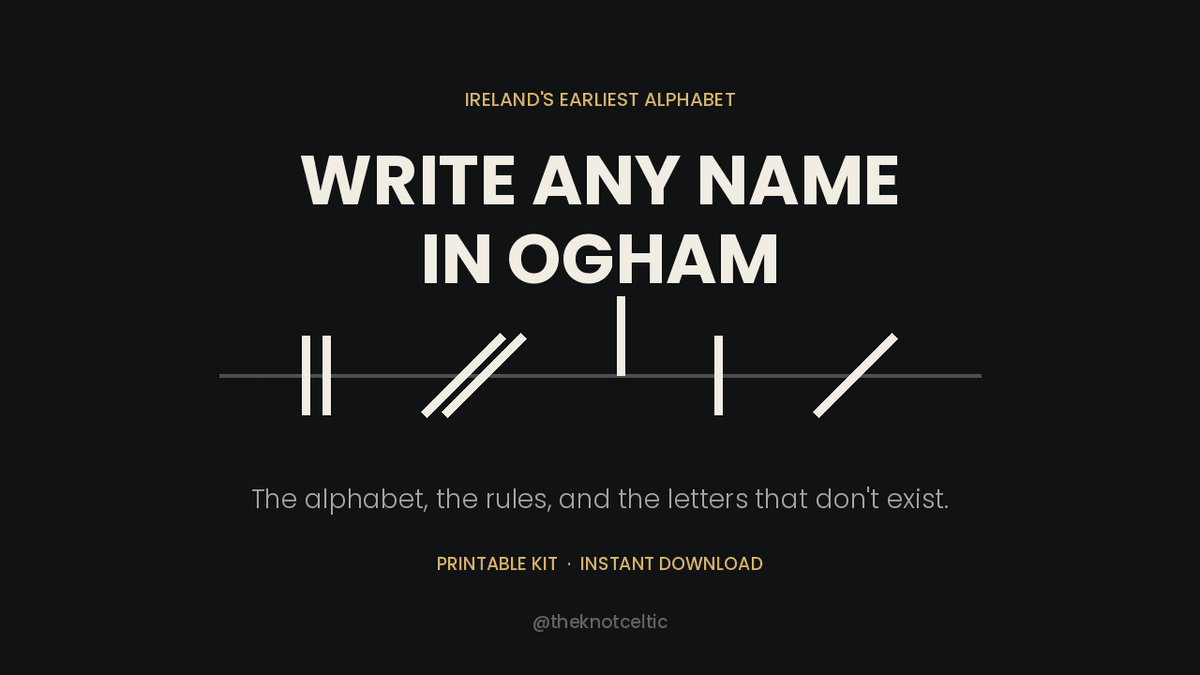
Write Any Name in Ogham
$9
Ireland's earliest alphabet, and everything you need to use it yourself.
Ogham was cut into the edges of standing stones from around the fourth century — twenty letters made of strokes across a line. About four hundred of those stones still stand in Ireland.
What's in it
The twenty letters, drawn clearly, with each one's Irish name and the tree it traditionally carries. How the four groups work — below the line, above it, diagonally across, straight through. The missing letters and what to do about them. Two worked examples: one name that writes cleanly, one that looks impossible until you know the rule. And blank stems at print size, so you can write it yourself.
Nine pages, A4 and A3.
The part nobody tells you
There is no J, K, P, V, W, X or Y in ogham. They never existed.
But ogham was cut for sound, not for English spelling — so most names people assume can't be written actually can. Kieran becomes Ciarán and writes cleanly, because C carries the same sound. A free generator won't tell you that; it'll either refuse your name or quietly write it wrong.
An honest note
The tree names come from a medieval scholarly tradition rather than from the stones, and the sources disagree. And the "meanings" you'll see on other charts — protection, new beginnings, transformation — are twentieth-century inventions, largely from Robert Graves in 1948. They aren't in the manuscripts and they aren't in this.
What you're getting is what's actually known, with the uncertain parts marked as uncertain.
If you'd rather I did it
I also write individual names by hand — see the ogham name cards.
$9
Saisissez un prix raisonnable
$
$9