

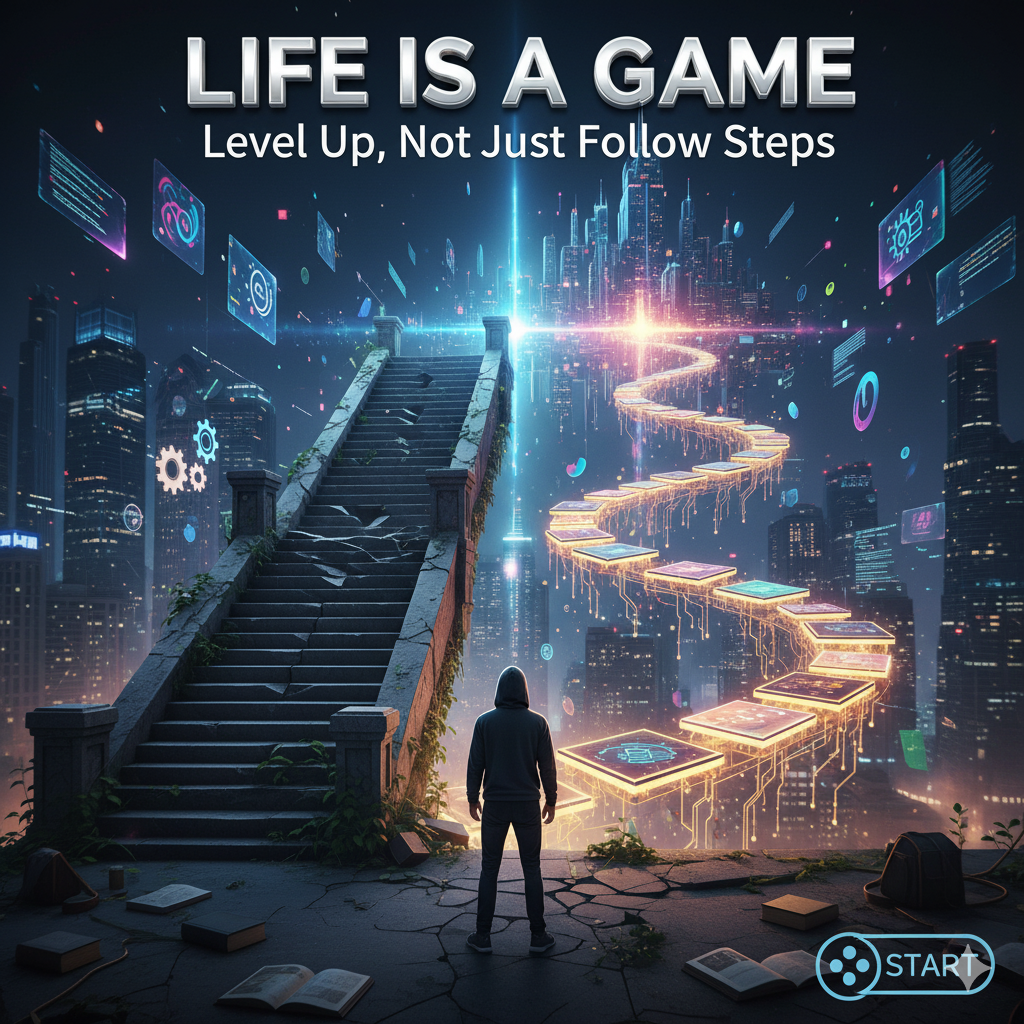
Last week, I wrote about the steep price we are forced to pay for following laid-down patterns and trying to find some steps or a curriculum to take to get to the place you wish to be. In this search for certainty in this seemingly chaotic world, many people read biographies as if they were school textbooks. That sucks.
You can go back and read it here: The Price of Certainty: How Security Becomes a Prison — Zarathustra of Finance.
Okay, there is a strong possibility that writing this may look hypocritical, because it seems like I am about to provide a solution to one of life's biggest questions: what do I do with myself? When I said there is no pattern to life, I may be wrong and I may not be wrong, but I will leave the verdict to the reader.
As we step out of the classroom and into the real world, we are faced with a myriad of options. We often seek safety by continuing in the industry we studied in school. If that's not available, we may opt for the nearest, highest-paying job and build from there. Some of us, however, take a step back and actively seek out the option we are truly interested in, even if the pay is less. The power of choice is in our hands, and it's up to us to decide our path. But most people choose the option with the highest pay, even if they do not like that field.
There are multiple ways to become a master of a craft. A couple of examples:
Choose the one you really love and then become the best you can be at it.
Choose the one with the highest demand and best rewards, even if you don't like it; master it until you love it, and then become the best you can be at it.
Choose the one that is available to you, make the best of it, and become the best you can be at it. And if it is not working, look for a way to use that as a launchpad to get into the industry you really love, and then become the best you can be at it.
There's no one-size-fits-all formula for success. But the question that often arises is: how can you become the best at something you don't like? It seems impossible. However, life is never straightforward. Sometimes we are forced to do things we don't like, but we can stick with it while preparing for an opportunity in an industry that strongly calls to us. This journey requires dedication and a deep understanding of the field, and it's this understanding that can lead to success.
My own journey is a testament to the fact that personal growth often involves unexpected career shifts. I switched to finance after getting my medical degree. It seemed neat, but it wasn't. Many twists and turns led me there. It's easy to assume that I finished youth service, promptly looked for a job in finance, got in, and then started learning the ropes. But that's not how it happened.
I was in my fourth year of medical school when I got a job as a cyber cafe assistant. A year after that, I set up one for medical students. The internet led me into the world of technology, but running the cyber cafe led me into bookkeeping, and then into the world of venture funding. The idea of funding businesses and watching them mature and grow intrigued me. And that was how I found my way to the stock market.
And then I started reading about stock valuations, company valuations, until a friend told me about the CFA Program from CFA Institute. I set up an investment club while I was still in medical school. When I started my internship, I started managing portfolios for senior doctors. It was during my youth service that I started preparing for the CFA examinations. I did not register for the exams because I was looking for a job—I was a medical doctor. I registered because I loved the idea of investing. Not once did it cross my mind to cross over.
It was during that time that I met someone who was amazed by my level of understanding of finance. The person suggested I speak with a friend of hers who was setting up a bank's asset management arm in Lagos. I did that, and I got an offer letter to work as an investment analyst 6 months before the end of my youth service.
In my head, I was like, "That's not going to work. I am a medical doctor. This is just a hobby."
A series of events happened: I finished youth service and was waiting for a call-up to come and work as a medical officer in some of the hospitals I had applied to, when I decided to dust off the offer letter and went to Lagos. I mean, someone wanted to pay me for what I was already doing for free. It did not look real. Someone actually wants to pay me big money to come and "play."
Three months after I started working as an analyst, I received my first offer to work at a hospital. The offer was a quarter of what I was already earning. And that was it.
But that was not the end. The CFA exams were grueling. There are three levels, and you receive the curriculum when you register. Each level has 5-6 books, each with about 300-500 pages. Some providers summarize the books and condense them to about 50 pages each. All you needed to do to pass the exams was have some understanding of the concepts and cram the formulae. I read the curriculum to understand the concepts and how the formulae were derived. This meant that I understood the concepts down to the molecular level. I did not grasp the weight of this until I started working. This understanding stood me apart in any room I walked into. People assumed I was just a medical doctor moonlighting as an analyst, looking for money, until I opened my mouth.
What happened here?
I played the game in hard mode. Remember from last week when I said people moved from one stage to the other, just like they did in school by putting in the bare minimum at work? That is precisely what people do in real life. They coast along, get promotions, get the next job, get the next gig, while keeping their eyes on the money. With time, they build valuable skills and experience. But something is missing: the x-factor.
Now, if you are a gamer (and even if you are not), you will understand this. If you are playing a game, you need to complete a level and get perfect scores before you can go on to the next level. Some games will allow you to go to the next level, but you must come back to complete the tasks before you can end the game. In the game of life, you don't need to have a perfect score before moving to the next level. But what if you decide to switch to game mode and get perfect scores before going to the next level?
This is where things change. Can you do this if you are in an industry you don't love? You can, but it won't be very easy. But if you are doing something you love, it does not make it easier, but it makes it worth it. You look at this game from a different perspective. You have stopped assigning a monetary value to it, and you do so because you love it. The difference might not be much at the beginning stages, but give it just a little time, and you will know why Cristiano Ronaldo is different from Eden Hazard.
That is my story, a testament to the power of passion, perseverance, and the willingness to take risks in shaping a successful career. I hope my journey inspires you to reflect on your own career choices and strive for mastery and fulfillment in your chosen field.