

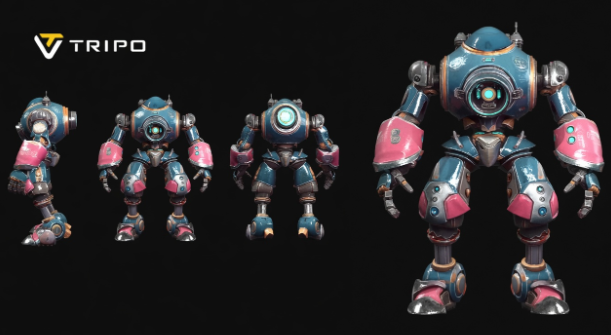
All across industries, rapid concept validation is desired in the current design process. In the world of designers, superior techniques to test ideas before going into production are now required. Traditional modeling is cumbersome and takes a long time to innovate. With the help of the advanced AI-powered tools, Tripo 3D can convert sketches into assets faster. This change is to be used for product design, gaming, architecture, and visualization workflows. Using fast prototyping, delays in the initial stages of development can be reduced, and decision-making can be improved. However, speed and accuracy are becoming more important in the world of creative industries as a key to competitiveness and efficiency in the production process in the digital era.
Why Sketch-Based Prototyping Often Slows Traditional 3D Development
One of the big problems that may prevent the prototype development is the problem of reconstruction from a flat drawing, which is a manual reconstruction process if sketch-based modeling is adopted. Designer manual interpretation causes delays in the proportion, depth, and structure interpretations. 2D sketches to 3D geometry are not accurate in terms of shape. Longer iterations, repeated changes, and corrections. Workflows that require a lot of resources require highly trained employees and more sophisticated software. Communication problems between concept artists and modelers often further delay progress in many instances. To overcome these challenges, Tripo 3D offers a streamlined approach to conversion with its AI 3d model generator technology, which minimizes manual effort and enhances speed.
How AI 3D Model Generator Converts Sketches into Detailed 3D Assets
AI systems analyze sketches, decomposing their structure into contours, forms, and spatial relationships. These systems understand proportions and turn flat visuals into structured 3D meshes. The 2D concept art and illustrations are transformed into 3D models and remain true to the design. This will help in achieving the consistent appearance of the output and sketch. Depth, geometry, and surface detail are automatically improved with advanced processing. Tripo 3D offers image to 3d conversion workflows that can easily and rapidly create usable 3D assets from simple inputs. This method greatly saves time in manual modeling and ensures fidelity and accuracy between various creative applications and industries.
Key Advantages of Using Tripo 3D for Fast Prototyping
Tripo text to 3d model offers quicker workflows, which can reduce the time from concept to actual model development. Reduces time spent by designers doing manual work during initial development phases. Iteration cycles are shortened, allowing for several iterations of the design in a shorter time. The sooner realistic models are viewed, the better collaboration can occur. This contributes to the more accurate design in the end. The platform provides less tedious conversions from sketches to usable assets. It also caters to large creative teams with scalable workflows. Efficiency gains are made at several points in the design development process, leading to a more flexible and reliable prototype process for the creative needs of today.
Essential Sketch Characteristics That Improve AI Model Generation
High-quality sketch inputs are needed for high-quality AI outputs, and the input must be clear and well-structured. The system will have a better recognition of the shapes if they have clean outlines. The accuracy of the models produced is increased by proportions that are maintained. Single-view sketches provide basic structure, and multi-view inputs provide dimensional understanding: the more reference information, the more accurate the final outputs. Processes are less confusing with clear borders and identifiable shapes. The AI system improves spatial interpretation because of the balanced composition. The best results with Tripo 3D occur when sketches are clear, well-structured, and with minimal visual noise to ensure the accuracy of the reconstruction and high-quality models in various design scenarios.
Steps to turn sketches into assets with an AI 3D model generator for fast prototyping
Step 1: Sketch Import and Project Setup
First access Tripo 3D and create your account. Then open the "Model" tab from the vertical left menu bar.
Choose the "HD Model" option to begin generation from visuals or sketches.
Upload your sketch by dragging and dropping it or use the "Upload" tab to select a file from your device.
If no sketch is available, switch to "Text to model" and describe your idea using a text prompt.
Step 2: Fast Prototyping Configuration
Open "General settings" and enable "AI complete" so the system can fully auto-generate your model.
Adjust "Texture Quality" for faster iteration or higher detail, such as 2K, 4K, or 8K.
Enable "PBR" to ensure realistic material response and reflections.
Select "Quad" or "Triangle" topology depending on your prototype needs.
Choose a model version like v3.1, best quality, v3.0 fast and balanced, or v2.5 legacy.
If available, activate "Generate in Parts", "8K Texture", and "Privacy" for advanced control.
Click "Generate Model" to start the fast prototyping process.
Step 3: Preview and Export Prototype
View your model using styles like "Solid View", "Cartoon Style", "Sketch Style", "Hologram Style", or "Unlit". Use "Refine" if adjustments are needed.
Adjust "Environment Settings" and reposition the camera using "Reset Camera".
You can send the model for 3D printing using "3D Print" if needed.
Finish by opening "Export", selecting resolution, format, and file name, then click "Export" to save it locally.
Features That Help Turn Prototypes into Editable Assets
Tripo 3D offers clean topology for seamless editing and animation preparation. Optimized for efficient workflow between tools with structured mesh organization. With the use of high-resolution texturing, the generated assets are more realistic. Export-ready formats enable integration with the leading 3D software. Flexibility in design to suit downstream pipelines. These features allow prototypes to be quickly and easily deployed in production environments with minimal rework. The system reduces manual editing and provides qualitative results for animation, visualization, and manufacturing processes in industries where precision and scalability are required.
Fast Prototyping Applications Across Creative Industries
This pre-visualization of the idea is beneficial to the design of the product prior to the engineering process. Gaming industries convert sketches into playable assets for quicker development. Architecture teams develop drawings and turn them into detailed spatial models for presentation. Generated assets are used as base models for the animation workflow. Quick production of functional prototypes for testing by 3D printing. Faster iterations and shorter modeling time for both industries. Tripo 3D empowers these applications by offering a quick time to market for ideas to be turned into usable digital assets in several creative production environments and pipelines.
Integrating Generated Assets into Broader Creative Pipelines
The generated models are compatible with the most popular 3D software used in professional workflows. Assets can be set up for rendering, animation, and simulation. They are used by designers to present and to get designs approved by stakeholders. Export options for game engine and visualization tools. These assets help speed up the decision-making process with realistic previews early in production. Integration improves the cooperation of the teams participating in the complex projects. By ensuring that the generated outputs are flexible and adaptable, Tripo 3D ensures that the 3D assets are easily managed and deployed in the ever-evolving creative workflows of industries that require efficient asset management and deployment.
Conclusion
Tripo 3D transforms sketches into usable digital resources in a short time and with a higher accuracy. It cuts the amount of manual modeling and enhances the design flexibility for designers. Rapid prototyping becomes more accessible in various industries such as gaming, architecture, and product design. AI-driven workflows enhance precision, uniformity, and production readiness. For today's creators, there is a quicker iteration cycle and improved visualization. AI technology is revolutionizing the concept of the final 3D asset workflow. This shift represents the next step in digital content creation, efficiency, scale, and intelligence in today's design landscape.