

I’ve been thinking a lot about death lately. The strange thing is that this does not make me feel despairing or sad, but then that is probably because Marcus Aurelius was right. (He was right about almost everything.) He believed that it was the contemplation of death that sets us free. The moment you accept that you are going to die and everyone is going to die then you are, oddly, liberated. He called this memento mori, and it’s one of the most useful tools in my toolbox.
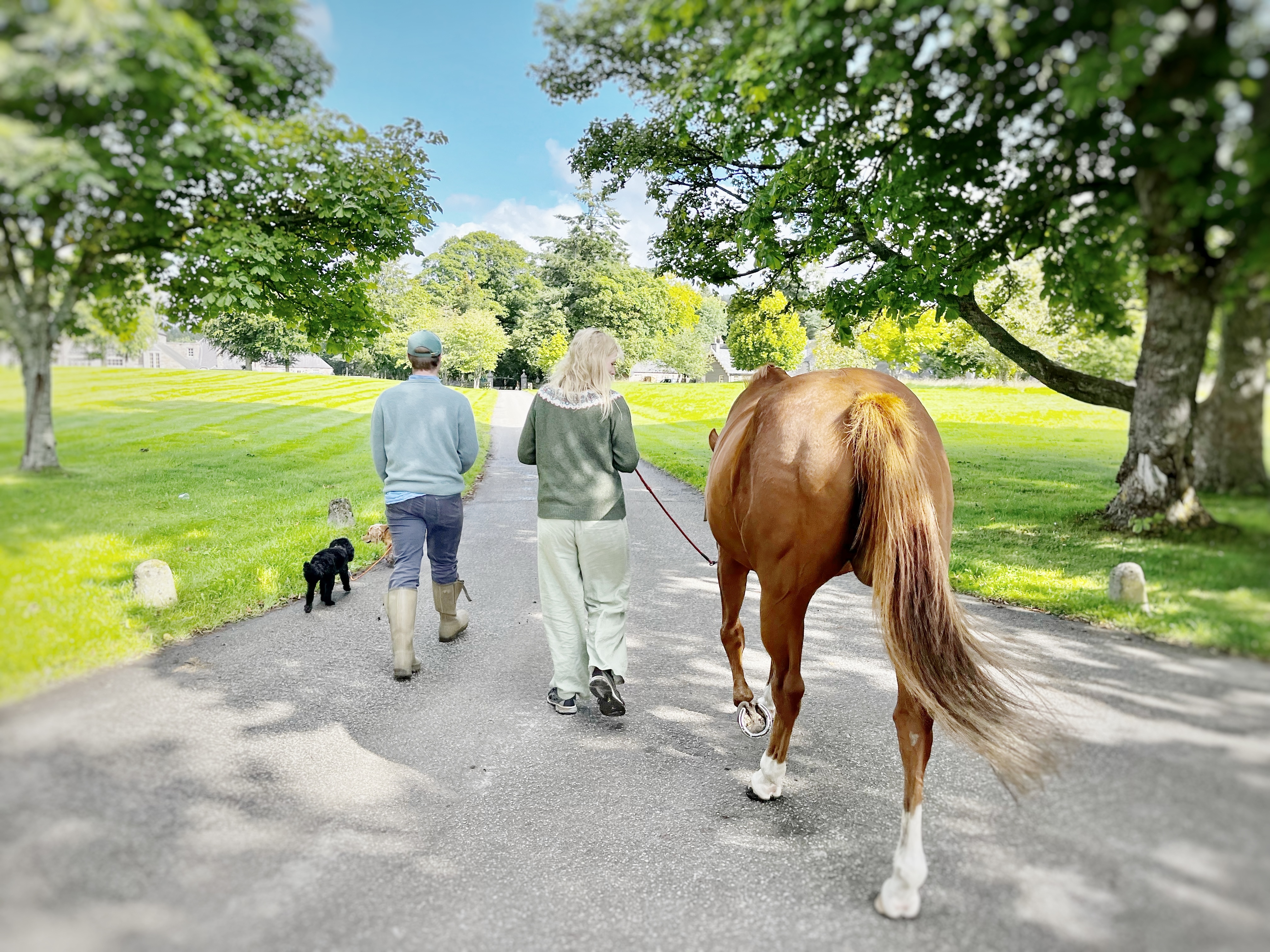
I was walking this morning with my niece and her adorable husband (the adorableness grows and grows) and we were in a particularly beautiful and serene oak wood not far from where I live and I looked up at the trees and said, ‘It gives me immense comfort to think these trees were here hundreds of years before I existed and they will be here hundreds of years after I am gone.’
There was profound joy and delight out on that walk. The red mare came with, and spread her inimitable brand of peace about her like a cloak. The happy faces of the newlyweds shone out into the bright world. We talked and laughed and the dogs ran around and Scotland beamed her beneficence down on us and all was well.
But here’s the question. I can do my memento mori and channel Marcus Aurelius but the slight glitch in the machine is that’s all death in abstract. Abstract death is excellent, because it makes us cherish our one wild and precious life. Where it gets gnarly is the other kind of death. The real, brutal, unexpected, unfair, rip-up-your life death. The untimely death of a child, for instance. I was reading this morning a piece by a father who lost his shining thirteen-year-old girl to sepsis. It was totally avoidable. Carelessness and complacency in the hospital doomed his child. She could have been treated and lived her life, but people went away for the weekend and missed the signs and she died, needlessly.
I read his wrenching words and then I found a link to a piece her mother had written and I saw more agonising, life-changing heart-smash. They are forever Other, and they know it. The mother said it’s like you go and live on an island, separate from the mainland, and you can never go back.
What do you do with that? How do you get up in the morning and clean your teeth and act like a reasonable human in the world?
I know quite a lot about grief. I’ve had my share of funerals and farewells. Friends, cousins, horses, dogs, parents; I’ve had to let them all go, with as much courage and grace as I could muster. I know what it is to feel the darkness come in and to fear that I will never again find the light. And I study grief - Joan Didion, C.S. Lewis, the mighty Julia Samuel. I know it is part of life and I think if I learn enough about it I might be able to figure it out.
But I’ve never experienced anything like those parents are going through, and I have a friend of my own who also lost his beloved boy and I don’t know what he is going through. My questions are many and I’m not sure they have answers. I sometimes feel almost guilty that I have the walks and the red mare and the oak wood and the beauty when, not so very far away, someone is so broken that no beauty can console them. I think about the collective weight of grief, and how that works. (I think a lot about the war, because I grew up with parents who lived through it as children, whose fathers fought in it. The awareness of the losses of the whole nation was very vivid when I was little and still lives in me.) I think of how, even now, we moderns don’t talk very much about grief or death. There’s still an idea that everyone should just get on with it. I get a little confused by the fact that I know what it is to lose a mother and a father, but I still put off writing a note to someone who has just buried her own mother, because I can’t find the right words, and language somehow seems paltry and pointless, and I have the old fear of saying the wrong thing.
Is it just that we do what we can? Send that note, even if it’s not much in the face of such loss; or be gentle with people, because we never know who is broken-hearted; or never get blasé when we ourselves are in a time of good fortune. (For me, at this age, good fortune really is a season when nobody has died.)
I can’t quite work it out, but I’ll keep on trying.
When I’m thinking of these things, I come back often to the magnificent, moving lines of E.M. Forster in A Room With A View.
‘We cast a shadow on something wherever we stand, and it is no good moving from place to place to save things; because the shadow always follows. Choose a place where you won't do harm - yes, choose a place where you won't do very much harm, and stand in it for all you are worth, facing the sunshine.’
Every time I remember these words, different ones jump out at me. Today, they are - ‘stand in it for all you are worth’. That feels hopeful and real and true. I have to remember that you can’t change people or fix people or save people. But you can stand beside them, and see them, and hear them, and honour them. You can send a little line of love, even if it doesn’t feel like much. Perhaps all the little loves add up to something vast, in the end.