

There is a line often attributed to Christina of Denmark when she was proposed as a potential bride to Henry VIII:
“If I had two heads, one should be at the King of England’s disposal.”
Whether she actually said it is uncertain. But the fact that people believed she might have said it tells you everything. Because it immediately raises a simple question:
What happened to Henry VIII’s six wives?
Most people remember the answer: divorced, beheaded, died; divorced, beheaded, survived.
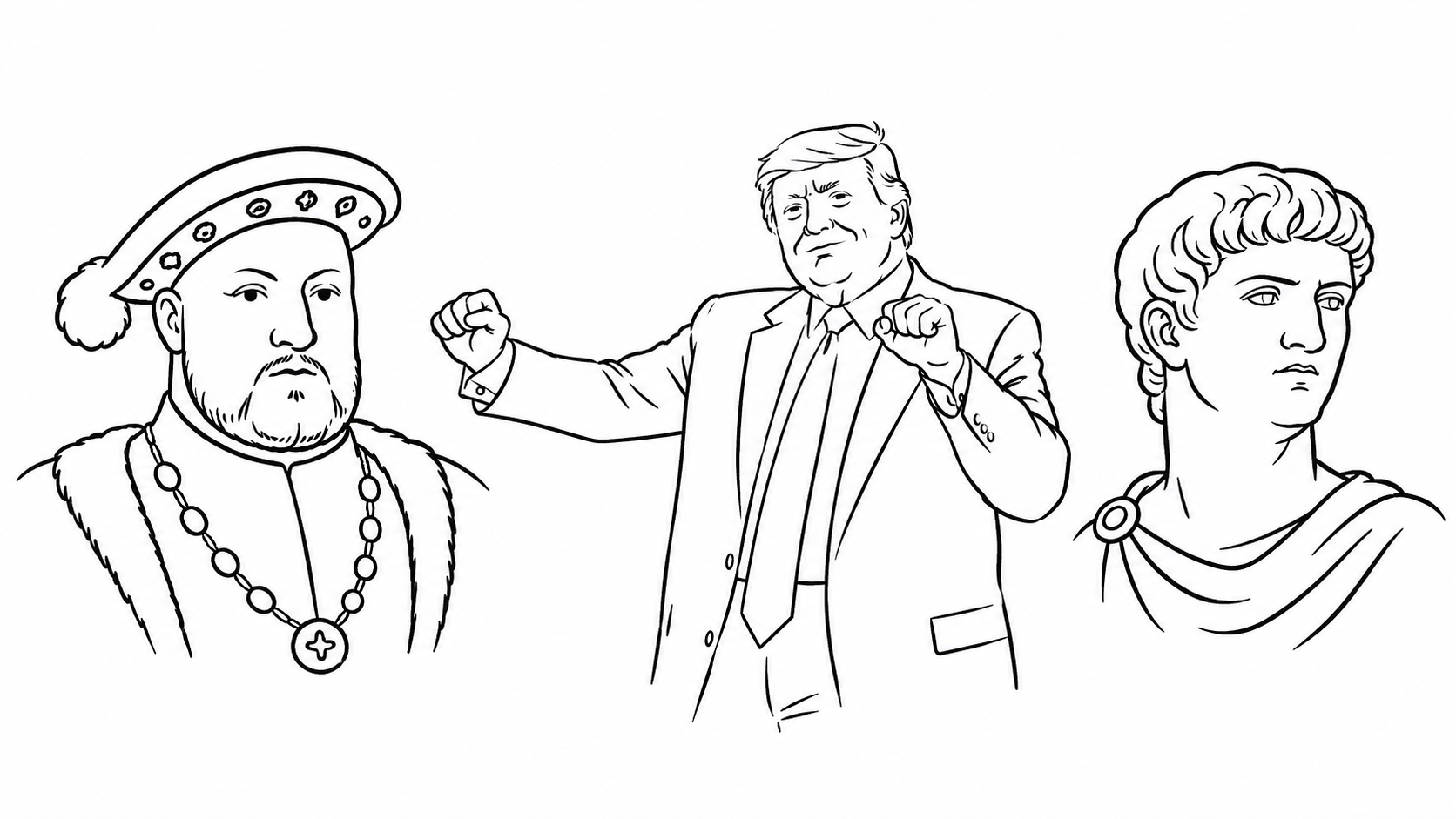
I. Henry VIII: Impulse, Pain, and Structural Transformation
But instead of treating this as gossip, I want to ask a different question:
Why were there six?
Let’s start with the first two.
Henry wanted a divorce. But divorce required approval from the Pope. That means there was an authority above the king.
And Henry’s response was simple:
If the system does not give me what I want, I will change the system.
So he broke from Rome. England became independent from the Papacy.
At first glance, this looks like pure impulse. He wanted something. He could not get it. So he forced it.
No grand design. No long-term plan. Just:
Act on impulse. That’s it.
But here is a way to think about it differently.
Growth often requires shedding. A crab grows by molting its shell. The process is not smooth. It is uncomfortable, even painful. But without it, growth is impossible.
Or think about illness. Sometimes, to recover and live longer, a body needs surgery. Surgery is not pleasant. It is invasive, painful, and consumes the body’s energy. Afterward, the body needs time to recover. But without the operation, the condition may only worsen.
Henry VIII’s actions can be understood in a similar way. Breaking from Rome was not a gentle reform. It was disruptive, costly, and in many ways violent.
religious authority was overturned
monasteries were dissolved
property and wealth were redistributed
These were not carefully designed reforms. They were, to a large extent, by-products of his will.
But those by-products mattered. They removed external constraints. They consolidated authority. They restructured power.
And this is where the long-term consequences begin to appear. Once England was no longer under Papal authority, it became a more self-contained political system. Over time, this made possible later developments such as:
the strengthening of Parliament
the evolution of constitutional practices
and eventually events like the Glorious Revolution
It would be too strong to say Henry VIII caused these directly.
But it is reasonable to say:
He removed a constraint that might otherwise have prevented them.
Here is the paradox.
Henry VIII was not trying to build a modern state. He was trying to remove anything that limited his will. But in doing so, he unintentionally created conditions that others could build upon.
And he did not complete the story. Others did. Most notably, Elizabeth I. Under her rule, England stabilized, consolidated, and moved forward.
So instead of saying:
“Henry VIII made England great,”
it is more accurate to say:
Henry VIII broke the shell. Others made use of what emerged.
II. Donald Trump: Breaking Constraints or Breaking the System?
If we move to Donald Trump, the comparison becomes tempting, though imperfect. There is a similar perception of:
acting on instinct
disregarding established norms
treating institutions as constraints rather than foundations
At times, policies appear arbitrary. Decisions feel personal. And reactions are often polarized.
But there is also another way to interpret this. Perhaps, in some cases, what appears as disruption is actually an attempt to:
shake off constraints that no longer function as intended.
There is a simple analogy:
An apple a day keeps the doctor away.
A rotten apple a day keeps the health away.
If an institution no longer produces the benefits it was designed to produce, then the question becomes:
Does it still deserve to remain unchanged?
This is not an argument against democracy. Democracy is, in principle, a valuable system. But it is not self-sustaining. It has conditions.
If you read The Federalist Papers, or Alexis de Tocqueville’s Democracy in America, one thing becomes clear:
A functioning democracy depends on the quality of its citizens. It requires:
a well-educated electorate
the ability to think critically
a willingness to participate responsibly in public life
When these conditions weaken, the system itself begins to change.
Two observations illustrate this tension.
First, the expansion of suffrage has coincided, in some arguments, with concerns about declining educational quality. Second, civic participation is uneven.
In some cases, participation is not just uneven—it is extremely limited. Even in New York City's 2025 mayoral election—the highest-turnout race since 1969—the winner was elected by roughly one in five registered voters, with a clear majority of the electorate not participating at all.
When participation is limited and engagement declines, a democratic system may still function procedurally, but its outcomes may not reflect broad, informed public deliberation.
In this context, one could interpret disruptive leadership in two ways:
either as destabilizing a system
or as reacting to underlying weaknesses within it
Unlike Henry VIII, however, Trump cannot redefine the system unilaterally. He operates within:
courts
elections
institutional checks
So what we observe is not pure transformation, but:
tension between individual will and institutional structure.
And the outcome remains uncertain.
President Trump on politics: It is vicious, it's full of lies, deceit and deception
III. Nero: Destruction Without Renewal
Then there is Nero.
At first glance, he also fits the pattern:
impulsive
self-centered
dismissive of constraints
There is, of course, the famous story of Rome burning. Whether he actually played music while the city burned is doubtful. But that is not the key issue. The real issue is structural.
Unlike Henry VIII, Nero did not replace what he weakened.
he alienated elites
he strained resources
he destabilized governance
But he did not build anything durable in return.
After his death came the Year of the Four Emperors (69 CE).
Instability. Rapid turnover. A breakdown of order.
Rome did not collapse. But it came dangerously close. After Nero’s death, the empire fell into violent instability—the Year of the Four Emperors. The system did not hold because of Nero. It held because it was strong enough to survive him—and because others eventually restored order.
So it would be too simple to say:
Henry VIII represents “disruption that leads to structure,”
while Nero represents “disruption without reconstruction.”
Because neither of them controlled what came after their death.
A more careful way to think about it is this:
They did not determine the outcome.
They changed the conditions under which outcomes became possible.
Henry VIII did not build the system that followed him. But he removed constraints and altered structures in ways that made certain developments possible.
Nero did not decide that Rome would fall into chaos. But he weakened the system to a point where instability became much more likely.
So the difference is not about intention, or even direct consequence. It is about something more subtle:
what kind of structural residue their actions left behind.
Conclusion
So the distinction is not about personality. Not about whether someone is impulsive, arrogant, or disruptive.
The real difference is this:
What remains after the disruption?
Some disruptions remove constraints and make growth possible
Some disruptions destroy without rebuilding
And some are still unfolding
History does not reward impulse. It does not punish it either.
It only reveals what survives it.