


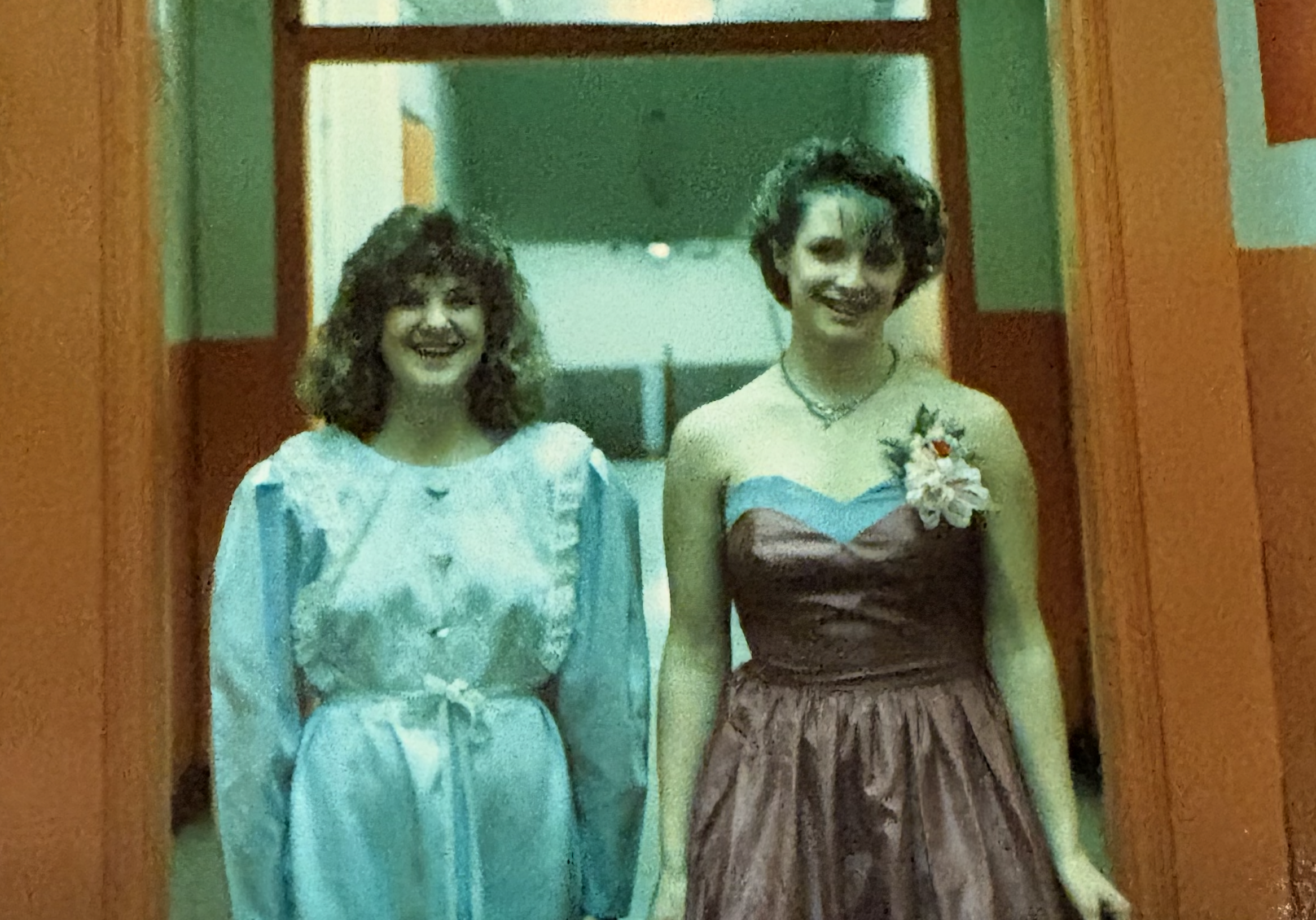
There’s a picture of me as a sophomore in high school, standing next to my gorgeous friend, Crystal. We were both homecoming princesses that year and this photo is us standing in the cinderblock hallway of our high school, the trim painted a garish orange that clashes with everything; especially our formal dresses. The fluorescent lighting doesn’t do the orange or our skin tone any favors, but the most
arresting thing about this photo is the contrast between me and Crystal. She stands a couple inches taller than me and has the most beautiful smile on her face as she poses in the strapless dress that shows off her figure.
I have a great smile, too, but my dress is an aqua color, high-necked, long sleeved, to the floor, and makes me look as though I live in Amish country or am a practicing Mormon. There is not an inch of skin showing from my collarbone down, and the entire front of the dress looks as though it’s constructed from an enormous doily that came off of the back of my grandmother’s couch. I remember being so embarrassed about that dress. All of the other homecoming princesses and the queen wore short or tea-length dresses, strapless or sleeveless, tight-fitted, and mine was frumpy and plain except for the lace trim.
I wore it because my mom made it for me. We couldn’t afford to buy a dress, and she wanted so badly to make me a dress for this occasion, and so I let her. And I was mortified. But also, I had a sentimentality, an affection, a feeling of softness that she had wanted to take the time and care to sew me a dress to wear. The danger in our small town was always that someone else would show up with the same dress you had because there were only a limited number of places to shop. That same year, I’d bought a Jessica McClintock dress to go to prom with a friend and when I showed up, the most popular girl in the senior class was wearing the same exact dress and she filled it out a lot better than I did. Despite that, she was furious with me.
This photo doesn’t give any indication that I was reluctant to wear the dress. And while I know that there were certainly conversations had behind my back about my choice of attire, what I remember from that night was the newfound, curious ability to hold two disparate things in my head at the same time – namely the embarrassment of this dress alongside the sweet knowledge that my mom had worked hard on it.
As these things go, people forgot pretty quickly that I’d worn that dress at all, and I went on with my social life mostly without a hitch, finding easy friendships and dating the quarterback of the football team and becoming salutatorian for our graduating class. Not only had I managed to find the maturity to explore equanimity, but I learned the really important lesson that other people don’t think about us nearly as much as we worry they will.
Every once in a while I pull that photograph out because I remember how uncomfortable I was and how I managed to let it stretch me, how I learned to sit with it and not do anything about it. I look at my gorgeous friend Crystal and don’t even wonder what she was thinking about my dress because I know it couldn’t have been more than a blip on her life’s radar.
I am reminded of a trip Sean and I took to Japan with two other couples between the original email where he confessed his unhappiness and the text message saying he was moving out. We knew these couples well and had traveled with them before, and maybe because I was in such utter confusion about the state of my marriage, I spent a lot of that trip floating somewhere above the six of us, just observing. At one point, I became acutely aware that I was the least attractive woman in the group.
It occurred to me that I should probably feel horrible about that, but I didn’t, really. I treated it as a curiosity. For most of my life, I had been considered pretty despite my average build, average height, brown hair, brown eyes. I had always had boyfriends in junior high and high school and I was lucky to have clear skin and long, shapely fingernails. I didn’t wear too much makeup or super tight clothing, and my skirt length was carefully considered. I smoked a joint at the back of the school bus occasionally and signed up for wood shop and home economics, and that somehow made me appealing to a certain subset of boys.
I know that I was beautiful on my wedding day because of the way Sean looked at me. I did my own hair in a simple fashion and wore barely any makeup. I didn’t want to be a bride who was so made up that I didn’t recognize myself in the photos years later.
But in Japan, I was the square peg. The other two women in our group carefully applied makeup every morning, colored and curled their hair and sprayed it, even on the days when we had plans to walk in the woods or take the bullet train to another city. My morning routine consists of brushing my teeth, combing my hair, and sliding a ponytail holder over my wrist in case it gets windy or too hot to have my hair on my neck. I occasionally wore a little mascara when we went out to a nice dinner, but I didn’t bring a hair dryer or a curling iron on the trip.
I wear clean, fashionable clothes, but these women – even though they were my contemporaries – wore better, younger clothing. I was the one who looks our age. The other wives were runners with slim bellies and toned arms and while I was happy with my health and weight, the thought of traveling with them to a place where we might all put on swimsuits was not appealing. That said, I won’t start running. I hate running. And the little pouch I have on my belly that came from my babies actually pleases me.
At a bar one night, Sean was talking about his Japanese colleague who would take us out for dinner and karaoke the next night. One of the women asked if he would bring his wife along, too, but Sean said no, he thinks not.
“Is his wife pretty?” one of the other women asked.
“No!” comes the emphatic, knee-jerk answer, accompanied by Sean’s head shaking. Oh. We are all a little shocked at his quick response. “Nicest woman you’ll ever meet – gracious and kind. But she is not attractive at all. Not at all. But very, very kind.”
Suddenly, it occurs to me that that maybe someone might describe me that way. I am kind, accommodating, and easy to be with, but compared to these other women who run, do their hair and makeup and know what kind of clothes are most flattering on them, I am most certainly not attractive.
I wonder if it bothers Sean. I try to think of a compassionate way to ask that won’t sound as if I’m fishing for compliments, but I can’t. I finally decide that if he does care, he knows he shouldn’t, and whether he lets it bother him or not, there isn’t anything I can do about it anyway. I’m not going to change myself now.
He used to say he loved how simple my needs were; that I wasn’t the kind of woman who gets her nails done every week or needs a new dress every time we go out. But there was something at the back of my mind that kept poking at me and it took a while, but I finally figured it out. His strong “no” told everyone else in the group that the other woman wasn’t pretty “at all.” Which meant he does gauge women in that way, that he does compare them to one another and assess their relative attractiveness, and that might mean that he’s already figured out he’s married to the least pretty girl in the room. And suddenly, I wasn’t floating up there anymore; I was inside the body of the least pretty girl in the room, and it didn’t feel good.
I don’t think anyone who has ever met me or really knows me would say that I am a person who has rage. But for much of my life, I was consumed with rage. It sat on a back burner, simmering away, mostly unnoticed. These days, when I teach workshops on rage, I tell people that resentment is aged rage and often, I hear gasps of surprise (mostly from women) as they let that sink in.
I directed rage at my mom as a kid, but never my dad. Despite the fact that they both abandoned me in one way or another, it was somehow more egregious that Mom did it because she was – well, the Mom. In my mind, that’s what men did – leave when things were hard. They couldn’t be held accountable. It was in their nature. Or maybe it was their right?
As an adult, I swallowed my rage in the form of wine and it became Deservedness. Instead of directing it at Sean for traveling so much and leaving me to care for everyone and everything all by myself, for doing so even after I begged him to find a job that didn’t require so much travel, I poured myself glass after glass every night as I sat alone. I never got drunk, because that would be dangerous for my kids and I couldn’t abandon them, but I drank alone every night until it was time to go to sleep.
I wrote my rage into opinion pieces on sexual assault and gun violence and social justice, fighting on behalf of other people and railing against misogyny and greed and violence. But most of my rage lived inside of me. Most of my rage felt questionable and, anyway, what was I supposed to do with it? The boy who molested me as a child was impossible to find and I couldn’t prove anything, anyway. I had long since forgiven my parents for their poor choices, and I didn’t frankly want to enumerate the other traumas I’d experienced, so I gaslit myself and that rage stayed put, a bright ball of energy sitting in my body, waiting to explode.
When Sean left without any explanation or effort to reconcile, I opened a steam valve. Only once before in our marriage had I been able to access my righteous anger and direct it at him – the night he spanked our youngest daughter. She had always been difficult to get to bed at night, seemingly cooperative and then popping out and tiptoeing downstairs to stand before us asking for one more story, a drink of water, please come check under her bed for monsters one more time. But on this night, I was exhausted. Sean had just come home from two weeks away and I had been solo-parenting her and her four-year old sister who was also a pain to get to bed at night. I took Lauren by the hand twice, patiently leading her back to bed, tucking her in, and sternly telling her to stay put. When she showed up the third time, my eyes welled up with tears and I begged Sean to take over. I had to tap out.
He carried her upstairs and instead of soothing conversation, I heard his angry voice. My ears tugged back to listen more closely. He threatened to spank her if she got out of bed again and my gut jolted. She had never been spanked. She wouldn’t even know what that meant, and also, she was the kid who did what you told her not to on a regular basis just to see what would happen. I started up the stairs quickly and got to the door of her darkened room just in time to see Sean pull his hand back, flat hand at the ready, and swing it to smack her on the butt. My adrenaline spiked. I couldn’t feel my legs, but somehow I raced into the room, ducked under his arm and scooped her into my arms, cuddled close against my chest. She was just beginning that surprised, hiccupping cry and while I knew her tears were tears of shock and not pain, that was almost worse. Her father had just hit her. I watched her face as she tried to understand why he would want to hurt her. His face went stony.
“I thought you asked me to put her to bed.” He was always accusing me of taking over the parenting, not letting him do enough, hoarding our kids.
“Get. Out.” I jerked my head in the direction of the hallway.
“What?” He was angry and confused and I was furious that, as I searched his face, I couldn’t find a trace of remorse.
“Don’t you ever hit our children. Ever. You know how I feel about that. If I’d known you were going to come in here and hit her, I never would have asked you to put her to bed. Get out of this room and if you ever hit either one of our children ever again, you can get out of this house altogether.” I turned my back on him and shush-kissed Lauren’s ear, rocking her back and forth, her legs dangling down and toes swishing back and forth across my thighs. I squatted low and laid her on her side in her toddler bed and climbed in behind her, spooning. I lay there stroking her hair and kissing her ear and telling her I loved her over and over again until we both fell asleep.
I didn’t yell at him for another 13 years, but after he left and he went on week after week, sleepwalking through his life, refusing to go to therapy with me, traveling as much as ever, sending me casual check-in emails as though he hadn’t just unilaterally decided to rototill our entire lives, I felt my anger build. The two times we did see a therapist together, I was mostly sad. I was afraid that raging at him would make him run farther away or give him some justification for leaving. But once it was clear that our marriage was over, that he wasn’t coming back, had no intention of trying to make it work, I felt safe unleashing my rage and it felt good.
When I began letting myself feel it a little, it felt like a trap. There was a righteousness that felt really good – like I was finally defending myself, taking care of myself, putting myself first. But there was something that said I needed to have compassion for him; that he was suffering and in pain or he wouldn’t have done this, and that felt like letting him off the hook. But then I remembered that it wasn’t my job to keep him on the hook. It wasn’t my job to make sure he was punished for the pain he’d caused with his abrupt disappearance, even though I really wanted to.
I know anger comes from fear and I hated it. I hated that he made me feel fear; that he was the one person in my life for so long that I thought I’d never fear, that I thought I could trust. I hated that I relied on him, built my life around him, and with one short email, he could set it all adrift.
I have always been a person who was concerned with fairness, justice, equity. I have told my daughters for years that I will do things for them that I know they would do for me, given the opportunity and resources. That philosophy opens the door to a lot of places where we can pitch in for each other when life is busy or we’re feeling overwhelmed, and it’s a way to make sure I don’t feel taken advantage of. And I thought I was operating on that principle in my marriage, too, even though it’s more complicated.
Sure, I’d go out and work 70 hours a week to make money for the family if Sean had asked me to, even though I have nowhere near the earning power he has. And I always thought I could ask him for help in a pinch, too, even when it didn’t work out that way. The times when I had a writing deadline or needed to go take care of Mom, he didn’t exactly rise to the occasion, but I let it go because we (ok, I) always found another way – asking his parents or Sarah to help me instead. I understood. He had to work. He was busy.
So maybe that’s where my fear and rage comes from – the possibility that I helped create this situation by continually expecting less of him than I wanted him to bring. Maybe I’m just as complicit as he is by not being more clear about my disappointment and frustration, by letting it slide when he didn’t have my back the way I needed him to. Maybe my anger is at myself as much as it is at him and that’s why it’s so uncomfortable. For weeks, I went to bed with a set in my jaw and woke up with a stomach ache. Fifteen times a day I had to remind myself to breathe and imagine the anger moving through me instead of pooling in my gut. I had imaginary conversations where I did most of the talking and he cowered as I unloaded my frustrations.
Six months after he moved out, I decided I was done living in limbo. For my own health and the girls’ well-being, I needed to move on. I told him I couldn’t keep waiting for him to make a decision, all the while watching him move further and further away from us – calling less and less, seeing the girls only twice a month. He suggested therapy one more time. I wrote him this email:
“So, for a few weeks now, I've been really struggling with anger and trying to
figure it out. I'm short with the girls, irritated with drivers on the road,
yank on the dogs’ leashes when I walk them. I hate feeling this way and I have
been really trying to get at the root of it and not really being successful.
But this morning, while I was driving to Redmond, I had this flash of insight
that made me feel like a total idiot for not having recognized it before. I
think I alluded to it once in session with Connie, but I hadn't really dug into
it. Anyway, after I had the insight, instead of feeling angry, I just felt
profoundly sad and I had to pull over to cry for a bit. The upside is that I
feel less angry now. The downside is that I suppose it means I'm not as far
ahead as I thought I was. Anyway, the insight was this: for obvious reasons, my deepest personal wound centers around abandonment, around being 'thrown away.' When I met you in college I had no
intention of being in a committed relationship with you or anyone else. In
fact, I was desperately trying to get rid of R, and I was determined to be
completely self-sufficient so that I could never be abandoned again. If I could
take care of myself forever and always, I could have fun with people and love
them, but never trust them to the extent that I could get hurt. Obviously, I
got over that and, while it took several years for me to really completely
trust you, I got to the point where I did. And that has been a huge gift -
knowing that you always had my back, that you had my best interests in
mind and loved me nearly unconditionally. I got to the point where I took for
granted that you and I would always be bedrock and that anything we built on
that would stand firm - that even if things got messed up in other ways, you
would be there for me and I would be there for you. So when you expressed your unhappiness to me in a way that felt really impersonal, it was a red flag for my psyche. The abandonments of my childhood occurred in a similar fashion - delivered very matter-of-fact or not discussed at all -
simply people leaving and never being spoken of again. And my emotional
reaction to all of that as a child was downplayed and even punished. Your lack
of engagement in therapy or willingness to treat this as an alarming, very
serious situation for months on end echoed all of those things that really
resulted in disaster for me as a kid. My parents never wanted to talk about
hard things or address them directly, and I think that was another red flag for
my subconscious. Then when you moved out in January and began pulling
farther away and not reacting to my (admittedly indirect) pleas for more
connection or help around the house or parenting, I felt gaslighted and
abandoned almost completely. Your desire to get together in a casual way to
have dinner or just hang out was really reminiscent of the way my parents
pretended nothing horrible or painful was going on when I was a kid and I began
to feel very alone all over again - something I never thought I would feel with
you because I had come to trust you so completely. While I never really
connected the dots with all of this until now, I have really been struggling to
figure out why I am so angry with you and why I've recently begun
fantasizing about walking away from the marriage altogether, selling the house
and putting together a new life for me and the girls. I realized this morning
that anger and disengagement is something that offers me power in the face of
being abandoned again and it feels much safer than surrendering to this process
only to maybe discover that you will ultimately not come back. I'm
not telling you any of this to make you feel guilty. I'm telling you
this because I think it's important for you to understand why I am
reacting the way I am. When my family fell apart and I was left to pick up
the pieces, raise my sister, cook dinner every night, care for the pets and
walk on eggshells around my mom, it was a profound loss and shift in my ability
to really take care of myself. I didn't take care of myself for at least a
decade after that. And so when you left and I started to feel the crushing
weight of responsibility for all the logistics and the girls' emotions, and all
you wanted was light/fun/flow, it was so reminiscent of how my dad treated the
situation with me - that I was overreacting, that I would be fine, that I was
strong and capable and that it really wasn't all that bad - it sent me into a
tailspin. “
In letting my anger begin to surface, I was excavating old rage. Rage that lived in the same place as the new wound because that’s where my body decided it belonged until I was ready to shift it. Sadly, Sean’s response only added fuel to the ball of fire churning in my gut. He wrote:
“I know all of that. And you’re not 12 and I’m not your dad.”
Walking the dogs is something I do to stay sane. We take the same route every time because they’re puppies. If I take them a different way, they stop every few feet to sniff the new territory and snap up rocks or pine cones or small branches to chew on as we go and one or the other of my arms is being constantly tugged at. It makes my shoulders sore and I can’t get lost in thought when I’m tasked with paying attention to make sure they’re not eating cigarette butts or someone’s discarded chewing gum. If we go the same way every time, they stop to pee on the same trees and, at some point, they begin to lead the way and my thoughts can wander.
Too late, I realize my thoughts have also wandered to the same old place. What are Sean and I even doing? Where are we headed? Will we end up divorced because he refuses to talk about any of this? Because he has eschewed therapy and sticking it out together until we come to some conclusions as “forced”? He won’t say he wants a divorce, but he won’t go to counseling and he won’t move back in. He is simply living apart from us, working and traveling as before, and taking the girls out for dinner once a week when he’s in town. He has no plan, he says, and he doesn’t want to.
You have power in this, Mom! Erin says. Use it! She wants me to file for divorce. It has been eight months since he professed his misery. Three since he moved out. She hates the uncertainty of it all. Will we have to sell the house? Will I have to get a full-time job? Will there be a custody arrangement that requires her to see her father only on certain days, even if she doesn’t want to? I know how she feels. I am uncomfortable with this limbo, too.
I tell her that I don’t know what I’ll do. The truth is, I do have power, but at this point, the only power I have feels destructive. I can’t force him to go to therapy, to try and fix it, to love me again if he doesn’t. I can only wait in this no-man’s land or cut him loose. I am not sure I want to be forever known as the one who chose divorce, who couldn’t wait, who was so uncomfortable with not knowing that she blew it all up. Maybe that is what he wants, though, to not have to be the one to do it.
I walk inside and let the dogs off the leashes. I look at the clock and wish I wasn’t alone right now. I want to sit in the sunny backyard with a friend and laugh, and not talk about my marriage. I’m so tired of talking about what isn’t happening. But soon, there will be five teenagers here, hungry and giggling as they get dressed up for the dance tonight. I will roast a chicken, pour glasses of lemonade, watch them do each others’ makeup and hair, and drive them back to school.
I walk to the refrigerator to check on the lemonade supply and pass by the sign taped to the small bar sink. BROKEN, it says in bright red sharpie. I don’t want anyone to try and use it tonight. This is a reminder of something I destroyed last week because I thought I could fix it myself, but it turned out I didn’t have the right tools to finish the job. The irony isn’t lost on me.
Hey there. I got too much mulch and it’s still in the truck. Any interest? Sean’s best friend texted me on a Sunday morning. It was that offer that pushed me over the edge. I was doing my best to stay out of anger, but preparing the house to go on the market stoked the fires regularly.
I had realized at some point on Friday that my holiday weekend would look much different than Sean’s, and a toxic brew of anger and sadness with a pinch of resentment tossed in was cycling through my body and brain like a science experiment gone wrong. So far, I had managed to complete the cycle dozens of times without venting anything outside of me but that text message popped up and it was game over.
I got too much mulch and it’s still in the truck. Any interest?
Pretty innocuous. Generous. Kind. And here I stand, chopping onions and slicing hard-boiled eggs
for potato salad with tears sliding down my cheeks and dripping from my chin. Sure, I’m interested. But after six months of doing all the yard work, housework, parenting, food prep, calendar gymnastics, and random other maintenance on my own, I know that Michael’s pile of mulch will sit in my front yard like a scab. One more example of my partnerlessness. A continuous visual reminder that the person I married is not interested in this life anymore.
Sean texted me on Friday to ask if I wanted to meet him for brunch on Saturday. I agreed, wondering all the while, why brunch, and figuring it was because he had plans on Saturday night. And therein lies the rub.
His Friday night – the first sunny evening of the year in Seattle – was spent with friends on their back porch, sipping cocktails and telling tall tales. In years past, we would have been there together, enjoying the sunshine and bitching with our friends about how hard it was to raise teenagers. Because they are our friends, not just his. But maybe not anymore.
This year, I had a glass of wine (okay, half a bottle) by myself in the backyard, fed and walked the dogs, ate a quiet dinner with Lauren, and read a book after I cleaned the kitchen.
Pleasant, yes. Lonely, yes.
Saturday afternoon was spent coordinating schedules with the girls, laying down the law about
summertime rules, pulling weeds, grocery shopping. His holiday weekend is full of friends. He does whatever he wants when he wants to. I take care of the kids. The house. The yard. The dogs. Alone.
So go out with your friends, he would say (and has said). The girls are old enough to stay home alone. You don’t have to be there.
I do go out with friends sometimes, but not every night. Many nights, my friends – who have kids
in middle and high school like I do – are home with their kids, helping with homework, walking the dog, making dinner. Like me. Except they are partnered. Some nights we meet for dinner or drinks or book club, but other nights I want to spend time with the girls. I am obliged to. This is my role. Even though
they’re teenagers and are busy with friends or say they want to be alone when they’re home, they show up pretty often. They come to the kitchen to tell me about a tough assignment or a frustrating friend. They stay and make jokes or ask about their grandmother and sometimes burst into tears and confess that they are sad or scared or confused. They know if I’m not around, even if we aren’t always on the same floor of the house. They know if I am around. If I am present. Available. And also, going out doesn’t mean some magical fairy shows up to do all the things I would still have to do when I’m away.
I feel betrayed and not a little bit jealous sometimes, although, if I’m being honest, I enjoy cooking and working in the yard and driving carloads of kids to a picnic at the lake. I sometimes get bored watching them jump off the dock and gossip and smear sunscreen on each other’s shoulders, but then one of them will come up and tell me about their annoying little brother or I hear them all break into spontaneous song and it’s all worth it. I think the problem is that, after all these years, I didn’t think I’d be doing this without Sean. But I am, and he’s off with his friends. His and ours. Or maybe just his now. And I am here.
Beyond betrayed and jealous, I am angry. Because even though he isn’t present and available and
doing the hard work, he still gets to be Dad. The girls adore him and fawn when he shows up to take them out to a fancy dinner or make plans to fly to St. Louis for a long weekend (first class, of course).
I want them to love him, but I want him to have to work for it. Maybe that’s wrong. Maybe I want him to have to earn their respect by engaging in all of it – everything it takes to be their Dad – housework, homework, fighting about rules and curfew, listening to them cry, feeding them food he has prepared. Instead, months go by and the scabs pile up, visible reminders that I can’t do it all. Peeling paint
on the outside of the house. Weeds encroaching more and more. I can’t add a pile of mulch to that.
It could be that I was simply paying more attention to things falling apart because I knew they
would have to be fixed by me and me alone, but it really felt like things were disintegrating all around me. It may have been like when you break your toe and then, for the next few weeks as it heals, you bang it on everything in your path. Is it that you always stub your toe this often and it doesn’t hurt because it isn’t broken? Is it that you’re more conscious of your toe now that it’s broken and your brain is somehow directing it toward random objects simply because it’s top of mind?
The expensive, custom-made Roman shades that cover the French doors in the kitchen and family room are fraying. Two of them have support straps that have snapped so that one side sags lower. It looks like it’s had a stroke and is paralyzed on one side.
The oven that was supposed to be fixed after special-ordering an $800 part that took weeks to arrive but only ten minutes to install isn’t fixed. So that means I have to track down the 24-year old who repaired it and pay him again to come back. And I have to wait for him to arrive within a four-hour window. And I have to hope that he actually fixes it this time.
I notice that the leather couches are showing a lot of wear. The set of cookware Sean gave me for Christmas ten years ago is stained and has baked-on bits that I can’t remove. The Williams-Sonoma everyday dishes we got for our wedding have held up well, but we’re missing a few salad plates and three of the dinner plates have chips on the edges. The expensive, Bloomingdale’s bath towels he splurged on nine years ago because he knew I never would aren’t soft and fluffy anymore and one is stained from Lauren’s hair dye.
I take pride in cleaning and conditioning the leather couches, seeing how they shine a little more and imagining one of the kids noticing and remarking on it. It feels good to have cared for something that I use every day, even if I can’t repair the corner the puppy chewed a hole in.
What is the shelf-life of household things, I wonder. When the designer and manufacturer of the leather recliner were conferring, did they say they wanted it to last for ten years? Thirteen? Twenty? Are there craftspeople who worry less about mass production and planned obsolescence than they worry about whether their wares will stand the test of time?
How long is too long to hold onto something? Last year, I threw away the air-bake muffin tins we got for our wedding 23 years ago. They were permanently stained and the air seals had popped years before, but it still felt awful to toss them in the recycle bin. I remember the family who bought them off of our Meier & Frank registry. I remember what it felt like to own an entire set of bakeware with my husband. I could probably remember every single item we put on that registry if I had to. How many of those things do we still have? Do I still have?
Everything in Sean’s place is new. He is renting a fully furnished apartment in a brand new building. Nobody has sat on his couches before, lain in the bed, sliced tomatoes with the knives. Everything in this house that surrounds me has history. Everything in this house has been touched by my hands. By Sean’s hands.
I am overwhelmed by the slow, inevitable decay I see every day. The new scratches on the hardwood floors, the door frame that is getting increasingly wobbly, the shower that needs new grout. All of those things were happening when Sean lived here, too, but it didn’t feel quite so overwhelming then.
These days, I struggle to triage. There are things I absolutely cannot fix by myself. There are others that I’d rather throw away or give away and do without. And there are others that take a little elbow grease and some focused time and give me a sense of accomplishment and pride. The problem is that it is hard to keep track of all of the things that are falling apart and I’m feeling an urgency around selling it and getting out before the whole house falls down around me.
After Sean moved out, I often wondered what would happen if one of my neighbors remarked that
they hadn’t seen him in a while. I walk the dogs at least twice a day and run into the same people over and over again, exchanging pleasantries – how are the kids; your garden is looking gorgeous; this wildfire smoke is so awful. I am nothing if not an open book, so at some point, I began crafting potential
answers should someone ask where he has been for so long. Most of my fantasy responses reflected my anger:
Oh, Sean doesn’t live here
anymore. He left in January.You haven’t seen him because he
isn’t living with us anymore.
When, in my imagination, the person to whom I was talking asked why, the answers got even snarkier:
Let’s just say it’s a classic
mid-life crisis.I suppose you’d have to ask him
that. I don’t understand it myself, to be honest.It seems he just isn’t
interested in being married anymore.
Of course, I don’t know anyone in the neighborhood who would have probed for answers, so those mental machinations were altogether ridiculous. And the fact is, not one person remarked that they hadn’t seen him around in a while.
Once I filed for divorce and began readying the house for sale, I started running potential scenarios in my head for when the neighbors asked about the sign in the yard. What do I say about why we’re selling this house we put so much time and money into renovating?
I can’t afford the mortgage now
that I’m going to be single.It’s too big for just the girls and I. Erin is leaving for college next year, and Sean is gone.
Again, reflections of my resentment. And the more I meditated on those answers, the more I realized that even if they were partially true, they painted me as a passive victim. But the truth is, I didn’t want the house. We bought it to indulge something Sean wanted (an outdoor kitchen and huge entertaining space in the basement with a wine cellar) and something I wanted (to be closer to the girls’ schools and live in the city). But I will never use the house to entertain large groups of people and Erin is leaving soon. The size and expense of this house don’t reflect who I actually am. I want simple. Small enough to care for by myself. Not something that is 115 years old and will likely need major repairs sooner than later. I want a small yard, forced air and a heat pump, solar panels. I want to be within walking distance of most of the things I need in any given week.
I am certain I could have worked something out with Sean so that the girls and I could stay in the house until they both graduated from high school, but Sean was the only one who wanted that scenario. The girls asked me to sell the house once they knew he wasn’t coming back and I couldn’t agree fast enough.
Once I made the shift to asking what I wanted and owning it, other shifts happened. Instead of soaking in the anger and shock I felt at Sean’s moving out, not engaging in therapy, and trying to just pretend everything was normal, I began to understand that he wouldn’t have left if he hadn’t been in a great deal of pain. The avoidance of therapy, the casual text messages about a delicious meal he just had or a funny event he witnessed – those were a frantic attempt to have some normalcy in his life. I started to understand that he needed to leave this marriage in order to start finding himself and defining what would make him happy. I also understood that he didn’t want to leave the girls and I entirely out of his life, but he didn’t know how to integrate us without facing the pain he caused.
The truth is, he had as much right to pursue his own happiness as anyone else on the planet does, and while I hate the way he did it, I tried to honor the pain he was in and his inability to figure out how else to do it. If I’m asking him to own his feelings and choices, I have to own mine, too. As much as I say I don’t want anyone to choose sides, my (imaginary) words were setting up a dynamic where people would be asked to do just that. I was giving him all the power and saying I merely reacted to what he did, and while that may have been true in the beginning, I did have a choice. I could step up into my power and own my decision to sell the house. I could even celebrate the freedom in having the choice to find a place to live that fits my values and ideals.