
 This is a piece I wrote four years ago and I just discovered it. It felt like it belonged here, alongside Space Mountain, Baby. Thanks for reading.
Yesterday, two boxes showed up on my front porch. They weren't unexpected. My mom died last year and her husband found them when he packed up the house to sell. I fully expected them to be filled with old photos and report cards and elementary school artwork Mom kept for sentimental reasons. What I hoped for were answers; adoption paperwork that might finally help me understand what happened to my brother forty years ago.
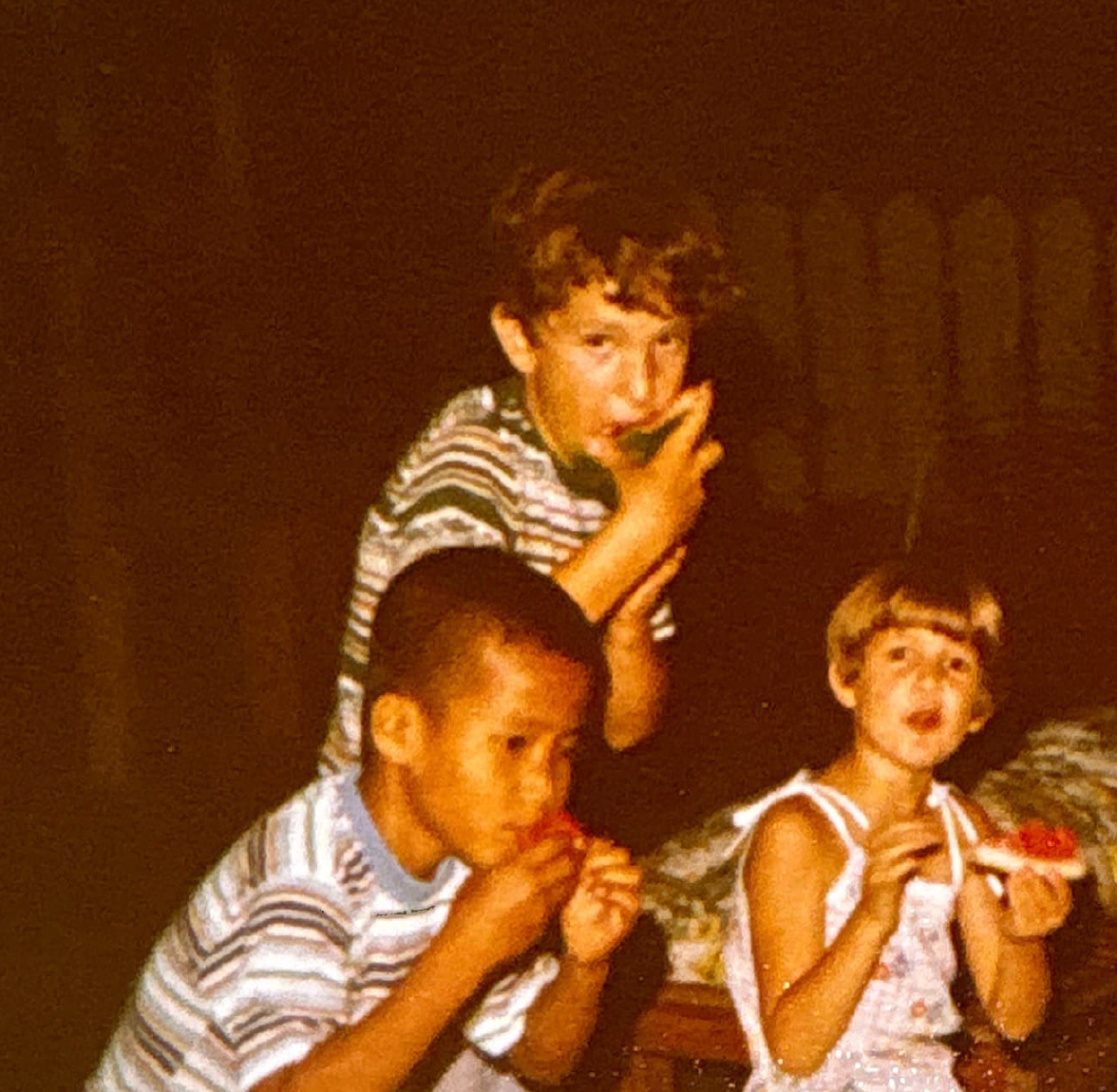
When I was seven, my parents adopted a boy my age from an orphanage in the Philippine Islands. It wasn't their first adoption - my younger sister had joined us four years earlier when Saigon was evacuated at the end of the Vietnam war. And while I adored my little sister, I was excited to have a new brother who was my age. I proclaimed us "twins," despite the obvious differences - his smooth, brown skin and my freckled white skin, his silky, jet-black hair and my dishwater blonde locks, the fact that he had one blind, milky-green eye because of an accident.
We were quickly inseparable. He spoke English pretty well, but didn't understand all of the idioms and 1970s things American kids said to each other, so I took him under my wing and showed him the ropes. I also promised to protect him against the cruel taunts of the other kids - the ones who saw his brown skin and mistook him for someone from Mexico and called him things like "wetback" and "beaner," and the others who mocked his "gross" injured eye.
My parents had named him Cameron to fit in with their naming scheme - boys with C names and girls with K names, all making a hard "K" sound - despite the fact that he had a name he'd lived with for his entire life. Cameron joined my older brother's soccer team, ate anything and everything that was put in front of him, and had the sweetest smile. He was joy personified. Eager to learn and play and laugh all the time. After having spent much of his life in an orphanage, he seemed ready to embrace all of the new experiences that presented themselves in small town America, living with a family of his own. He and my brother shared a room with bunk beds right across the hall from the room I shared with our younger sister.
And then one day, nearly two years later, he was taken away by the adoption agency. He had become one of us; was fully part of our family. I didn't understand, and our parents wouldn't explain or entertain questions. Photos of Cameron were removed from the walls and family albums, his bunk bed was stripped, his dresser drawers emptied. Within months, Mom and Dad were divorced and before a year had passed, Dad was remarried and lived two states away. In one series of horrific events, I had lost my best friend and my footing in life and I had no idea why.
My sister Katy was five and brother Chris was eleven. I was eight years old and precocious. My first instinct was to pepper my parents with questions and press for explanations, search for answers. I was punished harshly for my curiosity. Katy and Chris knew better - they stayed quiet. After Dad left, Mom retreated into herself and at some point it occurred to me that the rest of us might be at risk. What if they came to take Katy? She was brown and adopted, too. I quickly decided the best tactic was to stay quiet and compliant, to speed right past the daggers of grief into survival mode.
While I expected, on some level, to always carry the memory of Cameron with me, there was a part of me that wished I could be like everyone else and just get over it. What I didn't know was how that unmetabolized grief would color my life in different ways, rippling out for decades to come.
When I became a mother, the echoes of that grief hung around me like a ghost. Every time I yelled at my children, felt depression begin to engulf me, made a decision I wasn't entirely sure of, I panicked and imagined my girls being taken away from me. What if someone decided I wasn't fit to raise them? (I had no idea who that "someone" might be, but that's not surprising given the fact that I still don't know who took my brother away or why). What I didn't realize was that those brushes of panic would always be there. It's a little like when you see a horrible bug out of the corner of your eye and then, minutes later, you feel something brush across your ankle. Your brain decides that those things are definitely related; that it's the scary thing you just felt, that you need to freak out and lose your shit, even if it's just a stray dog hair or the corner of a blanket moving in the breeze. My nervous system was primed to believe that the worst thing was likely happening now because it had happened before. It was primed to tell me that when I felt something uncomfortable and slightly reminiscent of that grief I'd skipped on past as a kid, it meant things were going to get really really bad.
When I was married, I had a running joke with Sean that if he ever cheated on me or decided to divorce me, I'd kill him and bury his body where nobody would find it. Even though it was a joke, I had worked it out rationally; his job required him to travel extensively - often internationally.
"I'll just tell people you left on a business trip and I never heard from you again. They'll believe it," I laughed, sweeping my arm behind me to indicate the two acres we lived on, as if I was Vanna White presenting the newest puzzle to contestants on Wheel of Fortune.
"Jeez, Kari!" my friends reared back when they heard me say it. But I meant it. Once, I said to Sean, leaning in to whisper, "I'm not sharing my kids with anyone. Nobody is taking them away from me."
When the girls were 17 and 14, Sean did indeed decide he no longer wanted to be married to me. The first time he told me, it was in an email. Subsequent bombshells were delivered either via text message or email, even though we still slept in the same bed, ate dinner at the same table. It was months before he moved out, and even then, he did it while the girls and I were out running errands. We came home and he was gone. Nearly every single trace of him had been removed from the house.
In the days that followed, I wondered what to tell the girls. I didn't know why he left, didn't know where he was, didn't know if he would come back. I went through the motions of making breakfast, walking the dog, driving the girls to school and dropping them off with hugs inside the car so their friends wouldn't see. Once again, I was racing past grief and simply living in survival mode.
It took me a week or so to recognize what I was feeling; this particular flavor of grief. There was that old ghost again, only this time it was living inside of me and taking up space. I was simultaneously enraged and flattened with sadness. I wrote an email to Sean:
"...the abandonments of my childhood occurred in a similar fashion - delivered very matter-of-fact or not discussed at all - simply people leaving and never being spoken of again. And my emotional reaction to all of that as a child was downplayed and even punished. Your lack of engagement in therapy or willingness to treat this as an alarming, serious situation echoes all of those things that resulted in disaster for me as a kid. My parents never wanted to talk about hard things or address them directly and that is another red flag for my subconscious...when you moved out and began pulling farther away and not reacting to my pleas for connection or help around the house or parenting, I felt gaslighted and abandoned almost completely....When my family fell apart and I was left to pick up the pieces, raise my sister, cook dinner every night, care for the pets, and walk on eggshells around my mom, it was a profound loss and shift in my ability to really take care of myself....it was so reminiscent of how my dad treated the situation with me; that I was overreacting, that I would be fine, that I was strong and capable and that it really wasn't all that bad..."
His response came quickly:
"...but I am not your dad...you are not your mom...you are not your 12-year old self...we are not even our 20, 25, or 30 year old selves. We are who we are today - that's all."
I shook my head as I read this brief, cruel dismission over and over again. I was reminded that people who haven't experienced tremendous loss don't have any idea how these events continue to shape us and color our perspective for the rest of our lives, especially during moments of big emotion. I will never not feel the loss of Cameron. And I will often feel it in ways that aren't necessarily predictable or understandable to other people. I will feel it when my questions go unanswered. I will feel it when people leave without explanation. I will feel it when I worry about my kids and their safety. I will feel it when I see brown-skinned children taken from their parents on the news to be "sent back" or put in cages.
When I dug through those musty, dusty boxes and discovered three photos of Cameron that I didn't recall ever seeing before, that my mother saved for some reason I will never understand, I cried the same way I cried forty years ago when I stood in his bedroom staring at the empty dresser drawer where his soccer jersey should have been. I flipped the photos over to see if there was anything on the back that might help me resurrect my search for him after all these years and, as I did that, the thought came into my head, "I should text the girls and tell them I love them."
These things are not separate. The love of family, the connection to beloveds, the desire to remain connected to them and have them know that I will always be here to support them, sitting alongside the unshakeable truth that I can't make that promise with any sort of certainty. That will always be real for me.
These days, I no longer feel as though the loss of my brother defines me, and while I wish things had been different, I am also grateful for the way it has shaped me. My relationship with Chris and Katy was intensified by the loss of one of us. It held us together in solidarity against losing one more. It made us more gentle and forgiving with one another and led us to look out for each other in a myriad of ways. We were all we had.
It also taught me that I wanted to be the kind of parent who pays attention to the things my kids are afraid of, to make time and space for hard conversations, scary conversations, painful conversations. Although the girls are grown and no longer live with me, we still have the kind of relationship that invites hard questions, admissions of bad behavior and big mistakes, and endeavors to pull each other closer just when we feel like it might be safer to push away. It is one of the greatest things in my life to have this connection with my children, to know that they know I will never lie to them, even if - especially if - I don't have the answers.
There is a Greek myth about Echo, a nymph who angered Hera. The consequence for her mischievous act was that Hera took away Echo's ability to speak except as a reflection of the last thing anyone else said in her presence. While I have forgotten what Cameron's voice sounds like and I've accepted the fact that I won't likely ever know where he is or what happened, at least now it is not only the echoes of grief that stay with me, but also the feel of his small, warm hand in mine as we walked to school and the particular brilliance of his smile.