
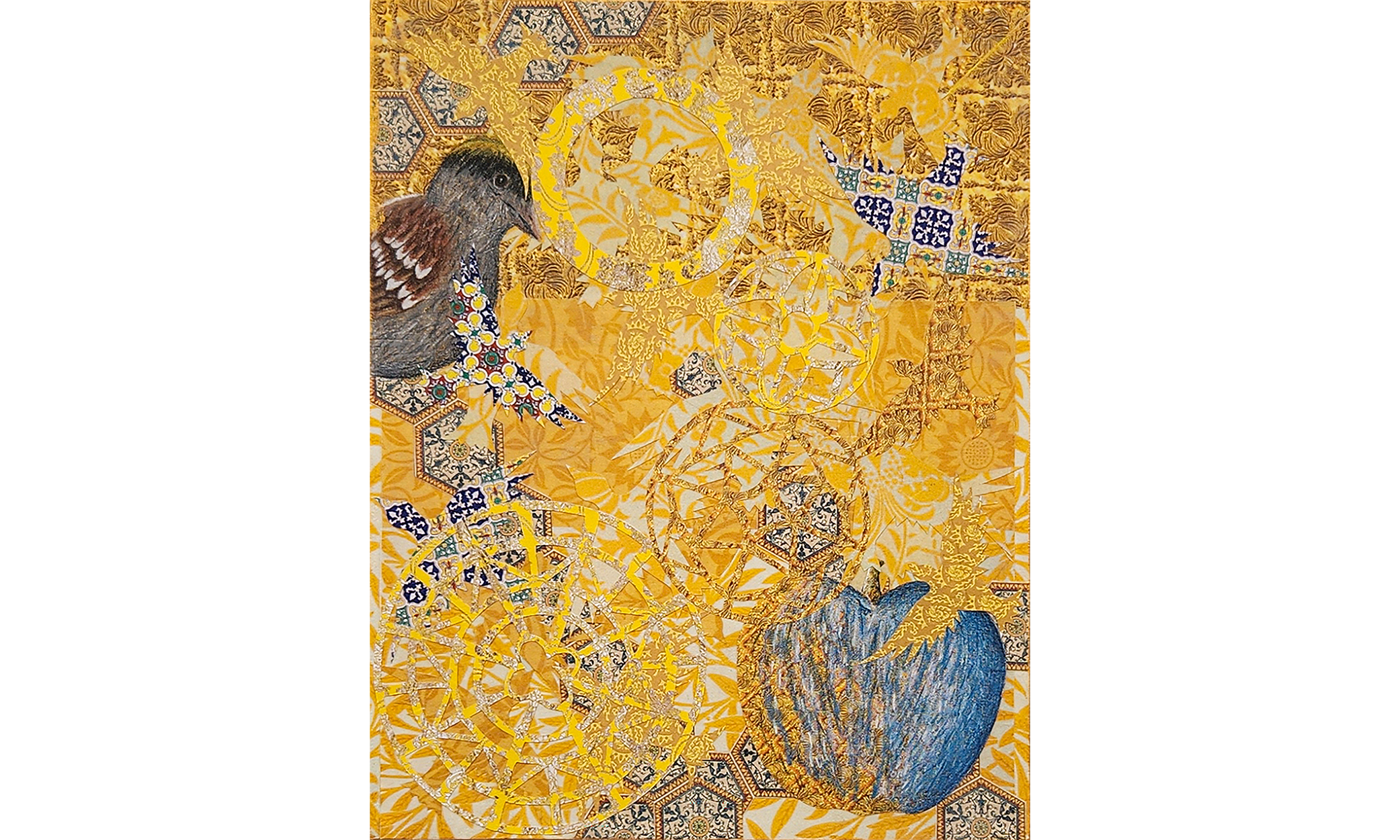
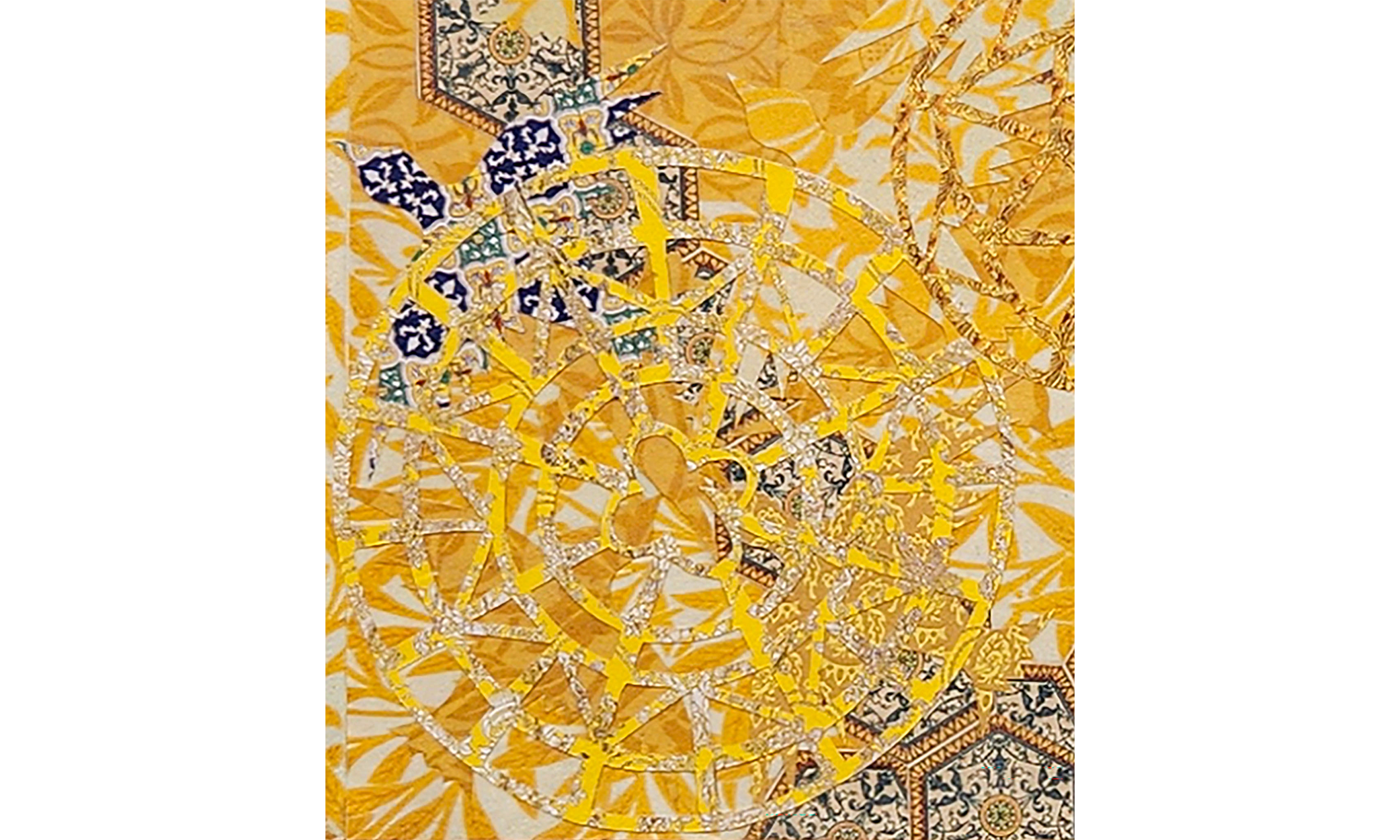
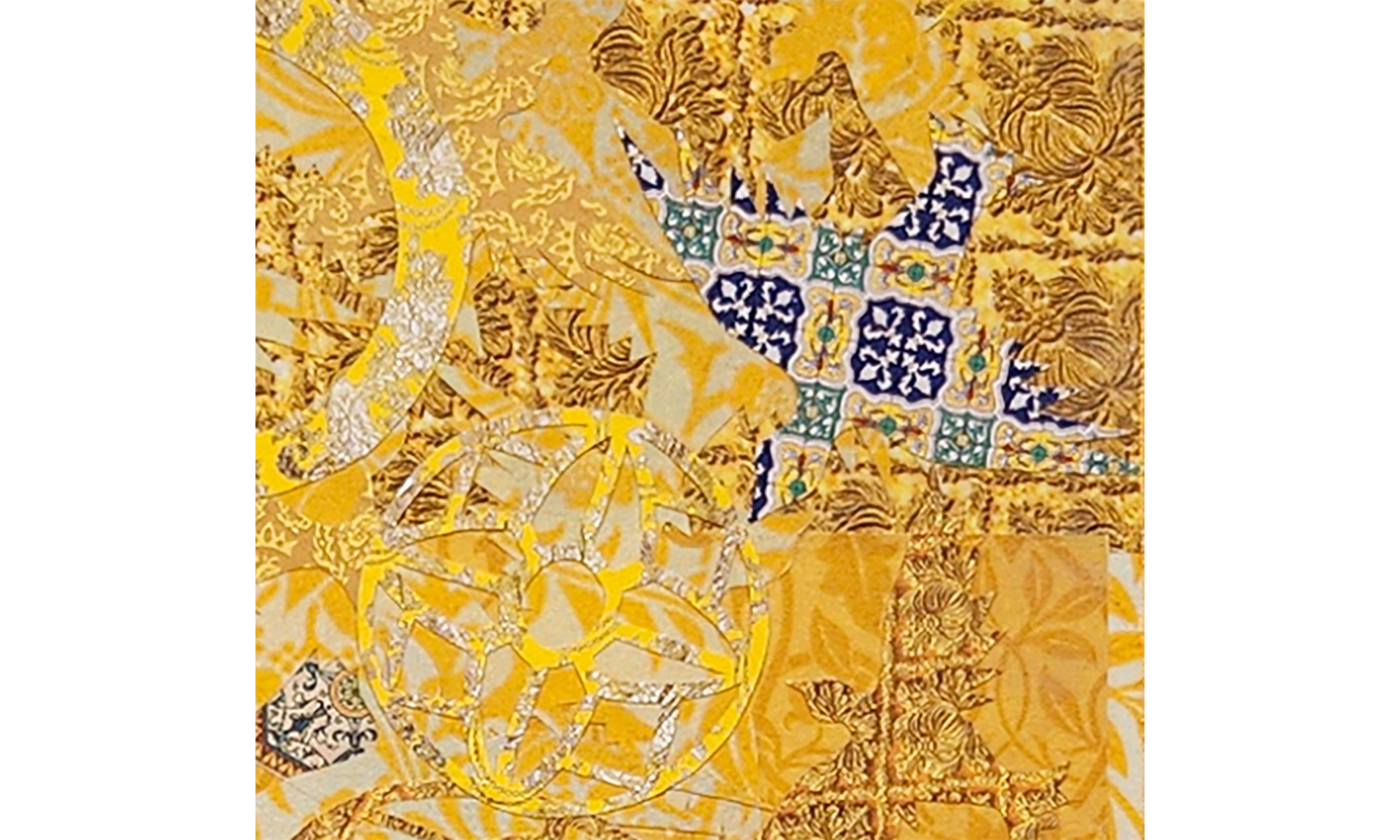
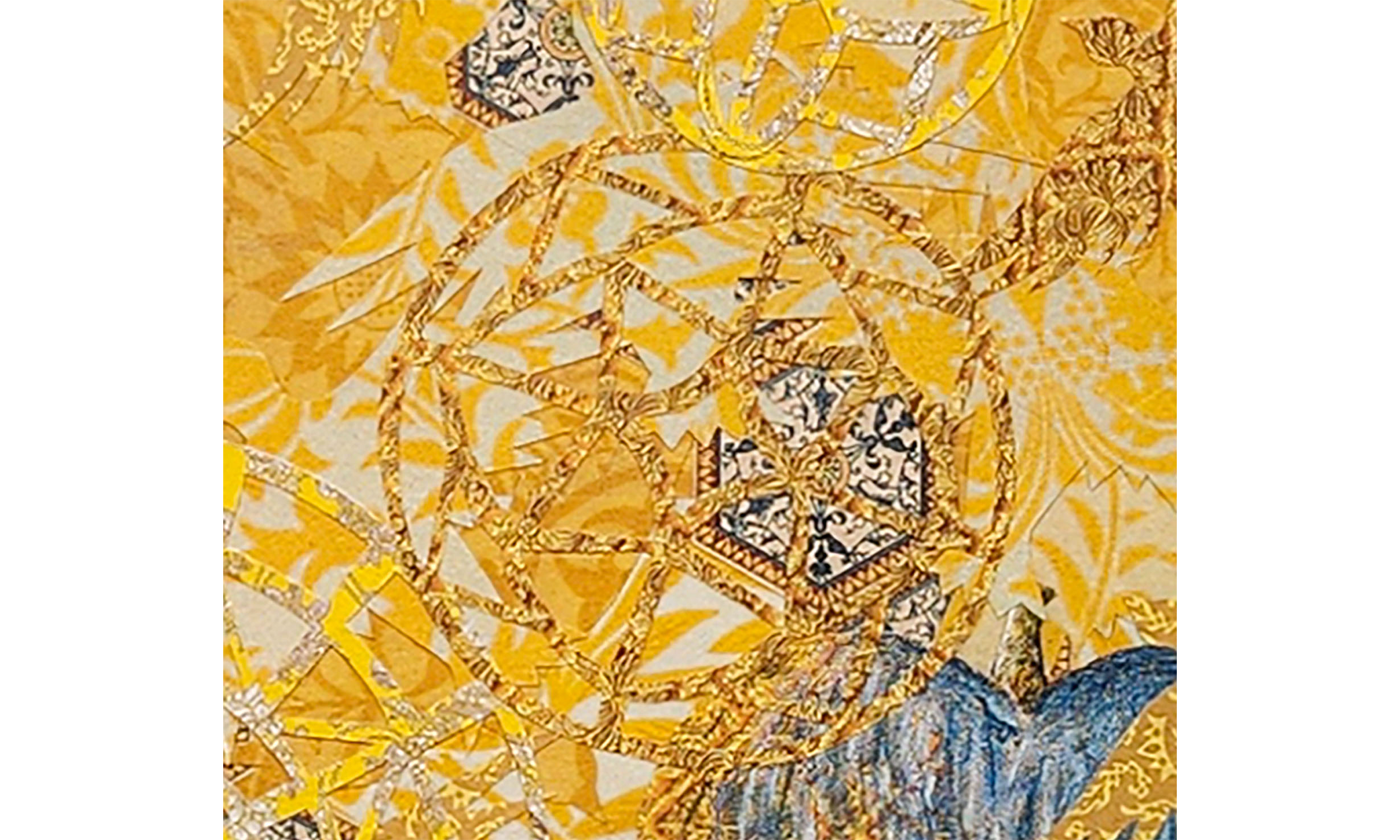
 Joy of Resolve 11x14 inches, collage and colored pencil on canvas, $308
a forgotten debate
Yellow, Manipura chakra, Leo, E Major, Vivaldi's Spring
In the rainbow chakra system the Manipura chakra sits at your navel, or solar plexus. Manipura is Sanskrit for "city of jewels," a chakra considered to be a convergence zone for thousands of energy centers in the body.
It is also your interior sun, or inner fire. The Manipura is associated with willpower, generosity, joy, and confidence.
Sounds like a very Leo kind of thing!
What's funny is when I look it up I see that this chakra stands for so many different things that it may as well stand for everything. I guess that's one reason it's called Manipura.
In my own personal experience the solar plexus is also associated with past life memories or flashes of intuition that are not quite accessible to the conscious mind, like a taste you can't quite identify.
It really used to confuse me as a kid when certain eras of classical music would give me a stomach ache, especially because I loved the music so much! It makes sense to me now, but I'm not going into it here.
Our gut tells us a lot! I guess it truly is a city of jewels to pay attention to.
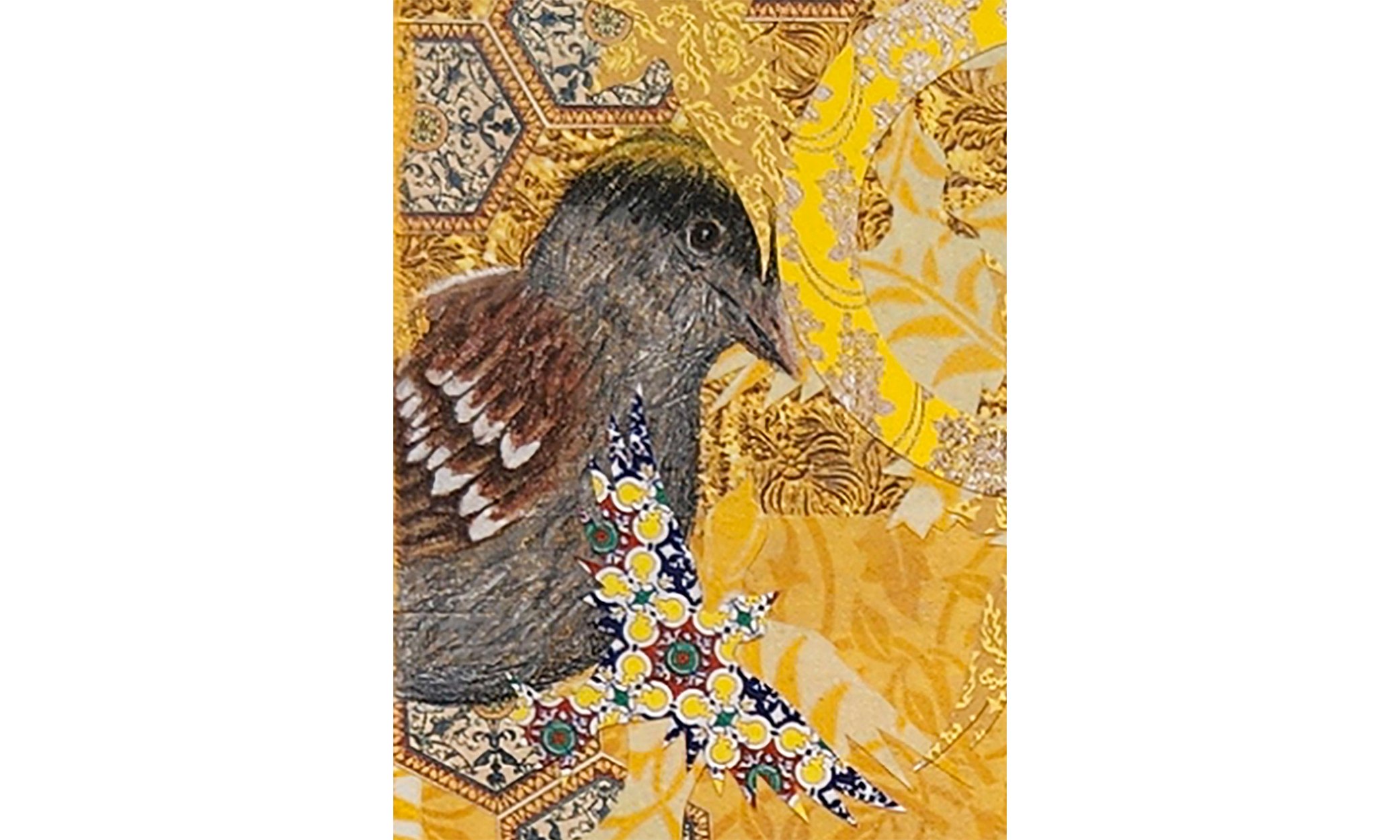 As we move down the chromatic scale, this solar plexus chakra would be associated with the key of E Major in a system of twelve.
Rudolf Steiner associates E Major with Leo in his tone zodiac, and here is the poem Steiner wrote about Leo in his work called Twelve Moods:
Invigorate with senses' might
Matured existence of all worlds,
Perceptive element of beings,
Toward the firm resolve 'to be.'
In the surging shine of life,
In the prevailing pains of growth,
With sense' might, arise!
Essentially, Leo is all about the fully ripened fruit of your existence, about completely and confidently inhabiting your self and your purpose.
What about E Major?
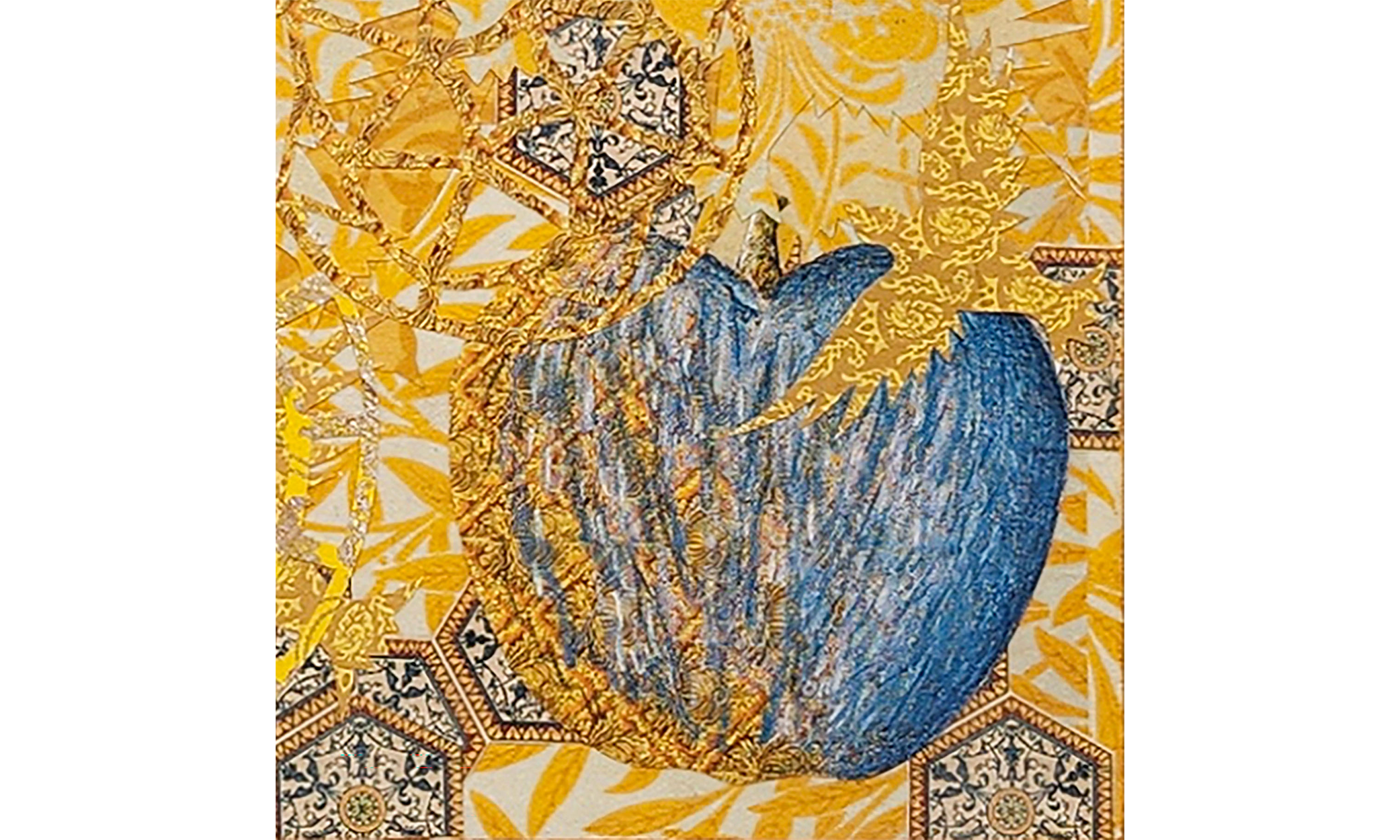 Here's what Christian Schubart had to say:
"Noisy shouts of joy, laughing pleasure and not yet complete, full delight lies in E Major."
Most accounts claim E Major to be a boisterous and ecstatic key, much like the sun itself shining in Leo, and while Leo is a summer zodiac sign, today I'm going to look at spring.
Yes, Spring from Vivaldi's Four Seasons is in E Major.
Funny enough, Summer is in a minor key. When you think about it, summer really is a terrible season that's only getting worse. It's too hot, and in Vivaldi's Italy stormy too, and storms that would threaten the ripening crops. Nothing benevolent about those.
Spring, on the other hand, is much more a time of "laughing pleasure" and "full delight."
 Vivaldi started each concerto in The Four Seasons with a sonnet for each movement that he probably wrote himself. Here are the three for Spring:
Allegro:
Springtime is upon us.
The birds celebrate her return with festive song, and murmuring streams are softly caressed by the breezes.
Thunderstorms, those heralds of Spring, roar, casting their dark mantle over heaven,
Then they die away to silence, and the birds take up their charming songs once more.
Largo:
On the flower-strewn meadow, with leafy branches rustling overhead, the goat-herd sleeps, his faithful dog beside him.
Allegro:
Led by the festive sound of rustic bagpipes, nymphs and shepherds lightly dance beneath the brilliant canopy of spring.
The fun thing is that these sonnets aren't simply written at the top of the score, but in the first publication each line is written out above the music that corresponds with the text.
These sonnets evoke many of the same scenes that Beethoven depicted in his Pastoral Symphony which I talk about here, including a thunderstorm that is more majestic than threatening.
Beethoven also mingled text with music in much the same way as Vivaldi, writing out the names of specific birds in the score above the music that played their songs.
 Music that is written to evoke a specific scene is called "program music," and here Vivaldi took it to a new level never seen before and rarely seen since.
By the way, hallucinations experienced when listening to program music don't count as synesthesia because the music is just doing its job...according to "experts," I guess.
Maybe for me all music is program music, hmmm.
A few decades after Vivaldi wrote The Four Seasons debate raged in the musical community as to whether program music was acceptable as high art or if it was just a gimmick.
Philosophers wondered: should the senses be muddled together like that or kept separated? Wouldn't crossing the audio and visual senses lead to madness? Music should stir up emotions, not images!
It's a very Enlightenment era kind of debate. In a time when science was young and increasingly popular everything needed to be dissected and kept within its own little sphere.
But today we are scientific enough to know that our senses do cross over and play with one another, and that is perfectly natural.
I imagine that when Beethoven performed his Pastoral Symphony that many people thought it a sort of de-evolution of what music should aspire to, and perhaps this is why he insisted that it depicted feelings rather than images or narrative.
 Vivaldi's Four Seasons were extremely popular in his own lifetime, and he would occasionally allude to these concertos in his operas.
The overture and first chorus of his opera Dorilla in Tempe uses the opening of the Spring concerto, and part of Winter is used in another opera.
While in the baroque era is was common practice to recycle an old piece hardly anyone would remember into a new piece, these are examples of Vivaldi highlighting his own popularity by reusing pieces that the public already knew and loved.
And these concertos are still beloved today. If you want to feel sunny, joyful, and connected to your own inner fire, Vivaldi's Spring concerto (heck, the whole Four Seasons really) is likely to hook you up.
And if you want to know more about this forgotten 18th century debate about what music's job should be, check out this book called Haydn's Sunrise, Beethoven's Shadow by Deirdre Loughridge.