
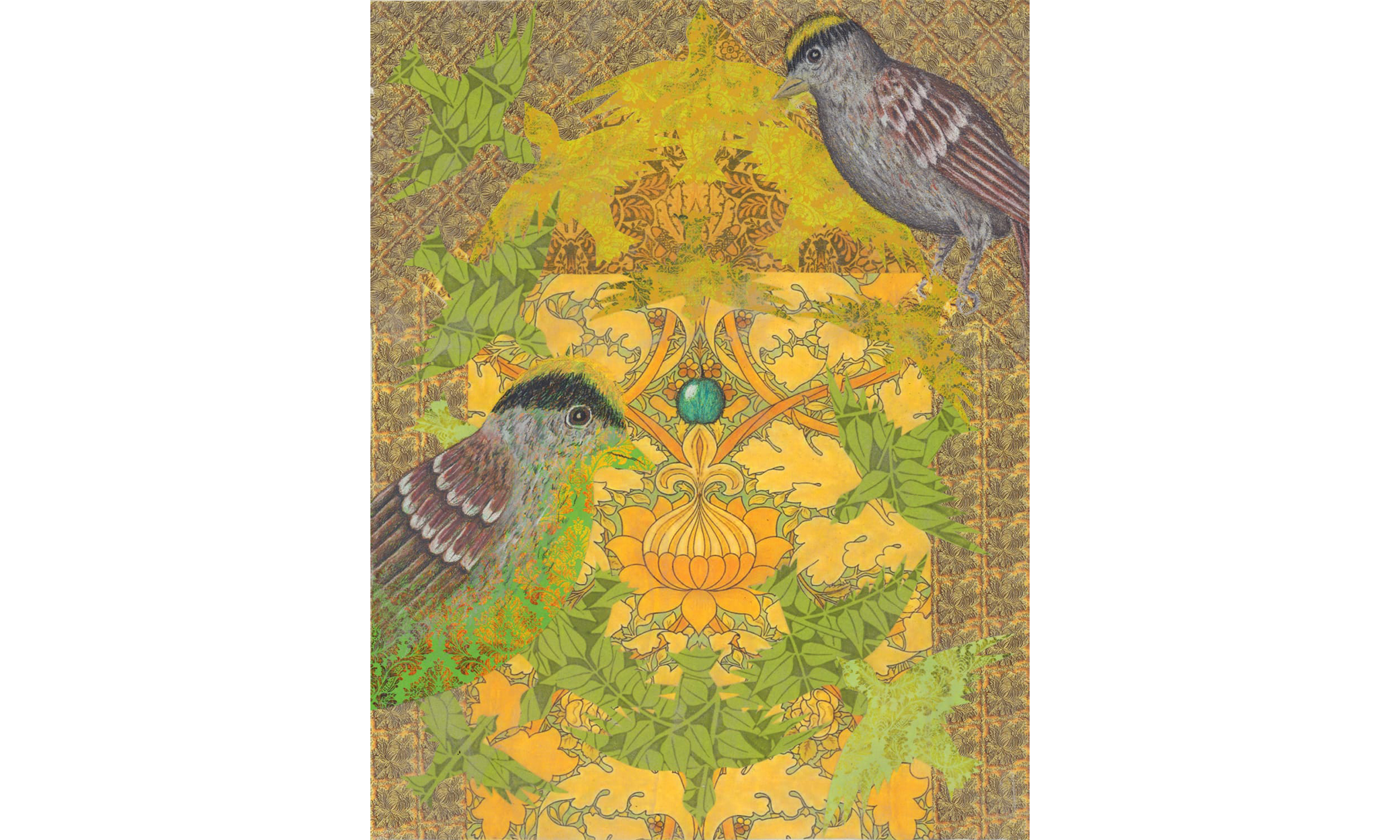
Love Under Will 11x14 inches, collage and colored pencil on canvas, $308
Beethoven's Tao
Yellow green, between heart and solar plexus, Pisces, F Major, Beethoven's 6th
Yellow green is not the color of any chakra in the rainbow system, but instead we can see it as a theoretical chakra that lies between the heart and the solar plexus, or Manipura, also known as the seat of the will.
So what we have here is a story about what happens when our will meets our ability to love.
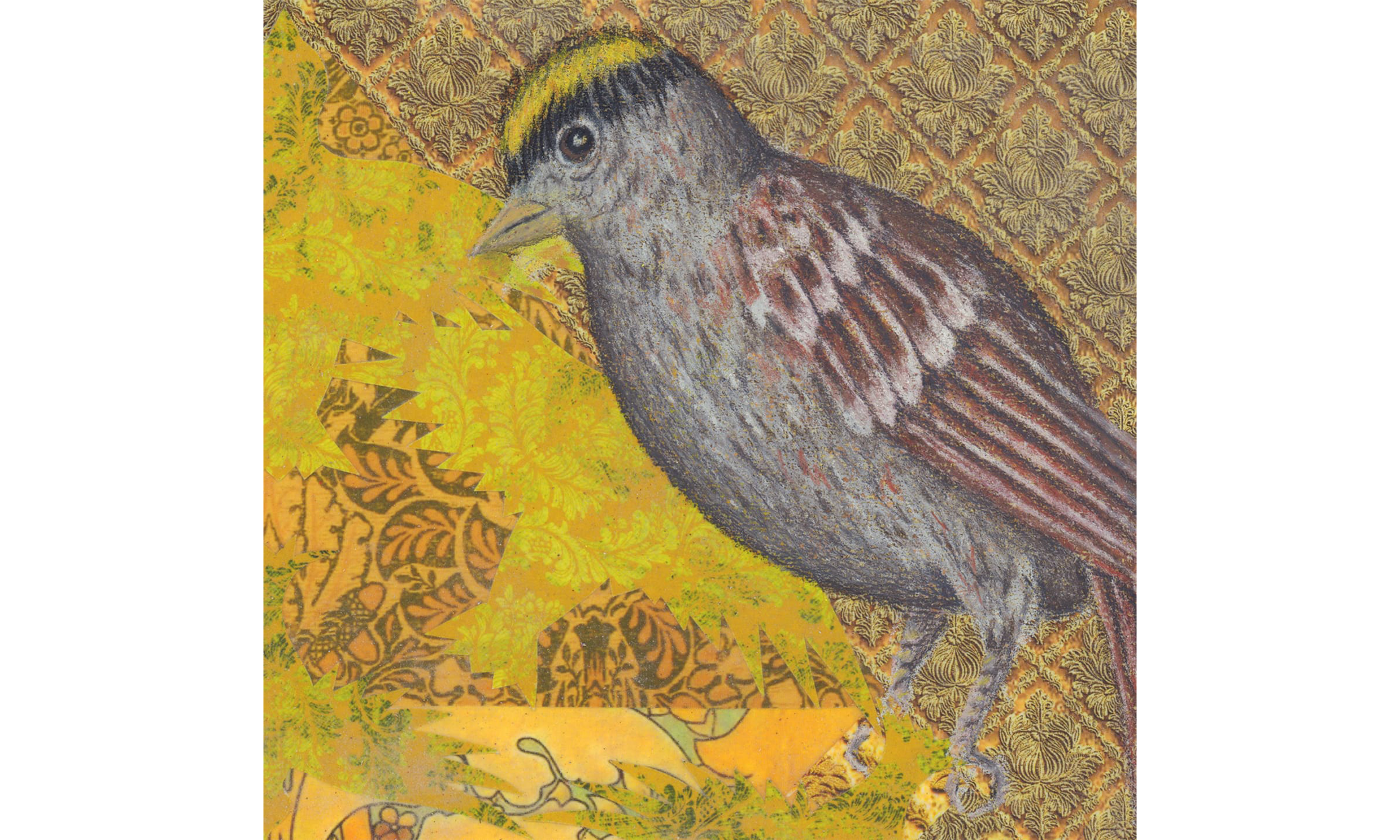
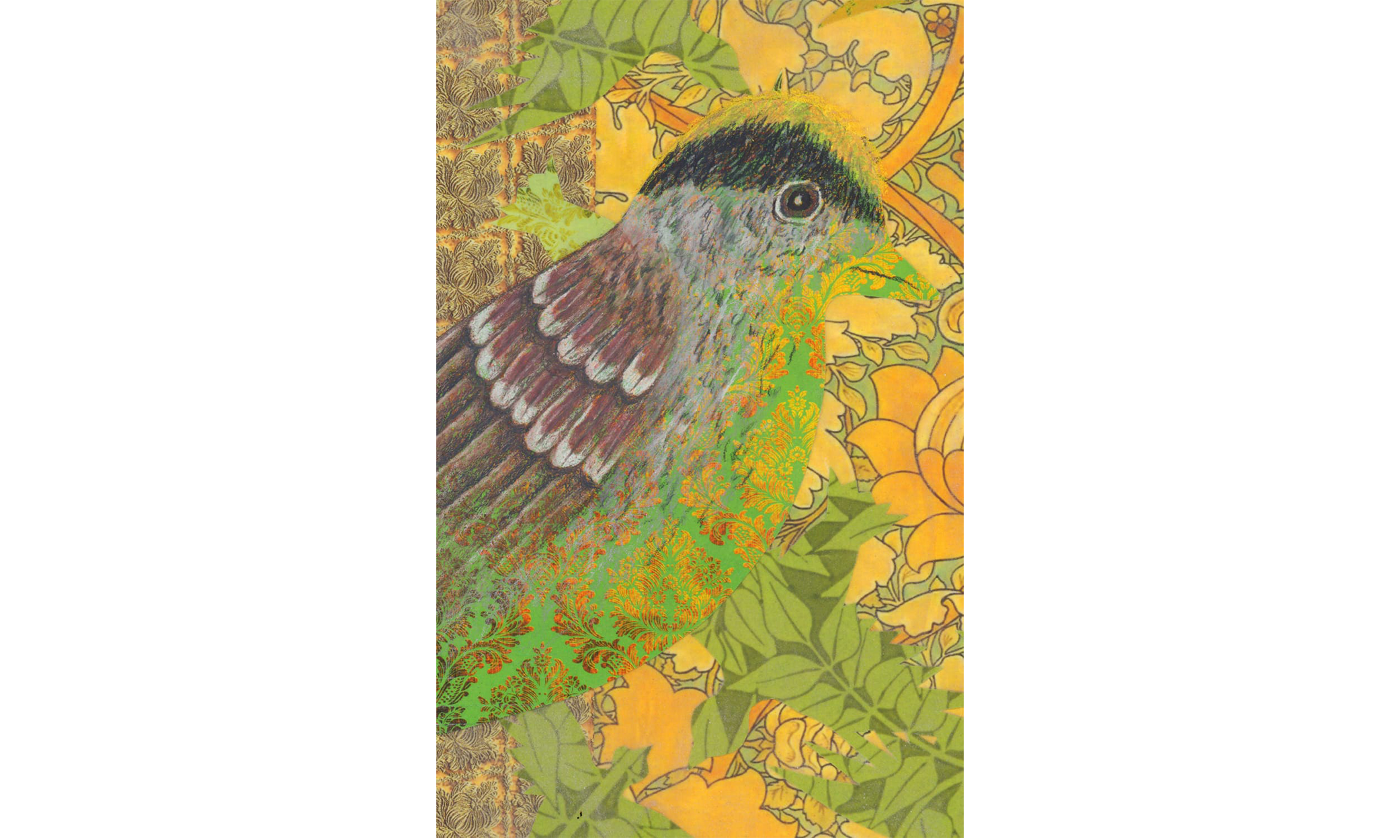
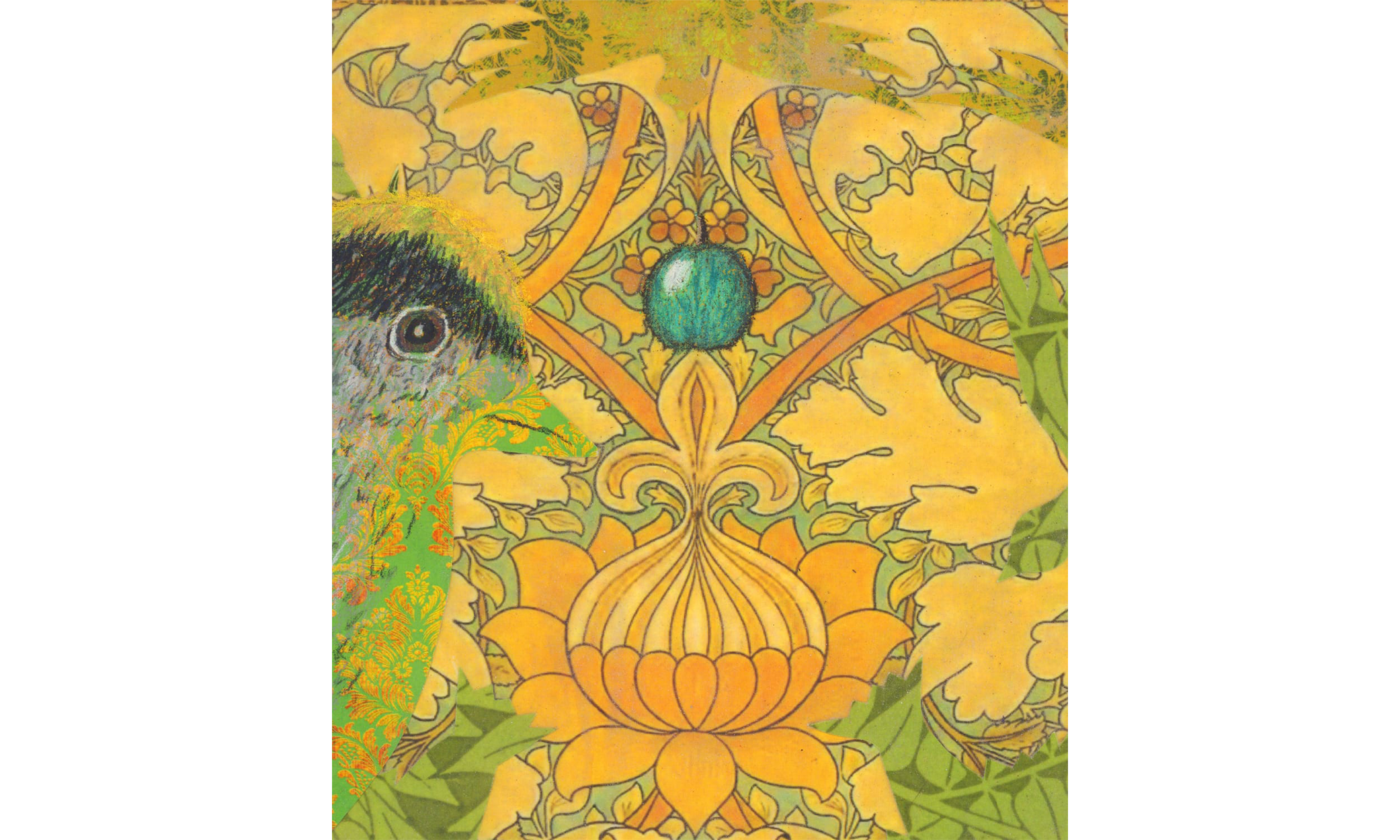
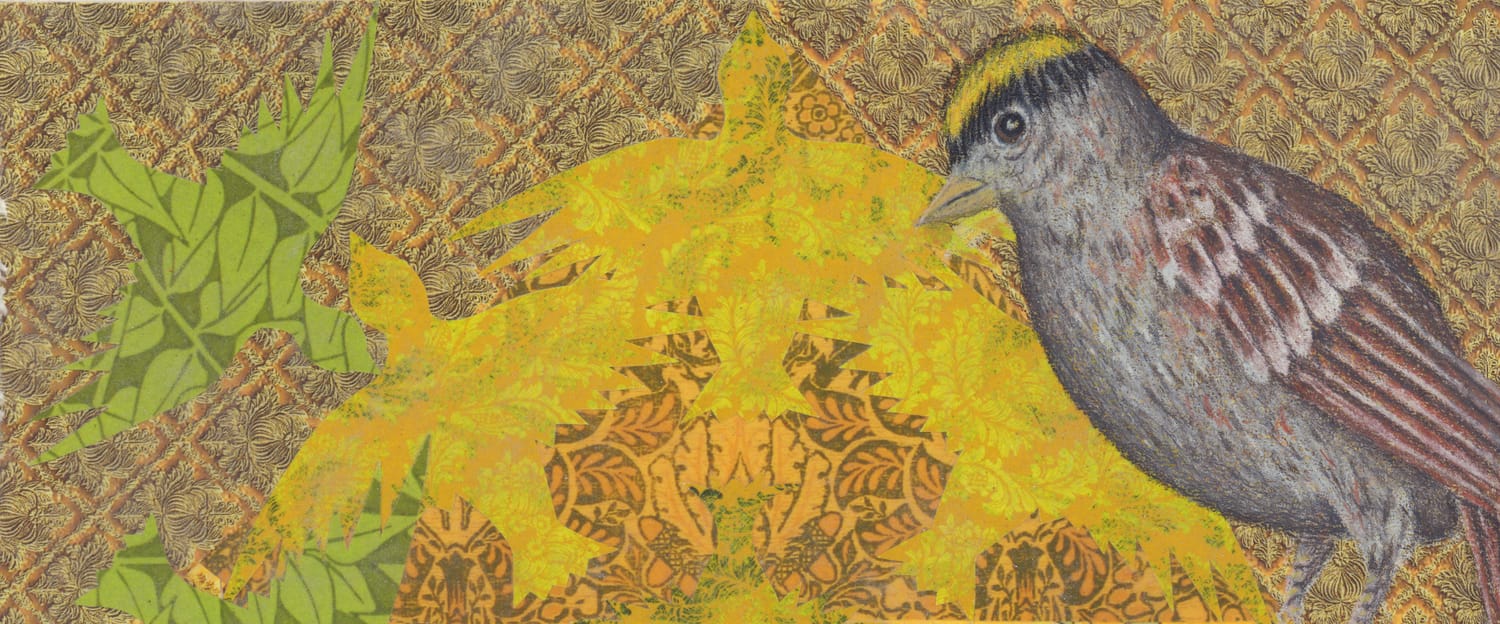
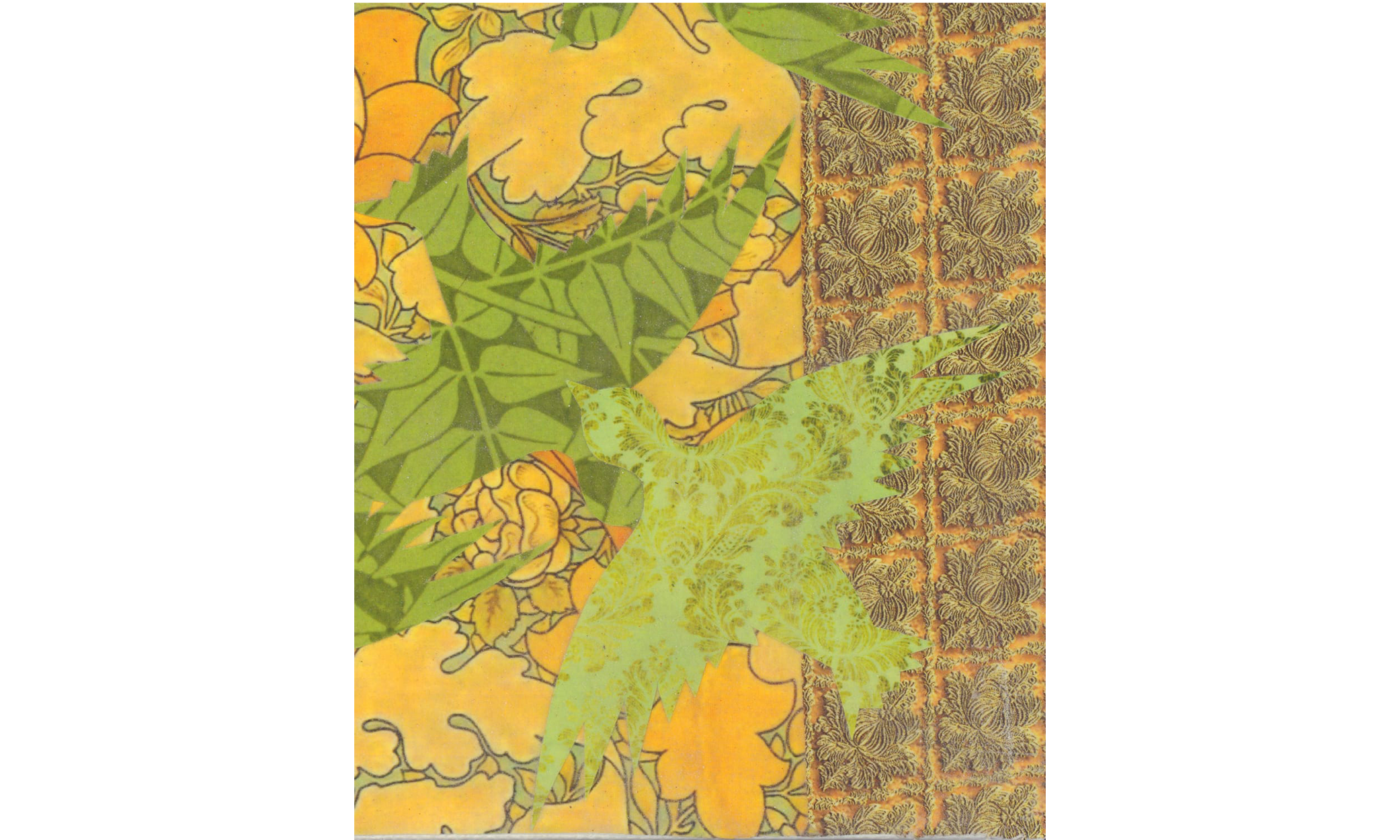
After leaving her beloved parrot, our sparrow is at a critical point in her quest. She must renew her resolve or quit. Here she tries to visualize what her future mother might look like. It's hard to do, but necessary to gather up the love and the will to continue.
Aleister Crowley famously said:
Do what thou wilt shall be the whole of the law,
Love is the law, love under will.
There is no law beyond do what thou wilt.
Usually we only hear the first line of that and assume this is an edict to do whatever the hell we want, but this isn't the case. Given that Crowley was a major asshat it makes sense that we would interpret this line in the worst possible terms, but here's what this actually means.
Love is a law of the metaphysical universe, the way that gravity is a law of our physical universe. Love acts in much the same way too, as a force that binds things together. On a spiritual level all souls and energies are connected via love.
Will is our soul's individual sense of purpose, our reason for incarnation, and it is this will that guides the universal energy of love through our hands, as if we were holding our own personal firehose.
I once heard this line from a spirit guide, "Your life's purpose is to love the best you can in the current moment." I thought it was to be an artist, but it's bigger than that.
Granted, art is my own personal firehose. It is how my will prefers to direct love, but I also can't be making art every moment of every day. Sometimes dishes need doing, family members need care, pets need feeding. These too are all acts of love directed by my free will.
 As we move down the chromatic scale, this liminal chakra between love and will would be associated with the key of F Major in a system of twelve.
Rudolf Steiner associates F Major with Pisces in his tone zodiac, and here is the poem Steiner wrote about Pisces in his work called Twelve Moods:
In what is lost, may the loss find itself,
In what is gained, may the gain lose itself,
In what is comprehended, may comprehending seek itself
And sustain itself by sustaining.
Through becoming, uplifted to existence,
Through existing, interwoven with the becoming.
May the loss be gain in itself!
Pisces is the last sign of the zodiac before the astrological year starts all over again in Aries. This poem seems to contain a reference to the idea of yin and yang: that not only is life cyclical, but always in balance. All things contain the seed of its opposite.
The World tarot card also comes to mind. The last card in the set, it is a reminder that in every beginning the end already exists, and every ending embraces a new beginning.
The World card is also a depiction of how the universe was created in the first place, how two sprang from zero and began to multiply from there, much like how yin and yang emerged from wuji, or "the non-ultimate."
Our lives are all wheels within wheels turning all the time. One quest contains many false endings and new beginnings. The only constant is that our souls are made of love, and we are meant to become good stewards of love on earth.
This dedication we have for our life purpose must be constantly re-evaluated and rejuvenated, our wills and vows constantly renewed, but never forced.
While sometimes the act of loving can feel difficult, the loving itself is never in doubt, and it always shows the path forward.
 Now let's look at what various 18th and early 19th century theorists had to say about the character of F Major.
Christian Schubart just says, "Complaisance and calm."
Johann Mattheson says, "Magnanimity, firmness, perseverance, love, virtue, ease. One cannot better describe the wisdom, the gentleness of this tonality than by comparing it to a handsome man who succeeds in everything he undertakes as quickly as he wants, and with “bonne grȃce,” as the French say."
Marc-Antoine Charpentier says it is suitable for, "furious and quick tempered subjects."
Seems there is some disagreement here. I think Charpentier is kind of an outlier. F is a key we mostly associate with grace and calm.
Given what Mattheson says especially, F Major seems to be the key of living in the Tao. The whole idea of succeeding with grace and seemingly without effort is the essence of Wu Wei, a Taoist idea that is often translated as "effortless action."
 When we attune ourselves to a life of using our will to naturally direct the love of our souls outward then we are in the Tao. There is no struggle, we flow with the divine current.
Just like Pisces, we are fish pulled through the water by our intuition alone.
Let's look at Beethoven's 6th symphony, The Pastoral, in F Major, as a trip via the Tao.
This symphony is basically a nature walk, and while people have long had a tendency to give it a narrative, Beethoven himself said that this symphony is more a depiction of feeling than of painting.
Living life in the Tao means we navigate according to feeling, but that doesn't mean we put our anxieties and neuroses in charge.
Intuition doesn't register fear the way our ordinary mind does. Darkness exists, but it is all a part of nature. It disappears as quickly as it arrives, just like the thunderstorm at the end of this symphony.
 The symphony starts with the feeling of entering the countryside, and apparently that feeling consists of a joyful musical spaciousness and a certain rhythmic flow that tells us this is exactly where we are supposed to be.
In the next movement we are by the brook, listening to the soothing repetition of the current and the singing of the birds. We're living completely in the present, contemplating the natural flow of life via a water meditation.
We meet the people who live in the countryside at a party in the third movement, and here we learn from them how to put living in the Tao into every day practice.
Then comes the thunderstorm. It is dark but magnificent, and while frightening, we know it will pass, and it does. It is just a part of nature along with everything else.
And when it does pass we sing a song of thanksgiving that seems to be about more than just the passing of the storm, but about the fact that the majesty of storms exists in the first place.
Furthermore, these last three movements that flow together seem to depict a kind of cyclical equilibrium. What began with peace and joy now ends with peace and joy after the spectacle of the storm.
 All of that is to say that love is the law, it is the Tao, and staying in tune with this love through all of life's ups and downs is what this journey of ours is all about.