
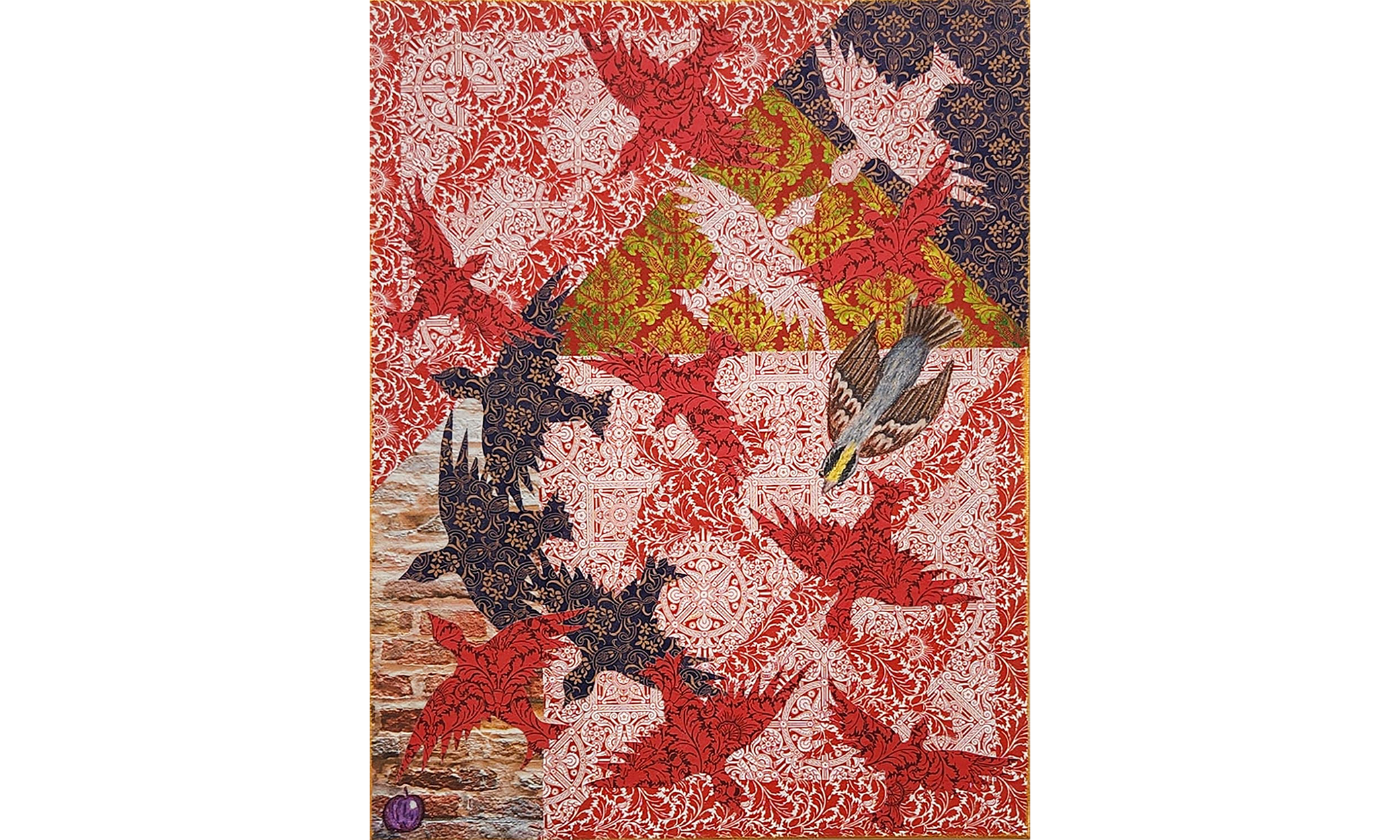
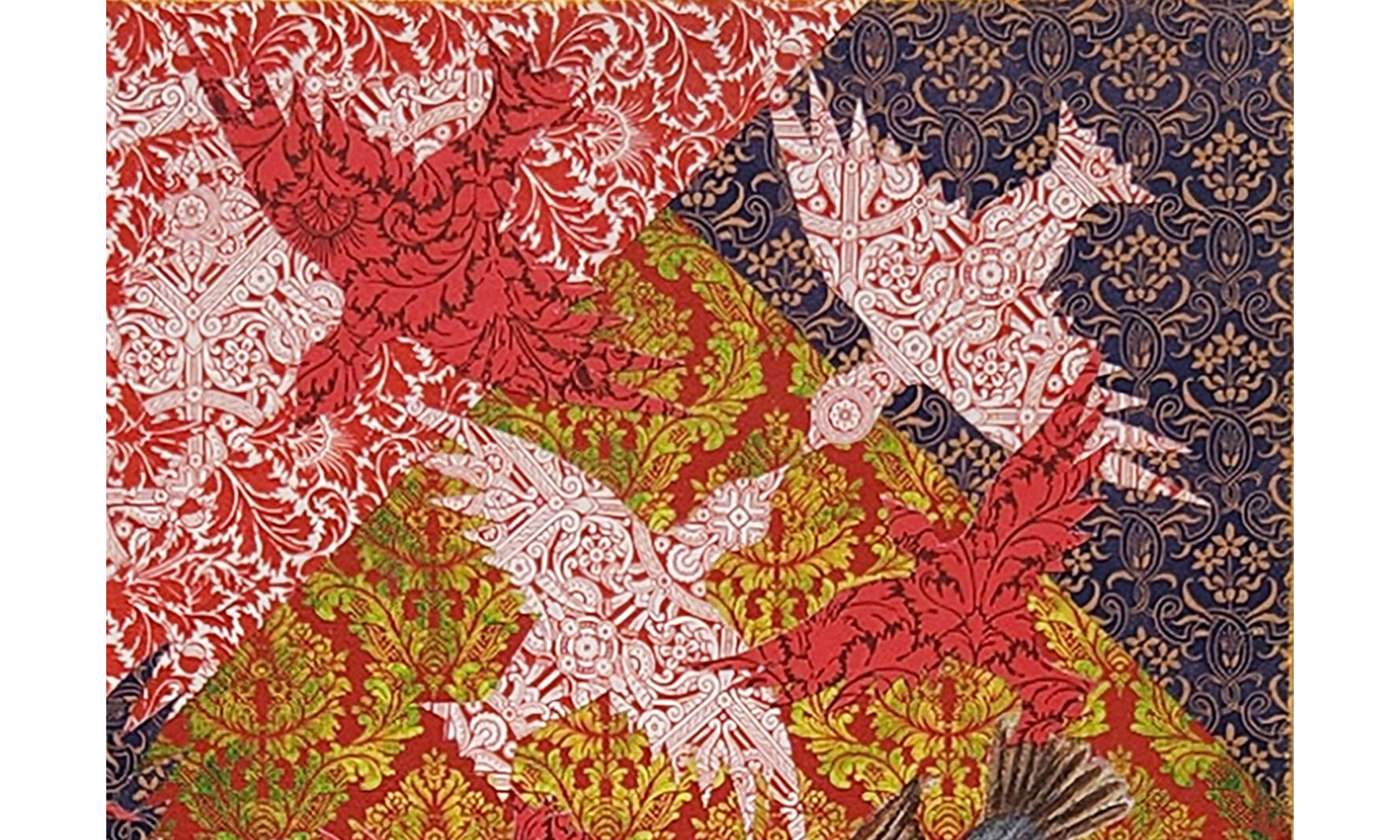
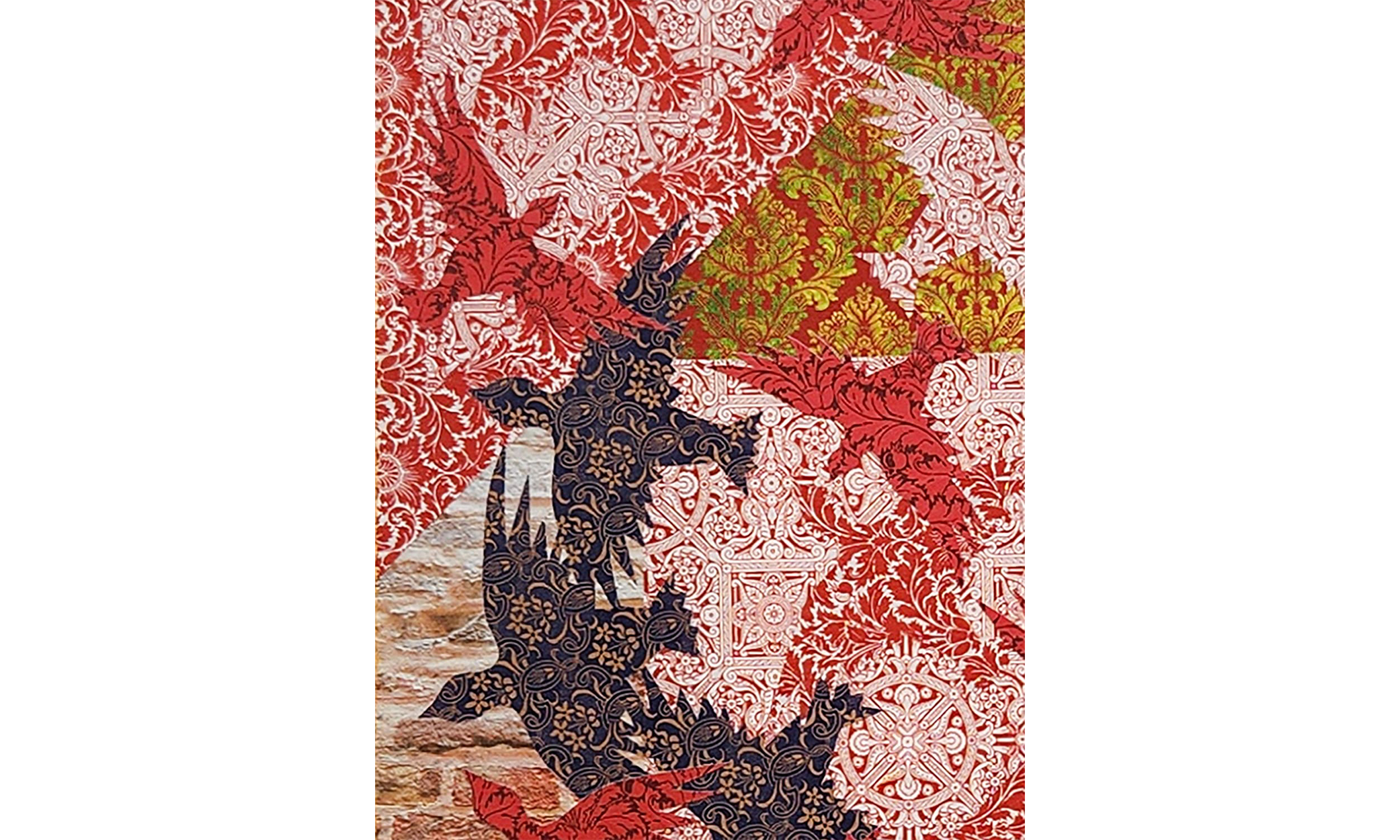
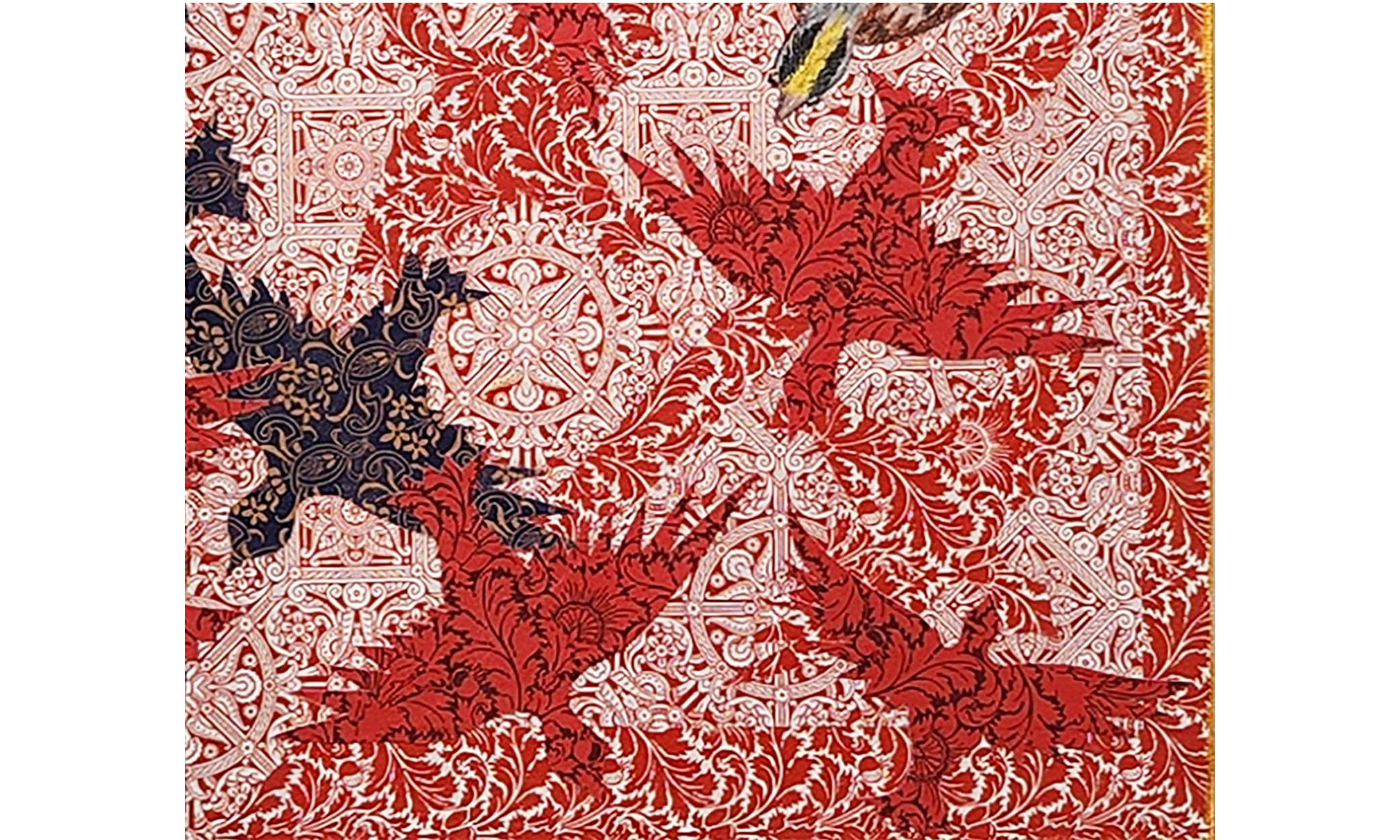
 Dramatic Landing 11x14 inches, collage and colored pencil on canvas, $308
Red, root chakra, Aries, C Major, Schubert's 9th symphony
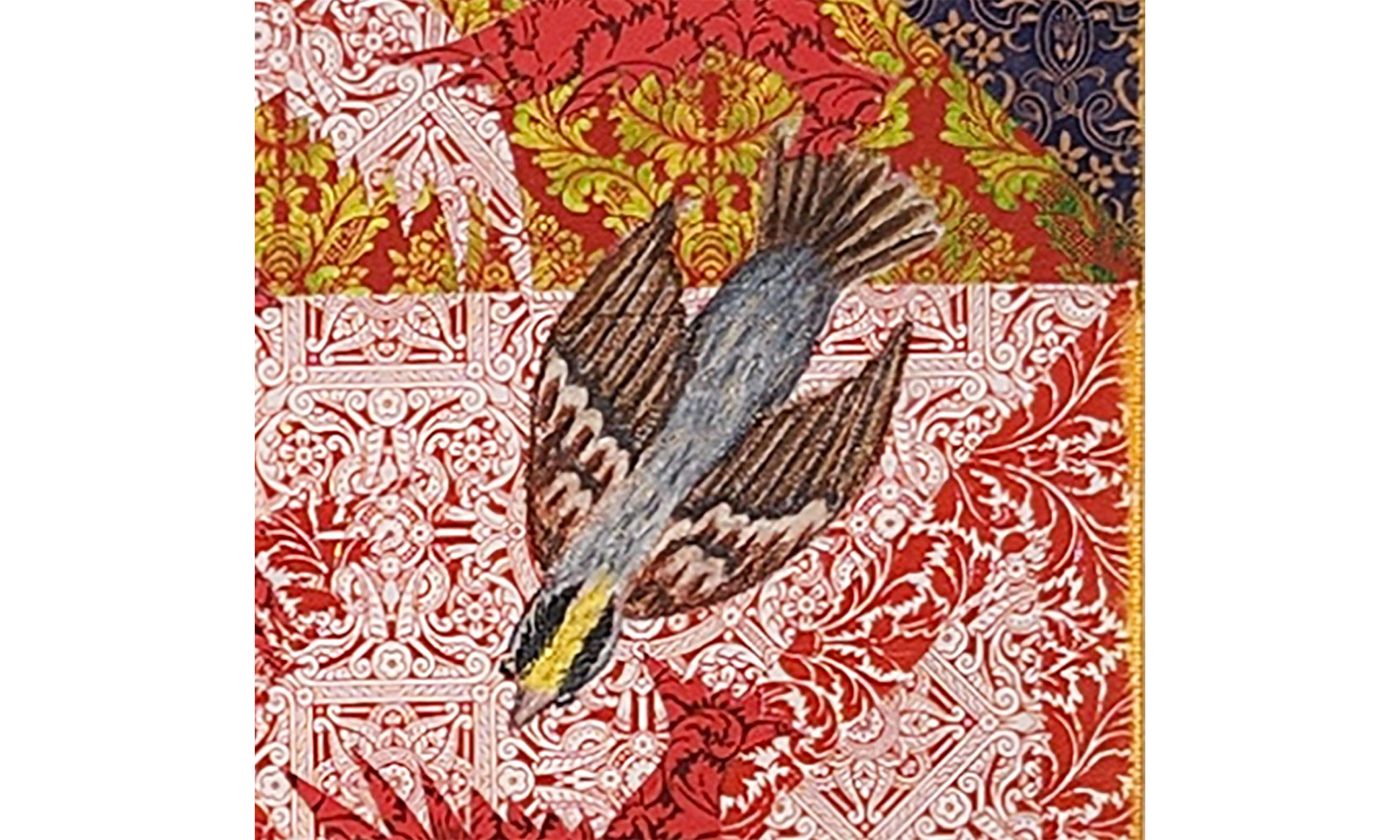
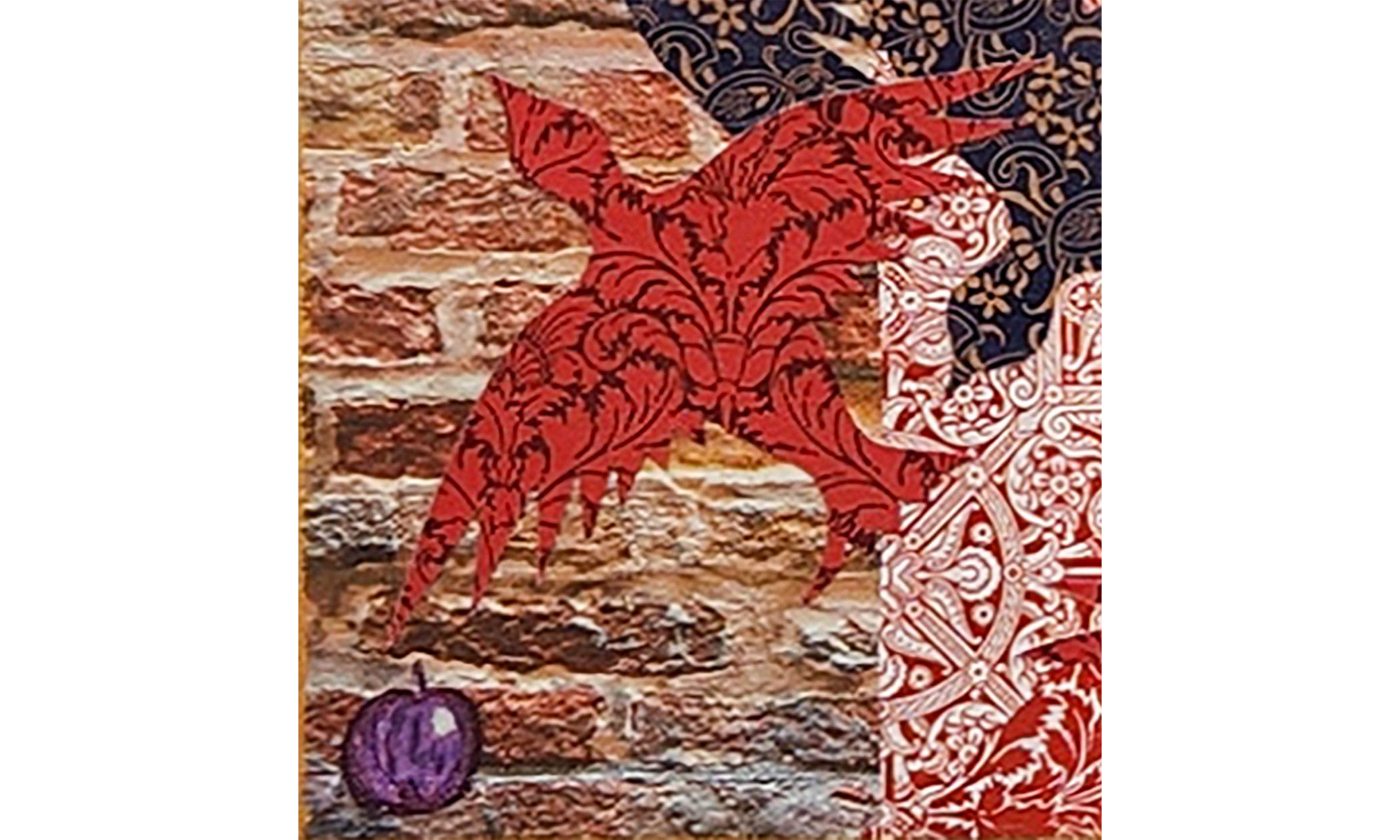
Yay! The sparrow has finally reached her goal of incarnating on earth, and apparently she's making a crash landing, so this place already sucks.
This is where the idea of traveling through the rainbow started for me, though it was not the first collage in the series that I made.
I decided that all things earthly surely must be related to the Muladhara, or root chakra. This is the chakra of support. It represents all things essential for your survival, for feeling grounded in physical existence.
As in Maslow's hierarchy of needs this is "the base," nothing else can happen if you aren't properly supported in your basic requirements for life.
 In the 12 color system I'm using as a metaphor for falling to earth and incarnating, red is associated with the musical key of C Major.
Rudolf Steiner associates C Major with Aries in his tone zodiac, and here is the poem Steiner wrote about Aries in his work called Twelve Moods:
Arise, oh shining light,
Take hold of growth and becoming,
Lay hold of the weaving of forces,
Yourself ray forth, life-wakening.
In face of resistance, gain;
In stream of time, disperse;
Oh shine of light, abide!
Aries is the sign of spring, of new life, and thus it kickstarts the whole zodiac cycle.
Finally we have a concurrence of all things that come first in these systems! Red is considered "the first" color, Aries the first sign, C the first note, Muladhara the first chakra. These things are also all cyclical in their way.
Just like incarnation itself, life on earth could be the beginning or end of a journey. In my story about a sparrow it just happens to be the end, but is it really?
 And we have finally arrived at C Major, Do, the key where all keys start because we decided it just made sense that way.
It's such a common key that I wondered how the heck I would choose a piece of music to talk about here. Well, I defaulted to Schubert, because of course I did! I have a really good reason though.
Schubert's 9th symphony in C is all about "the hero's journey." At least it always was in my mind, but then I found out that Robert Schumann basically agreed.
Not that Schumann knew about the concept of the hero's journey framework, that didn't come along until Joseph Campbell laid it out in 1949.
What Schumann did say was that Schubert's symphony had a "heavenly length," and that it was like a novel in four volumes that could go on and on without end because everything meant something. It was truly a life-changing journey.
Whenever the radio plays this symphony they have to mention the "heavenly length" quote, and I always snicker. I think Schubert would also be tickled that anyone would decide a part of him had a heavenly length, especially given his "Little Mushroom" nickname ;)
Ahem, anyway...
 If you're not familiar with the hero's journey framework it goes like this:
Call to adventure
Supernatural aid
The threshold (OMG, this is dangerous!)
Challenges and trials, the long part of the story
Disaster, dark night of the soul
Epiphany, resurrection
Atonement, reconciliation (external or internal)
Return to the regular world
It's often depicted as a cycle because you can go through more than one hero's journey in a lifetime. And yes, I believe we all go through some version of this at different points.
Star Wars or Lord of the Rings are the most oft cited stories that use the hero's journey framework, and epic as these tales are, they also appear within your own life.
Your own hero's journey may seem mundane on the surface but be deeply dramatic to you, or it could be overtly dramatic to anyone who knows the tale.
Some words that have been used to describe the key of C Major include: pure, innocent, decisive, powerful resolve.
These are qualities that one must take on to begin a hero's journey and continue it to the end.
How might Schubert's "Great C Major" symphony describe a hero's journey?
 What's great about a hero's journey in music is that it's relatively unspecific. You are left to imagine the details, but the feelings remain.
The symphony starts out with a trombone call, what literally sounds like a call to adventure. The music that follows feels like a flapping of angel wings, to me anyway, the supernatural aid.
The first movement feels like an overall illustration of how one internalizes the call to adventure and comes to terms with what that might mean, but the overall tone is heroic and optimistic.
The second movement starts to show us the challenges and trials. I always picture the ball scene from the beginning of The Count of Monte Cristo where the count, recently escaped from prison, comes home to a ball at his house, and finds his wife has married someone else.
The second theme of this movement, that sounds vaguely like Pachelbel's Canon, is the theme of the love interest slowly descending the staircase. Now the protagonist knows what he's fighting for and plots his scheme. There is a great struggle, and the movement ends with the dark night of the soul.
The third movement is the resurrection while the trio in the center is the atonement. Here is where the hero internalizes his lessons from the trials and vows to allow those trials to make him a better person.
I see the trio as a copse of waving trees, dancing just enough to let the light in. What was once rigid has now been made free.
 The fourth movement is the glorious homecoming. The hero returns to much fanfare and a fireworks show! Having vanquished the forces of darkness he has saved his people and gets to celebrate that.
One lovely little detail in the fourth movement is a tribute to the Ode to Joy theme from Beethoven's 9th symphony, tweaked just enough to clearly become Schubert's own. I see this as how he internalized the hero's journey he encountered in Beethoven's symphony and brought it home into his own.
For the sparrow we've been following through these collages the red world of earth is where the abyss and resurrection crash together. She has taken on her first incarnation and is beginning to grapple with what that feels like.
This may seem like the end of the story, the goal is achieved, but it isn't really. Next time we'll look at the rest of her journey.
The fourth movement is the glorious homecoming. The hero returns to much fanfare and a fireworks show! Having vanquished the forces of darkness he has saved his people and gets to celebrate that.
One lovely little detail in the fourth movement is a tribute to the Ode to Joy theme from Beethoven's 9th symphony, tweaked just enough to clearly become Schubert's own. I see this as how he internalized the hero's journey he encountered in Beethoven's symphony and brought it home into his own.
For the sparrow we've been following through these collages the red world of earth is where the abyss and resurrection crash together. She has taken on her first incarnation and is beginning to grapple with what that feels like.
This may seem like the end of the story, the goal is achieved, but it isn't really. Next time we'll look at the rest of her journey.