
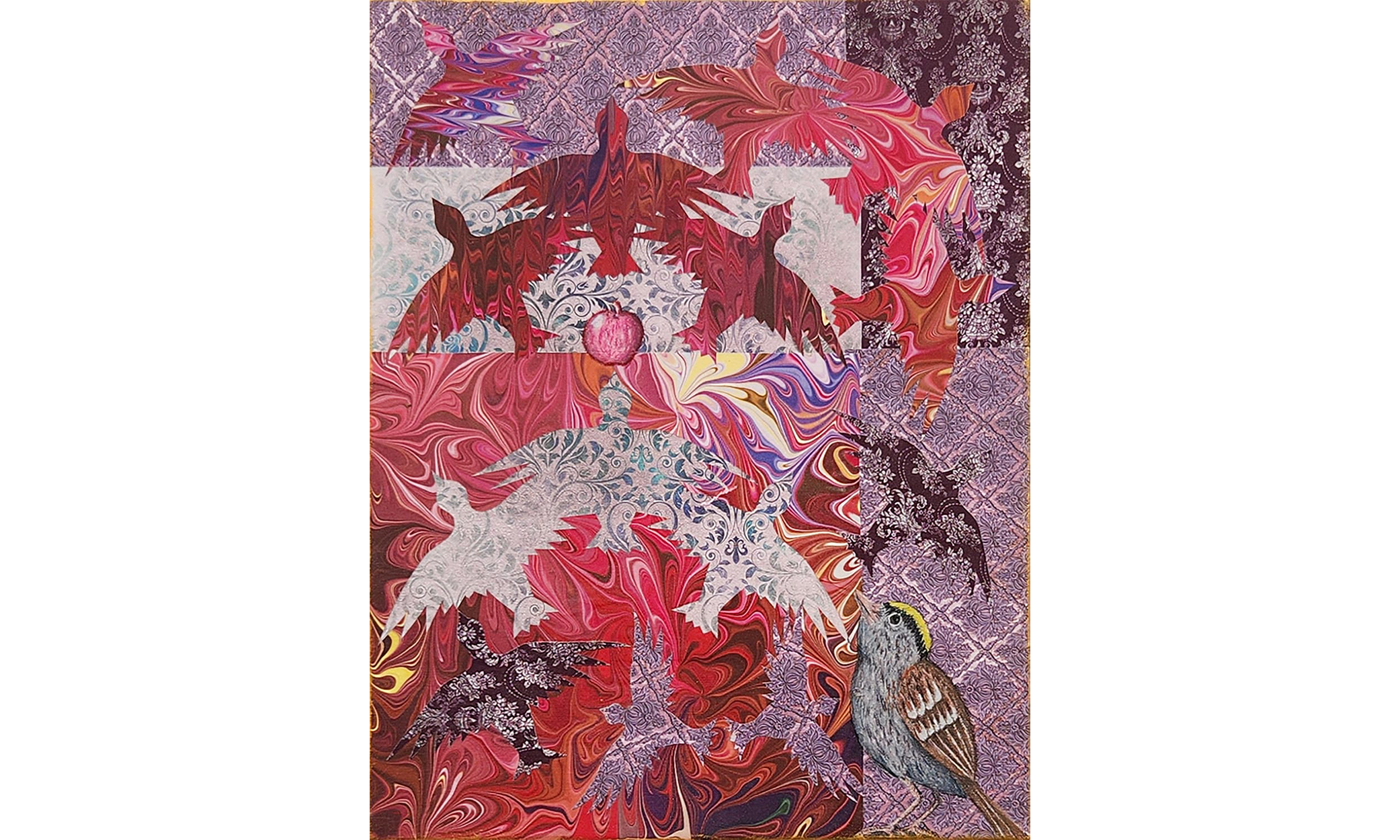
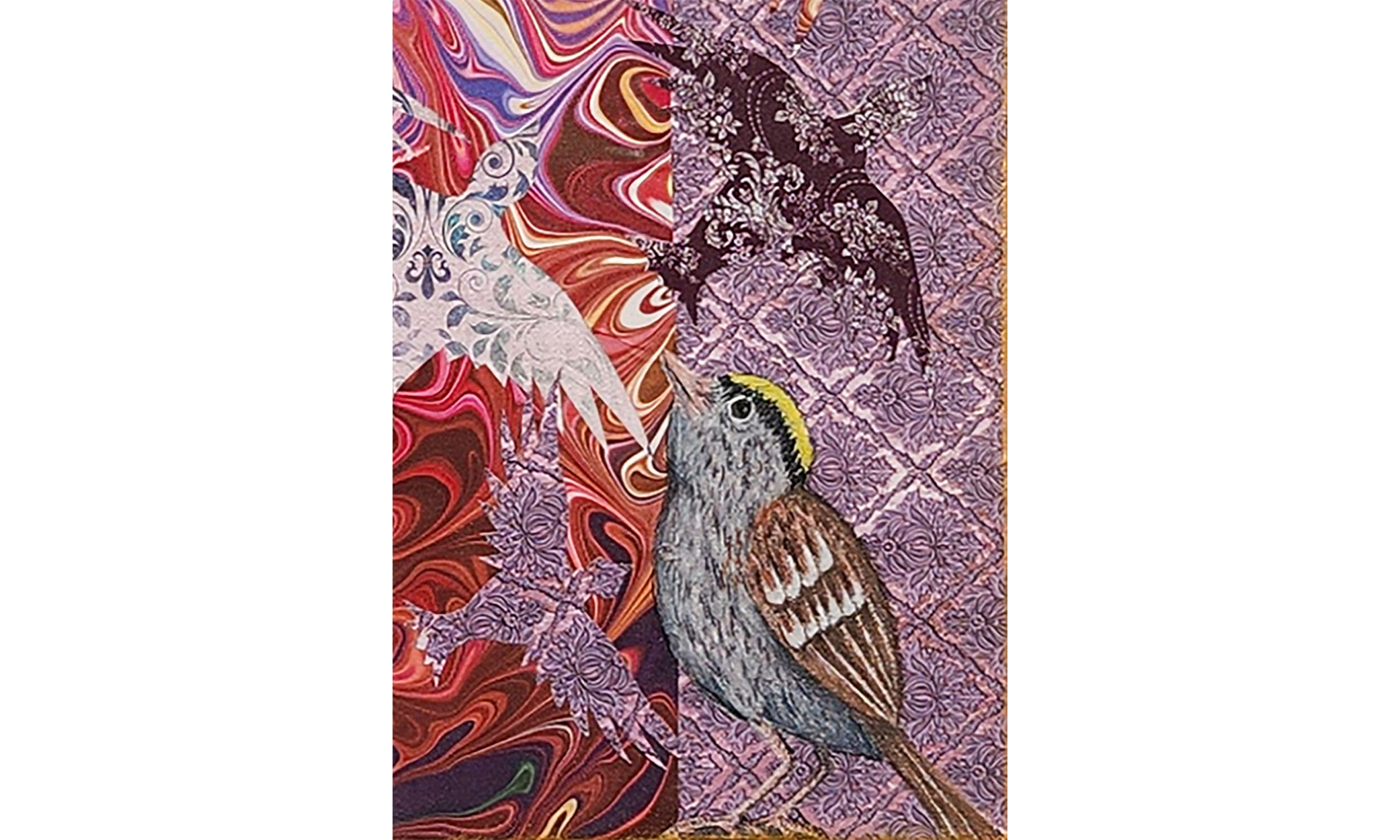
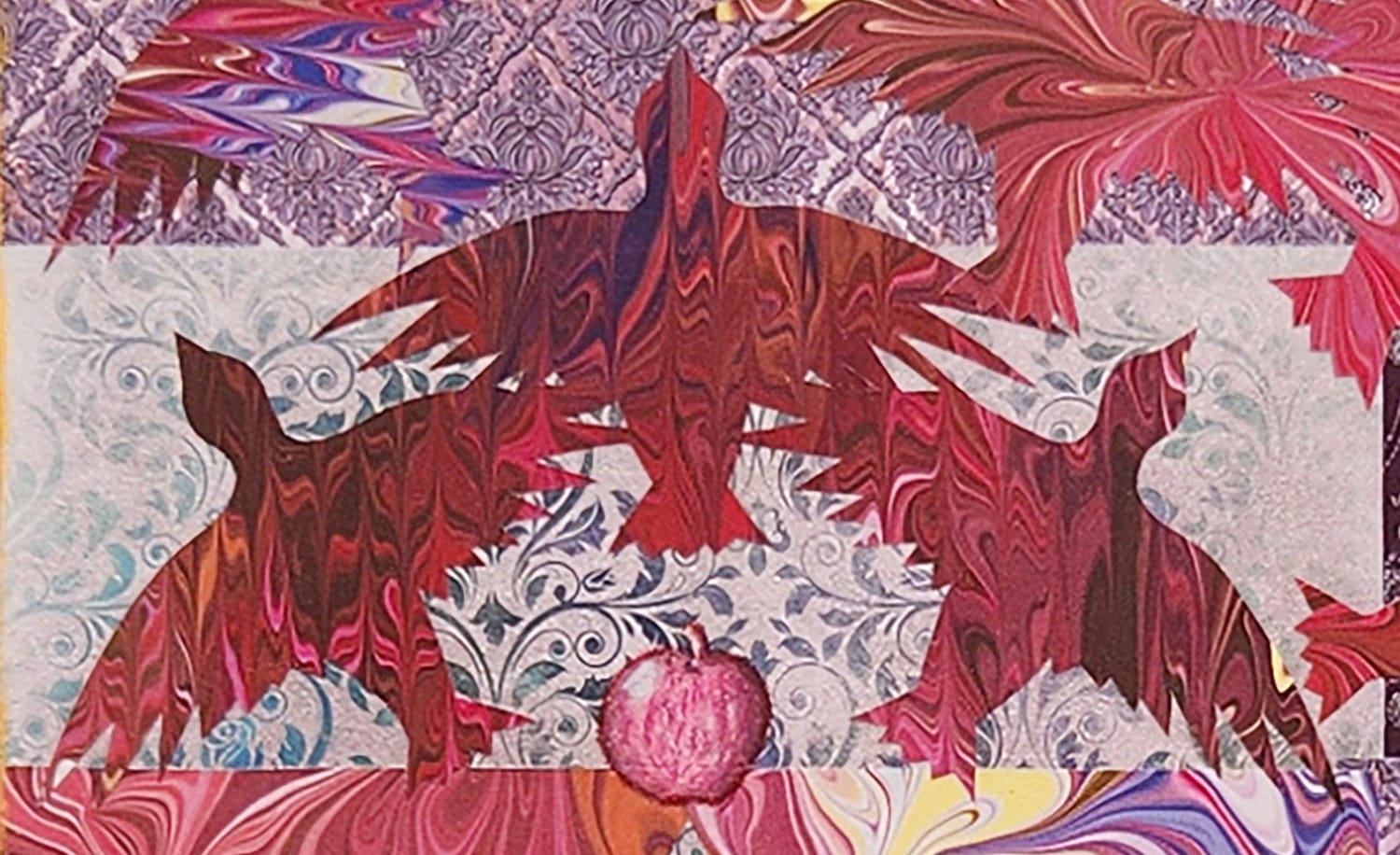
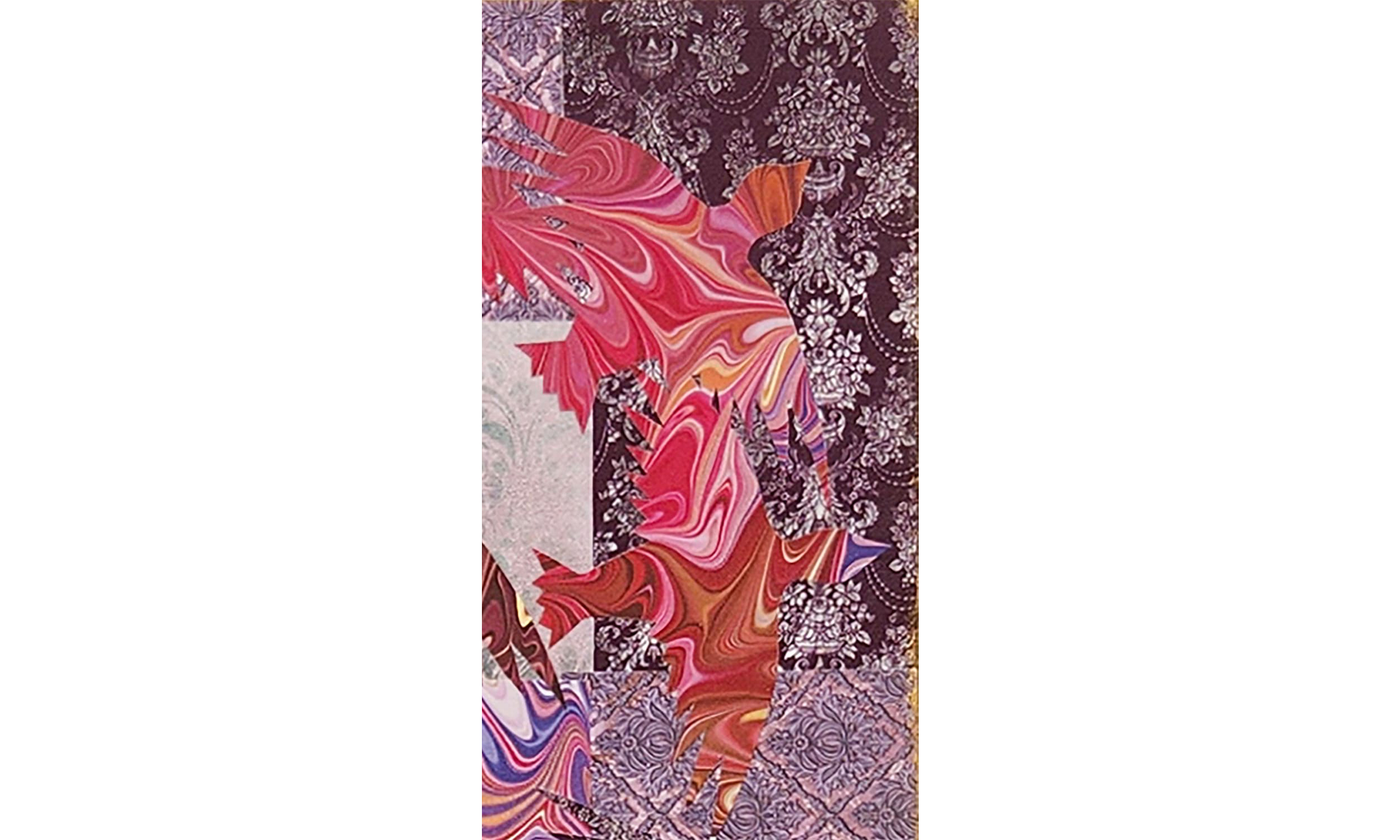
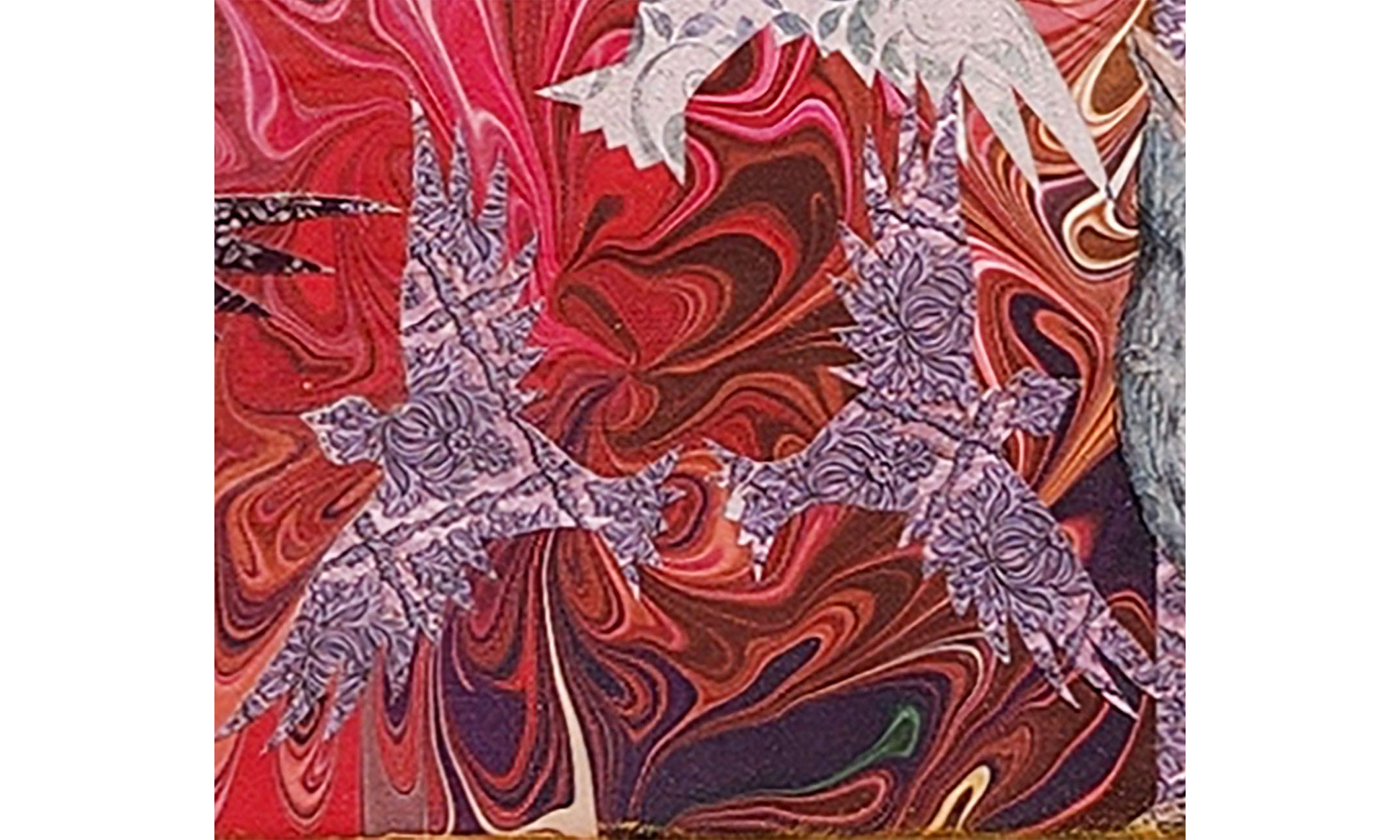
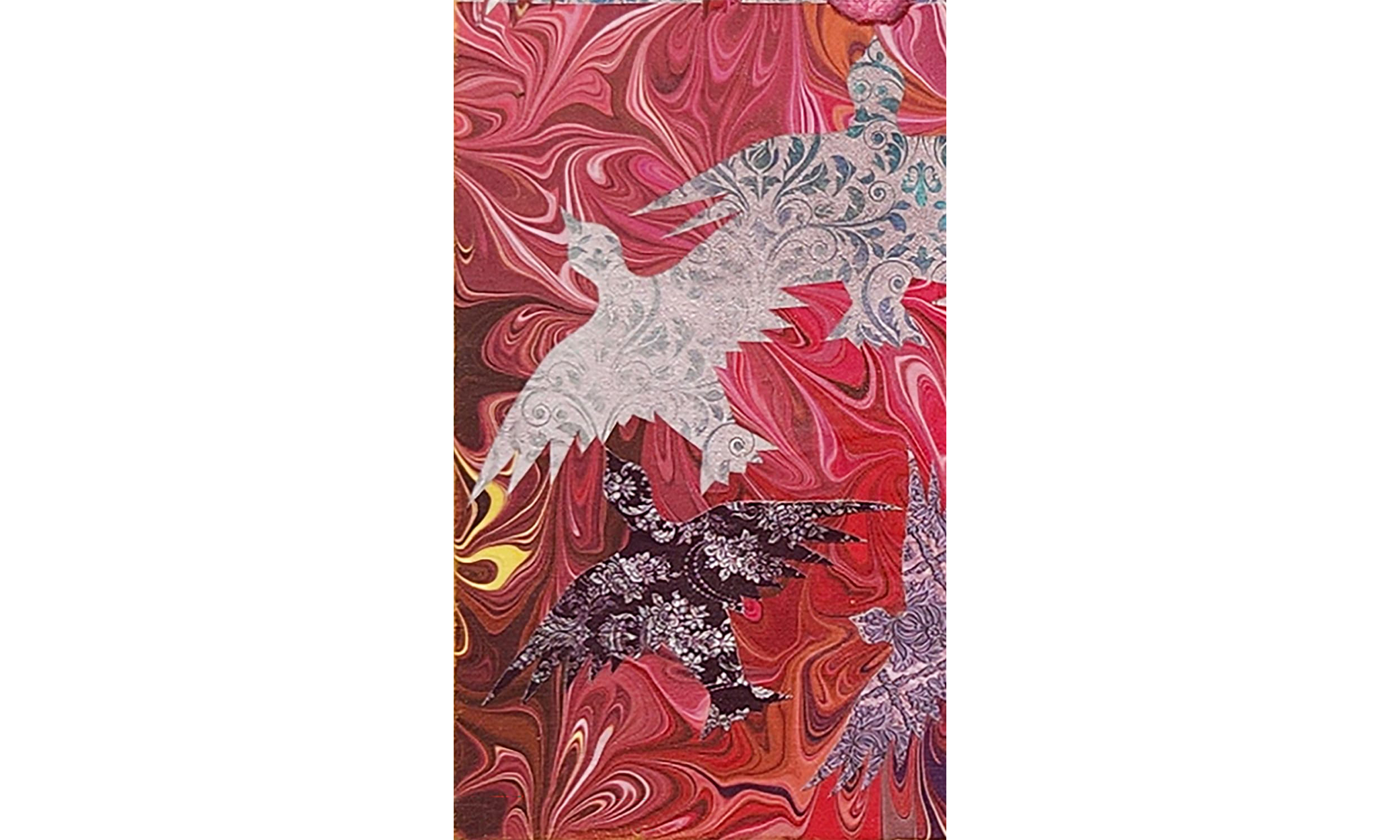
 Spirit's Shortcut 11x14 inches, collage and colored pencil on canvas, $308
a non-existent color
Magenta, "between" root and crown chakra, Virgo, B Major
That's right, red is not the end! The sparrow's journey to incarnate on earth doesn't end there either, but now we get to the most interesting place. Welcome to magenta, the world between worlds.
Magenta is a very strange color. It doesn't exist in the rainbow at all, and thus it is called a non-spectral color. Because red is on the outside of the rainbow while purple is on the inside, they never get a chance to mix.
Thus, magenta, or pink, is a color that exists completely within your own brain. When we see red and purple co-existing beside each other our mind translates that into a completely new color.
B Major is also a pretty rare key, and you will find very few examples of its use before the 19th century. In a cursory look I was only able to find a handful!
Together the color and the key form a cool metaphor for how our daily lives might blur into the spirit world.
 In the 12 color system I'm using as a metaphor for falling to earth and incarnating, magenta is associated with the musical key of B Major.
Rudolf Steiner associates B Major with Virgo in his tone zodiac, and here is the poem Steiner wrote about Virgo in his work called Twelve Moods:
Behold the worlds, oh soul!
Let the soul take hold of worlds,
Let the spirit lay hold of being,
Work out of powers of life,
Upon will-experience, build,
In blossoming worlds, put trust.
Oh soul, comprehend the beings!
For Steiner Virgo is all about the grounding of the human soul. As the seasons change from summer to autumn we can still carry the spirit of summer within us and draw from that reservoir of light through the dark months.
This is a microcosm of how incarnation works in the first place. We may be on earth, but we always have access to our soul.
 There are lots of techniques for accessing the wisdom of the soul from dreamwork to ritual to meditation to psychedelics. All of these take us to the "magenta place" where we exist in a liminal space of consciousness.
Meditation is my favorite technique to access that state, but another fun one is asking questions and listening for answers in the state between waking and sleeping.
It's always a trip to ask a spirit or your own soul a question in the half-sleep and hear an answer back. I've held whole conversations this way, the caveat being that they are really hard to remember when you wake up!
Just like magenta, the spirit world seems non-existent and invisible, but we can use our imaginations as the gateway to piece it together.
So how does this relate to B Major?
 It's not like B Major is a non-existent key, it's just not used all that much, or at least it wasn't until equal temperament tuning became much more common.
Before that point the key of B would have the most inconsistent tuning of any key. Some chords would sound great and some would sound off, maybe tense or strange.
As with how we see colors like pink, our brains also fill in how we hear music. We might hear an incomplete chord and mentally complete it, for example.
Or, we might hear a slightly out of tune chord and mentally correct it, at least to the best of our abilities. That means it might sound off to us but we might not know why unless your ears are well trained.
Maintaining contact with the spirit world is similar. The messages are always there, and they have always been there, but it does take training to notice them and interpret them.
These nods from the other world are easy to miss and dismiss because of their subtlety, like a tuning system you aren't familiar with. Something might seem odd, but you can't define it.
 This makes the various descriptions of musical key characteristics interesting as attempts to define exactly how someone felt something as "off" about certain tunings from key to key.
It's also why these descriptions are so subjective. The messages we get from spirit are likewise subjective, and the same message might mean something very different to you vs a family member.
The only description we seem to have about B Major, that I found anyway, is what Christian Schubart says: "Strongly colored, announcing wild passions, composed from the most glaring colors. Anger, rage, jealousy, fury, despair, and every burden of the heart lies in its sphere."
In the actual music that exists in B Major from the 18th and early 19th centuries I don't hear anything much like anger in any of them. There can be a certain restlessness, but I don't think it's out of the ordinary.
 Domenico Scarlatti wrote 4 keyboard sonatas in B Major, and while this may sound remarkable, this is 4 out of 555. Apparently he just loved to experiment, even with keys he didn't really like. And these aren't sonatas the way we think of a sonata today, each is a pair of movements that work together.
These pieces are definitely full of sonic surprises, but all of Scarlatti is like that. The funnest thing though, is to listen to these pieces played on different harpsichords and then on piano. It's the different instruments that really change their character.
Haydn wrote one symphony in B Major out of 104! It comes from his "Sturm und Drang" period, which was his era of emotional experimentation.
Bach of course wrote pieces in B Major for The Well Tempered Clavier, but he had to in order to fulfill the demands of his own assignment to write something in every key.
What this shows me is that B was a key for only the wildest experimentalists in classical music, and even then, it was rare for them.
So, while I wanted to talk about some early B Major piece in depth today, I thought it made more sense to talk about the lack of them, which tells us an even more interesting story.
It's the key of experimentation, and likewise, the only way to unlock your own relationship with the spirit world is through experimentation. Even if it doesn't make you a believer you'll find something worthwhile!