
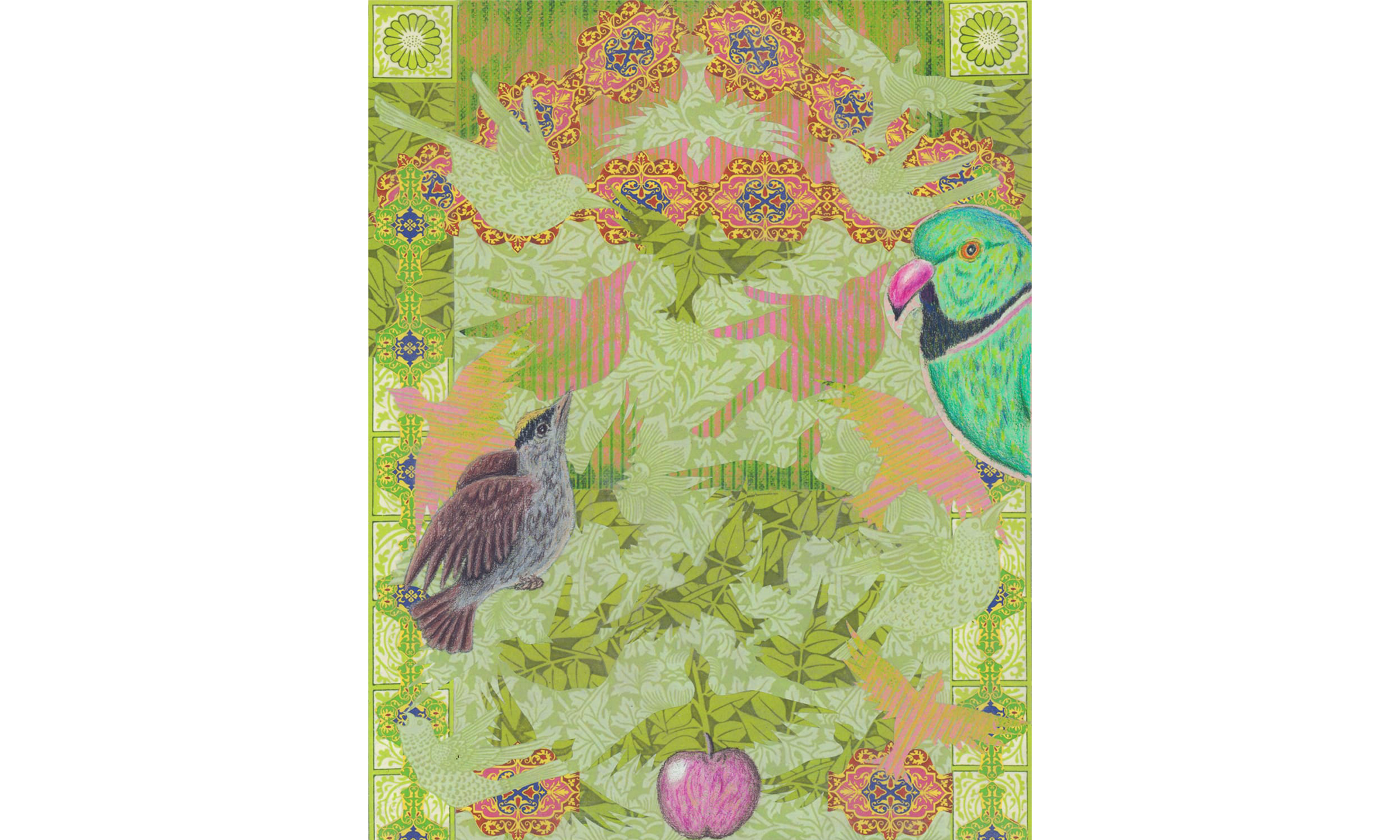
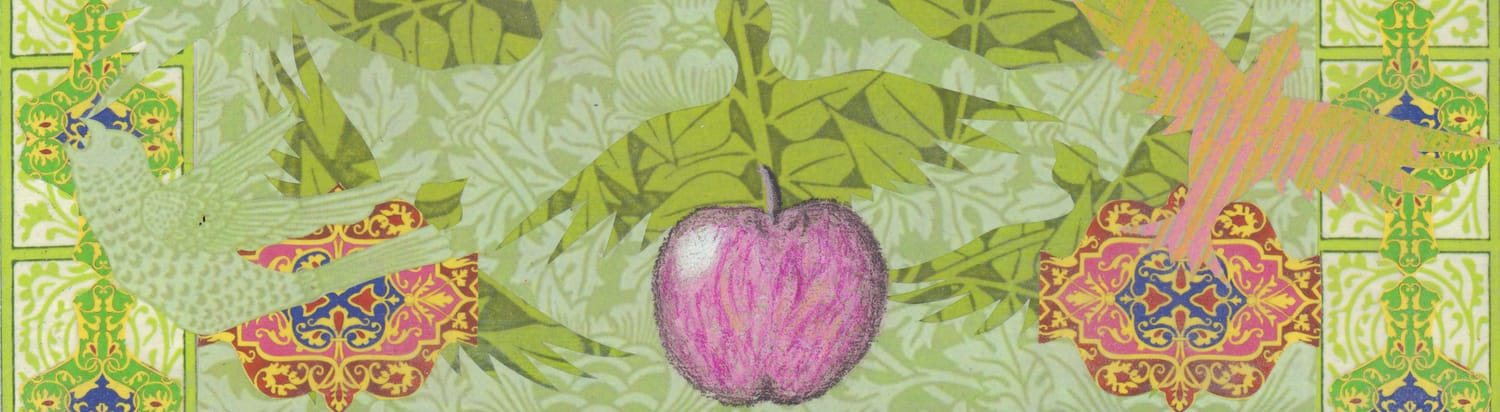
 What is Love? 11x14 inches, collage and colored pencil on canvas, $308
the hidden lover
Green, heart chakra, Libra, G flat major, the best impromptu
Ah, the heart chakra! This is where our physical and spiritual lives meet, in the realm of all things having to do with love.
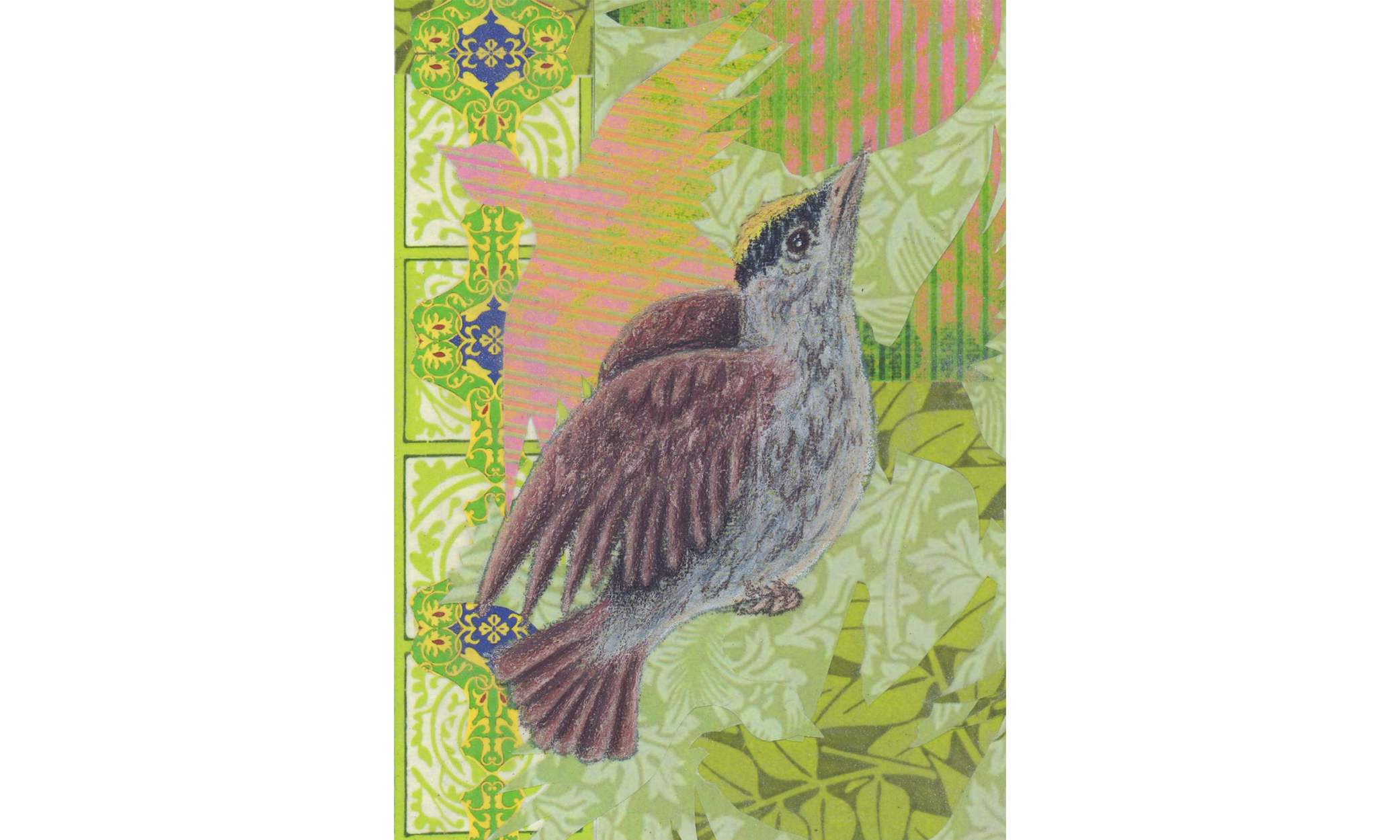
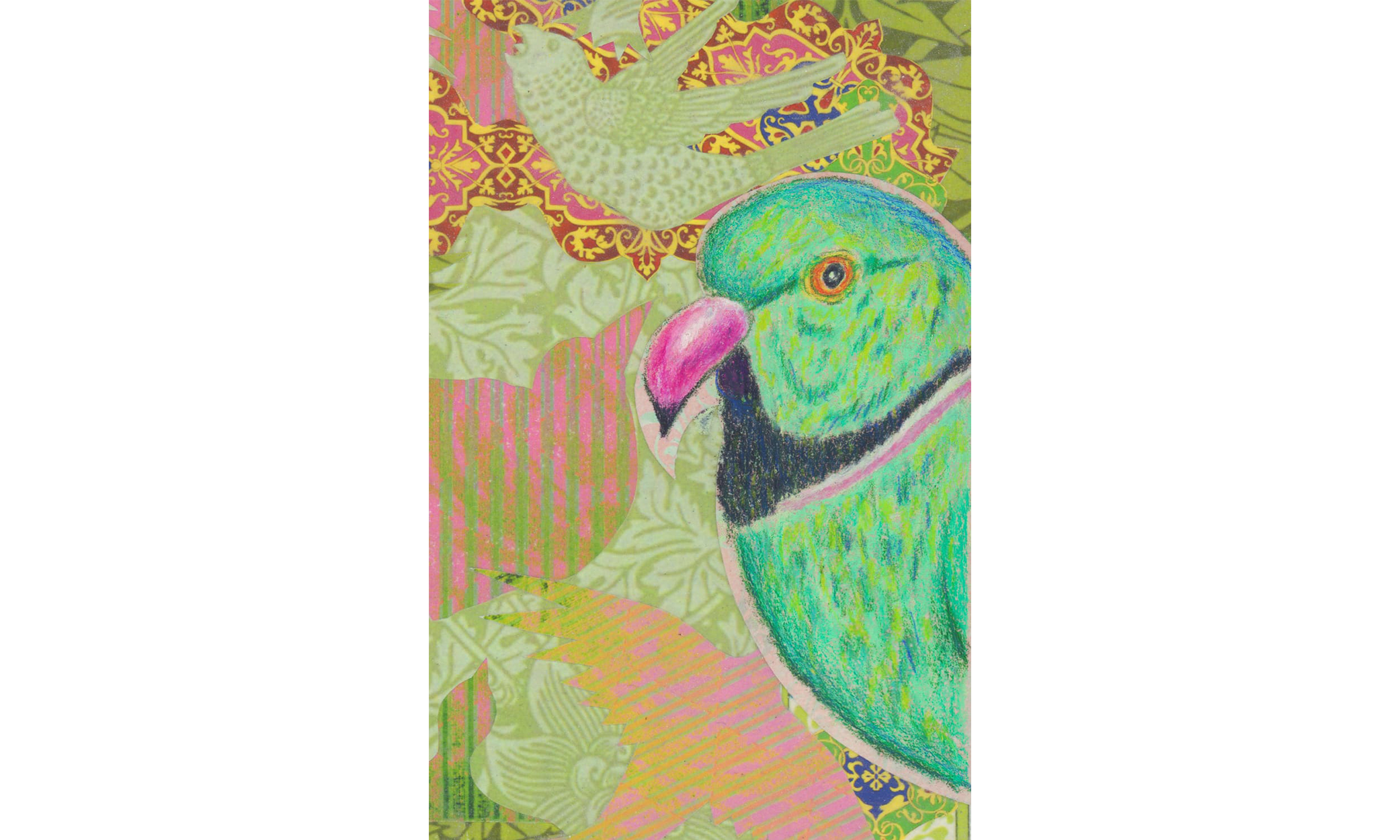
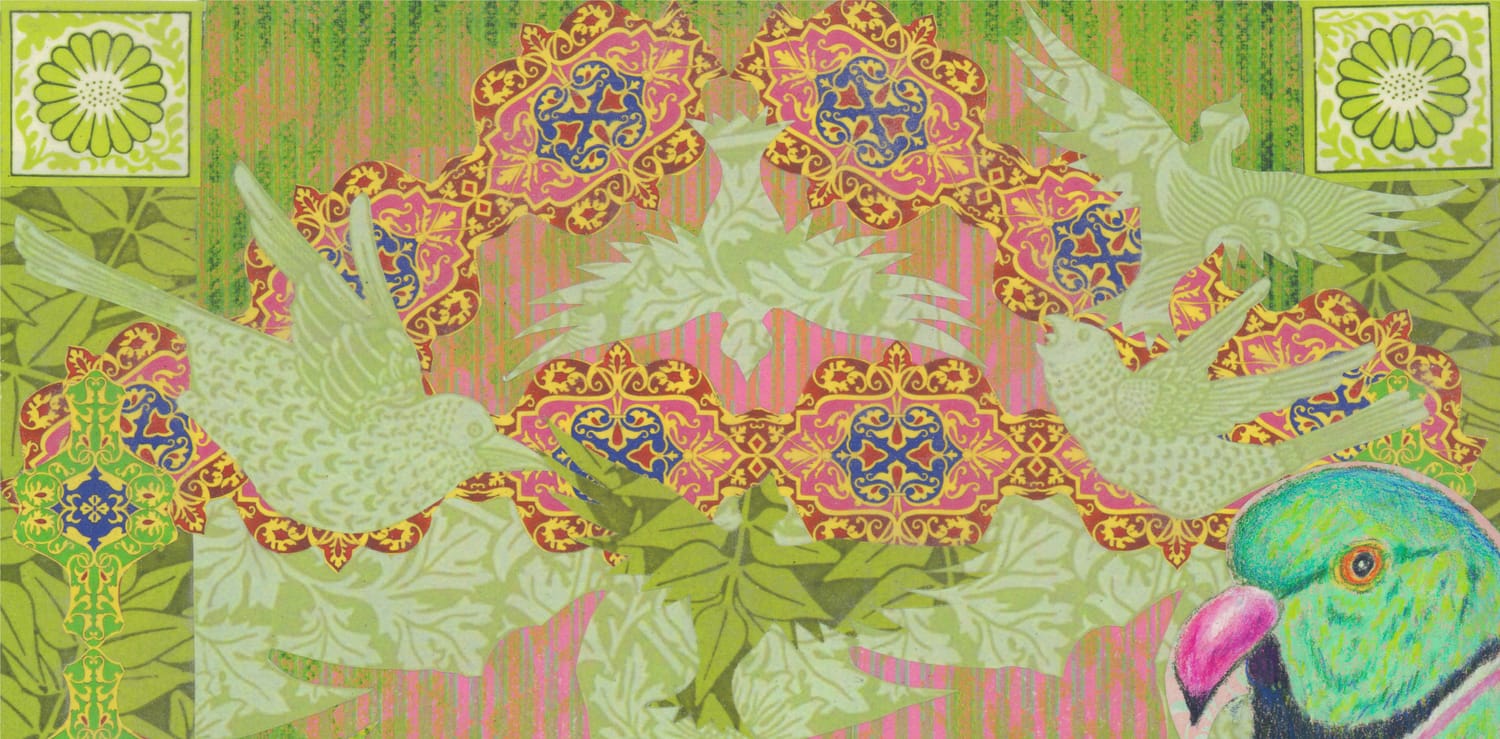
In my sparrow story this is where she meets a green parrot who claims to love her. This parrot asks her to marry him and settle down in a beautiful world of pink and green.
She doesn't quite understand what he means by marriage yet, but she loves him too. Now she must choose between staying with him and continuing her quest to see what incarnation on earth is like.
Of course she worries that continuing her quest will lead to the loss of her beloved parrot, but she also doesn't yet love herself, and maybe she will learn how to if she finishes her journey.
 As we move down the chromatic scale, the heart chakra would be associated with the key of G flat major in a system of twelve.
Rudolf Steiner associates G flat major with Libra in his tone zodiac, and here is the poem Steiner wrote about Libra in his work called Twelve Moods:
The worlds are sustaining worlds,
And being perceives itself within being,
Existence bounds itself with existence
And being stirs and causes being
To pour out deeds that unfold,
To rest in world-enjoyment.
Oh worlds, uphold the worlds!
Libra is all about balance, fairness, justice. This poem is also about balance, an "as within so without" kind of energetic balance.
In relationships balance is very important, but it can be difficult to see the line between true equity and codependence.
We all have different skills and world expertise that we bring to a relationship, and this is what makes any good team thrive.
I think the biggest warning that you're heading into codependency territory is when you rely on your partner, and only your partner, to feel good about yourself.
Now I need to talk about the concept of twin flames just a little bit.
 What is a twin flame?
It started as a joke in ancient Greece with Aristophanes, but there may well be more to it.
There are a lot of different ideas. My favorite theory is that in the beginning we were all one soul, but then we split, and the last individuated soul to be torn from you is your twin flame.
Your twin is your literal other half, and you would be together still if some part of "you" hadn't had the thought "I am."
Very romantic stuff, but it's also a recipe for toxic, codependent relationships. Once you think you found "the one," your divinely ordained twin, you will rationalize all sorts of abusive behavior to stay with them.
Even I have a hard time believing in the concept, and a twin flame relationship is at the core of my Little Mushroom Trips book series!
There is a tendency to think that twin flame relationships can only exist with both partners incarnate together on earth, but this doesn't seem to be the case. The most convincing stories I've read involve one partner on earth and one in spirit.
And this brings me to G flat major.
 First let's look at what Christian Schubart says about G flat: "Triumph over difficulty, free sigh of relief uttered when hurdles are surmounted; echo of a soul which has fiercely struggled and finally conquered lies in all uses of this key."
I don't know about "all," but whatever. I want to look at how Franz Schubert uses this key in two of his pieces: his piano impromptu in G flat, D.899 and his song on a poem by Friedrich Schlegel called Die Gebüsche (The Bushes.)
Granted, the autograph of Die Gebüsche is in G rather than G flat, but it is often sung in G flat, perhaps as a nod to its similarity to the impromptu. Likewise, for years the impromptu was often played in G just because it was considered easier.
I'm currently writing a book about the theoretical song cycle which ends with Die Gebüsche. This cycle is all about our oneness with all of creation, about the spiritual interconnectedness of plants, mountains, animals, and humans.
For me Die Gebüsche works together with the G flat impromptu to solidify an overall concept of "the hidden lover."
And while I can't really say that this idea has anything to do with Schubart's concept of G flat, I can see that finally finding this hidden lover would lead to a feeling of triumph and a sigh of relief.
 You can read the whole poem of Die Gebüsche here. The key line in the poem, translated, is "Through all tones resounding in earth's colorful dream, One, only one, soft tone comes forth." The words in italics are words that Schubert added to the poem, a clever way of drawing out even more what was meant to be drawn out.
The music is magical here as well. The whole song is always moving. The piano is playing in sextuplet arpeggios the entire time, and the voice is likewise always in motion until it gets to the word "One."
Suddenly the voice holds one long note, an emphasis on that "one" for whom the singer, poet, or composer, is secretly listening for.
The G flat impromptu likewise brings out what would otherwise be hidden.
Over the top of a similar arpeggiated accompaniment a gorgeous melody soars, but this melody is revealed only through the pedal. If you were to play it without the pedal the melody wouldn't be there at all, it would be a complete secret.
How the heck someone writes something like that on purpose is beyond me!
Notably, in the manuscript for Die Gebüsche the vocal line is notated on the same staff as the right hand piano part. This is odd for Schubert, and it could just be a way of saving paper, or it could be a way of highlighting the vocal line as a secret melody growing out of the accompaniment as well.
 One place where I used to cat sit would leave this piece out on the piano for me to struggle with while I was there, and what a struggle it was for me! I never got past the first four bars.
As I heard this impromptu on the radio one day I asked Schubert outright how the hell one was supposed to play it. Very clearly I felt an answer: this is an embodied melody, you can't think about it, it has to live in the rhythm of your foot.
My mind was blown, I had just been overthinking it. But what this meant was that there are countless other secret embodied melodies hidden in all music.
Schubert would often talk about the importance of feeling the emotion of the music you play, but in this instance that feeling is physical. Without allowing your body to feel the melody it can't exist.
I have a wonder, how did Schubert come up with this idea to begin with? I imagine him playing around with Bach's Well Tempered Clavier, trying some pedal action, making discoveries of other secret melodies that were just waiting to be revealed by the right keyboard technology.
Likewise, the twin flame is an embodied melody. If your other half is in spirit, then they are also a part of you, hidden but accessible when your heart finds the right rhythm.
I found a Reddit thread once that asked the question: which piece of music do you most associate with the twin flame experience? Several people mentioned the G flat Schubert impromptu!
Die Gebüsche is likewise symbolic of the twin flame experience. The beloved has always been there, always been around you, always been a part of you, and they always will be. You just have to tune in.
I would even say that this is not isolated to twin flames. Anyone you have loved deeply is always a part of you too.