

Upon arriving in Chumpón, he couldn't find accommodation. He tried several places, knocking on the doors of all one hundred and twenty-five houses, most of them made of small wooden sticks and topped with guano roofs.
Hotels? None. Not even one in sight. The same response came from every door he knocked on, well, at least from those who answered in Spanish, as a large portion of the residents spoke in an indigenous language. Those who spoke Spanish replied with the tranquility that only rural life can guarantee: "Speak with the leaders."
So, he went on, roaming the small village. Dirt roads. Modest houses with no greater technology than an occasional refrigerator, the smell of burning firewood inside, and that peculiar scent that reminded him of his first time in Quintana Roo, when the construction of new roads forced bricklayers to cook over open fires.
Children peeked from the doorways, observing him. For the suicidal man, that life seemed slow and awkward; he wanted to leave as soon as possible, but he needed a place to dry off properly and avoid catching a cold.
It didn't take long before he reached the Mayan dignitaries at the Ceremonial Center of the dusty community. Despite the lengthy name, the place was equally poor. A small house, perhaps slightly more grandiose but not enough to be the center of anything.
Before he could approach to inquire, an elderly man, about seventy years old according to the suicidal man's estimation, received him with a bewildered look, yet somehow familiar with the sight of lost travelers from the main road ending up there for one reason or another.
His straight and short hair with a small part on the right side that naturally formed among the gray strands. His eyes very close together, dark, small, and slanted. A flat nose with prominent nostrils. His mouth formed by two thin lines a little less dark than the rest of his wrinkled brown skin. That skin, that nose, and those eyes struck the suicidal man immediately.
"My name is Juan Pablo Pech Pool. What do you want?" he said in a grave tone that seemed unnatural, as when an animal tries to appear larger than it is to scare off potential enemies.
"No, no, no. We have no place to accommodate you here; right now, you've come at a very bad time. We don't receive strangers at this time of the year," the old man continued, after hearing the suicidal man's demands.
The subtle warning reminded the suicidal man of that Peruvian movie where an explorer visits the imaginary town of Manayaycuna only to find his death at the hands of the teenager Madeinusa, named after the labels of American products sold in Lima, the capital of Peru.
"What kind of time is this when hospitality is lost?" he asked with a tone that mixed seriousness, sarcasm, laziness, and weariness.
"Look, young man, the only time you should know is that it's time for you to leave. If you need a place to rest, you can go to Chunyáh. There's nothing for you here," the septuagenarian said quickly, cutting off the unwelcome visitor's protests. He said it the way the suicidal man wanted to hear it: quickly.
But that same haste seemed extremely rude, just like he probably sounded when he got annoyed by his interlocutors' questions. It didn't matter to him. After all, he had always been indifferent to most people, hovering without getting too close.
He traveled several kilometers in search of the mentioned town. He started to lose himself in his thoughts, trying to understand why he was riding that old, metallic horse. At what point did he prefer to take the path and forget stability, the thing that everyone has or wants? Why choose uncertainty?
The suicidal man wasn't stupid, at least not entirely, and he had common sense. He understood the "who" more than the "why" perfectly and knew all the clichés told to someone heartbroken.
"Keep moving forward." "Everything happens for a reason." "When one door closes, another one opens." "If she didn't truly value you, you didn't lose anything." "You'll find someone better." "God knows why things happen." But those were things no one had told him, as he ended up alone.
But he knew those words perfectly because he had said them more than once to people who, now he understood, were more alive than him. Passionate people who refused to settle for a "safe" and "reliable" relationship, preferring to take risks and go for what they truly loved instead of staying in comfortable mediocrity. People who didn't confuse what's right with what's easy.
Now he understood what it meant to pursue someone who took control of his life, to whom he surrendered control of his life. That love, which to him was the most real and alive. Perhaps that's why he hated the wretched woman, because he knew she had taken away something that was so difficult to find... madness.
"You're the one I've treated the worst," he remembered her words and accepted that they also applied in the opposite direction.
But he missed that madness that one only has for a first love and perhaps, just perhaps, a second time for those lucky enough to find true love, that reflective yet young and rebellious, passionate, daring, courageous, devoted feeling that gives light and life.
While he wanted to die, he didn't want to grow old, or perhaps that was precisely one of the reasons why he wanted to die... to die young.
"Old age leads to an indifferent tranquility that ensures inner and outer peace," the suicidal man recalled the words of one of his several memorized quotes to impress the unsuspecting, as any good pseudo-intellectual would. In this case, the phrase was from the French writer, Jacques Anatole France.
"Does tranquility equate to indifference?" he asked himself over and over again.
"I can't be surprised because she was the only one who could surprise me... just with her smile."
Suddenly, he returned to reality and followed another path. The motorcycle's wheels quickly became covered in white dust.
The heat increased; it was noon. His head cooked inside the enormous helmet, making him look like microphone on wheels.
The poor condition of the road made him move at a snail's pace, and the engine stopped purring and started squealing, clearly not appreciating the change in terrain.
But once he was deep into the route, he had no intention of turning back; one of his personal promises was not to look back, and he intended to keep it that way.
After a few more kilometers, the sides of the road changed from the spicy savannah color to a blend of green and brown, the result of houses or "palapas" made of guano.
He reduced his speed. Every now and then, someone peeked out, others worked outside their houses, cleaning and doing domestic chores.
It didn't take long for him to notice the strange peculiarity: they all had blue eyes!
This characteristic might be normal for a North American or another Anglo-Saxon, but in these people, with entirely indigenous features, those deep blue eyes were present. Their faces resembled the famous stone statue of Chac-Mool. They were definitely native to the place.
He counted scarcely fifteen modest families, each formed by a couple and two children.
Those fabulous eyes stood out against the tanned skin of the men and women in the community. For a moment, intrigue and even fear ran through his body, but his state of passivity quickly returned, leaving surprise out of the equation.
"Yes, it's strange that they have blue eyes, so what?" he said to himself while looking for someone who would give him a space to camp or a hammock to rest. Despite the heat, his clothes remained wet and heavy.
The response was the same as in the previous village: "You have to speak with the leaders."
With the last sigh of the Jin Long's engine, he arrived once again at a modest gathering place for the leaders. The house was made of guano, with no major modifications except for a slightly larger extension than the other houses. Four hammocks hung on the porch made of cedar and mahogany. When he noticed the materials, he understood the subtle difference between that dwelling and the others.
"What are you looking for?" a leader said calmly. His words were dry and strong, but his voice was soft and conciliatory.
"A place to rest, water, and food," he replied, also calmly, though in him it seemed feigned.
He stopped to observe the old man. Undoubtedly, he was a man with inner peace, visible from his bony face to the way he held the small clay cup of coffee, taking small sips. He held it with both hands, protecting it, but with a gentleness that prevented his own strength from destroying it – a quality the suicidal man had never acquired, always ending up destroying what he loved.
"Marta! Prepare food and bring a cup of chaya water!" the native shouted to his wife, who didn't respond, but the beginning of flames was heard, and the smoke started to come out.
"You'll have food and water in twenty minutes. You can rest in this hammock," the general of the village explained as he stood up with a leap. "You can sleep for an hour or two before nightfall."
It was clear they had no intention of inviting him to spend the night, and frankly, he didn't want to either.
He ate what seemed like deer meat, but with a sweeter taste and a tenderer texture. He drank each of the three glasses of chaya almost in one gulp. He jumped into the hammock to rest.
The deep blue eyes of all the leaders observed him, and for a moment, he felt fear, but it was too late to dwell on it. Without much concern, he fell asleep to the rocking of the hammock.
The tapping of a thin cane on his forehead woke him up.
It took a few seconds to remember that he wasn't in his bed, in his air-conditioned room. The second impact of the cane adjusted his memory, and he stood up immediately, looked at the leaders, and without even asking for their names or saying a simple thank you, he hopped onto the motorcycle, which had also rested from the sun's rays under the shade of a nearly one-meter diameter ceiba tree.
He headed towards the exit of the village. For a moment, he thought about asking about those blue eyes, but the time lost in an explanation could allow death to catch up with him, and he didn't have time to have death embracing him in the backseat. Not only did he barely have time to leave the village in daylight, it was already almost seven in the evening, but he feared being embraced by death and consumed prematurely. Besides, no matter how unusual the answer about those intriguing sky-colored eyes was, a few light eyes were merely a physical trait of no greater relevance.
Shortly after, he left the brown and green embroidery of the village behind, leaving only the jungle on each side. The motorcycle became heavier with each movement.
"Am I tired?" he thought, "Or is my extra baggage still not leaving me completely?"
But the answer was neither one nor the other: the rear tire had punctured, leaving him in the middle of a deserted road, plagued by mosquitoes, with a flat tire that would soon destroy the rear rim if he didn't stop to change it immediately.
He had what he needed: a flashlight, a new air chamber, a couple of flathead screwdrivers, and even a standing air pump. He was confident that he would emerge from the jungle without much trouble, despite the minutes, or perhaps hours, lost, and in spite of the mosquitoes that evaded the repellent like contortionists.
In less than an hour and one hundred twenty-two mosquito bites later, the tire was ready.
He was about to start the engine. The darkness, already complete, was interrupted by the light from his headlamp, which in turn was quickly obscured by several luminous points coming from the village he was trying to leave behind.
He looked closely. At first, he thought his assumptions were incorrect, and that those primitive villagers had some kind of electrical system. But nothing could be further from the truth. Not only did they not have electricity, but they also didn't use handheld lamps, oil lamps, or even candles.
The lights he saw were nothing but torches. What he didn't mistake was their origin. The luminescence came from the village he had initially identified as Chunyáh, but seeing the glow and remembering how lost he was in his thoughts before arriving at the site, he was no longer so sure.
In less than a second, he thought about how aggressive Mexican peasants can be and the number of lynchings seen on television, and especially the ones that go unreported, but everyone knows exist. He knew he was facing an image that, although unusual, was possible: an execution. He just hoped not to be the prey.
Quickly, he hid his motorcycle in the undergrowth. The still considerable weight of his luggage caused the metal horse to collapse on top of him, releasing its hydrocarbonic blood from the tank onto his clothes, a defect of a vehicle with over eleven years of constant use.
Fortunately, the synchrony between his fall and the passage of the torchbearers was perfect. They did not notice his presence nor perceive the smell of the gasoline oozing from the Jin Long. The suicidal man was trapped under the bike, enduring the pain, and holding his breath to preserve the limited air that remained, also trapped, in his lungs.
Although the heavy frame lay on top of him, he managed to observe the procession passing by while wondering at what moment a spark from the torches would fall, either intentionally or unintentionally, on his now gasoline-soaked black shirt.
He counted them; there were more than a hundred people. He mentally recalled the number of houses in the village, and undoubtedly, there were many more walkers than there should have been. Perhaps that's why he felt the need to hide and refrained from seeking help.
Before they advanced beyond him, the natives began to pray in what the suicidal man assumed was some pre-Hispanic language, given the location of the republic he was in: the Mayan Zone, a place where daylight saving time was not observed due to the logic, simple yet not plain, of its leaders: "The president is not above the sun."
Each burst of flame illuminated every pair of blue eyes, each one with an indescribable deep electric blue, as if the Caribbean Sea were trapped in each pupil.
An old man was at the end of the line, walking clumsily, assisted by two others who attended to him with a touch of admiration.
A spark flew through the air from one of the torches at the end of the procession, but it went out before it could land in the eyes of the captive motorcyclist, turning into harmless ashes.
The last eyes passed in front of him, and he noticed a substantial difference in the old man: his eyes were dark. The suicidal man was unshockable, but he was not devoid of curiosity... he had to know where they were going and why that veteran was the only one without an ocean in his gaze, although his unease stemmed not from the abyssal peculiarity of those marine pupils, but from the contrast with the man who seemed so respected.
After they had advanced about two hundred meters, the suicidal man moved slowly. The motorcycle weighed a ton after the fatigue of his enslavement beneath it, but adrenaline kicked in. A feline movement left the bike perfectly parked in the jungle, while he stood firmly on his pair of skinny legs.
There was no time for anything else. The group of gazes had turned into the forest, and if he lost sight of them, he could get lost without any knowledge of the terrain.
He picked up his handheld lamp and moved stealthily along the small path where the line moved in an orderly fashion: one foot, then the other, one foot, then the other, as if it were a synchronized dance, although each person wore different clothes, there was a kind of harmony between the colors that, while not radiant, had something eye-catching that turned the path into a rustic catwalk.
Their chants resonated with a feeling of depression and distance, yet the suicidal man could hear them clearly. He tried to remember the melody or any word, but they quickly slipped away in his mind, which was not accustomed to that pre-Columbian language.
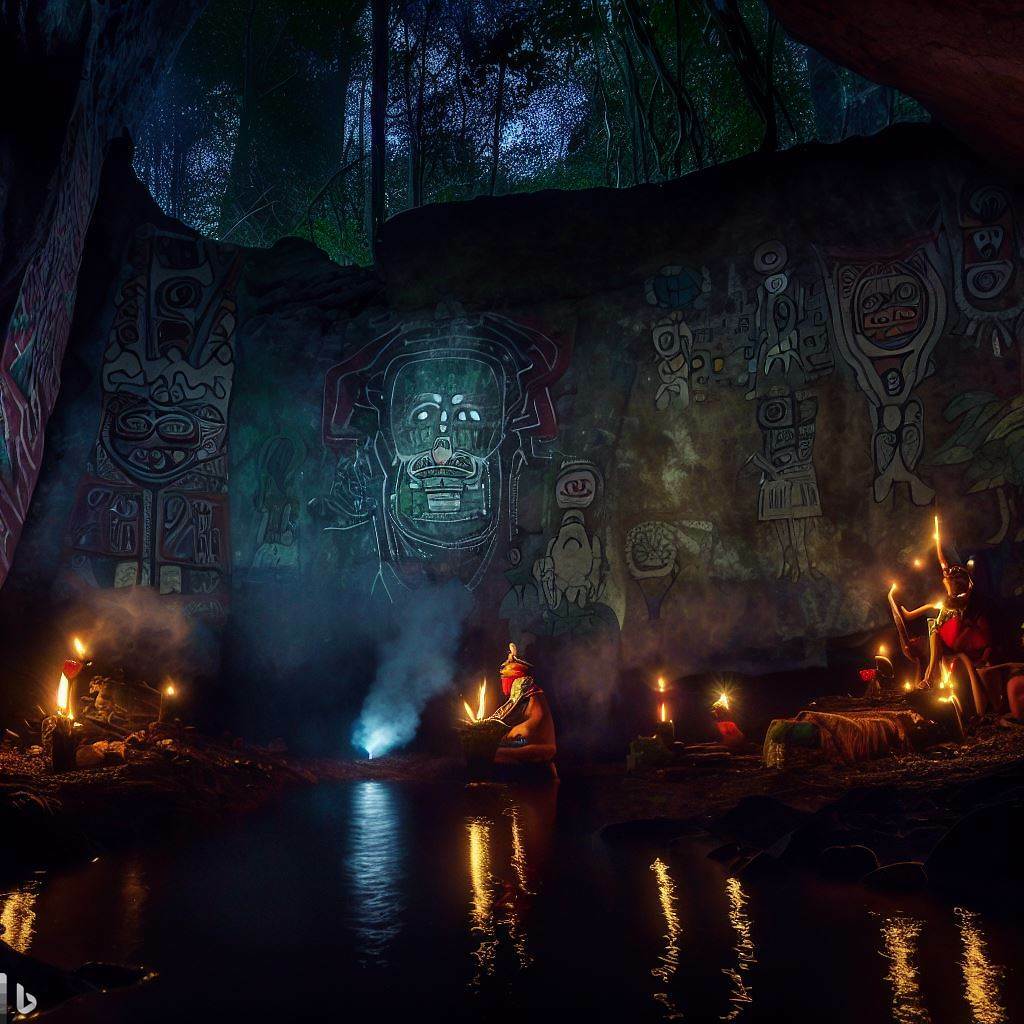
It didn't take long for him to reach a small mound with an entrance in the center, resembling a miniature mountain, and the entrance was even smaller, forcing the lined-up people to slightly bow their heads to access the opening, less than a meter and a half high.
The suicidal man approached little by little, trying to make as little noise as possible. Every step he took, to him, sounded like a full orchestra revealing his presence, but for them, there was no sound other than the usual ones.
The silhouettes disappeared inside the unusual cave. The torchlight flooded the walls of the cavity, where the voices intensified in a sort of acoustic shell.
He got close enough to hear and see clearly what was happening inside. He could see cave paintings; the cavity had a diameter of over five hundred meters, allowing the people to fit perfectly around. In the center, a dark hole formed a perfect circle.
The hymns resonated with more force, and with each refrain, the suicidal man clung to the sounds trying to capture them to find out their meaning... "Ts'o'ok yiknal taam tu' ich" [End the abyss of these eyes].
A woman approached the center of the cave, almost falling into the huge pit. Exactly at the opposite end, the old man with dark eyes did the same. Both pairs of feet stood at the edge of the precipice. She was beautiful and young (about twenty years old, if not less), and he was old and rough. But the contrast between them was deeper; there was joy in the woman that the old man looked at with sorrow.
The voices fell silent, giving way to the voice of the melancholic elder, who addressed the woman strictly. It was clear he was giving her an order, and the young woman nodded, allowing the blue of her eyes to dance up and down.
The woman's skin was covered by a white cotton tunic that went from her shoulders to her knees, passing over her bulging belly; she was in the last months of pregnancy... "Ts'o'ok yiknal pa' muuk' ich" [End the agony of these eyes].
The woman held two small rocks, almost perfectly spherical. It seemed that these pellets were related to the peculiar color of her eyes, which in the woman seemed like tiny slits toward an open and fertile sky... "Búulul haahil ich" [Inundate these eyes with truth] – the old man continued.
Suddenly, that hunched octogenarian straightened up completely like a young man stretching in front of the enormous central hole... "P'aat bo'oy búulul sáasil ich" [Let me be in darkness, flood these eyes with clarity] – he shouted with strength as the woman's hands slowly opened to drop the pair of mineral pills.
The sound of water losing its tranquility was heard. A few drops splashed outward, revealing that the circular precipice in the center was nothing more than a cenote.
A few seconds passed, the woman stood still with her hands open, arms extended, and her gaze fixed directly on the old man's, who finally whispered, "Kex chamal puksi'ik'al suut sáasil ta' tuunich ch'ooh" [May the frankness of his heart be reflected in the clarity of his turquoise blue eyes].
The verses gradually returned until they resonated inside the cave with the same force as before.
El suicidal man moved to the side, completely concealed in the undergrowth, as the procession now led by the old man emerged, ending with the pregnant woman, who was being helped by two of her companions.
They advanced along the path for a few meters, but after a short time, the march came to a halt. The suicidal man observed from the grass. The old man signaled to the next person in line, a young and strong man; they muttered for a while, and finally, the old man bent down, illuminating the ground with his torch, clearly revealing the footprints of a pair of size twenty-eight Jeep boots.
The suicidal man immediately realized he had been discovered, and his heart started beating rapidly due to adrenaline. His lungs began to cease their function, his breathing slowed down, and he tried to minimize any sound. He knew that as soon as they turned around, he would have to run in the opposite direction.
“Kex ich mix bik’in sáasital úuchak ta' kux k'amik… yaan tia'al beh kex xiinbah” [Even if his eyes never clear up, perhaps his gaze will... he has his own path to follow] – the old man said to the air. The suicidal man heard the words and repeated them over and over again to add them to a list of phrases in his memory that he planned to decipher as soon as possible.
After a subtle nod from the old leader, the procession continued its journey back to the village, eventually disappearing into the jungle.
The suicidal man could finally breathe more calmly; he even sighed with relief. The flames had moved away, leaving him back in the environment most comfortable for him: darkness.
Curiosity invited him to enter the cave, to which he agreed without much hesitation. He turned on his handheld flashlight and entered carefully. He didn't know if it was completely empty or not, so he walked stealthily, having seen enough movies where the main character was hit on the head when entering a dark and isolated place... he didn't want to make the same mistake.
The small beam of light traveled through the entire cavity, finding nothing but rocks, obstacles, and boulders; some bats rested on a few stones again, but that was all, nothing more in the place.
The paintings on some rocks were rudimentary but understandable, basically, it was a pictorial description of the ritual he had witnessed. The drawings were primitive and childish, and if he hadn't seen the scene for himself, the inscriptions would have seemed incomprehensible.
He began to think about what he had seen; for any observer, it would be clear that the peculiar turquoise eyes and the nocturnal rite were related, but the suicidal man could no longer be sure of anything. At some point, certainly in his thoughts had been his best ally, but now he doubted everything, even his own ideas. It was an irony and the worst punishment for someone with his personality: obsessed with uncovering hidden things and exposing lies solely through conjectures, something he was particularly good at, especially due to his experience as a liar.
The light from the flashlight continued to dance. The suicidal man circumnavigated the central circle entirely, analyzing the cave paintings on the sides.
Finally, the beam of light illuminated the depths of the cenote; the light was immediately stopped by an incredible number of pebbles, similar to the ones dropped by the pregnant woman. He didn't need to assume anything to realize that each pair of rocks had been thrown in a performance similar to that of the woman on that night; they had been performing this ritual for generations. Although the pit was more than fifteen meters deep, the light was stopped at just three meters, where the stones lay like a grayish carpet.
For a moment, the suicidal man observed the rocks. He wanted to take a pair to be sure that what he had experienced was real, but his arms didn't reach the deposit. After several attempts, he gave up and prepared to return to his motorcycle and continue his journey. He knew in advance that he would not get more answers, and to be honest with himself, he didn't need them. He had other more personal concerns in his head.
The scrawny figure finally left the cave; he was so confident that he did not fully understand what was in front of him, waiting for him.
The change of light made him have to adjust his eyes to the brightness of the moon's rays.
At first, he only saw a barely distinguishable silhouette. It didn't take long for his brain to interpret that dark blotch into learned representations: there he was.
His leather sandals surrounded those tired, calloused feet with black nails from daily walking. His skin of ochre darkness shone with the blue light that even reached his ankles, which disappeared into simple and common clothes that would never be considered remarkable for an ordinary "peasant" if seen on an ordinary street. He wore simple white cotton pants darkened by use and a tunic of the same material, across which a small leather string from his leather backpack hung on his right side, next to one of those ocher hands with its nails also black from fieldwork.
He finished tracing the silhouette until he reached the neck, already wrinkled by the years, and ended at that face with the corners of his mouth sagging from use and with wrinkles around it, probably from numerous emblematic speeches. Some white hairs protruded from his nose, the bags under his eyes were prominent, and his gaze... his gaze was completely dark.
The two stared at each other intently for nearly a minute, looking into each other's eyes, almost with an animalistic resentment, like when two dogs attack each other for no apparent reason.
Both gazes analyzed each other, studied each other as if they were seeing something so foreign, different, and profoundly incomprehensible.
After the exchange of glances, the suicidal man continued to scrutinize him, observing those ears drooping from the passage of years, the skin detaching from his bones.
At one point, he tried to compare the loose skin to that of a Shar Pei dog. The suicidal man possessed that indifference towards death that only the cynics understand. "What kind of dog would I be?" he wondered, without finding an answer beyond the self-indulgent and reality-lacking ones.
He analyzed the few gray hairs protruding from the old man's head. Once again, he fixed his gaze on the dark eyes, darker than a moonless night and certainly darker than that night, which was overshadowed by the intensity of that gaze as deep as the bottom of the cenote within that cave, a darkness that is only achieved through absolute emptiness.
The suicidal man's body remained motionless as the old man approached, not because of a mystical or supernatural power but simply because he couldn't react.
The old man put his hand into his small bag, getting so close to the suicidal man that their noses almost touched. They never broke eye contact. The suicidal man felt the old man's hand on his own. The elder leaned in close to his ear to whisper softly, with the calmness that only the passage of years can provide.
The whisper was almost imperceptible, but what he said was so forceful that the suicidal man's eyes widened in an instant, almost popping out of their sockets. But his reaction quickly centered on his left hand, where he felt the rough and earthy element of the pair of rocks that the old man had just handed him, then the old man quickly entered the cave, and the suicidal man could barely see him.
The sound of water was heard, which awakened the traveler from his lethargy. He stumbled inside and illuminated in all directions... the old man was no longer there.
He stayed there, sitting inside the cave, with those two rocks in his hand, trying to understand what had just happened and what he had heard. Hours passed before he finally stood up. One rock in each hand. He extended his arms over the edge of the cenote and let them go, listening to the sound of the water splashing and imagining the journey to the bottom of the cenote. When he believed the spheres had reached their destination, he sat down again for a few more hours until the sound of distant roosters announced the imminent dawn... he left the cave as if he were entering the world.
He breathed in the morning dew and watched the sun rise among the trees, above the high jungle that surrounded what he now easily saw as a clearing amidst the undergrowth.
He walked calmly toward his motorcycle, knowing that no one would follow him. He reflected on what he had just experienced, but the experience failed to astonish him. However, a lump formed in his throat, which accompanied him to his vehicle.
The Jin Long behaved admirably, starting on the first try, taking him away from that place and from the words of the old man, which, although he never spoke them again, the suicidal man repeated in his mind over and over again along the way: "I hope you find the clarity in your gaze that I could never find..."
"I hope so too," he said aloud as the engine began to purr again like a kitten after a rejuvenating nap in which it might have lost one of its nine lives.