
The modern monarchy presents itself as a gentle, apolitical symbol of national unity. A sort of national teapot: decorative, harmless, and vaguely comforting. But there’s something far older and far sharper beneath the carefully curated image: a ruthless propaganda machine built to soften, sanitise, and sentimentalise the history of empire. Royal imagery doesn’t just float around in the background; it actively rewrites the past, reframes the present, and keeps a very particular (but entirely false) version of Britain alive. The one where colonialism was a friendly visit, rather than a violent project.
The trick begins with how royal tours are framed. Every trip to a former colony is described as a “warm visit,” a “celebration of friendship,” or a “renewal of ties.” The reality, that these “ties” were forged through conquest, extraction, and racial hierarchy, is simply ignored. Instead, the imagery shows smiling crowds, colourful dances, and royals in linen shirts enjoying local hospitality. The message is clear: Look how loved we are. Look how well it all turned out.
This framing, though, depends on erasing the actual history. Colonial violence is rarely mentioned, and when it is, it’s wrapped in passive voice so thick you’d think the empire just “happened” one day, like a light drizzle. Museums full of looted objects (looted at the end of a gun) become “treasures.” Countries that fought for independence are described as “choosing a new path.” The monarchy positions itself as a benign presence, a sort of global grandmother who simply popped round for tea and accidentally acquired a fifth of the world.
The Commonwealth is the crown jewel of this narrative. It’s presented as a cosy family of nations, all voluntarily gathered around the British hearth. In reality, many members joined under pressure, stayed out of pragmatism, and are now openly questioning why on earth they’re still involved. Yet the royal PR machine continues to infantilise these nations, describing them as “young democracies,” “emerging partners,” or “friends who look to Britain for guidance.” It’s a linguistic pat on the head, a way of keeping the old hierarchy alive without admitting that’s what’s happening.
The imagery does the rest of the work. Royal tours are choreographed to produce photos that look like postcards from a world where empire was a cultural exchange programme. Royals are shaking hands or admiring local culture. Never confronting the legacies of extraction, displacement, or racial violence. The camera tries to avoid protests, dissent, or anything that might disrupt the fantasy. The result is a visual story that says: The past was lovely. The present is harmonious. The monarchy is welcome everywhere.
This isn’t accidental. It’s propaganda designed to maintain imperial nostalgia. The comforting belief that Britain’s global influence was benevolent, that its power was earned rather than taken, and that the monarchy is a symbol of unity rather than domination. It’s designed to keep the public from asking difficult questions about wealth, land, reparations, or the ongoing political influence of the Crown. It also reassures the Firm itself that it still matters on the world stage, even as more countries quietly edge toward republicanism.
The monarchy’s colonial PR machine (usually) works because it wraps everything in politeness. It doesn’t deny history; it edits it. It doesn’t claim innocence; it implies it. And because the imagery is so familiar, it’s easy to absorb without noticing what’s missing.
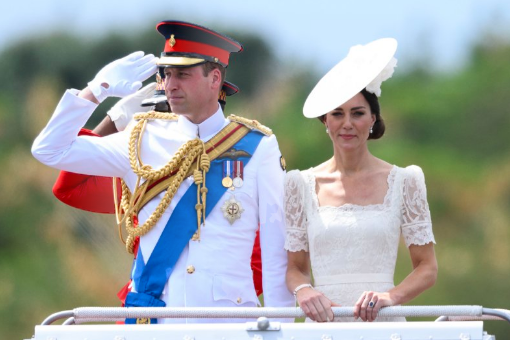
The Waleses’ 2022 Caribbean tour is the perfect example of what happens when the monarchy pushes the nostalgia narrative too hard. The whole trip was designed to evoke a soft‑focus version of empire … the linen shirts, the military parades, the smiling schoolchildren, the “warm welcome” language. But the imagery that emerged told a very different story. Photos of William and Kate greeting children through a wire fence ricocheted around the world, stark reminders of the power imbalance. Then there was the open‑top Land Rover moment: the couple standing upright in a vintage military jeep, echoing the Queen’s 1960s tours. What was meant to be a tribute to tradition instead looked like a time warp. A tableau straight out of the colonial photo album the palace hoped no one would examine too closely.
The mistake the palace propaganda machine made on this tour was making the usual choreography too obvious. Every royal tour is built on the same foundations: carefully staged images, curated crowds, and a nostalgic script that frames Britain’s relationship with former colonies as affectionate, uncomplicated, and mutually adoring. Most of the time, the palace and the press manage to keep the seams hidden. But on that Caribbean tour, the visuals were so on‑the‑nose — the fences, the jeep, the military salutes — that the underlying message became impossible to ignore.
The tour wasn’t an outlier; it was the blueprint. Only this time the layer of PR Vaseline just wasn’t laid on thick enough.
This is part of a run of posts looking a little more closely at the palace propaganda The Crown’s Greatest Trick