

The royal family has a long tradition of presenting itself as adored by “the people.” And nothing sells that image quite like a line of tiny children waving flags they didn’t choose, in weather they didn’t ask for, at adults they’ve never met. It’s one of the monarchy’s most reliable PR tricks: put a royal in front of a group of schoolchildren, take a few photos of small hands offering flowers, and voilà. Instant proof that the Crown is beloved by the next generation.
But the truth is far less charming. These children aren’t there because they begged to see a Mountbatten-Windsor. They’re there because their schools and nurseries were told to bring them. They’re there because teachers were instructed to line them up. They’re there because the monarchy needs them.
The Firm depends on these images. Royals simply don’t draw spontaneous crowds the way the press pretends; they draw organised ones. Schools are notified. Nurseries are asked to participate. Children are bussed in, taken out of class, and placed along a route so the cameras can capture a “warm welcome.” It’s just choreography.
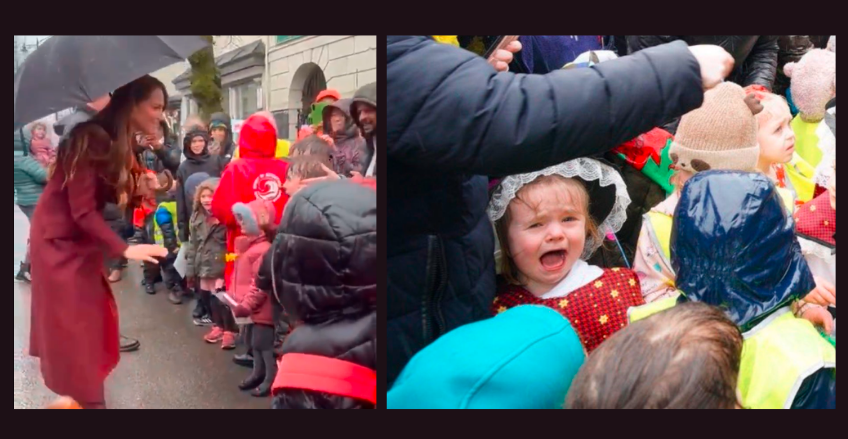 And the choreography matters, because the monarchy’s survival depends on the illusion of popularity. Adults can be sceptical. Adults can ask questions. Adults can remember the scandals, the hypocrisy, the racism, the money. Adults, as has been happening recently, can shout awkward questions. But children? Children are perfect for the Firm’s purpose. They’re photogenic, malleable, and, crucially, they can’t object. A four‑year‑old can’t say, “Actually, I’d rather be inside doing colouring than standing in the rain waiting for an adult I don’t know.” A toddler can’t say, “I don’t consent to being used to prop up your wealth and privilege.”
So the palace uses them. And the press plays along, breathlessly reporting that the royals were “greeted by delighted children,” as though those children had any say in the matter. The photos are then circulated as proof that the monarchy is adored by the young. A neat little loop of propaganda that hides the reality: these kids were drafted, not delighted.
The Firm feels it’s necessary because the monarchy is, at its core, a PR project. It has no democratic mandate. It has no measurable public service output. What it has is imagery — the waving, the smiling, the crowds. And when the crowds aren’t guaranteed, the palace ensures they appear anyway. Children are the easiest way to manufacture innocence, warmth, and continuity. They are the monarchy’s human wallpaper.
But the cracks show. Every now and then, a photo slips through. A child crying, a child shivering, a child looking utterly bewildered by the whole spectacle. And in those moments, the truth is impossible to ignore: this isn’t national unity. It’s stage‑managed adoration. It’s PR dressed up as tradition. It’s an institution so desperate to appear loved that it will happily pull children out of school to stand in the cold and wave at strangers.
The more the palace relies on these children, the clearer it becomes that the Crown’s power isn’t rooted in public affection, it’s rooted in the ability to choreograph the appearance of it.