
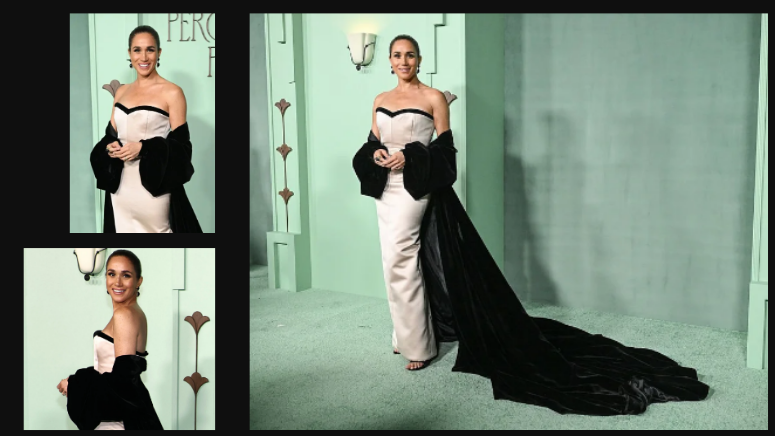
At the Fifteen Percent Pledge fundraising gala in Los Angeles, the Duchess of Sussex turned heads … And she turned the cultural dial.
Dressed in a strapless gown with a draping, trailing, lush velvet coat (sorry, I’m not really sure how to do it justice in words), she channelled the kind of old Hollywood glamour that once belonged to the likes of Marilyn Monroe, Lauren Bacall, Elizabeth Taylor and Vivien Leigh. But this time, the woman in the spotlight is Black. And that, friends, matters.
Hollywood has always been a paradox. It sold dreams of sophistication and allure, with Monroe’s breathy charm, Bacall’s smoky voice, Taylor’s diamonds, and Leigh’s tragic elegance, while being more progressive than the rest of the country. At times, the industry nudged forward on race when the wider nation was still digging in its heels. Films like Stormy Weather (1943), starring Lena Horne and an all-Black cast, showcased Black talent in ways mainstream America rarely allowed. Cabin in the Sky (1943), directed by Vincente Minnelli, also featured an all-Black cast and gave audiences a glimpse of Black life beyond the stereotypes. Even Intruder in the Dust (1949), based on William Faulkner’s novel, tackled racial injustice in the Deep South, daring to show a Black man wrongly accused of murder and ultimately vindicated.
 These films were still shaped by white studios and often limited in scope, but compared to the country’s segregationist reality, they were radical gestures. The NAACP even brokered agreements with Hollywood studios in the 1940s to reduce reliance on racist caricatures and open up opportunities for Black actors behind the scenes.
But just as Hollywood flirted with progress, it slammed the door shut again. The promise of Stormy Weather and Cabin in the Sky wasn’t followed by a wave of roles for Black women. Instead, the industry retreated, returning to its comfort zone of white stars and sidelining Black talent.
Dorothy Dandridge’s nomination for Best Actress in Carmen Jones (1954) should have been a breakthrough, but it wasn’t. She was celebrated, yes, but Hollywood refused to cast her in leading roles afterwards. Lena Horne, despite her brilliance, was often cut from films when they were shown in the South, her presence deemed too “controversial.”
The message was clear. Black women could be glamorous, talented, and magnetic, but they weren’t allowed to be central. Hollywood dangled inclusion, then snatched it away.
Fast forward to 2026, and Meghan’s presence at Paramount Studios for a gala honouring Tina Knowles, herself a powerhouse of Black creativity. Clearly, more than just a fashion moment. A cultural one.
The Fifteen Percent Pledge, founded by Aurora James, asks retailers to commit 15% of their shelf space to Black-owned businesses. It’s about equity, visibility, and rewriting the rules of who gets to belong in spaces of influence. Hollywood’s golden age was built on a fantasy that excluded Black women, yet here we have Meghan, at an event celebrating Black entrepreneurship and creativity, stepping into that same visual language. So it’s hard to see Meghan’s choice to show up, dressed like a screen siren of old, as anything other than a nod to Hollywood’s past and a statement about its present: glamour is no longer the preserve of whiteness.
Meghan’s choice to channel old Hollywood glamour wasn’t happening in a vacuum. The event honoured Tina Knowles, Beyoncé’s mother. Knowles has long been a creative force, shaping the image of Destiny’s Child and Beyoncé, and championing Black women’s visibility in fashion and culture.
Meghan’s Monroe-esque glamour at an event honouring Knowles immediately recalls Beyoncé herself, who once channelled Marilyn Monroe in an ad campaign, using the blonde bombshell aesthetic to flip the script and show how Black women can inhabit, and redefine, those icons of glamour. (Piers Morgan, of course, lost his sh*t.) Black women have always been the backbone of style, from Josephine Baker’s Parisian cabaret chic to Diana Ross’s disco glamour. They’ve influenced music, fashion, and film, but often without the recognition they deserved.
Meghan’s moment at the gala sits in that lineage, but with a twist: she’s not just influencing culture, she’s visibly occupying the space that was once denied.
Culture shifts not only through policy or protest, but through presence. The very aesthetic that once excluded Black women is now being claimed by one. Meghan’s look said, “I’m here, I belong, and I’m not playing by your old rules.” When a Black woman walks into a room dressed like Monroe or Bacall, she’s not imitating; she’s reclaiming. By appearing in a gown that could have walked straight out of a 1950s Paramount premiere, Meghan was saying: this glamour belongs to us too.
Meghan’s own story makes the moment even sharper. Facing prejudice from the British royal family and enduring years of attacks from the British press, she has lived through the 21st-century version of what Black actors experienced in Hollywood nearly a hundred years ago.
Just as Hattie McDaniel (the first Black actress to win an Oscar but who wasn’t allowed to sit with her white co-stars at the ceremony), Dandridge and Horne were celebrated but sidelined, Meghan has been both elevated and undermined. Praised for her glamour yet vilified for her independence, scrutinised for her success, and treated as an outsider in institutions built on whiteness. The tabloids counting the bathrooms in Meghan’s Montecito home are not much different from the studios that counted her predecessors out of leading roles. The hostility Meghan faced from the British establishment echoes the exclusion Black women endured in Hollywood. Glamour has always been political, and visibility comes with backlash.
But the old Hollywood fantasy is being rewritten. Glamour, once a gatekeeping device, is now a tool of reclamation. Black women are not waiting for permission to be icons, they’re claiming it outright.
Hollywood once barred the door, and now Black women are not only inside, they’re rewriting the script. Meghan’s look at the gala wasn’t just about sparkle; it was about continuity, about showing that glamour can be a tool of cultural power when wielded by those who were once excluded.
The old Hollywood fantasy is being rewritten. Glamour, once a gatekeeping device, is now a tool of reclamation. Black women are not waiting for permission to be icons, they’re claiming it outright. Meghan’s appearance was warm, witty, and quietly radical. She didn’t need to shout; the gown did the talking.