

Royal women are crafted.
Every adjective, every headline, every “insider says” is part of a long-running system that turns real women into palace‑approved symbols. And once you start paying attention to the language, you can see exactly how the monarchy uses words to keep its women in line, keep the public emotionally hooked, and keep the institution looking softer and less psychopathic than it is.
Most of the vocabulary can be split into two neat piles: the words used to elevate, and the words used to punish.
When the rota wants to lift a woman up, she becomes “radiant,” “dutiful,” “stoic,” “gracious,” “brave,” or “elegant.” They look like compliments, but they’re actually instructions. They tell us, the public, what a “good” royal woman looks like: calm, pretty, endlessly patient, and crucially, silent. A woman described as “stoic” is one who absorbs pressure without complaint. A woman described as “dutiful” is one who doesn’t challenge the institution. A woman described as “radiant” is one whose appearance matters more than her agency. It’s femininity as a performance, and the palace as the director.
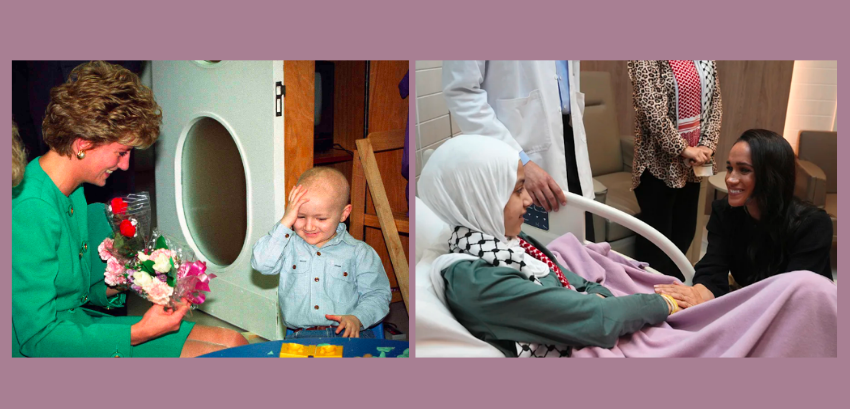
And when the rota wants to dim a woman’s shine? The vocabulary flips. Suddenly she’s “awkward,” “emotional,” “jealous,” “difficult,” or “snubbed.” These words assign blame, turning tiny social moments into moral failings. They paint a woman as out of step with the royal ideal … and therefore out of step with the institution. It’s a quiet form of discipline, delivered through headlines instead of orders.
This is why “snub” stories are so popular. They’re easy to inflate, easy to weaponise, and nearly always aimed at women (though the Firm is so furious at Prince Harry’s success that they’re increasingly aiming “snubs” at him). A missed glance becomes a feud. A seating arrangement becomes a scandal. A neutral expression becomes “icy.” These stories keep royal women in their assigned roles. The men rarely get this treatment because the monarchy doesn’t rely on their emotional labour. It relies on the women’s.
You can see this pattern clearly in the treatment of Diana, Princess of Wales.
When she was young, and obedient, she was “shy Di,” “radiant Di,” “fairytale bride Di.” The language wrapped her in softness, innocence, and charm. But the moment she began asserting herself … speaking honestly about her marriage, her mental health, her loneliness … the words hardened. She became “unstable,” “emotional,” “difficult,” “attention‑seeking.” The rota gleefully policed her on behalf of her husband and the wider Mountbatten-Windsor family. It punished her for stepping outside the role the palace had written for her. Diana, sadly for her, was all too aware of what they were doing. She said it. She lived it.
Meghan, Duchess of Sussex, walked into the same machine, only this time the language was turbo‑charged by racism, and the internet. The moment she showed independence, intelligence, or boundaries, she became “difficult,” “divisive,” “ambitious” (the insult version), “manipulative,” “icy,” “snubbing,” “feuding,” “controlling,” “too American,” “too outspoken” … too everything. Again, the palace and the press used the words to discipline her. They were telling the public: She’s not one of the good ones. And they were telling Meghan: Know your place.
Royal women are not allowed to be full people. They are symbols first, humans second. Their personalities are flattened into archetypes. The saint, the villain, the awkward cousin, the jealous sister‑in‑law. Symbols are far easier to control than women with agency. The Firm relies on this. It needs its women to be palatable, pliable, and publicly adored, because the women are the emotional glue that holds the whole institution together. The men get to be flawed, complicated, even scandalous. The women get to be metaphors.
And, of course, as with so much palace propaganda, the language also distracts.
When the palace is dealing with something serious (a scandal, a lawsuit, a diplomatic mess), the rota reaches for the soft-focus vocabulary. A woman (think Kate Middleton in the midst of the Epstein-Royal scandal) becomes “brave” instead of “under pressure.” She becomes “stoic” instead of “shielding the institution.” She becomes “radiant” instead of “avoiding questions.” The words smooth over the cracks, keeping the public focused on the fairy tale instead of the machinery behind it.
Once you start noticing the patterns, the whole system becomes impossible to ignore. The words aren’t just descriptive; they’re prescriptive. They tell royal women who they’re allowed to be. They tell the public who they’re supposed to love. And they keep the monarchy looking stable by turning its women into characters instead of citizens.