

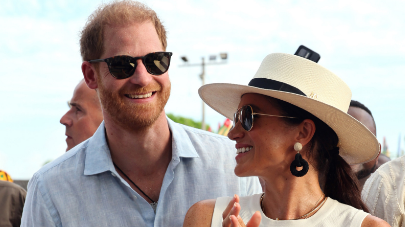
 Families fall out all the time. They fall out over who didn’t reply to a message, who forgot a birthday, who said something snippy at a barbecue … they fall out because we humans are imperfect. And when families fall out, the usual response is space and time. Eventually, sometimes, there’s some kind of re‑entry. Nobody gets exiled. Nobody is banished from the village. Nobody is told they must never again set foot on the land of their birth because Auntie Brenda is still annoyed about the Christmas trifle.
Yet when Harry and Meghan, the Duke and Duchess of Sussex, left the Mountbatten-Windsor family firm, a section of Britain decided they must be permanently cast out of the country. Not just criticised or debated. Exiled. As though we’re living in medieval England and the punishment for refusing to work for your relatives is banishment from the realm. It’s a bizarre fantasy, and it reveals something uncomfortable about how the monarchy is viewed here: not just as a public institution, but as a feudal family whose emotional dramas must be treated as national events.
Why should leaving a hereditary institution alter anyone’s perceived right to belong to their own country? Harry and Meghan may have stepped away from royal duties, but they didn’t resign from being British citizens. They didn’t surrender their passports, their memories, their friendships, their family connections or their right to come home. Leaving the royal machine is not the same thing as giving up citizenship. And yet, somewhere along the way, a strange idea took hold that if you reject the Firm, you must also surrender your place within the country.
That’s a profoundly peculiar way of thinking about citizenship. Most of us understand that institutions are things people can join, leave, criticise or disagree with. We don't tell someone they can no longer live in their hometown because they quit the family business. We don't decide that leaving a job means forfeiting the right to visit the town where the office is located. Yet when the institution happens to be the monarchy, ordinary boundaries seem to disappear. Suddenly a family disagreement becomes a question of national belonging. The monarchy becomes so entangled with the idea of Britain that stepping away from it is treated, by some, as though it were stepping away from Britain itself.
Harry and Meghan’s extended stay in Britain now is simply a family doing what families do: making decisions around work and family life. Ordinary life, made strange only by the lens through which Britain insists on viewing it.
And that lens is the problem. It’s the lens that says royal conflict can’t be normal conflict. It must be mythologised, moralised, and weaponised. It must be turned into a morality play where loyalty is measured by proximity and disloyalty by postcode. It must be framed as treason rather than a workplace or family dispute. It must be treated as a national betrayal rather than a family boundary.
Harry and Meghan’s return quietly challenges that unhealthy mythology. It shows that stepping away from an institution doesn’t mean stepping away from a country. That citizenship isn’t conditional on obedience to a hereditary system. And it shows that the monarchy isn’t the emotional centre of national life, no matter how loudly some commentators insist it must be.
It also punctures the fantasy that Harry and Meghan must remain permanently broken for the story to make sense. Their presence here - living, laughing, raising children, visiting friends - disrupts the narrative that they’re universally hated, permanently disgraced, or trapped in regret. It reminds us that the loudest voices are not always the majority, and that kindness can exist off‑camera, in school playgrounds and village pubs, far away from the outrage economy.
The fury directed at their return reveals something deeper about British culture. It shows how quickly private citizens can be turned into public battlegrounds. It shows how racism and misogyny still shape who’s allowed to be forgiven, who’s allowed to heal, and who’s allowed to simply exist. It shows how deeply some people have internalised the idea that royal hierarchy must be defended at all costs, even against the right to live in the country of your birth.
This is the 21st century and Britain is supposed to be a democracy. Even if Harry wanted to abolish the monarchy (he doesn’t)... well, Brits these days are actually allowed to be anti-monarchists. We’re even allowed to disagree with our democratically-elected leaders without risking banishment. Harry and Meghan may have done the country a massive favour by moving back here - no matter how temporary the stay - because it might help us put the whole royal feud in perspective.
Families fall out. Families mend. Families change shape. Harry and Meghan returning to Britain isn’t a scandal. Even in a country obsessed with monarchy (in some quarters at least) people are still people, and home is still home.