

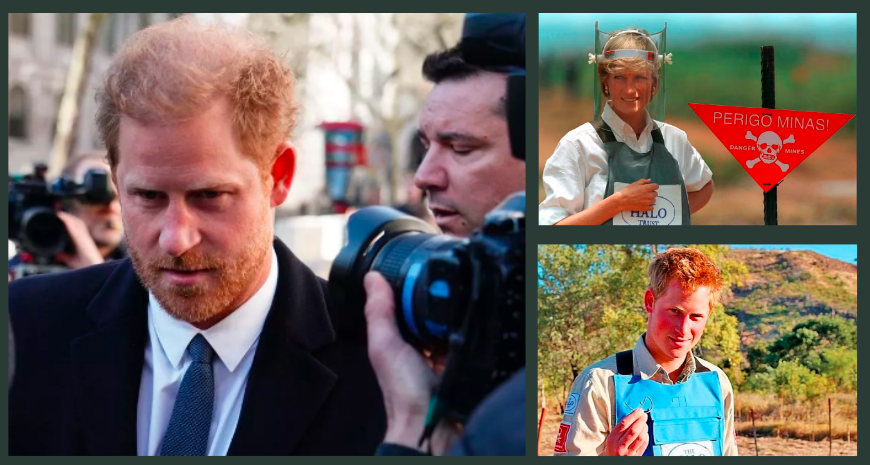
When Diana walked through minefields in Angola and Bosnia in 1997, she was accused of “political meddling.” Ministers and commentators claimed she had strayed into government policy. But the real reason her campaign was attacked was because it threatened powerful interests: governments that relied on landmines for military strategy, defence contractors who manufactured and sold them, and political leaders who feared being seen as weak if they supported a ban. At the time, there were an estimated 100 million landmines worldwide, devastating civilian populations. Diana’s openness forced the issue into public consciousness, mobilised global opinion, and helped push through the Ottawa Treaty banning landmines, signed just months after her death in December 1997. Her honesty cut through the silence that protected profit and power.
Harry’s openness functions in the same way. When he speaks about NATO soldiers, racism, or unlawful press intrusion, he exposes truths the establishment prefers hidden.
His testimony in London against Associated Newspapers reveals industrial-scale surveillance and intrusion, a business model built on violating privacy while profiting from scandal. Harry and six other claimants, including Elton John and Elizabeth Hurley, allege that the publisher engaged in a “clear, systematic and sustained use of unlawful information gathering” for decades, hiring private investigators to hack phones, bug cars, and access private records. He described how the tabloids had made Meghan’s life “an absolute misery” and invoked Diana’s own suffering to show the continuity of press abuse.
 You’ll no doubt have noticed the press repeating the smear line that Harry “invades his own privacy.” It is a tactic designed to delegitimise him, to shift the debate from their misconduct onto his character, and to protect both their financial interests and the monarchy’s political role. By framing Harry as hypocritical, tabloids distract from their own illegal practices and shield the Crown from scrutiny.
Other newspapers, supposedly rivals of the Daily Mail, have gone on the attack over the last week. With the Fail in court defending itself against Harry’s lawsuit, the paper has taken a brief respite from its usual barrage of Sussex coverage. Keen not to look bad in front of the judge, I guess. But the smear campaign hasn’t stopped. Rival outlets have stepped in to fill the gap, recycling the same tropes about Harry’s supposed hypocrisy. The newspapers have a shared interest in protecting power. They may compete for readers, but when the system itself is threatened, they act in concert to defend it.
The latest hit-piece to catch my eye (actually, I was directed to it by Bluesky friend “L”) was by William Sitwell writing in the Telegraph. You might remember him from previous hits like hating on vegans and railing against people giving their livers a rest from booze.
This isn’t his first foray into Sussex-bashing. He has previously written sneering pieces about their supposed irrelevance, their legal battles, and their decision to live thousands of miles away. One might wonder why a food critic, whose métier is meant to be the seasoning of lamb or the bouquet of a Bordeaux, spends so much time screeching about a couple who are neither funded by the British taxpayer nor remotely within his remit.
The answer, of course, lies in the function of these attacks. By framing Harry as hypocritical (daring to speak openly, daring to sue newspapers) the press and its aristocratic hangers-on distract from their own illegal practices. Harry’s lawsuits have exposed industrial-scale intrusion: phone hacking, blagging, surveillance. But rather than confront that, Sitwell and his ilk prefer to paint him as a man undone by his own openness. “Invades his own privacy” is not analysis.
Sitwell’s lament that Harry should “spare a tear” for Charles is particularly rich. This is the same Charles who, upon the Sussexes’ departure, stripped them of their publicly funded security despite the very real threats they faced. It was a decision that spoke volumes: the Crown’s protection is conditional, withdrawn the moment one dares to step outside the institution’s control. To demand Harry’s tears while ignoring the fact that his father chose to leave his family exposed is breathtaking. And the establishment’s favourite trick. Guilt the dissenter, sanctify the institution, and pretend that the viciousness was simply protocol.
What makes Sitwell’s fixation so absurd is its distance from reality. Harry and Meghan live in California, raising their children, producing documentaries, funding their own lives. They’re not on the public purse. Yet Sitwell, perched in his Telegraph column, writes as though they’re still wards of the British taxpayer, as though his aristocratic scorn is some kind of fiscal oversight. It is not. It is obsession, pure and simple. A food critic who can’t stop chewing on a couple who long ago left the table. A man whose career was built on judging soufflés now spends his time judging the prince who dared to speak.
Sitwell’s aristocratic lineage may give him the confidence to sneer, but it also reveals the establishment’s desperation. They can’t forgive Harry for exposing the mechanics of their power, so they brand him hypocrite, traitor, privacy-invader. It’s theatre, and Sitwell is one of its most willing actors. I do feel strangely sorry for the Telegraph’s readers: Camilla Tominey had written a whole hysterical piece claiming that Prince Harry had invaded “his own privacy” only the day before. (You may remember her for writing tosh like Meghan made Kate cry when the opposite was true, and being really pissed off that the Sussex Squad expresses opinions.) Sitwell could have at least tried to come up with an original angle. Something about the substance of Harry’s case perhaps? Or if actual journalism is too much to hope for, and seeing as how Sitwell’s meant to be a food writer, something amusing about court lunches? Anything but this repetitive, utterly transparent smear.
Still, it leaves us in no doubt about the establishment’s absolute, continuing fury that Harry and Meghan dare speak out.
Silence is the establishment’s shield. Diana broke it on landmines, the Sussexes broke it on the invisible contract and royal racism, Harry breaks it again now on soldiers and surveillance. Each time, the response is the same: smear, ridicule, delegitimise. Because openness is dangerous. It makes visible what power wants hidden.
And that’s one more reason why the press continues its campaign against Harry and Meghan. Because their refusal to stay silent threatens the system itself.