
 The current fuss over Prince Archie and Princess Lilibet’s schooling is being sold as public interest. But it’s simply the modern form of an old story: gammon-y parts of Britain deciding that a Black, mixed‑race family’s private life is somehow its business.
The demand to see the children’s faces didn’t appear out of nowhere. It’s not a neutral curiosity, nor a simple case of royal fandom, but the latest chapter in a much older story. One where Black women’s bodies, pregnancies, and children have been treated as public property … and where that entitlement carries forward into the present.
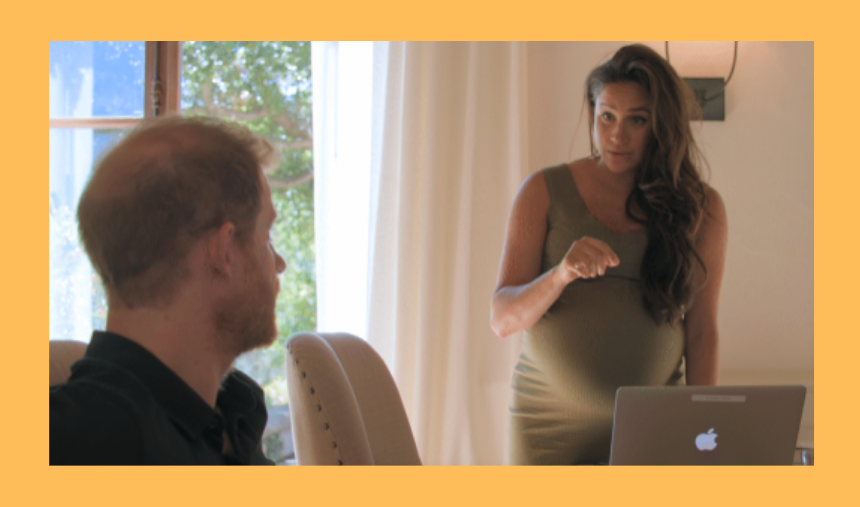
When Meghan was pregnant, the press behaved as though her body was public property. They judged how she walked, how she stood, how she dressed, how often she touched her stomach. They accused her of “flaunting” her bump and even “virtue signalling” by resting her hand on it. They treated her womb as a public event and her bump as a national spectacle.
Women’s bodies have long been subjected to public scrutiny, of course, especially when pregnant. But the intensity of the scrutiny here was unusual. It was even very different to how other royal pregnancies are covered. The double standards, as many have pointed out, were glaring. Kate Middleton was praised for cradling her bump, praised for wearing fitted maternity clothes, praised for looking serene and maternal. Meghan did the same things and was told she was showing off, performing, seeking attention. The behaviour was similar; the interpretation was markedly different and, critics argue, racialised. This is how racism often works in Britain, through different readings of the same actions. One woman is tender. The other is theatrical. One is glowing. The other is “flaunting.”
The surveillance of a pregnant Meghan followed a long historical tradition in which Black women’s reproductive lives were controlled, doubted, or displayed for others.
And then there was the vile “moonbump” conspiracy. The claim that Meghan faked her pregnancy with a prosthetic belly.
The suspicion and policing of Black women’s reproductive bodies isn’t a modern invention. It sits in a long, grim history of denying Black women’s bodily truth. Enslaved women’s pregnancies were counted and controlled for profit. Later, Black women were subjected to coerced sterilisation, medical neglect, and disbelief about their pain. Their reproductive lives were treated as public property, never fully theirs. When Meghan’s pregnancy became a magnet for conspiracy theories, it echoed these older patterns: the idea that a Black woman’s body is suspicious, excessive, untrustworthy.
The entitlement didn’t stop when Archie and Lilibet were born, it simply changed shape. The rhetoric has changed from accusing Meghan of displaying her pregnancy too prominently to criticising the Sussexes for restricting access to their children. The same press that treated her pregnancy as public property now treats access to her children as public property. The logic is seamless: if the British public believes it had a right to judge her pregnant body, it’s only a small step to believing it has a right to see her children.
This is why the demands for Archie’s and Lilibet’s faces feel so intrusive. They’re not about affection, they’re about ownership.
Race provides an important lens through which the contrasting treatment can be understood. We don’t see trending hashtags demanding to see Princess Eugenie’s children. We don’t read headlines reminding the Sussexes that “we pay, you pose.” The Sussex children, by contrast, are treated as contested territory. Their visibility is demanded, their privacy criticised and their absence framed as a slight. The press behaves as though their faces belong to the nation, and critics behave as though Harry and Meghan are selfish for protecting them. It’s not a coincidence that the children who are treated this way are the mixed‑race ones.
Racists still use those old pregnancy headlines as ammunition. They still claim Meghan “performed” her pregnancy. They point to the criticism of her touching her stomach as proof she was “attention‑seeking.” They recycle the “flaunting” narrative to paint her as vain. They revive the moonbump conspiracy to deny her legitimacy as a mother. They treat the press coverage as evidence rather than prejudice. The old headlines have become a toolkit for ongoing abuse, that continues every time someone claims the Sussexes “owe” the public their children’s faces.
The pregnancy coverage shows where the entitlement began. It shows how racism shaped the narrative, how the press taught the public to believe Meghan’s body - and now her children - belong to them. And it shows why the Sussexes’ insistence on privacy isn’t arrogance, but protection.
Archie and Lilibet don’t owe the public anything. Their faces aren’t public property, their childhoods aren’t national content. And the belief that they are isn’t a harmless curiosity. It’s the legacy of a long history in which Black women’s bodies and Black children were never fully allowed to belong to themselves.