

The palace’s habit of manufacturing “adoring crowds” is one of the oldest tricks in the royal survival handbook. It stretches back centuries, evolving with each era, and always serving the same purpose: to make the monarchy look loved, inevitable, and permanent, even when reality is wobblier than the official photographs suggest.
From the moment English monarchs realised that power depended not just on force but on the appearance of public devotion, they began staging it. Tudor triumphal entries were some of the earliest examples: Henry VII’s 1486 procession into Worcester featured scripted speeches, choreographed greetings, and crowds assembled by local officials to present him as the fulfilment of prophecy. The people cheering him weren’t random passers‑by; they were placed there by civic leaders under royal instruction, performing loyalty on cue.
By the time of Henry VIII and Elizabeth I, propaganda had become a statecraft in its own right. The monarchy used pageantry, church sermons, civic rituals and carefully managed public appearances to project stability and divine favour. The church itself became a conduit for royal messaging, shaping public perception through controlled narratives and orchestrated displays of loyalty. The Tudors understood that a monarch must be seen to be adored — and if adoration didn’t appear naturally, it could be arranged. (Prince Harry’s grandmother, Queen Elizabeth II, famously softened this to “I must be seen to be believed.”)
The Victorians refined the formula. After Prince Albert’s death, Queen Victoria’s long withdrawal damaged the monarchy’s popularity. When she returned to public life, her appearances were meticulously stage‑managed and newspapers were fed the story of a nation united in affection. The monarchy learned that children — small, photogenic, and incapable of dissent — were perfect symbols of innocence and continuity. The image of a child handing a flower to a queen became a staple of royal myth‑making.
By the 20th century, the system had professionalised. The royal rota emerged as a formalised relationship between the palace and a select group of journalists, granting access in exchange for favourable coverage. Crowds were no longer just assembled; they were curated. Children were placed at the front. Pensioners were positioned for emotional resonance. “Community representatives” were selected to create the illusion of national unity. The monarchy discovered that a well‑framed photograph could do more than any speech, and the press became its most loyal amplifier.
Today, the choreography is more obvious than ever, especially once you know what to look for.
Schools and nurseries are asked to bring children to line the route. The children have no choice; the photos are then used as proof that “the young love the royals.” Care homes organise outings so pensioners can be placed at the front for the cameras. Councils coordinate “community groups” to ensure diversity in the crowd. Security barriers restrict access so only pre‑screened “well‑wishers” get close enough to be photographed. The result is a crowd that looks spontaneous but is anything but. A carefully assembled backdrop designed to project popularity.
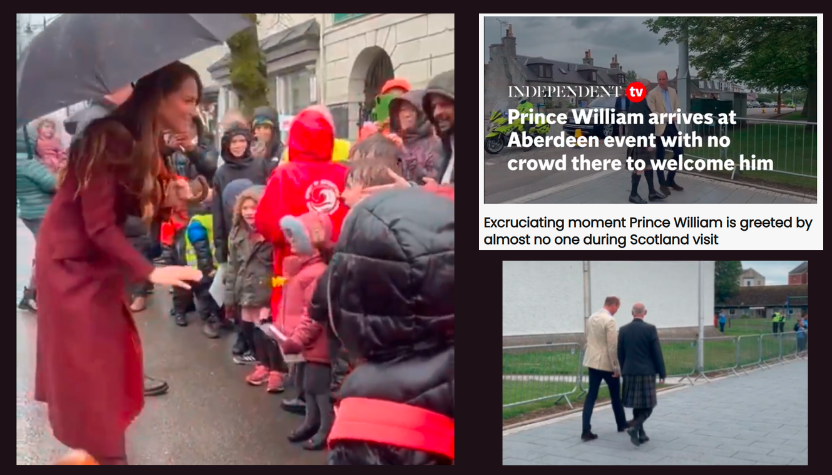 This is the monarchy’s oldest magic trick: manufacturing the appearance of love to justify its existence. And the Firm needs it desperately. The monarchy has no democratic mandate. Its power rests entirely on public perception. If the public stops believing the royals are loved, the entire structure begins to wobble. Staged crowds serve as a visual argument for legitimacy. A way to drown out criticism, to suggest that republicans are fringe, that scandals are blips, that the Crown still “binds the nation together.” The more trouble the Firm is in, the more trouble they will go to, to project popularity.
Once you see the strings — the bussed‑in schoolchildren, the organised care‑home outings, the curated “community” line‑ups, the pre‑screened “well‑wishers” — the spell breaks. The crowds stop looking like proof of love and start looking like what they are: a set, built to keep the monarchy standing.