

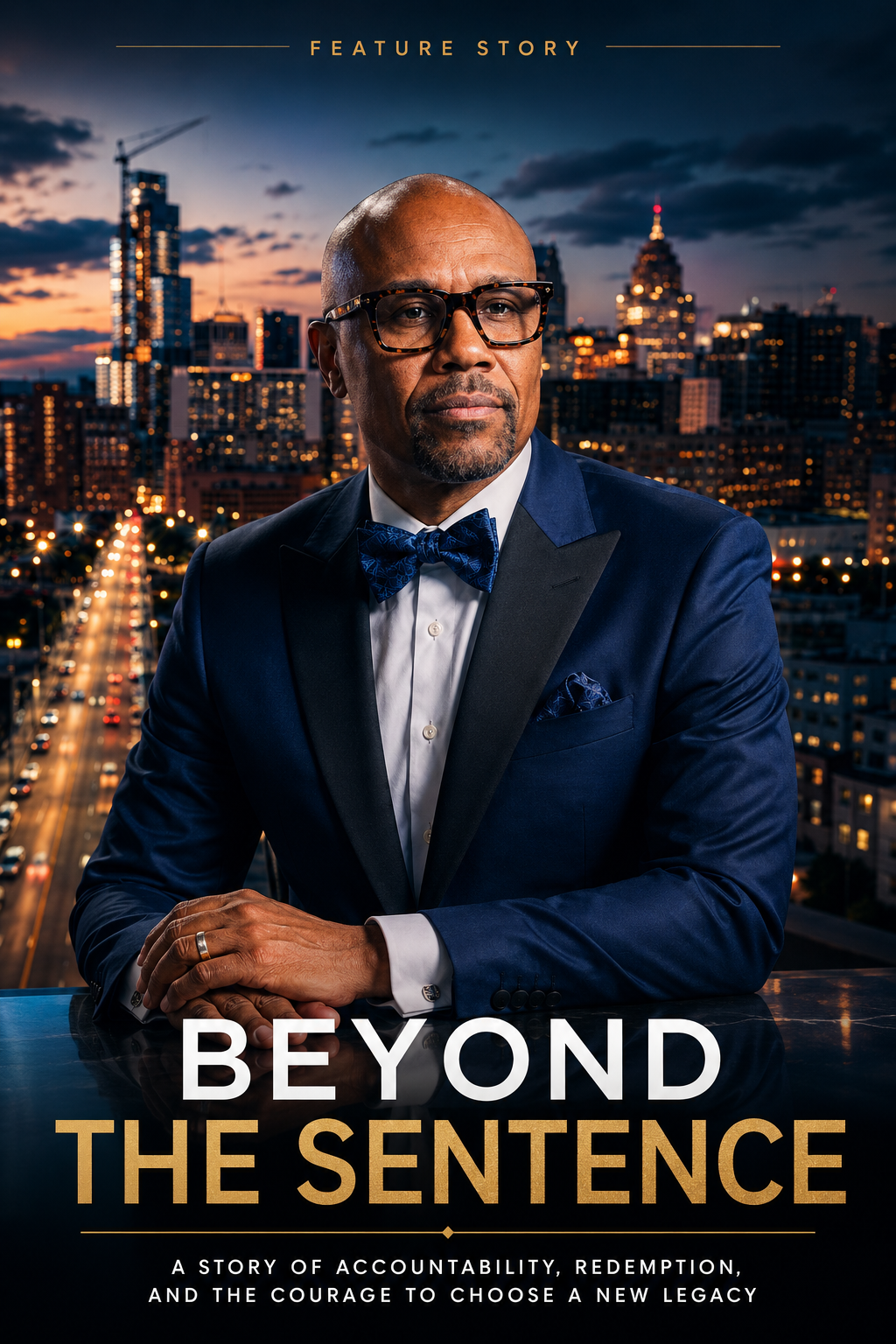
going to prison was the only way for him to get his life back.
Part One of Two
I knew before he said a word.
I had spent years learning to read this man. The way he stood. The way he sized up a person before he ever shook their hand. I had watched him walk into a room and quiet it without raising his voice. So on the day I ran into him and he turned to look at me, I caught something on his face I had never seen there before. Not once, in all the years I had known him.
It was a sad look. Serious. Heavy in a way I did not yet have words for. He held my eyes and he said, “Hey. I got to talk to you.”
Whatever was coming, I already knew it was big.
*
To understand why that moment hit me the way it did, you have to understand who he was to me.
We had moved back to Detroit from Grand Rapids after my brother and I finished high school. I was sixteen, maybe seventeen. We landed on a street called Asbury Park, in the Rosedale Park neighborhood, in a house that is still standing today. My stepfather and my brother live in it now. They have remodeled it since, so it looks like a different place. But the bones of the house where I grew up are right there.
Next door was an older man named Tony.
It started the way these things do, with nothing at all. We would catch each other in passing, in the driveway, out back, and we would talk. A few minutes turned into an hour. An hour turned into something regular. Before long he was inviting me onto his patio, and then down into his basement, where he had built a small world of his own. He had a chair set up where he cut hair. He had a whole room for nothing but music.
That room changed me.
Tony was a student of sound. Real sound. He taught me about high fidelity the way some men teach a son to fish. He would name the companies that built the finest equipment in the world, names most people have never heard, and he would explain why one piece reproduced music more honestly than another. He taught me about distortion. About how a recording is made, and how it is meant to be heard. I was a kid, and I was learning the things they train sound engineers to understand. To this day I cannot sit in a car or a quiet room without hearing what he taught me to hear.
But the music was never really the point. The point was the time. A young man and an older one, sitting in a basement, talking. About books. About life. About how to carry yourself in the world.
That last part is the thing I carry with me more than anything else. Tony taught me how to be a man. Not with speeches. By example. How to walk into a room. How to look a person in the eye when you speak to them. How to shake a hand like you mean it. How to hold your chin, choose your words, and stand like you belong wherever your feet happen to be.
It worked. For years, people I met would ask if I had served in the military. Strangers assumed I had come out of the service. I had not. I had come out of a basement on Asbury Park, listening to a man who had figured out something about how to move through the world, and who decided, for reasons I would not understand until much later, to hand it to me.
He never lied to me. Not once. He was the kind of man who would tell you the truth even when it cost him, even when it stung, even when you did not want to hear it. I trusted him completely.
What I did not know, what I had no way of knowing, was that the man teaching me to look the world in the eye was living his own life looking over his shoulder.
*
I only learned the full story a few days ago. For all those years I knew there was something. He had told me once, long before, that he had gotten into trouble when he was young. He never gave me the details, and I never pushed. Then a few days ago he finally walked me through all of it, and what I heard reframed everything I thought I knew about him.
Tony was born in Detroit to parents who were barely more than children themselves. His mother was a teenager when she had him. The house he grew up in was not a safe one. His father held a real job and sold drugs out of the home on the side, and behind the front door there was a kind of violence a small boy is never meant to see.
He told me about a day his mother came home from work with shopping bags, proud of the bargains she had found. His father did not like that she had spent the money. The next thing Tony saw was the bags flying through the air and his mother hitting the floor. He was four, maybe five, frozen in place, watching. His father looked over at him and said, “What are you looking at? Turn around and watch TV.” So that is what he did.
A few years later, it was his mother holding the gun. His father was beating her again, and she shot him. Tony was seven or eight. He came down the stairs to find his father on a stretcher, being wheeled out of the house. They got back together after that. That was the world he came up in.
The cruelty was not his father’s alone. His mother had her own ways. There were beatings with extension cords. There was a punishment, when he was small, where she lit matches and held them to his skin so he would learn not to play with fire. And there were the words. She called him a dumb bastard so many times that he told me he half believed it was his name. He cannot remember her ever once telling him that she loved him.
A boy raised like that has every reason to grow into nothing. Or worse, to grow into his father.
There was one light. His mother’s brother, his uncle Levi. Levi gave him his first job, cleaning and buffing marble floors in the wealthy suburbs north of the city on Saturday mornings. It was the first time in Tony’s life that he felt pride in doing something well, the first time someone handed him responsibility and trusted him to carry it. Ask Tony today what value he holds above all others and he will answer without hesitation. Loyalty. He had learned young what it felt like to be let down by people, and he decided he would never be that for anyone else.
*
But before he became the man I knew, there was the trouble. The thing he could not outrun.
He was barely out of his teens. The neighborhood he came up in did not exactly discourage it. There was a kid he ran with, I will call him William, the kind of kid who set cats on fire for fun and broke into houses up and down the block. One day William showed him a suitcase. Inside it was forty thousand dollars in old hundred dollar bills, somebody’s life savings, pulled out of a house he had robbed. This was the early eighties. That was a fortune.
Tony had an idea of his own. He knew of someone who might keep money in the house. What he did not know was that the man’s father was a lawyer, that the house sat in a good neighborhood, and that the family would be home.
They went in wearing stocking caps. There was a sister inside with special needs, and Tony told me he felt sick about that part even then. Someone upstairs called the police. They were in the middle of carrying a big projection television out the door when the cruisers arrived, and they ran out the back and got away clean.
Except for one thing. Tony had let his friend drive his car as the getaway car, and the friend got caught. Tony, instead of disappearing, drove back to collect his own vehicle, figuring nobody knew he had been there. He was wrong. His friend had already given him up. He was arrested on the spot.
The judge who set his bail took one look at him and said, “Son, you are a menace to society.” Fifty thousand dollars, cash. This was 1983. And in a twist that sounds invented, the man whose house he had robbed turned out to be a lawyer who worked in the very court where Tony’s case would be heard.
He managed to get the bail reduced, and he got out. Then came the offer. Plead guilty, serve eight to sixteen years. He was twenty one years old. He looked at that number, the best part of his twenties and into his thirties gone, and he made a decision.
He ran.
He got a driver’s license under a borrowed address. He built a life under a name that was not entirely his own. And he stayed gone. Not for a year. Not for two.
For ten and a half years.
*
Here is the part that still stops me. He did not spend that decade hiding in the dark. He built something. He started a high-end painting company, doing decorative work in the finest neighborhoods around the city. He walked into those homes with that carriage I told you about, that way of holding himself, and people handed him the keys and trusted him with their money.
He met a woman. He saw her for the first time across a store, and something in him said, that is going to be my wife. That same day, before they had spoken a single word, she turned to a coworker and said the same thing about him. They married. They are still married, more than thirty years later.
By every outward measure, Tony had won. A business. A marriage built on something real. The respect of people who had no idea where he came from. A man who had every excuse to fail had instead made himself into someone others looked up to.
And none of it was clean. Because underneath the success, underneath the carriage and the calm, was a man living as someone else. Looking over his shoulder. Carrying a thing he had done as a kid that he had never answered for.
*
You would think a man in that position would hold on to what he had built with both hands. Run out the clock. Keep the secret and take it to his grave. He had gotten away with it. The life was good. Why look back.
But that is not how it works when a thing is sitting on your conscience. The better his life got, the heavier it became. He had spent years teaching a kid next door how to look people in the eye, and he had not yet found a way to look his own past in the eye. He was tired of being someone else. He wanted his own name back. His own life. And there was only one way to get it.
*
Which brings me back to the day he looked at me with that face I had never seen.
“Hey. I got to talk to you.”
He told me he was going to turn himself in. That he had gotten into something serious as a young man, and that he had to go back and answer for it. He did not offer the details, and I did not ask for them. He had taught me that too, without ever saying it out loud. You do not push a man. When he is ready, he will tell you.
What I remember most is the fear. I was losing him, and I did not know for how long, or whether I would see him again on the other side. The man who had shown me how to stand up straight was about to walk into a courtroom and hand over everything he had built. On purpose. At the very height of it.
I did not understand it then. I am only beginning to understand it now.
He was not throwing his life away.
He was going to get it back.
Part Two continues.
=====================================
Thank you for taking the time to read this article.
In a world filled with endless notifications, deadlines, and distractions, your time and attention are among the most valuable gifts you can give. I appreciate you spending a few moments here with me, and I hope these thoughts offered something useful, meaningful, or worth reflecting on.
If anything here got you thinking about how you eat and you are tired of figuring it out meal by meal, I put together something to take that weight off your plate. It is a simple, done for you meal plan built for real life, so the daily question of what do I eat just stops being a question.
You can find it right here:
[ medium.com/@joyo_62025 ]
Until next time,
~ Joseph Young
RI Studio