

Remembering Stanley Fisher z”l — British Jewish soldier, witness to Bergen-Belsen, and keeper of memory, who’s died, aged 101.
I am so very lucky to have met Stanley about seven years ago, spritely, full of reliable memory and happy to regale the story of his war time for our benefit. 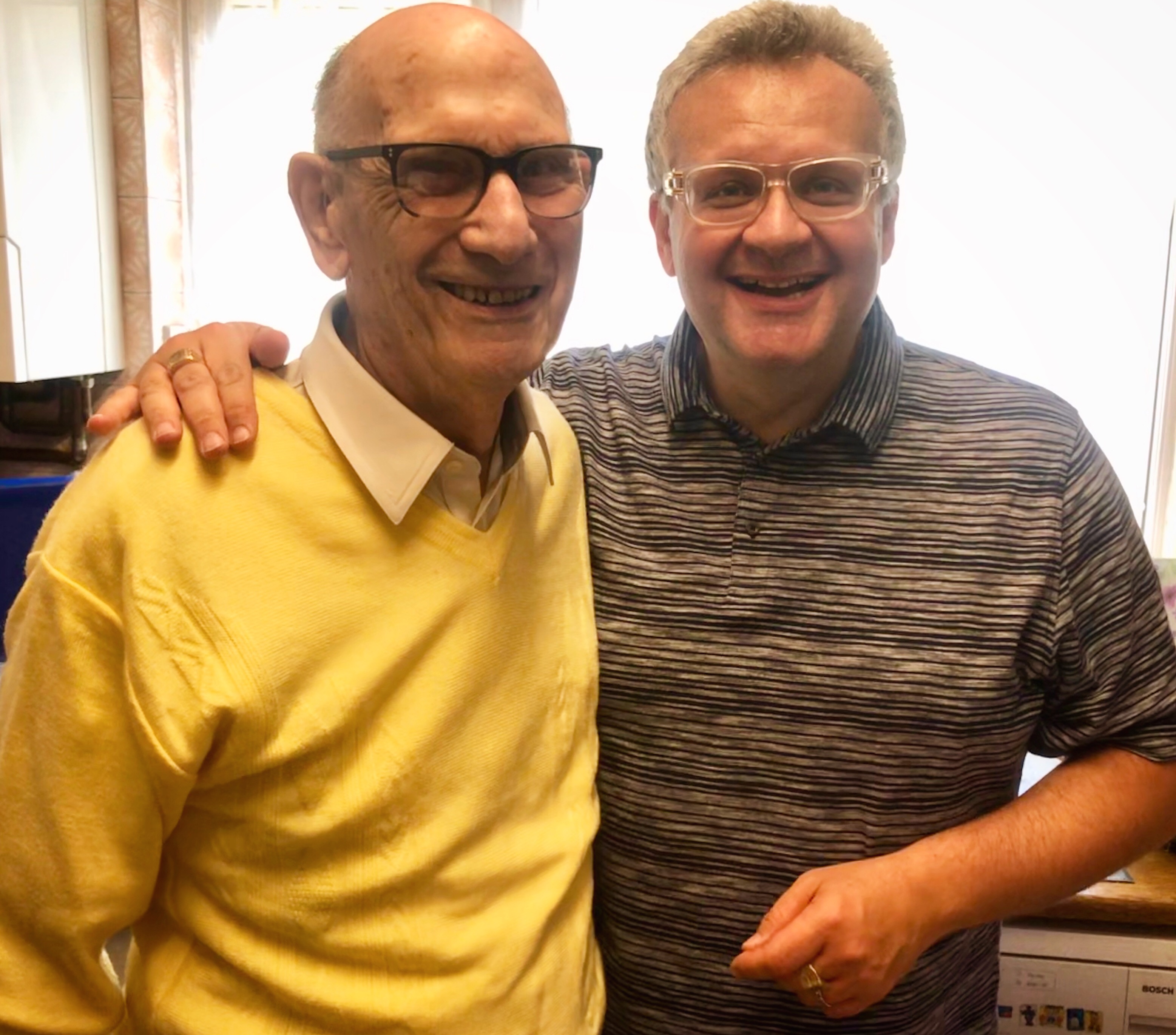
Stanley passed away on 28th April 2026, leaving behind his children, grandchildren, great-grandchildren — and a testimony of immense historical and moral weight.
I met him by chance at the Bar Mitzvah of my cousin Samuel Posaner in Birmingham. Stanley was Samuel’s great-grandfather. He was in fine fettle, full of warmth and good humour, and, to my surprise, more than willing to talk about a war he had barely spoken of for most of his life.
As the simcha raged on downstairs, I went upstairs with Stanley and his son-in-law, Esmond Rosen, a good friend of mine for decades and I put the voice memo on to see what Stanley might say.
That conversation became one of the most powerful episodes of Jonny Gould’s Jewish State.
Stanley was just 18 when he was called up. He remembered the date clearly: 17th December 1942. His first training was in Canterbury. From there, he was eventually posted to a battalion he had never even heard of before — the Wiltshire Regiment. He served in the 4th Battalion, working in infantry signals, handling radios, learning Morse code, and staying close to his commanding officer.
When D-Day began on 6th June 1944, Stanley was stationed in Rye, Sussex, preparing to cross the Channel. Six days later, he went across in a flat-bottomed landing craft.
Unlike the men who had stormed the beaches in the first hours of D-Day, Stanley and his comrades were among the first to land on the pontoon that had been constructed by Allied engineers at Arromanches.
“We were fortunate, in a sense, that we were the first people to land on the pontoon that they had built. So we actually landed dry.”
The engineers, Stanley said, were extraordinary.
“The engineers were wonders, they really did.”
Arromanches would become one of the great logistical symbols of the invasion: one of two assembly points made up of artificial harbours, temporary jetties, prefabricated concrete supports, steel spans and floating piers. They were towed across the Channel in sections and aligned in straight lines to the beach. Even today, their remnants lie just yards out to sea.
Stanley remembered being stationed at “the painter’s place” — Monet’s studio, as he recalled it — where sketches still remained.
“I was actually in Monet’s studio. I’m stupid because there were a lot of sketches there and I couldn’t do a thing about it.”
From Normandy, Stanley’s war moved east. He travelled by truck through France and Belgium towards the Netherlands. He saw no action until they got near Arnhem, where British forces were trying to reach and rescue airborne troops after Operation Market Garden.
The battle went badly for the Allies. Stanley remembered three battalions trying to get the paratroops and other soldiers out.
“Out of the three battalions, I think, number-wise, we lost a lot of men. A lot of men.”
The place Stanley remembered was Nijmegen, the bridge, the desperate effort to pull men back, and the terrible cost paid by boys who were scarcely older than he was.
In the episode, I ask Stanley what he thinks, as an older man, about the comrades who never returned — young men of 18, 19, 20, some married, some with children, all denied the lives they should have lived.
But the part of Stanley’s story that stayed buried longest was not Normandy, nor Arnhem.
It was Bergen-Belsen.
At the end of the war, Stanley was stationed near Celle, only a few miles from the camp. His commanding officer knew he was Jewish because Stanley worked closely with him as a signaller. Stanley asked permission to go and see Belsen.
He did not know what he was about to witness.
“When we heard about Belsen, we thought it was like a prisoner of war camp… When I saw, or what I saw, was horrific. I saw walking skeletons.”
Stanley had arrived at the end of April or beginning of May 1945, as inmates were beginning to be moved out. The reality of the camp was beyond anything he had imagined.
“I had nightmares for years after that.”
This episode also carries the wider voice of Britain’s reckoning with Belsen: the unforgettable report of Richard Dimbleby, the BBC war correspondent whose broadcast from the liberated camp brought the horror into British homes.
Dimbleby spoke of the barbed wire fence, the dust, the smell of death and decay, and the “world of a nightmare” beyond the barrier. He described dead bodies lying along the road, starving women at hut windows, and the dead and dying lying together inside the huts.
Stanley had witnessed that world too — not as a reporter, not as a historian, but as a young Jewish British soldier standing on the edge of the abyss.
For decades, he said nothing.
“You never heard me mention it to the family at all. I couldn’t. I couldn’t even watch a film about Hitler and the camps.”
He could not speak of it. He could not revisit it. He could not watch the images. Belsen remained inside him, unspoken, for most of his life.
So why did Stanley finally break his silence?
His answer was simple and urgent.
“Because people have to know. And you can’t forget these. You can’t let people forget these things.”
That line sits at the heart of the episode.
Because Stanley’s testimony is not only about what happened between 1939 and 1945. It is about what happens when memory fades, when hatred returns, when antisemitism is excused, minimised or dressed up in new language.
Stanley saw the connection clearly.
“Look at the antisemitism we’re putting up with now. And there are a lot of Jewish boys that died for this country.”
More than 60,000 Jews served in the British Armed Forces during the Second World War, including around 14,000 in the RAF and 15,000 in the Royal Navy. Another 30,000 Jews from Palestine served in the British military. Some parachuted behind enemy lines in special operations. Around 10,000 Jewish refugees from Hitler enlisted in alien pioneer companies.
The 5,000-strong Jewish Infantry Brigade Group, commanded by Brigadier E. E. Benjamin, fought in Italy. Its members earned four Military Crosses, two OBEs, four MBEs and 68 mentions in dispatches.
In total, 3,024 British Jews and 694 Palestinian Jews — 3,718 altogether — died in battle during the war. Around 1,500 were awarded medals, including three Victoria Crosses and three George Crosses.
Stanley himself said that, as far as he could remember, he was the only Jewish boy in his battalion. Yet among his comrades, he never experienced antisemitism.
“I never had one word of antisemitism while we were there. We were all in the same boat.”
There is even a brief moment of Jewish wartime comedy amid the darkness. Stanley remembered being pulled out of the line before Pesach and being asked whether he would like matzah for Passover.
“I said yes, and we got them for Shavuos!”
In the conversation, I tell Stanley that my own grandparents came to Britain from Vienna in 1939, escaping the catastrophe engulfing Europe. Their safety, and the safety of so many others, was made possible by men like him — men who gave their youth, their courage and, in so many cases, their lives.
The freedom that Britain offered Jewish refugees was not abstract. It was defended on beaches, bridges, roads and battlefields by soldiers like Stanley Fisher.
And that is why his testimony matters so deeply.
Stanley also reflected on the persistence of antisemitism, especially in Europe, and the painful fact that even after Jewish soldiers fought and died for the liberation of the continent, Jews could again be cast as outsiders or enemies.
“For some reason, the Jews are always scapegoats.”
He wondered aloud whether hatred begins at home, in the language children hear, in the prejudices passed down by parents.
“I think this is where we could stop this if they were taught from the homes, by their parents.”
Towards the end of the interview, the conversation widens. I ask Stanley what we can tell our children — and their children — to guarantee the peace that was so hard-won.
His answer is not comforting, but it is honest.
“I don’t think there’s a time when there hasn’t been a war somewhere going on in this world. And I don’t think we’re ever going to stop it.”
Then comes the sentence that should haunt us:
“We do not learn from what’s been going on in our history. We do not learn at all.”
This episode is dedicated to Stanley Fisher z”l: a British Jewish soldier who suffered in silence, and then chose, in his later years, to speak for the benefit of future generations.
It is also a tribute to the Jewish soldiers of Britain and the Commonwealth, to the Jewish Brigade, to the Jews of Palestine who served in British uniform, and to the refugees from Hitler who returned to Europe as Allied servicemen.
Stanley’s story is military history. It is Jewish history. It is British history. It is family history.
And now, after his passing, it is an inheritance.
Please listen, share, and remember.