

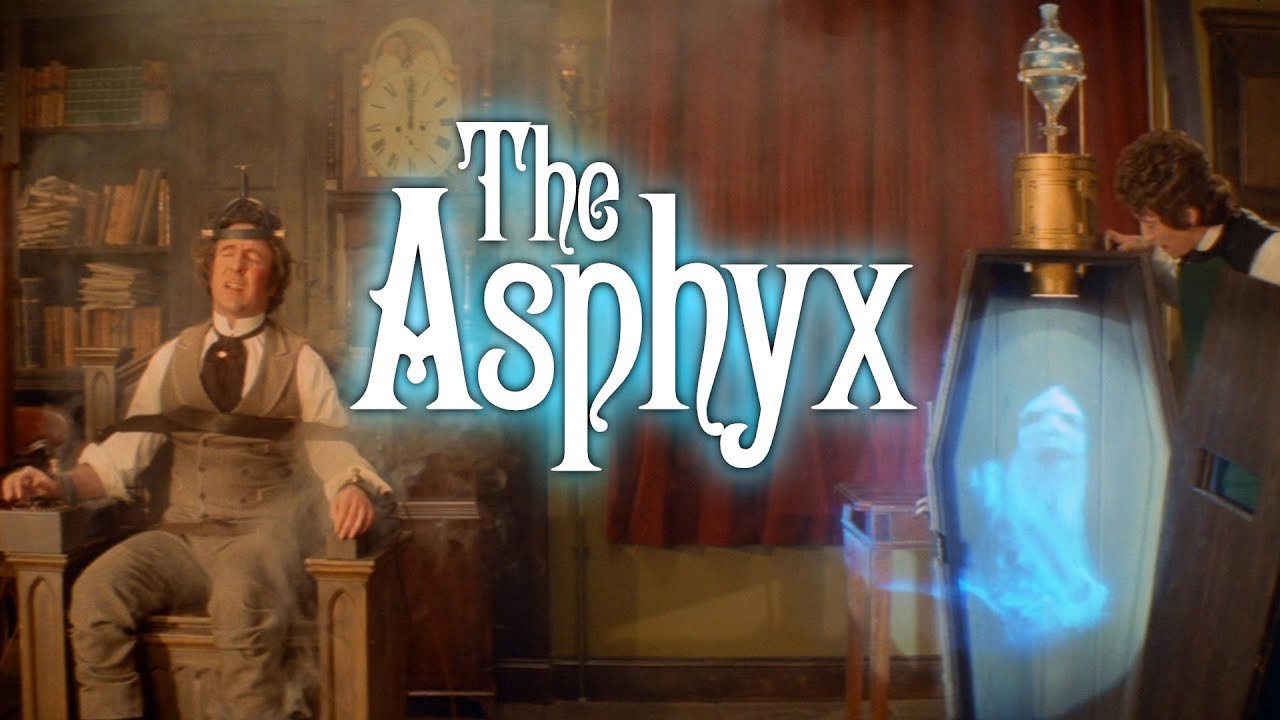
I was asked by a bluray distributor to do a commentary and write some liner notes for The Asphyx (1972) - the film ultimately ended up not coming out because of the quality of the elements, I believe. Here is the first draft of those liner notes.
As always, this post is free, but please do consider throwing the price of a coffee my way.
AN ABUNDANCE OF SPIRIT(S)
JOHNNY MAINS
In The Asphyx (dir. Peter Newbrook, 1972), Sir Hugo Cunningham, becomes obsessed with the concept of immortality. He discovers the "Asphyx," which is believed to appear at the moment of a person’s death to claim their soul. Through experiments involving photography and innovative light projection, Hugo learns that he can trap the Asphyx, thereby halting death and granting immortality to the individual. The film ties into the concept of ‘spirit photography’, a process that claimed to visually capture spirits or supernatural entities through photographic techniques. While Sir Hugo uses ‘advanced’ (fictional) devices, the film shows us how photographers of the Victorian era would have used photographic manipulation to try and bridge the gap between life and the afterlife.
Before the Victorian era and the rise of spirit photography, the history of photography underwent significant developments. Photography’s origins trace back to the early 19th century, a period when the desire to capture and preserve images intersected with scientific and technological advancements, and it was these innovations laid the groundwork for the eventual introduction of spirit photography. The journey began in 1826, with French inventor Joseph Nicéphore Niépce, who created the first permanent photograph using heliography. His process involved coating a metal plate with a light-sensitive substance and exposing it to light for several hours. The picture, Untitled 'point de vue,' ‘(View from the Window at Le Gras’) from 1827, was made with a camera obscura, and was “the first uncertain step in a completely new direction.”[1]
Along came Niépce’s artistic partner, the painter and printer Louis Daguerre. After Niépce’s death in 1833, Louis continued to experiment and in 1839, introduced the daguerreotype, an invention that blew open the doors, revealing the remarkable quality that could be had. By exposing a silver-plated copper sheet to iodine vapor to create a light-sensitive surface, then developing the image with mercury vapor, Daguerre produced sharp, detailed photographs that absolutely captivated the public.[2]
Photography’s next milestone came with William Henry Fox Talbot’s calotype process in the 1840s. Unlike daguerreotypes, which produced singular images, calotypes used paper negatives to create multiple prints, introducing reproducibility and paving the way for photography’s widespread adoption as a medium for documentation and artistic expression.
By the mid-19th century, Frederick Scott Archer’s collodion wet plate process emerged, allowing for sharper images and shorter exposure times. This method became the dominant photographic technique of the era[3], setting the stage for creative and unconventional experiments, including spirit photography. During this period, photography began to intersect with cultural practices and societal shifts. Victorian society, influenced by Romanticism and a fascination with the supernatural, viewed photography as a tool not only for documentation but also for exploring the unknown.
This convergence of technological progress and cultural context culminated in the rise of spirit photography in the 1860s. New techniques like double exposure and composite printing enabled the manipulation of images, giving rise to photographs that purportedly captured spectral figures. William H. Mumler, a Boston-based photographer, claimed to have accidentally discovered spirit photography while developing a self-portrait[4]. His work aligned with the spiritualist movement, which was gaining momentum during this period. Spiritualism, rooted in the belief that the living could communicate with the spirits of the dead, was fuelled by widespread grief and loss, particularly during periods of upheaval like the American Civil War and Europe’s cholera outbreaks. In this context, spirit photography emerged as a compelling medium for bridging the perceived gap between the material and spiritual worlds.
The Victorian era, marked by profound social, cultural, and technological change, saw spirit photography flourish at the intersection of burgeoning photographic technology and the fascination with spiritualism. This combination reflected Victorian preoccupations with the supernatural and the afterlife, offering both solace and controversy to a society grappling with mortality and rapid modernisation. Spirit photography extended the tradition of post-mortem photography, a widespread custom where deceased individuals were photographed for memorialisation. These were expensive, so only commissioned after death, especially if there were no prior images of them. This was particularly common for children and infants due to high mortality rates during those times, making them significant keepsakes for grieving families. The addition of a supernatural element enabled families to believe they had captured a glimpse of their loved ones in the afterlife. As Clément Chéroux observes, “Spirit photography was a logical extension of Victorian society’s preoccupation with death, mourning, and remembrance, reflecting a culture deeply invested in the continuity of life beyond physical demise.”[5]
From its inception, spirit photography faced scepticism from scientific and photographic communities. Critics argued that the ghostly images resulted from deliberate manipulations, such as double exposures, composite printing, or pre-prepared negatives. These techniques, while innovative, called into question the photographs’ authenticity. Mumler himself became the subject of scrutiny, culminating in his fraud trial in 1869. Experts testified that the images could be replicated through conventional methods, and while Mumler was acquitted, the trial underscored the contentious nature of spirit photography and its place between belief and deception. Despite controversies, the emotional appeal of spirit photography ensured its continued popularity. Photographs provided tangible evidence of the afterlife for many believers, reinforcing spiritualist doctrines and comforting the bereaved. As Arthur Conan Doyle described, “Spirit photographs were not mere curiosities but sacred relics, imbued with the essence of those who had passed beyond the veil.”[6]
The practice occupied a unique cultural space, blending technological innovation with the human longing for connection with the unseen. Photography, regarded as an objective means of capturing reality, lent spirit photographs a veneer of authenticity. The ghostly aesthetic, evoking Romanticism and Gothic traditions, further enhanced their emotional depth. As Kaplan (2008) notes, “Spirit photography occupied a unique cultural space, where technological innovation met the timeless human longing for connection with the unseen.”[7] The Victorian fascination with spirit photography also mirrored broader societal tensions surrounding science and religion. The 19th century, marked by rapid scientific advancements, often challenged traditional beliefs. Spirit photography became a focal point for debates over the compatibility of science and spirituality, with supporters claiming the photographs provided empirical evidence of spiritual phenomena and critics dismissing them as hoaxes exploiting public credulity.
Psychological factors played a critical role in the reception of spirit photographs. Pareidolia, the tendency to perceive familiar patterns like faces in random stimuli, contributed to belief in their authenticity. Confirmation bias further reinforced interpretations of spectral figures as genuine manifestations of the dead. For grieving individuals, the photographs’ emotional resonance often outweighed rational scrutiny. Chéroux argues that this psychological dynamic was central to the practice’s appeal, stating, “Spirit photography tapped into the universal human desire to find meaning in loss, transforming visual anomalies into symbols of hope and continuity.”[8]
As the Victorian era ended, spirit photography’s popularity waned due to technological and cultural shifts. Advances in photographic techniques, such as dry plate processes and roll film, heightened awareness of photographic manipulation. Simultaneously, forensic science and sophisticated photographic analysis exposed the methods behind many spirit photographs, eroding their credibility. However, the legacy of Victorian spirit photography persisted, influencing artists, spiritualists, and cultural commentators. Doyle (1926) observed, “The spirit photograph is more than an image; it is a testament to the enduring power of faith and imagination in the face of life’s greatest mysteries.”
In retrospect, spirit photography offers a lens through which to examine the interplay of technology, culture, and belief. Rooted in grief, mortality, and the search for meaning, it engaged with cutting-edge technologies and intellectual currents of its time. Kaplan eloquently states, “Spirit photography captures not only the ghosts of the dead but also the aspirations of the living.”[9] This duality ensures its continued relevance as a window into the complexities of belief and the enduring power of the visual medium.
Revisiting The Asphyx, we can have sympathy with Sir Hugo Cunningham, as he tried to find way into the spirit world. And be they accidents, con artists or people who truly tried to help the grieving, those Victorian spirit photographers have left a legacy that continues to fascinate.
[1] https://www.hrc.utexas.edu/niepce-heliograph/
[2] https://www.metmuseum.org/toah/hd/dagu/hd_dagu.htm
[3] https://blog.scienceandmediamuseum.org.uk/photography-a-z-frederick-scott-archer-wet-collodion-process/
[4] https://tomruffles.wordpress.com/2017/02/10/the-strange-case-of-william-mumler-spirit-photographer-by-louis-kaplan/
[5] The Perfect Medium: Photography and the Occult (Yale University Press, 2005), Clement Cheroux, Andreas Fischer, Pierre Apraxine, Denis Canguilhem and Sophie Schmit.
[6] The History of Spiritualism (1926)
[7] Louis Kaplan, The Strange Case of William Mumler, Spirit Photographer (University of Minnesota Press, 2008)
[8] The Perfect Medium: Photography and the Occult (Yale University Press, 2005), Clement Cheroux, Andreas Fischer, Pierre Apraxine, Denis Canguilhem and Sophie Schmit.
[9] Louis Kaplan, The Strange Case of William Mumler, Spirit Photographer (University of Minnesota Press, 2008)