
Huldra
Imagine the power contained within the realms of the Scandinavian Forests, here the spirits of the forest watch every step you take, and non-more so than a spirit that takes the form of a beautiful young woman. This female forest spirit is known in Norway as Huldra, in Sweden skogsrå (Forest Spirit) and Hulder in Denmark. In Gotland, there are records of a female troll known as Torspjäska that occupies a similar role to the Huldra.
The tales of the Huldra have been passed down orally from generation to generation captivating the imagination of the people of Scandinavia and beyond. In this piece, we will explore the origins of the Huldra, her characteristics, and her significance in Scandinavian folklore.
The origins of the Huldra can be traced back to very early Scandinavia folklore, where they were believed to be supernatural beings closely connected to the natural world, often associated with areas of wilderness like the deep forests, mountains, and secluded areas of the countryside. The Swedish form of Huldra (Skogsrå) may have originally belonged to a group of collective creatures known as South Swedish trolls and are often referred to as Trollkäringen (Troll’s Witch).
The word Huldra is thought to mean “hidden” or “secret” which likely refers to their hidden nature or what they try to hide. The word Huldra is only used for a female, the male being called a Huldrekall and are thought to be more troll like. Huldra are not the same as Huldufólk or “hidden people” this is an Icelandic and Faroese term used in folklore to describe elf like beings that live in nature and are only visible should they choose to be.
The Huldra as a specific figure is not mentioned in the old sagas, she remains closely associated with Scandinavian folklore rather than the formal texts of the poetic and prose eddas. However, the Huldra does share some similarities with other beings in Norse mythology and her portrayal of a seductive, shapeshifting forest dweller does resonate with themes found in many mythological traditions, from this we can assume that the Huldra’s roots are as a pre-Christian forest spirit, evolving throughout time to incorporate the new Christian order.
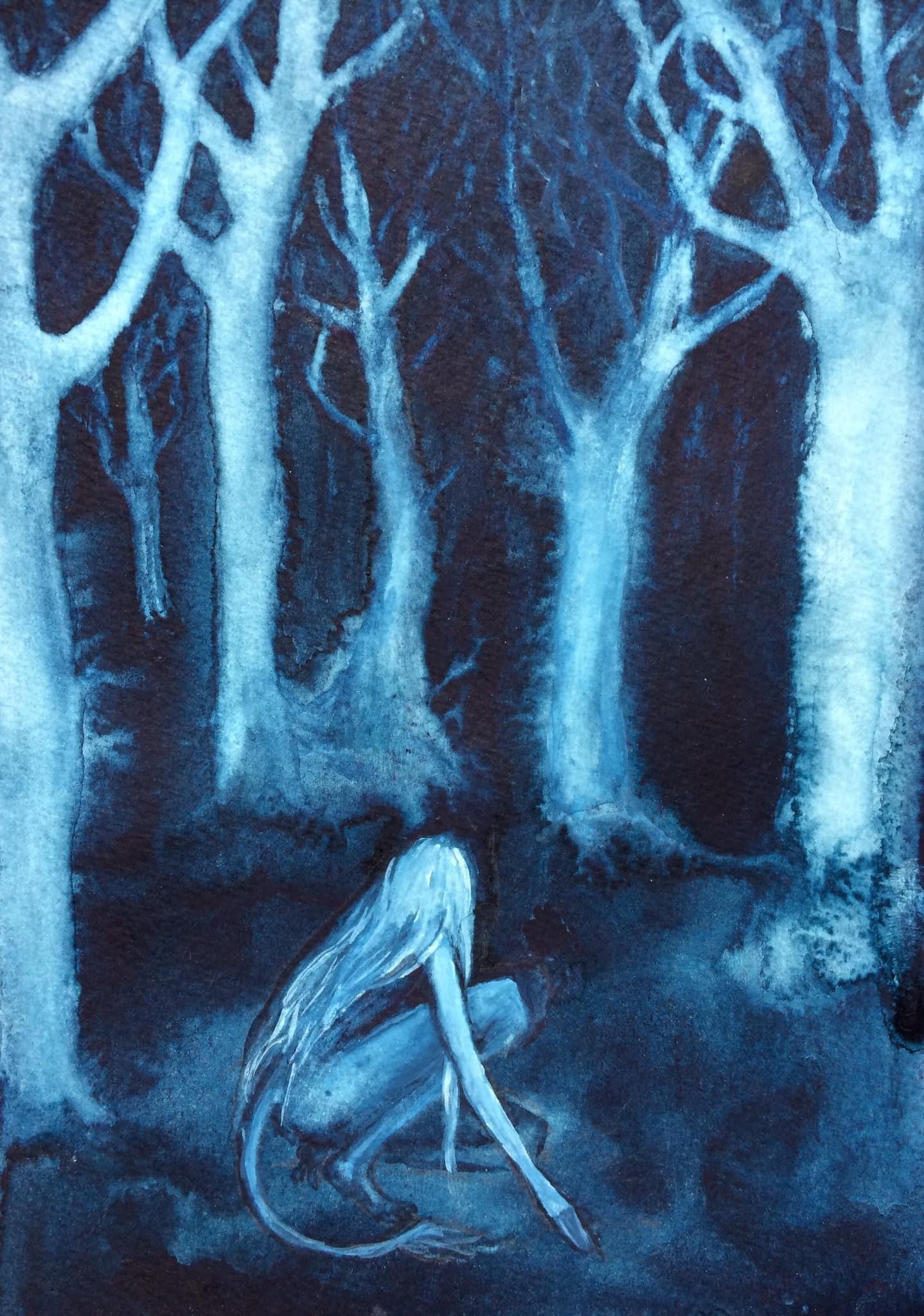
The Huldra is mostly described as seductive and very beautiful with long flowing hair, captivating eyes and wearing traditional clothing. However, despite her outward beauty, the Huldra possess a hidden, more ominous appearance. In many folkloric stories she is said to have either a cow's tail or fox tail and a hollow back, which she conceals to appear human. The hollow back may signify nature itself which is both full of life but also hollow and devoid of life if we are lost or alone within it.
This duality is part of her nature and appears many times in her character, symbolising the idea that things are not always as they seem or that beauty and ugliness, good and evil, natural and supernatural can exist in the same entity.
One of the most prominent characteristics of the Huldra is their ability to entice, seduce and enchant unsuspecting humans, they are temptresses who use their beauty and charm to lure wanderers deep into the forest where she enchants her prey, once enchanted the man may befall a variety of fates including death and she is particularly fond of praying on men that are betrothed. Her seductive nature is all about the allure of the unknown or forbidden, and the potential dangers of giving in to such temptations.
However, she does not enchant all men, Swedish stories often mention charcoal burners who she offers protection to, allowing them to sleep restfully by keeping an eye on their charcoal kilns, in return the charcoal burners would leave provisions for the Huldra.
In another folklore story we see the importance of being polite to the Huldra. A boy in Tividen went fishing, but he was having no luck, when he met a beautiful lady who was so beautiful that he had to catch his breath. However, he realized who she was when he saw a fox's tail sticking out below her skirt. The boy knew that it was forbidden to comment on the Huldra’s tail if it were not done in the politest manner. The boy bowed deeply and said with his softest voice, "My lady, I see that your petticoat shows below your skirt". The Huldra thanked him gracefully and hid her tail under her skirt, telling the boy to fish on the other side of the lake. That day, the boy had great luck with his fishing, and he caught a fish every time he threw out the line. (Hellström, AnneMarie (1985). Jag vill så gärna berätta)
The Huldra is also a capable sorcerer known to be able to change environments, control the elements, hide trails and animals, even making game impervious to the hunter’s gunshots and traps. The Huldra are often associated with the völva (seiðkona) who practice seiðr magic and it’s not hard, with the above list of the Huldra’s magical abilities, to see why as they are very similar to that of the powers attested to the Völva.
Despite the Huldra’s potentially treacherous nature, she is also depicted as a protector of the forest and its wildlife, punishing those who disrespect or harm this environment. In some stories, the Huldra is seen as a guardian spirit of the forest, where people would often leave offerings to her to ensure good luck and protection. Again, her dual nature reflects both the complex relationship between humans and the natural world and highlights the importance of respecting and preserving the wilderness.
Inevitably the Christian era brings changes to the Huldra, she is now able to marry in a church, but if she does her tail falls off rendering her human, forcing her to bow to the church as her powers within the forest were stripped away.
The post Christian authorities took severe measures when someone was thought to have had a relationship with a spirit being. Folklorist Tommy Kuusela research highlights that the crown and the church viewed intimate relationships with the forest spirit as a crime that could lead to catastrophic consequences. Indeed, in Sweden there are judicial records dating from the 1600’s to 1700’s that show accusations of men having intimate relations with the Skogsrå and the trial records show that people could and were sentenced to death for this crime.
Through all this change though it is her role as guardian of the natural world and a cautionary figure that has made her so significant within Scandinavian folklore. She embodies the attraction of the wilderness but at the same time serves as a reminder of the dangers that lie beyond the safety of human civilization. These stories reflect the connection between Scandinavian culture and the natural environment, emphasizing the respect and reverence for the land and its inhabitants.
As a final thought, what would happen if you wandered into the forest and came across Huldra? would you instantly become a charcoal burner, or perhaps you would try politeness and not mentioning her tail, would you try turning your shirt inside out and reciting our father several times to help find the right path out of the forest. Whatever you choose to do remember the Huldra is pretty much impossible to deter once set on luring her victim in.
Written by Freyja Mae Lomas 🖤
Artwork by Erica Keating at
https://www.etsy.com/uk/shop/ForestFaeryCreations
I write all my articles for free but if you would like to support me by buying me a coffee it would be greatly appreciated 🖤🖤
Further Reading:
HELLSTROM, AnneMarie. (1985). Jag vill så gärna berätta: (ISBN10: 9179080022)
KUUSELA, Tommy. (2020) Spirited Away by the Female Forest Spirit in Swedish Folk Belief: Published in Folklore, Volume 131:2, pages 159-179.
KOSONEN, Heidi & GREENHILL, Pauline. (2022) ‘Something’s Not Right in Silverhöjd’: Nordic Supernatural and Environmental and Species Justice in Jordskott. Folklore 133:3, pages 334-356.
PORTEOUS, Alexander. (2002). The Forest in Folklore and Mythology. Dover Publications Inc.