

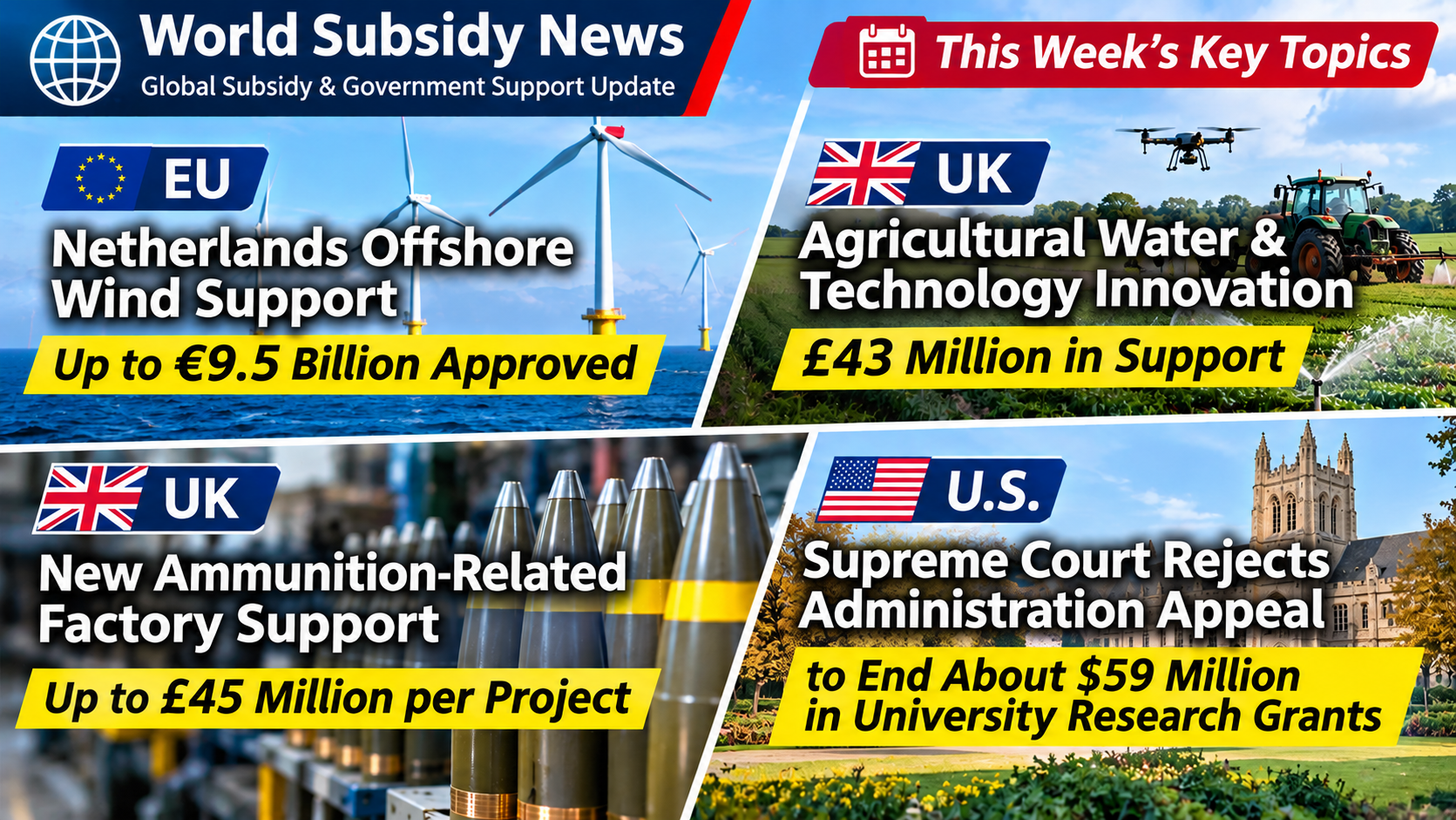
 This week, major developments included substantial European support for offshore wind power, UK subsidies for agriculture and the defence industry, and a U.S. judicial decision concerning cuts to research grants.
This Week's Headlines
EU: Up to €9.5 billion in support approved for offshore wind projects in the Netherlands.
UK: £43 million for agricultural water management and technological innovation.
UK: Grants of up to £45 million per project for new ammunition-related manufacturing facilities.
U.S.: Supreme Court declines to hear the administration's appeal over the termination of approximately $59 million in university research grants.
Key Takeaway
A common theme in this week's policies is that subsidies are being used not merely to support businesses, but also as policy instruments to maintain energy security, domestic production capacity, food supplies, and research activities.
Contents
EU | €9.5 Billion in State Aid Approved for Offshore Wind Power in the Netherlands
EU | €57.6 Million for Germany's Semiconductor Supply Chain
UK | £43 Million for Agricultural Water Management and Technological Innovation
UK | Grants of Up to £45 Million for Ammunition-Related Factories
U.S. | Judicial Decision Over the Termination of Approximately $59 Million in Research Grants
China | Implementation of Local Employment and Livelihood Support
Why Is the UK Building Ammunition Factories in the Age of AI and Robotics?
1. EU | €9.5 Billion in State Aid Approved for Offshore Wind Power in the Netherlands
Announced: November 17
Status: Approved by the EU
The European Commission approved a €9.5 billion Dutch state aid scheme supporting offshore wind power development in the North Sea.
The scheme covers two offshore wind projects: IJmuiden Ver Gamma-A and Gamma-B.
Support amount: €9.5 billion
Target: Offshore wind power projects in the Netherlands
Policy objectives: Expansion of renewable energy, decarbonization, and stronger electricity supply
Status: Approved under EU state aid rules
The €9.5 billion represents the scale of the support scheme and does not mean that the entire amount has already been paid to project developers.
From an industrial perspective, the scheme is expected to generate demand for wind power equipment, submarine cables, construction, and maintenance services.
The impact on household electricity bills remains uncertain at this stage, as it will depend on generation costs, market prices, and the design of the support scheme.
The key question is how effectively this substantial public support will reduce investment risks for renewable energy projects and how much electricity the projects will ultimately supply.
Source: European Commission, November 17
2. EU | €57.6 Million for Germany's Semiconductor Supply Chain
Announced: November 19
Status: Approved by the EU
The European Commission approved a total of €57.6 million in direct subsidies for semiconductor-related facilities in Germany.
Lidrotec GmbH — €43.5 million
A manufacturing facility for laser-based equipment used to cut semiconductor wafers.
Dockweiler GmbH — €14.1 million
A production facility for critical precursor chemicals required in semiconductor manufacturing.
The policy aims to strengthen Europe's semiconductor supply chain and technological independence.
The European Commission assesses factors such as whether the investment would take place without public support and whether the impact on competition would be excessive.
This demonstrates that public funding extends beyond finished semiconductor products to manufacturing equipment and materials.
However, whether these subsidized investments can achieve long-term financial independence will depend on their future business performance.
Source: EU Reporter, November 19
3. UK | £43 Million for Agricultural Water Management and Technological Innovation
Announced: November 19
Status: Support measures announced; applications scheduled to open
The UK government announced £43 million in support measures aimed at strengthening the resilience of agricultural businesses.
Agricultural technology, soil, and water quality improvements: £28 million
Reservoirs and agricultural water infrastructure: £15 million
The measures target farmers and related technological innovation projects.
Applications for water management grants are scheduled to open on November 30 and remain open until February 23, 2027.
The objective is to improve preparedness for droughts and other challenges, reduce production costs, and strengthen food supply stability.
If agricultural profitability improves, the measures may also help maintain regional employment.
However, agricultural support does not necessarily lead to lower food prices for consumers.
Production volumes, operating costs, and water-use efficiency following investment will be important indicators of the policy's effectiveness.
Source: UK Department for Environment, Food & Rural Affairs, November 19
4. UK | Grants of Up to £45 Million for Ammunition-Related Factories
Announced: November 20
Status: First funding competition launched
The UK Ministry of Defence launched a grant competition offering up to £45 million per project to support the construction of new domestic factories producing explosives, propellants, and related materials.
The scheme forms part of the government's £1.5 billion policy to strengthen ammunition production capacity.
The government expects its broader "Factories of the Future" initiative to create more than 1,000 skilled jobs.
Source: UK Ministry of Defence, November 20
5. U.S. | Judicial Decision Over the Termination of Approximately $59 Million in Research Grants
Reported: November 16
Status: Supreme Court declined to hear the appeal
The U.S. Supreme Court declined to hear the administration's appeal in a dispute over the termination of approximately $59 million in federal research grants awarded to University of California researchers.
As a result, a lower-court ruling requiring the restoration of the grants remains in place.
The dispute concerned the extent to which the federal government can terminate funding for research activities that do not align with the administration's policy priorities.
Target: Federally funded research projects involving University of California researchers
Amount: Approximately $59 million
Policy and legal issues: Government discretion in allocating research funding and freedom of expression
Impact: Continuity of research activities and stability of research employment and funding
The Supreme Court's decision does not mean that research grant reductions in general have been ruled unlawful.
Rather, the lower-court ruling in this particular case remains in effect.
Public research funding supports scientific and technological development, but its continuity may also be affected by changes in administrations and government policies.
Source: Reuters, November 16
6. China | Implementation of Local Employment and Livelihood Support
On November 19, Jiayuguan City in China's Gansu Province published the sixth batch of review results concerning expanded eligibility for social insurance subsidies.
Source: Jiayuguan Municipal Human Resources and Social Security Bureau, November 19
Why Is the UK Building Ammunition Factories in the Age of AI and Robotics?
The UK is now providing subsidies for ammunition factories because the war in Ukraine has exposed Europe's insufficient ammunition production capacity to sustain a prolonged conflict.
In fact, the UK has not suddenly developed a need for ammunition. Following the Cold War, European countries reduced their production capacity for large-scale warfare.
However, Russia's full-scale invasion of Ukraine in 2022 changed the situation.
What matters is that the UK is not simply purchasing ammunition. It is investing public funds in factories capable of manufacturing ammunition domestically.
This is both a defence policy and an industrial policy.
The UK government aims not only to secure a stable ammunition supply but also to rebuild domestic manufacturing, create skilled jobs, and expand exports.
Even if factories are built with government subsidies, will they be able to operate without subsidies if demand declines in the future?
The UK government also recognizes this issue and requires applicants to demonstrate long-term commercial viability and secure private investment.