

 In modern society, most people earn their living by working for a company or another organization.
There is no need to reject work or employment itself. However, we may be approaching the limits of a system in which people must remain employed by a single organization in order to meet nearly all their living expenses.
This article examines why.
Table of Contents
Automation Can Create Excess Staffing Within Companies
Labor-Short Industries Often Cannot Pay Adequate Wages
Pay Depends More on an Employer’s Financial Strength Than on Social Demand
In Japan, Difficulties in Dismissing Employees Can Create Indirect Pressure to Resign
Labor-Short Industries Struggle to Invest in Automation
One Possible Direction: Basic Income and a “Social Demand Supplement”
Reducing Dependence on Employment—Not Eliminating It
1. Automation Can Create Excess Staffing Within Companies
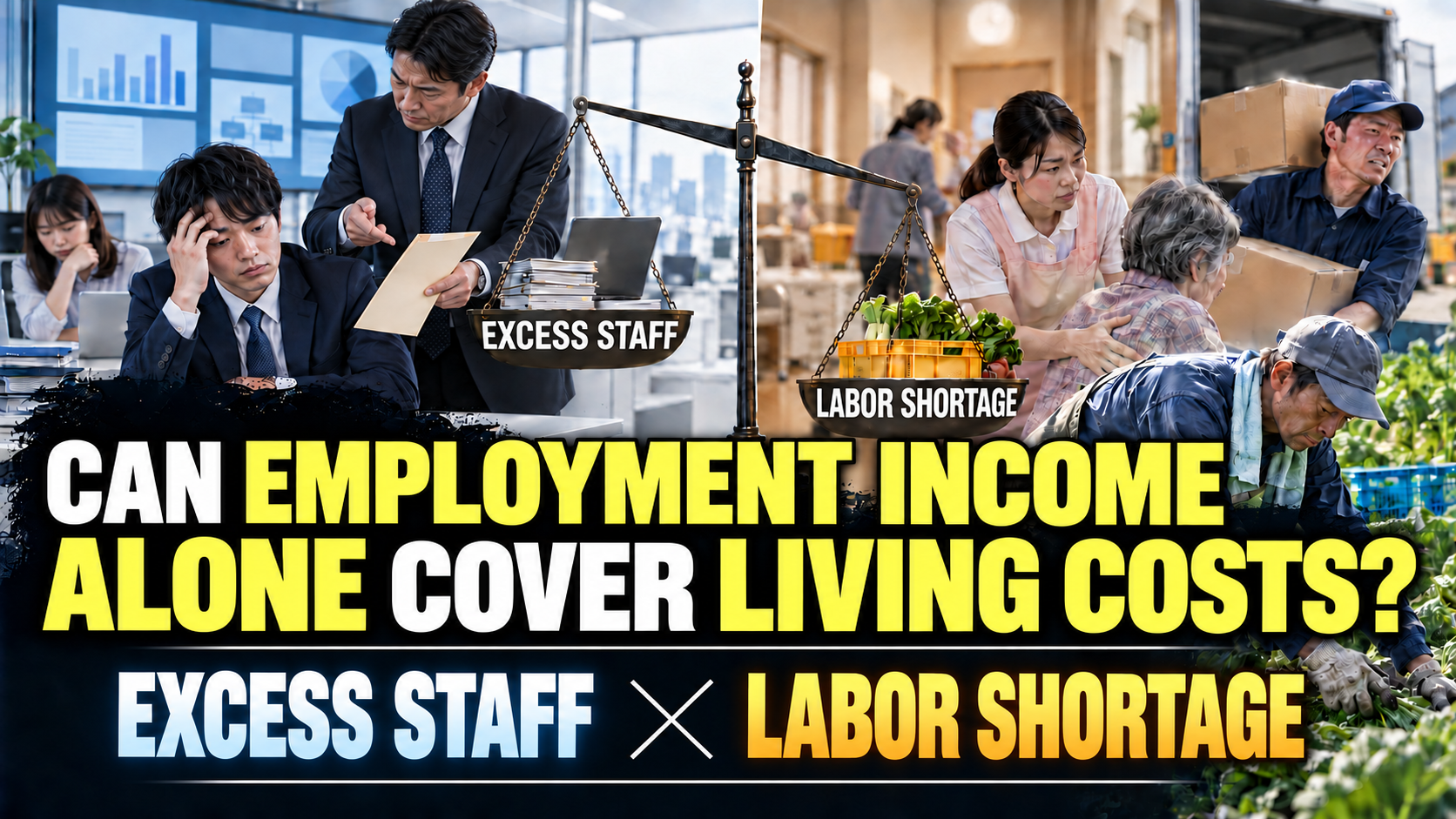
As AI, online services, self-checkout systems, and automated booking platforms become more widespread, fewer employees are needed to perform routine tasks.
This does not necessarily mean that entire occupations will disappear. More often, it means that work previously performed by ten people can now be handled by five.
For companies, automation is a rational investment that can improve productivity and profitability. However, when the number of employees required declines, excess staffing can emerge within the organization.
In 2020, Japan’s Mizuho Financial Group announced that it planned to transfer 1,100 back-office employees to customer-facing roles, including consulting services, after improving the efficiency of branch operations through digitalization.
This was not simply a case of reducing headcount. The company publicly acknowledged that fewer employees would be needed for administrative processing and presented a plan to reassign them to other roles.
Not every company, however, can provide suitable alternatives.
Japan has relatively strong employment protections, and dismissing regular employees generally requires stricter justification and procedures than in many other countries. Even when automation, business contraction, or poor workforce planning creates excess staffing, companies cannot necessarily reduce their workforce quickly.
In some cases, the business reasons behind the situation may not be clearly explained to employees. Workers may instead find their positions becoming increasingly uncomfortable until they eventually feel compelled to resign.
2. Labor-Short Industries Often Cannot Pay Adequate Wages
At the same time, socially essential industries—including elderly care, agriculture, logistics, and childcare—continue to experience serious labor shortages.
In theory, wages should rise when workers are scarce. In practice, many of these industries cannot easily pass higher costs on to customers. Some are affected by government-regulated prices or public budgets, and many consist of small businesses with limited financial resources.
The work exists, and society needs people to perform it. Yet employers may be unable to offer wages high enough to make these jobs financially attractive.
As a result, labor shortages persist, while the workload placed on the remaining workers continues to increase.
3. Pay Depends More on an Employer’s Financial Strength Than on Social Demand
A person’s salary is not determined solely by their skills or by how necessary their work is to society.
It is also heavily influenced by the profitability of their employer, the margins and pricing power of the industry, the size of the organization, and assets accumulated in the past.
This can create a paradox. A highly profitable company may be able to maintain relatively high salaries even when it has more employees than it needs. Meanwhile, a low-margin industry facing a severe labor shortage may be unable to raise wages.
This is not intended to dismiss the effort of people working for successful companies or to suggest that they do not deserve their compensation. Nor is it easy to measure the social value of every occupation objectively.
However, when severe labor shortages continue for years without producing sufficient wage increases, it is reasonable to ask whether the current system needs to be reconsidered.
4. In Japan, Difficulties in Dismissing Employees Can Create Indirect Pressure to Resign
Compared with some countries, Japanese companies generally face stricter requirements when dismissing regular employees. This helps protect workers from arbitrary job losses, but it can also make workforce adjustments more difficult when automation, business contraction, or poor workforce planning creates excess staffing.
Most companies respond through measures such as reassignment, retraining, hiring restrictions, or voluntary retirement programs. However, when suitable positions are unavailable, some employees may face indirect pressure to resign.
This can include being removed from meaningful work, repeatedly receiving unreasonably poor evaluations, being isolated, or being placed in roles that appear designed to encourage resignation. These practices are sometimes described as “quiet firing.”
This does not mean that every reassignment, negative evaluation, or case of workplace harassment is intended to force someone out. Nevertheless, when the business reason for excess staffing is not explained and the problem is instead presented solely as an individual employee’s failure, workers may be pushed toward resignation without understanding the wider organizational situation.
Leaving is not always easy. Many workers depend on one employer for nearly all their living expenses, and frequent job changes may still be viewed negatively in parts of the Japanese labor market. Moving to a labor-short industry may also involve lower pay or more physically demanding work.
As a result, some workers remain in uncomfortable workplaces until their mental or physical health deteriorates. The cost of internal workforce adjustment may then be transferred to employees, their families, and public healthcare and social security systems.
5. Labor-Short Industries Struggle to Invest in Automation
If an industry cannot attract enough workers, robots and AI could potentially reduce the amount of dangerous or physically demanding work performed by humans.
However, many labor-short industries consist of small businesses that cannot afford expensive equipment.
Agriculture, elderly care, and logistics also involve widely varying environments and working conditions. Unlike standard office software, the same automated system cannot always be installed everywhere without modification.
These industries need not only engineers but also people who understand frontline operations and can introduce, adjust, and maintain robotic systems.
Labor shortages leave organizations struggling simply to keep their daily operations running. They have little time or money to invest in automation. Without automation, productivity and profitability remain low, making meaningful wage increases difficult.
The labor shortage therefore becomes self-perpetuating.
6. One Possible Direction: Basic Income and a “Social Demand Supplement”
Encouraging people to change jobs will not be enough to correct this imbalance.
One possible approach would combine a basic income that covers part of essential living costs with an additional income supplement for people performing work for which there is high social demand.
The first step would be to separate part of a person’s livelihood from any particular employer. The purpose would not be to allow everyone to live comfortably without working. It would be to ensure that leaving an unreasonable or harmful workplace does not immediately make survival impossible.
In addition, people working in socially essential fields with serious labor shortages—such as care work, agriculture, and logistics—could receive a public income supplement separate from the salary paid by their employer.
Support for companies should also be evaluated according to actual outcomes, rather than simply counting how many systems or robots were purchased.
Possible measures could include reductions in working hours, physical strain, workplace accidents, and employee turnover, as well as improvements in wages and output.
Instead of merely directing more people into labor-short industries, governments and investors should also direct capital and talent toward robotics and other technologies that reduce physically demanding work.
Education also needs to change. Employment at a famous company should not be treated as the only model of success. Students should learn about industrial structures, labor shortages, AI, and robotics so that they can consider career paths based on the skills society is likely to need.
It should also become easier to start a side business or small independent venture. Having more than one source of income can reduce dependence on a single employer.
However, side work must not become another form of individual blame: “If your main job does not pay enough, simply work more.”
7. Reducing Dependence on Employment—Not Eliminating It
Basic income would raise major questions about funding. It would also be difficult to decide which occupations are socially essential and how to prevent subsidies from creating new forms of dependency or rent-seeking.
The proposals described here should therefore not be presented as the only possible answer.
Nevertheless, the underlying imbalance is difficult to ignore. Some companies can automate their operations and develop excess staffing, while labor-short industries lack the money needed to raise wages or invest in automation. At the same time, workers still depend on salaries from individual employers for nearly all their living expenses.
Part of the cost of living could be separated from any particular employer. People performing work that society urgently needs could be rewarded beyond what their employer’s financial capacity allows. Dangerous and physically demanding tasks that have long been imposed on human workers could gradually be transferred to robots and other technologies.
Employment itself may not be approaching its limit.
What may be reaching its limit is a system that makes a single employment relationship responsible for nearly every aspect of a person’s livelihood.