

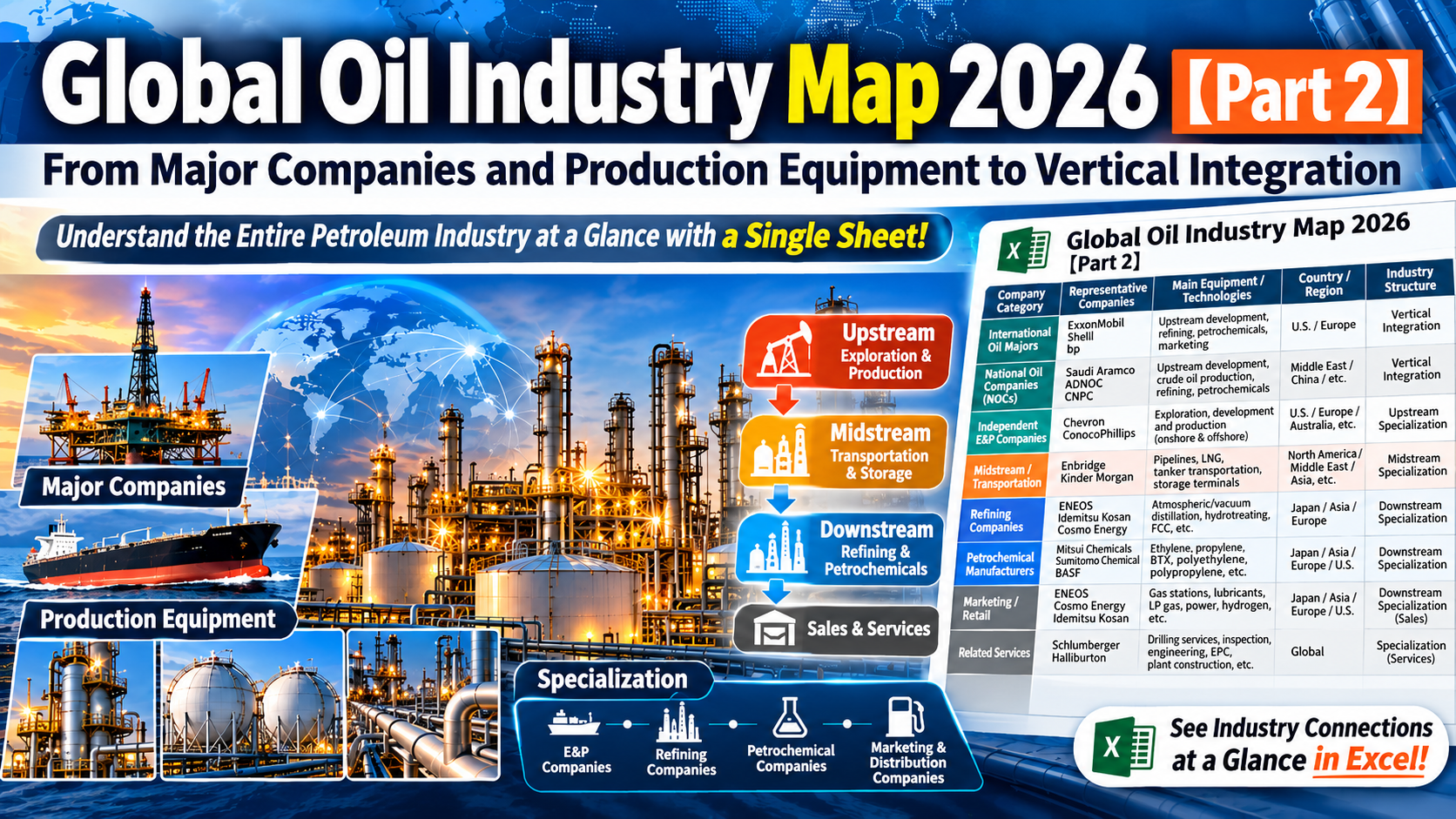
 The petroleum industry involves a wide range of companies, including those that extract crude oil, refine petroleum, manufacture petrochemical products, and supply production equipment and technologies.
To make these complex industry connections easier to understand, we have organized the information into a single Excel worksheet called the Global Oil Industry Map 2026.
[Download: Global Oil Industry Map 2026 | Excel]
buymeacoffee.com/japanbusinessinsights/e/594351
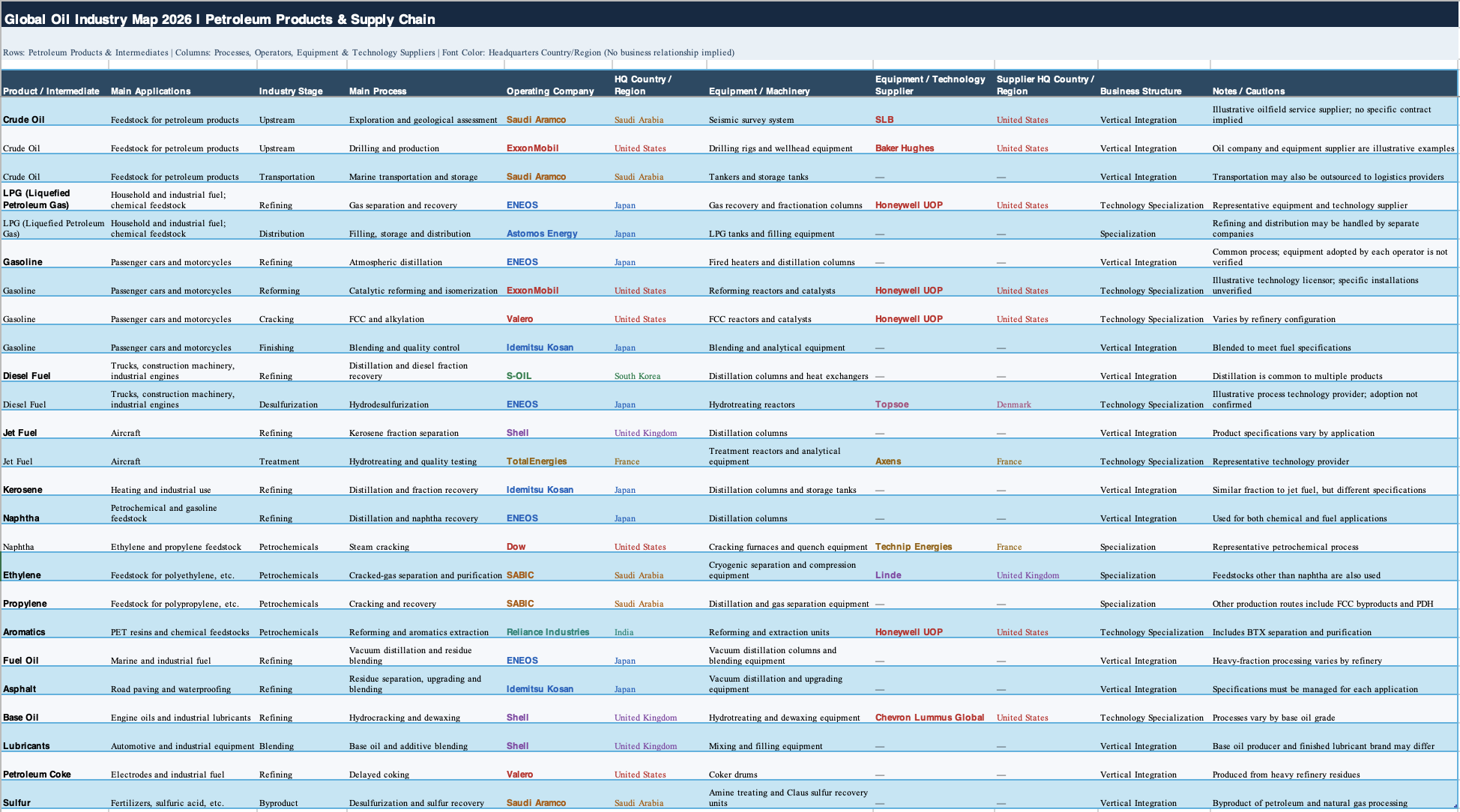
Global Oil Industry Map 2026.xlsx
In Part 2, we use this map to explore the production equipment supporting the petroleum industry, major companies, regional characteristics, and industry structures such as vertical integration and specialization.
For an introduction to petroleum products and refining processes, please see Part 1.
Contents
What Equipment and Machinery Are Used in the Petroleum Industry?
What Types of Companies Operate in the Petroleum Industry?
The Petroleum Industry by Country and Region
Vertical Integration and Specialization
Conclusion: What Can We Learn from the Petroleum Industry Map?
1. What Equipment and Machinery Are Used in the Petroleum Industry?
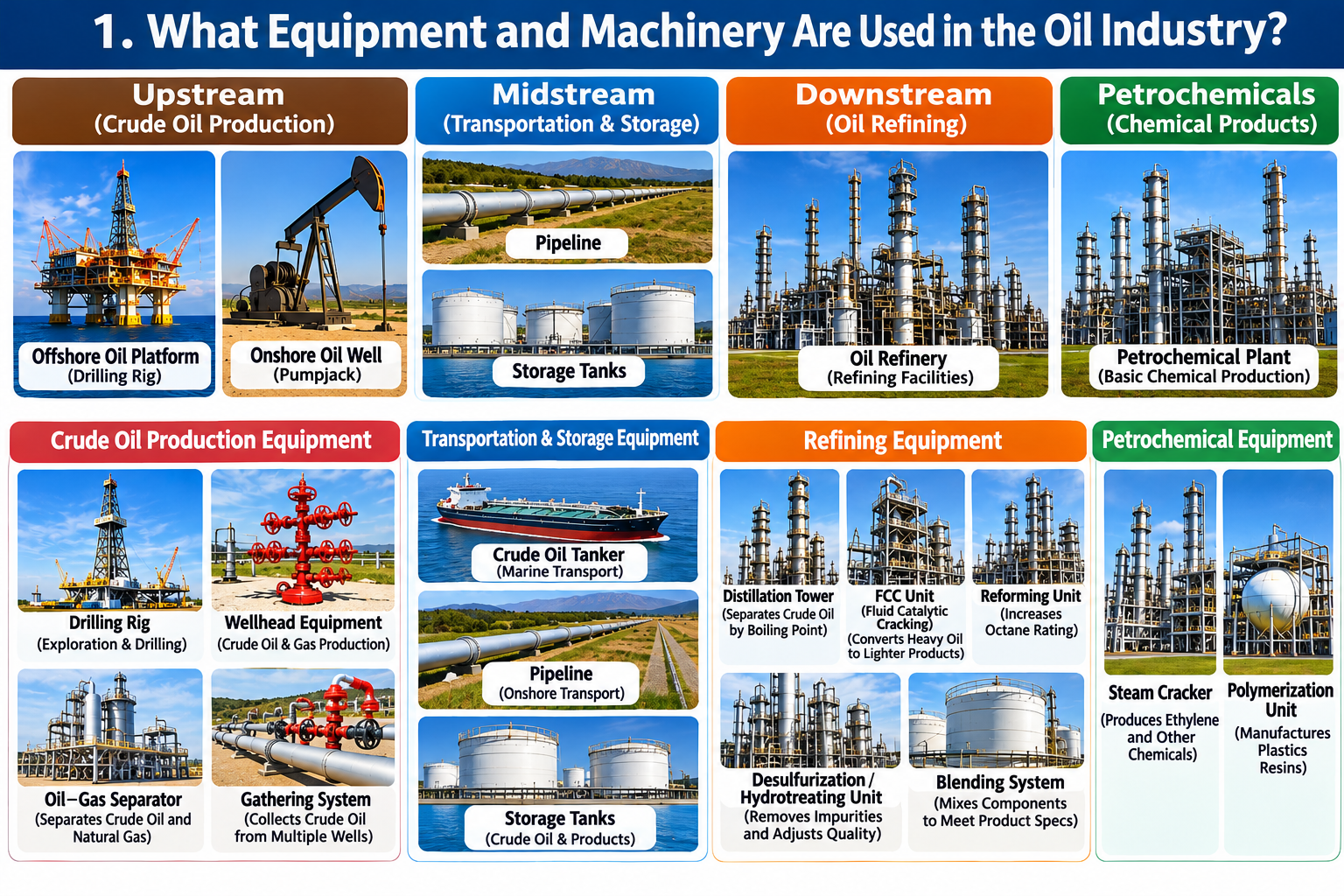 The petroleum industry uses a wide range of equipment, from crude oil extraction to refining and petrochemical manufacturing.
Exploration and Production Equipment
Seismic Survey Systems
These technologies are used to investigate underground geological structures and estimate the locations and characteristics of oil reservoirs.
Drilling Rigs
Drilling rigs are used to drill wells into underground formations to extract crude oil and natural gas.
Wellhead Equipment
Wellhead equipment is used to control and manage the production of crude oil and natural gas from underground wells.
Transportation and Storage Equipment
Tankers
Tankers are ships used to transport crude oil and petroleum products by sea.
Pipelines
Pipelines are used to transport crude oil, petroleum products, and other materials over long distances.
Storage Tanks
Storage tanks are used to temporarily store crude oil and refined petroleum products.
Petroleum Refining Equipment
Distillation Columns
Distillation columns separate crude oil into different fractions based on differences in their boiling points.
Heat Exchangers
Heat exchangers transfer heat between process streams. They are used for heating, cooling, and improving energy efficiency.
Fluid Catalytic Cracking (FCC) Units
FCC units use catalysts to convert heavy petroleum fractions into lighter hydrocarbons.
Hydrotreating Units
Hydrotreating units use hydrogen to remove sulfur and other impurities and improve product quality.
Reforming Reactors
Reforming reactors change the molecular structure of hydrocarbons to produce gasoline blending components and chemical feedstocks.
Coker Drums
Coker drums are used in thermal cracking processes that convert heavy residual oil into lighter products and petroleum coke.
Petrochemical Equipment
Steam Cracking Furnaces
Steam cracking furnaces break down feedstocks such as naphtha at high temperatures to produce ethylene, propylene, and other basic petrochemicals.
Gas Separation Units
Gas separation units separate specific components from mixed gas streams.
Reactors and Polymerization Equipment
These facilities are used to manufacture resins and other chemical products from basic petrochemicals.
An important point is that the petroleum industry is supported not only by oil companies but also by specialized companies that supply equipment and manufacturing technologies.
2. What Types of Companies Operate in the Petroleum Industry?
Companies in the petroleum industry can be broadly categorized according to their business activities.
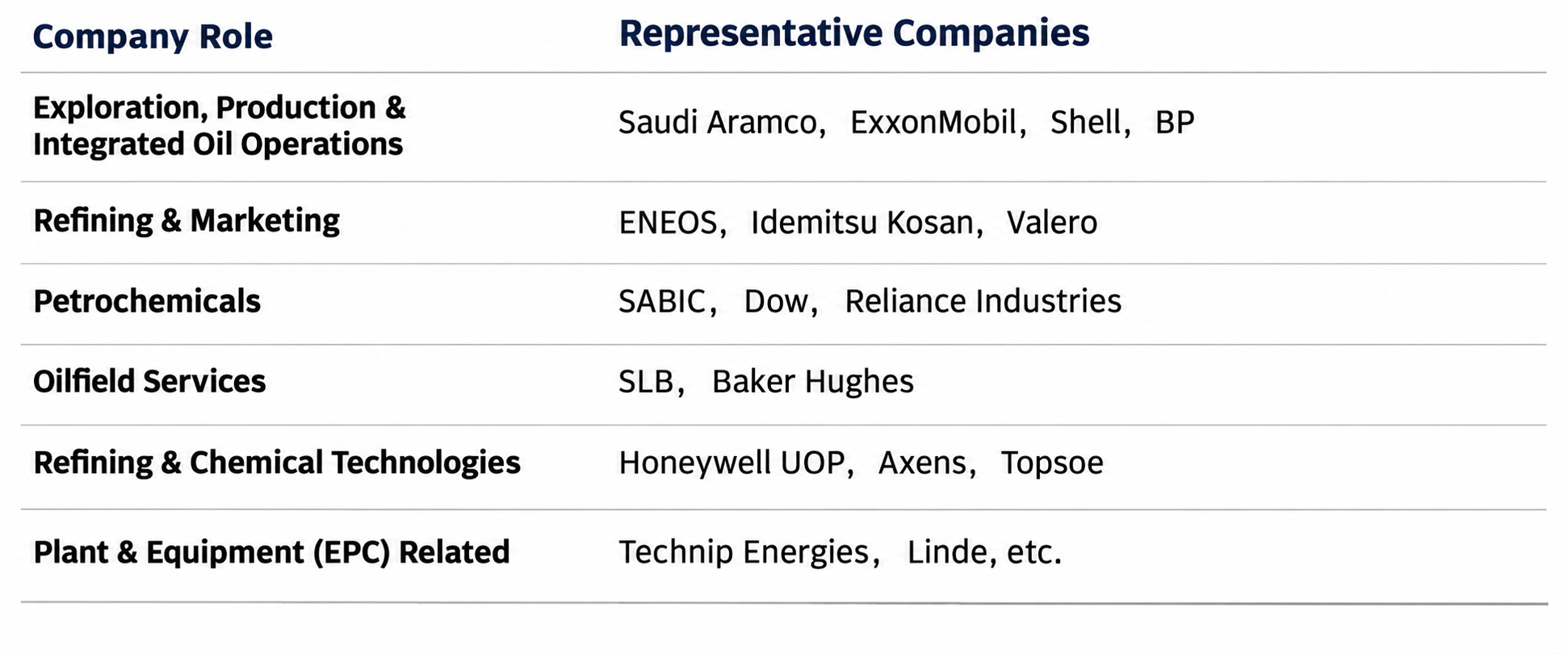 Note: Companies are not necessarily limited to a single business category. Many operate across multiple segments of the petroleum value chain.
International Oil Majors
International oil majors are large energy companies operating across multiple segments, including crude oil and natural gas exploration and production, refining, marketing, and chemicals.
Representative examples include ExxonMobil, Shell, and BP.
Saudi Aramco is also a major company with extensive operations spanning crude oil production, refining, and petrochemicals.
Japanese Oil Companies
ENEOS and Idemitsu Kosan are among the major companies supporting petroleum refining and distribution in Japan.
They procure crude oil from overseas markets, process it at refineries in Japan and elsewhere, and supply fuels, chemical feedstocks, and other petroleum products.
In the case of ENEOS, its group company ENEOS Xplora is involved in crude oil and natural gas exploration, development, and production.
In other words, behind the brands consumers see at gas stations are extensive business operations ranging from crude oil development to refining and distribution.
Petrochemical Manufacturers
Companies such as SABIC and Dow manufacture basic chemicals, resins, and other petrochemical products.
The technologies and core business activities involved in refining crude oil into fuels differ from those used to manufacture chemical products from feedstocks such as naphtha.
Oilfield Services and Process Technology Companies
Companies such as SLB, Baker Hughes, Honeywell UOP, and Axens provide services, process technologies, equipment, and other solutions related to oilfield development and petroleum refining.
Companies that produce petroleum and those that provide the technologies supporting its production and processing play different roles within the industry.
3. The Petroleum Industry by Country and Region
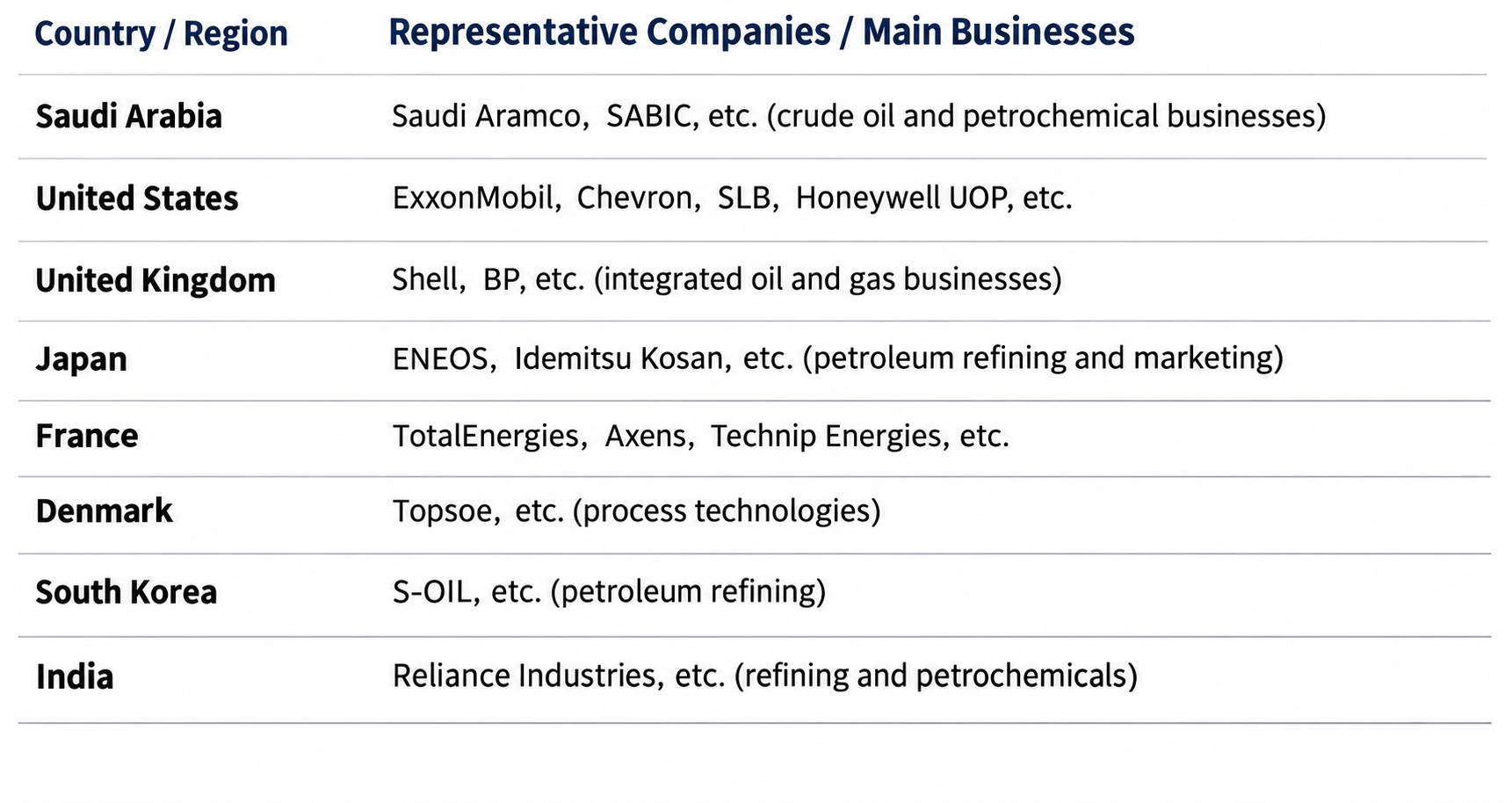 Different strengths and areas of specialization can be observed among petroleum companies headquartered in different countries and regions.
These observations are based on representative companies included in the industry map and do not constitute a ranking of market shares by country.
A company headquartered in the United States, for example, may operate production facilities and other business locations in many countries.
The country and region color coding in the industry map is intended to help readers compare companies according to the locations of their headquarters.
4. Vertical Integration and Specialization
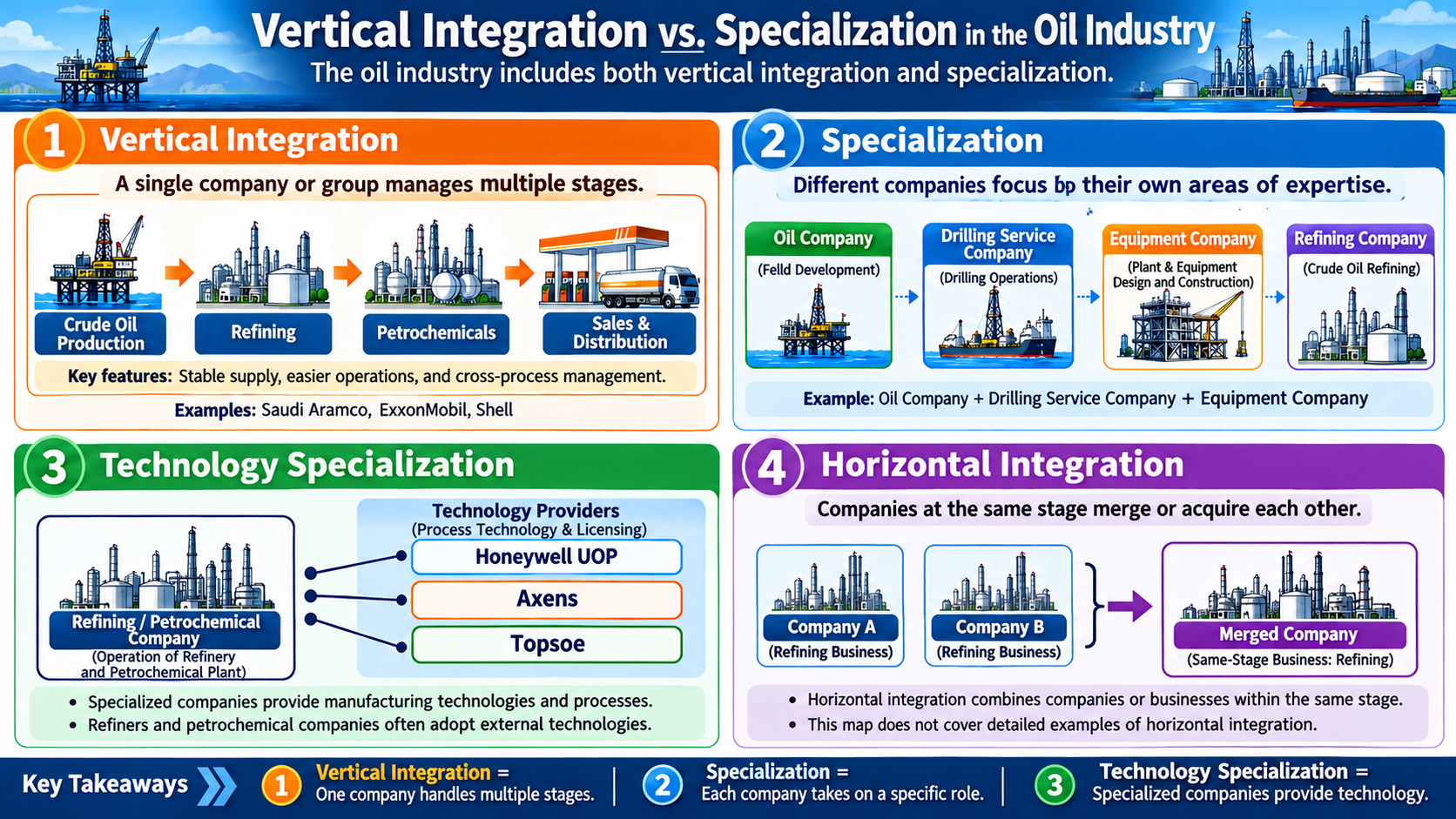 One of the characteristics of the petroleum industry is the coexistence of vertically integrated companies and specialized businesses.
Vertical Integration
Vertical integration refers to a business structure in which a single company or corporate group operates across multiple stages of the value chain.
For example, a company involved in crude oil extraction may also operate refining, petrochemical manufacturing, and product distribution businesses.
This structure can be observed in companies such as Saudi Aramco, ExxonMobil, and Shell.
Vertical integration can help companies secure stable outlets for crude oil production and coordinate operations across different stages of the industry.
However, this does not mean that these companies perform every operation or own every piece of equipment themselves.
Specialization
Specialization refers to an industry structure in which different companies focus on their respective areas of expertise.
For example, an oil company may develop an oil field while specialized service providers supply drilling services, production equipment, and related technologies.
Refineries may also adopt process technologies and equipment developed by specialized suppliers.
Technology Specialization
In petroleum refining and petrochemical manufacturing, specialized companies may provide the production technologies themselves.
For example, Honeywell UOP, Axens, and Topsoe offer various industrial process technologies.
The relationship between refining companies and process technology providers is an important example of technological specialization within the petroleum industry.
Horizontal Integration
Horizontal integration refers to the consolidation of companies or businesses operating at the same stage of the value chain, typically through mergers or acquisitions.
It is a different concept from specialization.
The Global Oil Industry Map 2026 primarily focuses on vertical integration and specialization. It does not provide a comprehensive list of horizontal integration cases involving corporate mergers and acquisitions.
5. Conclusion: What Can We Learn from the Petroleum Industry Map?
While researching the petroleum industry, we found that its complexity extends far beyond the variety of petroleum products.
The industry involves numerous manufacturing processes, types of equipment, technologies, and companies operating across different stages of the value chain.
To make this complex structure easier to explore, we have organized the information into a single Excel worksheet: the Global Oil Industry Map 2026.
[Download: Global Oil Industry Map 2026 | Excel]
Global Oil Industry Map 2026.xlsx
We hope this reference sheet will serve as a useful starting point for anyone interested in exploring the global petroleum industry.
About This Article and the Reference Materials
This article and the Global Oil Industry Map 2026 are independently compiled reference materials based on publicly available information from government agencies, public institutions, and companies.
They are intended to provide an accessible overview of the global petroleum industry.
The companies, production equipment, and technologies presented are representative examples and do not constitute an exhaustive list.
Their inclusion does not imply that specific business relationships between companies or actual equipment adoption at particular facilities have been verified.
The scope of companies' business activities and petroleum manufacturing processes may vary depending on operating locations, crude oil characteristics, facility configurations, and other factors.
Any diagrams or AI-generated images included in this article are intended for illustrative purposes only and may not accurately reproduce actual products or equipment.
© 2026 Japan Business Insights
References
Saudi Aramco — Annual Report
https://www.aramco.com/en/investors/annual-report
ExxonMobil — What We Do
https://corporate.exxonmobil.com/what-we-do
Shell — What We Do
https://www.shell.com/what-we-do.html
Honeywell UOP
Axens
Topsoe
SLB
Technip Energies