

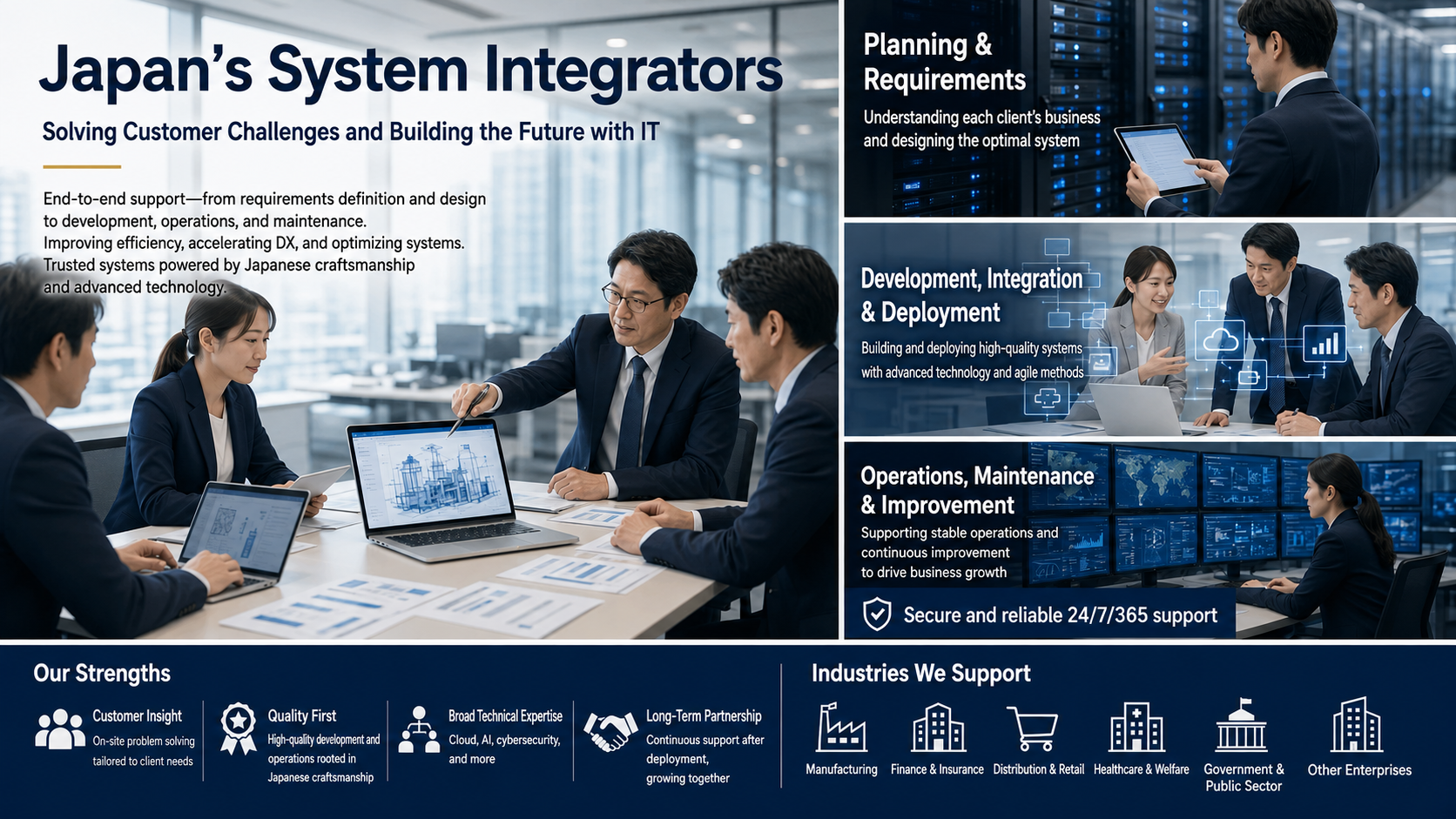
 Japan is home to many large companies that design, develop, and operate complex IT systems, including NTT DATA, Fujitsu, NEC, and Hitachi.
In Japan, these companies are commonly known as SIers, an abbreviation derived from “system integrators.” They develop and maintain systems for governments, financial institutions, manufacturers, retailers, and other major organizations.
However, company names alone do not tell us:
Which companies are publicly listed
Which corporate groups they belong to
Who their parent companies or major shareholders are
Which industries and technologies they specialize in
Although they are all classified as major SIers, their origins differ considerably. Some emerged from telecommunications companies, others developed from electronics manufacturers, while others maintain close relationships with financial institutions or general trading companies.
In recent years, several leading Japanese SIers—including NTT DATA Group, SCSK, and ITOCHU Techno-Solutions—have also been delisted following acquisitions by their parent companies.
This article compares 10 major Japanese SIers in terms of revenue, ownership, corporate origins, areas of expertise, and main customer industries.
It also examines why parent companies are increasingly turning listed SIer subsidiaries into wholly owned subsidiaries, and how this trend relates to concerns over parent–subsidiary listings in Japan.
For an explanation of Japan’s SIer industry, including its multilayered subcontracting structure and the roles of primary, secondary, and tertiary contractors, see the following article:
How Japan’s Unique SIer Industry Works
Listing status, stock codes, and ownership relationships are current as of August 30, 2026. Revenue and employee figures are approximate and based on company disclosures. For Hitachi, this article primarily refers to its IT services business.
Contents
Comparing 10 Major Japanese SIers
Major SIer Delistings Since 2023
Why Were So Many SIers Listed Alongside Their Parent Companies?
Why Are Major SIers Being Delisted?
Conclusion
Main Sources
Comparing 10 Major Japanese SIers
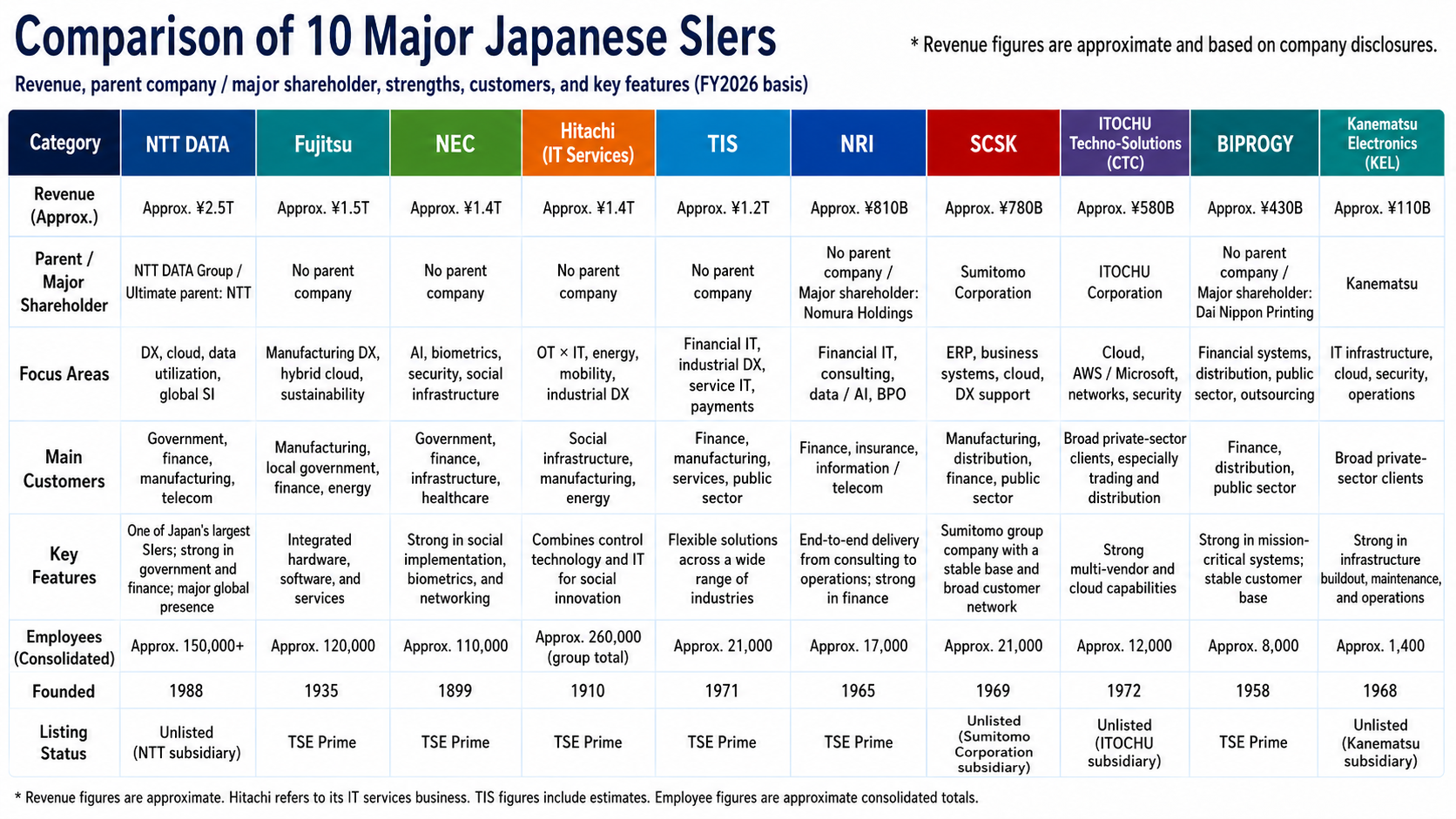
The following 10 companies are included in this comparison:
NTT DATA
Fujitsu
NEC
Hitachi
TIS
Nomura Research Institute (NRI)
SCSK
ITOCHU Techno-Solutions (CTC)
BIPROGY
Kanematsu Electronics (KEL)
NTT DATA is the largest of these companies by revenue. However, size alone does not fully explain the differences between them.
NTT DATA
NTT DATA is an information technology and communications company within the NTT Group.
It is particularly strong in large-scale systems for government agencies and financial institutions and also has an extensive international presence.
Fujitsu and NEC
Fujitsu and NEC developed as electronics manufacturers with long histories in telecommunications equipment and computers.
Their strength lies in their ability to combine hardware, software, networks, system development, and operational services.
Hitachi
Hitachi operates not only in IT but also in areas such as railways, energy, manufacturing equipment, and other forms of social infrastructure.
It is therefore well positioned to combine operational technology (OT)—which controls factories and infrastructure—with IT systems that manage data and business processes.
TIS
TIS has particular strength in financial IT, including credit card and payment systems.
It has also established a broad customer base across manufacturing, distribution, services, and the public sector.
Nomura Research Institute
Nomura Research Institute, commonly known as NRI, traces its roots to a research institute associated with Nomura Securities and a computer services company.
In addition to its strength in financial systems, NRI can provide integrated services covering consulting, system development, and ongoing operations.
SCSK, CTC, and Kanematsu Electronics
SCSK, ITOCHU Techno-Solutions, and Kanematsu Electronics are SIers owned by Japanese general trading companies.
Their respective parent companies are:
SCSK: Sumitomo Corporation
CTC: ITOCHU Corporation
KEL: Kanematsu Corporation
These companies have expanded their operations by using the customer networks, international connections, and business relationships of their parent trading companies.
BIPROGY
BIPROGY, formerly known as Nihon Unisys, is a publicly listed SIer.
Dai Nippon Printing holds 21.46% of its voting rights. However, DNP is not classified as BIPROGY’s parent company. It is classified as an “other affiliated company” under Japanese disclosure rules.
These differences show that Japan’s major SIers vary not only in size but also in corporate origins, ownership structures, and areas of expertise.
Major SIer Delistings Since 2023
Several major Japanese SIers have been delisted since 2023.
May 2, 2023
Kanematsu Electronics
Former stock code: 8096
Parent company: Kanematsu Corporation [8020]
December 1, 2023
ITOCHU Techno-Solutions (CTC)
Former stock code: 4739
Parent company: ITOCHU Corporation [8001]
September 26, 2025
NTT DATA Group
Former stock code: 9613
Ultimate parent company: NTT [9432]
March 12, 2026
SCSK
Former stock code: 9719
Parent company: Sumitomo Corporation [8053]
Within approximately three years, four of the 10 major SIers examined in this article disappeared from the stock market.
However, these delistings did not mean that the companies had failed or ceased operations.
All four were delisted because their parent companies made them wholly owned subsidiaries. They continue to operate as core IT companies within their respective corporate groups.
Meanwhile, Fujitsu, NEC, Hitachi, TIS, Nomura Research Institute, and BIPROGY remained publicly listed as of August 30, 2026.
Why Were So Many SIers Listed Alongside Their Parent Companies?
 Historically, listing an SIer subsidiary while maintaining its relationship with a parent company offered advantages to both sides.
A parent company could retain management influence by holding a majority stake while monetizing part of its investment through the subsidiary’s public listing.
The SIer subsidiary could also benefit in several ways:
Raise capital independently through the stock market
Improve its public profile and credibility
Recruit highly skilled IT professionals more easily
Use its shares to finance acquisitions
Demonstrate independence to customers outside its parent group
SIers do not necessarily develop systems only for their parent companies.
By operating as publicly listed companies with a degree of independence, they could more easily win contracts from customers across different industries—including companies that competed with their own parent groups.
In other words, the parent–subsidiary listing model allowed an SIer to use its parent company’s reputation and customer network while growing as a relatively independent IT services company.
Why Are Major SIers Being Delisted?
 The main reason is that IT, data, and AI are no longer viewed simply as back-office support functions. They have become strategic resources that directly affect a parent company’s competitiveness.
In the past, corporate IT departments were often seen primarily as support functions responsible for improving operational efficiency and maintaining systems.
Today, however, corporate growth increasingly depends on:
AI-powered business transformation
Customer data analysis
Development of digital services
Group-wide system integration
Cybersecurity
New business creation through digital transformation
When an SIer remains publicly listed, its management must consider not only the interests of the parent company but also those of the subsidiary’s minority shareholders.
This can create potential conflicts of interest when the parent company seeks to use the subsidiary’s personnel, technology, customer information, intellectual property, or financial resources across the broader corporate group.
By making an SIer a wholly owned subsidiary, the parent company can integrate personnel and technology more closely and invest more quickly in AI, digital transformation, new services, and shared infrastructure.
Kanematsu explained that its acquisition of KEL would strengthen integrated group management and accelerate initiatives in digital transformation and green transformation.
ITOCHU has similarly positioned closer cooperation with CTC as part of its growth strategy for digital businesses.
Another factor is growing pressure from the Tokyo Stock Exchange and investors. Japanese companies are increasingly expected to explain why a parent–subsidiary listing remains necessary and how minority shareholders are protected.
Kanematsu
ITOCHU Corporation
Japan Exchange Group
Conclusion
Japan’s major SIers may appear similar, but their corporate origins, ownership structures, and areas of expertise differ significantly.
NTT DATA is an information and communications SIer within the NTT Group
Fujitsu and NEC originated as electronics, computer, and telecommunications equipment manufacturers
Hitachi combines IT with industrial and social infrastructure
TIS is an independent SIer with particular strength in finance and payments
NRI is a publicly listed company with strengths in financial IT and consulting
SCSK, CTC, and Kanematsu Electronics are owned by general trading companies
BIPROGY is a listed SIer whose major shareholder is Dai Nippon Printing
Between 2023 and 2026, NTT DATA Group, SCSK, CTC, and Kanematsu Electronics were all delisted.
This represents more than a simple reduction in the number of listed IT companies.
As IT, data, and AI become increasingly central to corporate competitiveness, major Japanese companies are bringing their SIer subsidiaries more directly into their group strategies.
At the same time, publicly listed companies such as TIS and NRI remain independent from any single parent company. This independence allows them to serve a wide range of industries and distinguishes them from trading-company-owned and telecommunications-group SIers.
Comparing revenue, stock codes, parent companies, major shareholders, corporate origins, and areas of expertise provides a clearer picture of the competitive landscape of Japan’s SIer industry.
Main Sources
Nomura Research Institute Investor Relations
This article is intended for industry research and informational purposes only. It does not constitute a recommendation to buy or sell any securities.